| FORWARD TO A FRIEND > | |
 |
Patriot Games [AP Photo] [AP Photo]
Welcome to the weekly round-up of news by Kathimerini English Edition. With Russia stepping up its ballistic missile attacks on Ukraine in recent weeks, Athens has been under pressure by European partners to provide further assistance to the embattled country. Specifically, Greece has been pushed to transfer some of its six Patriot surface-to-air missile defense system batteries to Ukraine, along with a substantial number of interceptors from its munitions stockpile. There are reports that some in Brussels are even asking for as many as three of the batteries. However, it seems that Ukraine, being more realistic in its demands following previous rounds of negotiations over military assistance, has reportedly asked for up to 200 PAC-2 interceptor munitions. The Ukrainian side adds that the current interceptors in use by the Hellenic Air Force are getting a bit long in the tooth, being more than 20 years old, and must be nearing the end of their shelf life. While this may be true, it is important to make the point that the request for the transfer of the interceptors comes at a time when global demand for Raytheon’s missile defense system is at an all-time high, both due to the global increase in defensive spending but also due to the conflict in the Middle East which saw both the US and its Gulf allies burning through their stocks of Patriot interceptors to counter Iranian drone attacks. Should Greece decide to transfer its munitions stockpile to Ukraine, reportedly through Norway, then it risks finding itself at the end of a very long queue to replace them. So far, there has been no indication from Athens that it will acquiesce to the request. Greek officials have conveyed the message that the Greek Patriot batteries are hard at work protecting the interests of its partners in the region, pointing to the Patriot battery deployed in Saudi Arabia that is assisting in safeguarding critical infrastructure in the Kingdom. Additionally, the Greek side has pointed out that during the climax of the crisis in the Middle East, it was the Hellenic Air Force batteries in Karpathos, Crete, and the Evros region, that protected important Allied infrastructure in the region. Essentially, they point out, the burden of the air and missile defense of NATO’s southeastern flank was almost exclusively borne by Greece, while Turkey relied on an anti-air and anti-ballistic umbrella provided by the Italian, Spanish, and United States armed forces. Spotlight
|

MUST READS
|
OPINION
 [AMNA] [AMNA]One of the favorite subjects of discussion among Greeks during their vacation this summer is the uncertainty, if not confusion, surrounding the timing of the next election. Prime Minister Kyriakos Mitsotakis publicly insists that the country will go to the polls in the spring of ‘27. Still, his actions point to an early election this fall. In the latter scenario the most likely date would be a few weeks after his keynote speech on economic policy at the Thessaloniki International Fair, on September 5, where he is expected to offer a package of handouts, targeted subsidies and tax cuts that could amount to € 2 billion. The Prime Minister is expected to weigh the pros and cons and make up his mind during his own vacation, in August. According to the opinion polls, New Democracy is clearly ahead, with former Prime Minister Alexis Tsipras’ newly founded center left party, Greek Leftist Alliance (ELAS), in second place. But the Conservatives are far from winning a parliamentary majority. And when another former PM, Antonis Samaras, officially establishes his own party – indications are that he will do so when Mitsotakis announces the elections – things will get worse for the ruling ND as Samaras will chip away a relatively small but crucial amount of the conservative vote. Mitsotakis hopes that the promise of continuity and stability, along with handouts, as well as the contrast with a fragmented opposition, will be enough to boost his chances. At the same time, an objective assessment of the present political reality leads to the conclusion that we will end up with some form of coalition government. The easy part of the equation is that ND will be at the core of such a government. Under what circumstances and with which partners is the difficult one. According to the polls, persistent inflation and more generally the issue of affordability, as well as a widespread sense of corruption and the need for more transparency, are the main shortcomings the ruling party is faced with. For the opposition the problem is twofold; on the one hand its fragmentation, and on the other its inability to capitalize on the government’s weaknesses. |

| CHART OF THE WEEK |
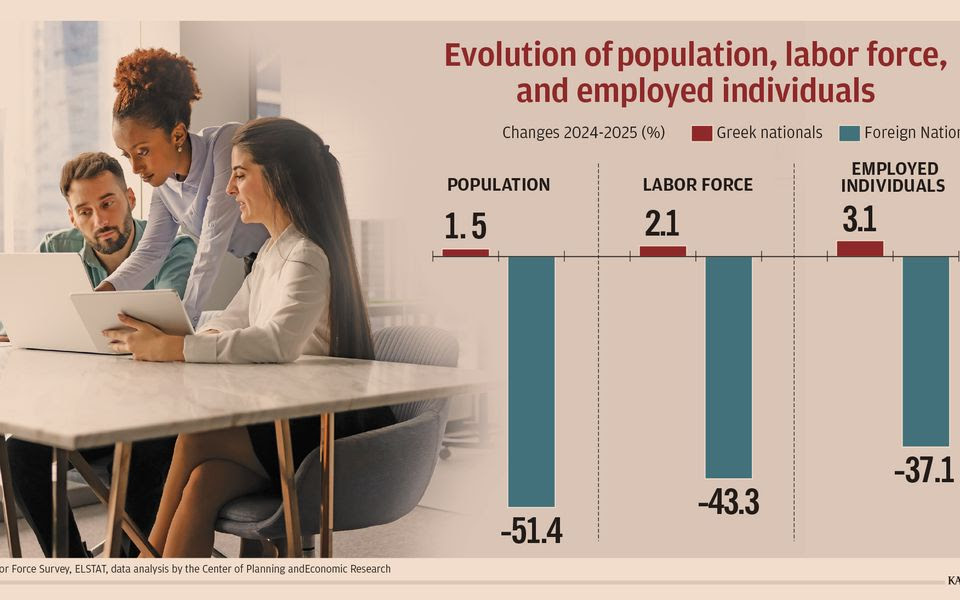 The Greek labor market is facing several challenges, that risk becoming systemic features. Namely, while businesses are increasingly reporting an inability to meet their staffing demands, the labor force of the country is shrinking. This is not only due to the demographic challenge facing Greece, but also because foreign workers are leaving Greece. Indicatively, before the financial crisis in 2008, foreigners comprised 6% of the country’s population and 8.2% of the labor market. Today, they are just 2.2% and 2.9% respectively. In numbers, this translates to more than 74,400 foreign workers leaving the labor market in just one year. The Greek labor market is facing several challenges, that risk becoming systemic features. Namely, while businesses are increasingly reporting an inability to meet their staffing demands, the labor force of the country is shrinking. This is not only due to the demographic challenge facing Greece, but also because foreign workers are leaving Greece. Indicatively, before the financial crisis in 2008, foreigners comprised 6% of the country’s population and 8.2% of the labor market. Today, they are just 2.2% and 2.9% respectively. In numbers, this translates to more than 74,400 foreign workers leaving the labor market in just one year. |

|
| ECONOMY IN A NUTSHELL |
| “The Euronext Athens (ATHEX) closed at 2,447.25 points, down 2.62% from last week.” |
| “Record tourist arrivals are still expected this summer across Southern Europe, including Greece, despite the economic aftershocks of the instability in the Middle East. Early data from 2026, along with that from 2025, show an increase of revenue for hotels in the country.” |
| “Demand for luxury residences in Greece saw a 35% increase compared to last year, and 19% more than the average of the last five years. This means that the total value of properties that showed demand reached €6.11 billion, with much of the demand originating from the United States and United Kingdom.” |
| WHAT'S ON THE AGENDA |
|
Editor's Pick An artist must be free to engage as much as they want with whichever gender they want; and another artist, say Nolan, must have the same freedom to match any role they choose with whichever skin tone they please, say, Nyong’o’s.Aris AlexandrisRead the article An artist must be free to engage as much as they want with whichever gender they want; and another artist, say Nolan, must have the same freedom to match any role they choose with whichever skin tone they please, say, Nyong’o’s.Aris AlexandrisRead the article |
| PODCAST |

| We’d like to hear from youShare your feedback at newsletters@ekathimerini.com |
| Did you receive this email from a friend?Subscribe to our newsletters here |

No comments:
Post a Comment