
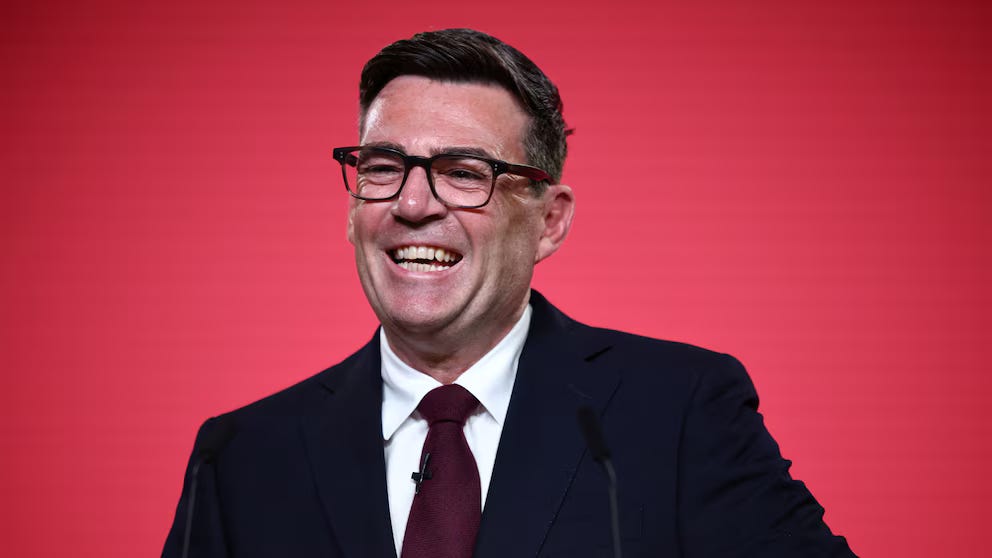
Burnham’s central promise — the pledge that guides his entire mission — is simple: he will return power to the British people. That’s the central message that he and his team have been reinforcing at every possible opportunity. “The mission of my government”, Andy Burnham proclaimed, on becoming leader of the Labour Party last week, “will be to return power to the British people — to take it out of Westminster, out of Whitehall, and put it back into the hands of the communities who know their own future best”. There’s no doubt it’s an attractive message. After years of growing public frustration with Westminster, collapsing trust in politics, and rising disillusionment with the entire system, the idea of handing power back to the people does sound appealing. As a political message, it’s also in touch with today’s populist spirit across the West, where millions of people are demanding the return of powers from failing elites. Indeed, I’ve made a similar argument myself, calling for the restoration of popular sovereignty and the transfer of power back to the decent majority of Brits. But when it comes to Andy Burnham and the Labour Party you need to look a little closer. Scratch beneath the surface and you’ll soon spot the fundamental contradiction that sits at the heart of his entire project, like a ticking bomb, just waiting to go off and derail his Labour government before it even gets started. What am I talking about? I’m talking about the fact that you cannot promise to return power to the people while simultaneously refusing to take power back from an array of unelected, unaccountable, distant, and remote institutions that now wield enormous influence over our country. You cannot claim to give power back to citizens while pushing them further and further away from the crucial decisions that affect their daily lives. It’s this fundamental contradiction, I’m willing to bet, that will not only define Andy Burnham’s premiership but end up bringing it down, too. Take immigration and border security, which most people say is the most important issue facing Britain today. Andy Burnham talks about ‘returning power to the people’ but unless Britain fully leaves the European Convention on Human Rights, rather than just tinkering around the edges, then the British people will never be able to regain power over their own borders, their own laws, and their own future. So long as an army of unelected and unaccoutanble activist lawyers and judges are able to use Articles 3 and 8 of the European Convention on Human Rights to frustrate the deportation of illegal migrants and foreign criminals, then countless decisions the British people think should be made within their sovereign, national democracy will instead continue to be made beyond their reach, with next to no reference or accountability to the people who then have to live with the disastrous consequences. Look, too, at the general direction of travel on this issue. Andy Burnham is talking boldly about giving power back to the people but behind the scenes he’s already paving the way for the very opposite of what the people want to see: an enormous new wave of immigration and refugees into Britain. How is imposing a policy that nobody ever voted for, and which only a radicalised minority want, giving power back to the people? It’s not. It’s once again treating the British people with utter contempt. Or take Europe and democracy. Burnham waxes lyrical about returning power to the people while his Labour Party continues to ignore millions of voters by pushing ahead with much closer alignment with the European Union on vast swathes of policy. Labour is so respectful of ‘the people’ that it’s now openly turning its back on the more than 17 million of them who actually voted for more sovereignty, democracy, and independence by voting for Brexit. Increasingly, Labour will now strip more and more power away from the people, further reducing Britain to a vassal state that’s forced to pay billions of pounds so that Brussels and Strasbourg can impose EU policies and rules from above, with basically no democratic accountability, influence, or mandate from the British people. Does this look like restoring people power to you? Forcing them to pay billions of pounds for rules and policies they never voted for and cannot influence? Or look at the British state. Burnham talks about restoring people power but the Labour Party’s done nothing to reverse the relentless expansion of an increasingly undemocratic, remote, authoritarian, and out-of-touch state. Even worse: Labour’s put the state on steroids by consistently empowering unelected bureaucrats, regulators, statutory bodies, and remote institutions at the expense of the British people. The civil service continues to grow at record speed, while last time I checked the Labour Party has created nearly thirty ‘quasi-non-governmental organisations’, or quangos, since coming to power only two years ago. If Labour really wants to empower the people then why, year after year, is it transferring more and more decisions away from the people to a sprawling array of unelected and remote bodies, quangos, regulators, statutory agencies, and international organisations that are fully insulated from democratic accountability? Burnham talks, too, about returning power to the people through devolution. But after decades of devolution in Wales and Scotland, for instance, who really feels more powerful? Both continue to struggle with some of the worst outcomes in healthcare, education, and public services in modern times, if not among all advanced societies. Simply shifting power from Westminster to devolved and often highly centralised administrations might sound appealing but it’s clearly not empowered the people. On the contrary, it’s often further eroded their public services and quality of life. The contradiction doesn’t end there. Returning power to the people, if done right, means actually encouraging, welcoming, celebrating, and incentivising those people among us who become wealth creators, job-creators, take risks as entrepreneurs, and who, ultimately, pay the lion’s share of tax. But Burnham’s Labour Party, which is shifting ever leftwards from one day to the next, appears utterly hostile to those people who drive prosperity in Britain. While Burnham is hinting at yet more tax rises for higher earners — despite the fact taxes are already at historic highs — his senior allies who have handed appointments in the early hours of his premiership have openly called for wealth taxes and clearly despise successful people. I find it significant, for instance, that Andy Burnham enters power in the same week that we learn the top 10 per cent of British taxpayers now contribute close to 60 per cent of income tax receipts in this country — up from 50 per cent at the start of the century. If Burnham’s Labour continues to pummel people who invest, build businesses, create jobs, and pay the bulk of tax by handing them even higher taxes and even more regulation alongside a culture of resentment, deteriorating public services, broken borders, and a social contract that no longer makes any sense then many of these people will simply leave Britain for good — as many are already doing. And if they do leave — taking all that potential tax revenue with them — then how powerful do you think the British people will feel, then? Driving away the hardworking, tax-paying, successful minority is not ‘empowering the people’ — it’s eroding the very foundations on which our entire economy and social contract depend. And while Burnhamites are already talking in incredibly vague and vacuous terms about returning power to the people, look closely at the figures who Burnham is choosing to lead his premiership. To govern is to choose, it is often said. Well, just look who Burnham is choosing. Instead of promoting figures who recognise, respect, and represent the concerns of the silent majority on issues such as mass immigration, broken borders, and two-tier justice, Burnham has specifically chosen to begin his premiership by appointing radical left-wing figures who once worked for Hope Not Hate — an organisation that routinely portrays mainstream conservative views as extremist, as symbolised by the fact Hope Not Hate was just revealed to have quietly removed a hostile profile of Ann Widdecombe around the time of her murder. Appointing the likes of Matthew McGregor to serve as Director of Political Strategy for the entire Burnham project is highly significant. Why? Because as Emma Schubart points out, McGregor ran Hope Not Hate’s campaigns for years, overseeing efforts to place mainstream conservative views in the same conceptual universe as violent extremism, put parties such as Reform UK alongside Nazism and Holocaust denial, and, as Emma Schubart continues, “blur the line between monitoring genuine extremists and pathologising millions of British voters”. Personally, I think it speaks volumes that instead of surrounding himself with figures who understand that people’s concerns about mass immigration, broken borders, and two-tier justice are not just legitimate but need addressing, Burnham’s first instinct is to surround himself with people who worked for charities that campaigned for the return of ISIS brides to Britain, and to block the removal of British citizenship from extremists and members of the Pakistani Muslim grooming gangs. A man is known by the company he keeps, so the saying goes. Well, so too are politicians. And, lastly, look at free speech. If you genuinely wanted to give power back to the people you’d let them speak freely, debate, protest, and oppose policies they disagree with. But ever since it came to power, this Labour Party — the Labour Party Andy Burnham now leads — has been doing the very opposite. Expanding restrictions on protest. Imposing more and more online censorship. Openly opposing new media that gives expression to alternative views, and strengthening regulators that oversee them. Pushing for more non-crime hate incidents. Fast-tracking a dogmatic new definition of anti-Muslim hostility that will restrict what the British people can say about Islam. And trying to rig digital platforms so they prioritise politically correct news and opinion. Ask yourself this: would a political party that was genuinely interested in returning power to the people work this hard to restrict the people’s free speech, their ability to debate contentious topics, and organise legitimate dissent? None of this is bringing politics and power closer to the people. If anything, it risks pushing power further away from them — towards unelected, unaccountable, and increasingly distant bureaucrats, censors, and extremist activists, many of whom, like Keir Starmer before them, clearly seem to hold the decent majority of hardworking, law-abiding, and patriotic British people in contempt. The more you actually step back to examine the Burnham project, the clearer this fundamental contradiction at its heart becomes. Contrary to what our new prime minister claims, almost every major proposal involves transferring power away from the people and handing it instead to an assortment judges, bureaucracies, foreign courts, regulators, international conventions, quangos, and distant elites. When I look at Andy Burnham, I don’t see a politician who is serious about returning power to citizens. Far from it. I see yet another Labour leader — shaped by the authoritarian progressivism of the New Labour era — who looks set to take even more power away from them. Somebody who will not restore popular sovereignty but continue to weaken it. And if Burnham continues down this path then the result out there in the country will be entirely predictable. More frustration. More disillusionment. And more anger — among a people who never even voted for Prime Minister Andy Burnham in the first place. Power to the people? Or yet more power to a political regime in Westminster that is now rapidly falling apart? We’re about to find out. Paid subscribers can join Matt Live EVERY Monday evening at 7pm UK time on the Substack App to discuss the big issues of the day. Tonight we will be discussing the arrival of Andy Burnham, what it means, what to expect, and YOUR predictions! |





No comments:
Post a Comment