A man with a child arrives to vote at a polling station in Jerusalem, October 27, 2026. REUTERS/Ronen Zvulun
Live: Israeli exit polls deadlock in pivotal election as Netanyahu faces main rival Eisenkot
What's happening?
- Israelis have voted in their first election since the October 7, 2023 Hamas-led attacks
- Israeli Prime Minister Benjamin Netanyahu's Likud party and its right-wing allies face a rival alliance led by former military chief of staff Gadi Eisenkot
- Exit polls by major TV networks showed no clear winner in the election, with neither Netanyahu nor Eisenkot on track for a majority in the Knesset
- The Central Elections Committee earlier reported voting at a record pace, and turnout at 8 p.m. (1800 GMT) stood at 74.3%
- Netanyahu has campaigned on his wartime leadership and his alliance with US President Donald Trump, who has endorsed him
- Eisenkot has accused Netanyahu of running a campaign of 'fear-mongering' and said he was confident Trump would work 'with any leader chosen by the people'
If you can't see the content of video posts, please adjust your cookie settings
Likud outperforms expectations but is still set to lose seats

Netanyahu's Likud party has done better than it was predicted to do by opinion polls in the run-up to the election.
However, if the exit poll projections of about 24 or 25 seats are confirmed by the results, that still represents a loss of around a quarter of the party's seats.
At present, Likud has 32 seats in the 120-seat Knesset.
'The celebrations of the left are premature'
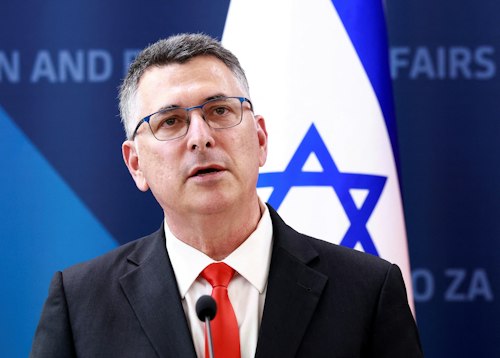
Saar, September 9, 2026. REUTERS/Borut Zivulovic
We are also getting reactions from Foreign Minister Gideon Saar, who said in a post on X that “the celebrations of the left are premature.”
He added: “One thing looks quite clear: Likud is the largest party in Israel.”
'The Netanyahu bloc has suffered a crushing defeat'
Yair Lapid, the current opposition head, said in a statement: “Don’t let anyone confuse you: the Netanyahu bloc has suffered a crushing defeat. This is a total collapse and the public has told them to go home.”
Eisenkot says he is ready to govern if exit poll numbers are right
Eisenkot said in a statement that the exit polls showed Israelis' non-confidence in Netanyahu.
If the results are the same as the exit polls, he said, he will act immediately to replace Netanyahu's government.
If you're just joining us, here's what you need to know

Israel's election has ended in an apparent deadlock, exit polls by major television networks showed.
The polls indicated that neither Netanyahu nor his main rival Eisenkot were on track for a majority in the 120-seat Knesset.
Unless one of them can assemble a majority, Israel faces prolonged coalition talks or another election.
The stalemate could work in Netanyahu's favour, allowing the long-serving prime minister to remain in power in a caretaker capacity while parties try to forge a governing coalition.
Final results could take days, and Israel's fragmented political system leaves smaller parties potential kingmakers.
No single party has ever won 61 seats outright in the 120-seat Knesset, making coalitions the norm.
The vote drew record turnout as Israelis passed wartime judgment on Netanyahu in the first election since the Hamas-led attacks of October 7, 2023, and the ensuing wars in Gaza, Lebanon and Iran.
Stay with us — we'll bring you the latest details as we get them.
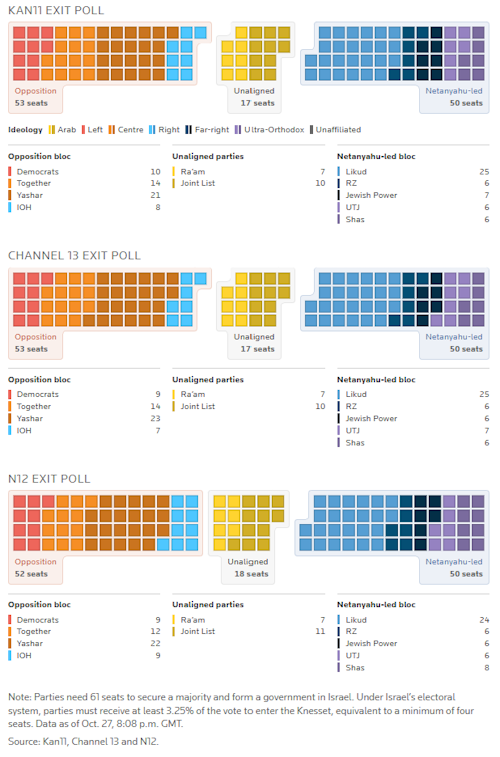
The full exit poll breakdown
Celebrations at Joint List HQ

The crowd at the headquarters of the Joint List, an alliance of several Arab parties, burst into whistles and applause as exit polls came out.
The turnout rate among Israeli Arab voters was extremely high.
Supporters chanted “Ben-Gvir out” and began to clap and dance.
The combined Arab parties are expected to pick up around 17 seats in the Knesset, according to the exit polls.
More details from the exit polls
Israel's Channel 13 is reporting the Eisenkot-led bloc will win 53 seats, while Netanyahu's bloc will win 50.
The Kan public broadcaster is reporting the Eisenkot-led bloc will win 55 seats, with 50 for Netanyahu's camp.
Channel 12 is reporting the Eisenkot-led bloc will win 52 seats, with 50 for the Netanyahu bloc.
Exit polls indicate deadlock
Exit polls by major television channels showed that neither Netanyahu nor Eisenkot were on track for a majority in the 120-seat Knesset.
Voting has now closed
Stay with us for the details of the exit polls.
'This is about our future'
The Eisenkot campaign has sent out a statement to journalists via WhatsApp, with a final message to voters from their candidate.
“I urge the public to choose enlistment over draft evasion, responsibility over evading responsibility, and commitment to citizens over political and personal commitments," Eisenkot was quoted as saying.
"This is about our future and the future of our children."
The mention of enlistment was in reference to the issue of whether ultra-Orthodox Jewish men should continue to be exempted from military service, which is compulsory for most other Jewish Israelis.
As we mentioned in a post a few minutes ago, Eisenkot's party and those allied with it have said they would end the exemption, which many secular Israelis resent.
What you need to know about Eisenkot

It is now just under 10 minutes until polls close.
Let's take a closer look at Netanyahu's main rival Eisenkot, a former military chief of staff and security hawk.
He aims to unseat Netanyahu with the support of parties on the right and centre, as well as the rump of an increasingly marginalised left.
In this video I discuss what you need to know about Eisenkot, and what he says about some of the election's hot button issues.
Will ultra-Orthodox parties stick with Netanyahu?
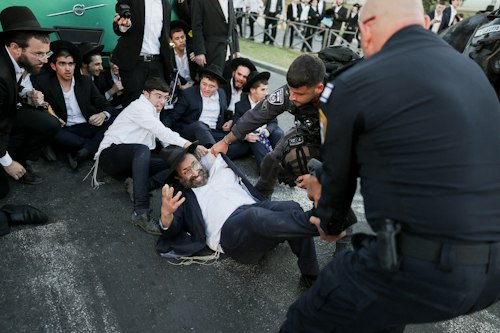
A protest by Ultra-Orthodox Jews against conscription into Israel's military, Jerusalem, June 1, 2026. REUTERS/Ammar Awad
Israel's ultra-Orthodox parties, Shas and United Torah Judaism, may find themselves playing the role of kingmakers after the election.
If they do, the issue of military service will be crucial.
Also known as Haredim, the ultra-Orthodox are a tight-knit community in which men typically study religious scripture rather than working.
They have been largely exempted from military service, stating it would compromise their way of life.
But the exemption is a source of increasing anger, given the burden on others.
Most Jewish Israelis are obliged by law to serve in the military from the age of 18, for 24 to 32 months.
Nearly all anti-Netanyahu parties have vowed to pass a new law that would see more Haredim obliged to serve too.
Ahead of the election, Netanyahu maintained his political alliance with the ultra-Orthodox parties by keeping the exemption.
Whether they stick with him or back someone else could depend on exactly who offers them what on this core issue.
October 7 families joined the election race
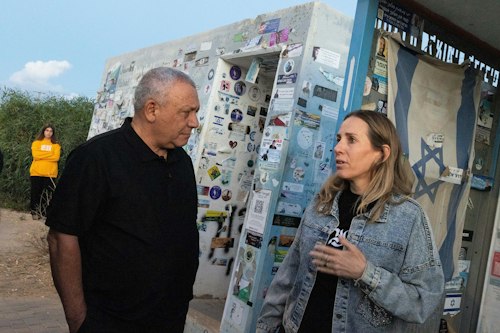
Eisenkot and Shapiro visit a roadside bomb shelter near Reim in southern Israel, October 7, 2026. REUTERS/Nir Elias
Three years after Hamas's October 7 attack in 2023, at least nine Israelis from families directly affected by the deadliest day in the country's history are running for parliament in this election.
Most back parties aligned against Netanyahu, driven by what they see as failings on that day and since.
Shira Shapiro, 51, is running as a candidate for Eisenkot’s new opposition party, Yashar.
Her eldest son Aner, a 22-year-old off-duty soldier and musician, had attended the Nova music festival, which was attacked that day, and took cover with 26 others in a roadside bomb shelter.
As Hamas militants lobbed grenades into the packed shelter, Aner tossed them out.
In his last moments, he told the others that if he was hurt, they should continue.
Shapiro said she and other parents of October 7 victims "are trying to take this pain and give it meaning, to grow from it. This is also what we need to do on a national level."
"I hear his voice say 'continue after me,'" she said.
For more on the other candidates, click here.
Guns and 'Jewish pride' drive support for Ben-Gvir
Itamar Ben-Gvir, the bellicose face of Israel's far right, has been the police minister in Netanyahu's government for more than four years.
In the role, he has imposed tougher conditions for Palestinian detainees, supported a new law making death by hanging the default for Palestinians convicted of deadly attacks, and mocked detained Gaza flotilla activists being forced to kneel with their hands bound.
In this video, I delve deeper into why Ben-Gvir has been gaining support among young, urban voters, a very different group than his traditional base of extremist settlers in the Israeli-occupied West Bank.
Disenchanted Netanyahu voters are the prize
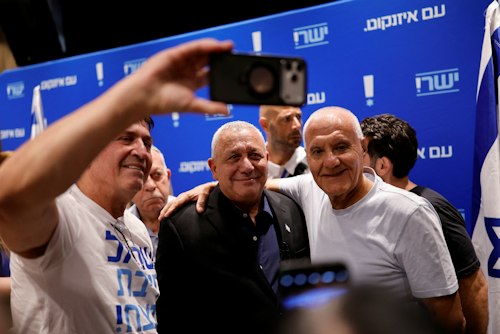
Eisenkot campaigning in Dimona, July 6, 2026. REUTERS/Amir Cohen
One of the main prizes in this election will be undecided voters who previously supported Netanyahu’s Likud party.
I travelled to Dimona, a hardscrabble town in the Negev Desert in southern Israel that has long been a Likud bastion, to meet some of these voters.
"We must have change. Bibi has to go," said Yossi Assayag, 74, who has supported Likud most of his life.
"Bibi has brought disaster to Israel," he said, using Netanyahu’s nickname.
Assayag was among a cohort of town residents who were going door-to-door, trying to convince their community to vote for Netanyahu’s main rival Eisenkot.
It's a tough task in Dimona.
"I will never betray Likud," said Ruti Ohana, a pensioner, who says she has voted for Likud ever since immigrating to Israel from North Africa more than 60 years ago.
To be sure, Netanyahu has a hard core of supporters who cannot be won over.
But some former supporters “understand that we are in a state of crisis” and are open to persuasion, said Michal Elmalem Abu.
She was elected as a Likud member of Dimona city council but is now leading Eisenkot’s campaign in the town.
Click here for the full story, which I worked on with my colleague Maayan Lubell.
Which parties are seeking to unseat Netanyahu?
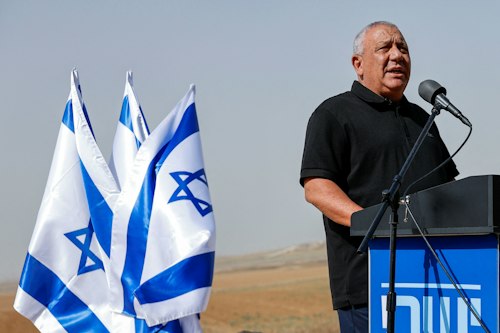
Eisenkot speaking near Israel's border with Gaza, October 15, 2026. REUTERS/Amir Cohen
YASHAR
This new party's name means "straight" or "honest" in Hebrew. It is led by former military chief Gadi Eisenkot, who lost a son in Gaza.
Yashar campaigned on a platform of integrity and social cohesion, promising to pull Israel out of crisis, strengthen its security and return to its democratic foundations.
TOGETHER
This new party rests on an old alliance between former prime ministers Naftali Bennett and Yair Lapid, who jointly ousted Netanyahu in 2021. Their campaign messages focused on healing a traumatized nation after the October 7, 2023 attack.
Bennett objects to Palestinian statehood while Lapid has supported it in the past.
ISRAEL OUR HOME
Led by the hawkish former defense minister Avigdor Lieberman, this party draws support from Israel's ex-Soviet immigrant community.
Lieberman quit Netanyahu's government in 2018, accusing him of being too soft on Palestinian militants in Gaza, and has since become one of his staunchest critics.
ARAB PARTIES
Israel's 21% Arab minority is represented by two parties, which both oppose Netanyahu: Ra’am and The Joint List.
In 2021, Ra’am, a historically Islamist party led by Mansour Abbas, became the first Arab party to join a governing coalition in Israel's history.
THE DEMOCRATS
Founded on the moribund remnants of Israel's historical Labour party and smaller left-wing Meretz, this party advocates for a peace agreement with the Palestinians.
It is led by Yair Golan, a former general hailed for his rescue of people from one of the Hamas attack sites on October 7, 2023.
More on these parties here.
The election will not change Israel's Iran policy

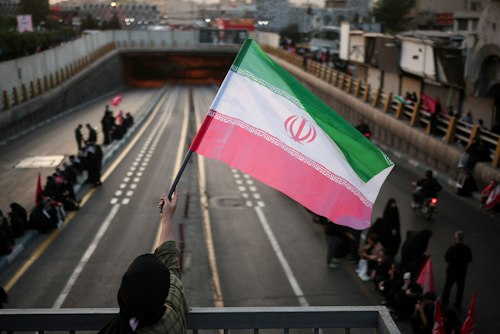
An Iranian flag, Tehran, July 6, 2026. REUTERS/Alkis Konstantinidis
The election may change Israel’s leader, but not its strategy on Iran.
Tehran will remain Israel's chief adversary, with military force its preferred tool, regional policymakers and analysts say.
That is because of the October 7, 2023 attack by Iran's regional ally Hamas and the subsequent wars in Gaza, Lebanon and Iran. All have hardened the strategic assumptions underpinning Israeli policy.
Michael Young of the Carnegie Middle East Center said Israel's security establishment and much of its political class share a common strategic outlook. It centers on confronting Iran, maintaining "forward defense," and preserving military deterrence — leaving little scope for big policy shifts.
The real divide is one of degree rather than direction: how aggressively Israel fights its wars, how far it expands Jewish settlements in the West Bank and whether any leader opts for diplomacy, the analysts said.
Read the full analysis here.
What will change for the Palestinians if Netanyahu loses?
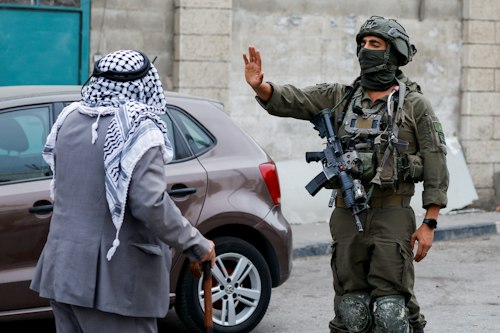
An Israeli soldier and a Palestinian man during a Palestinian protest against their displacement, in Hebron, Israeli-occupied West Bank, October 27, 2026. REUTERS/Mussa Qawasma
There will be no sweeping change, such as a push for a two-state solution.
Netanyahu and his main opponent Eisenkot both oppose an independent Palestinian state.
Both say Israel must retain ultimate security control over all territory between the Jordan River and the Mediterranean Sea.
They also have similar positions on Gaza, saying they would resume the war there if Hamas doesn't disarm.
However, they do have different positions on settlements in the occupied West Bank.
Netanyahu has presided over a rapid expansion of settlements, including small outposts in areas supposed to be administered by the Palestinian Authority. Those outposts are illegal under Israel’s own laws.
Settlers have increasingly attacked Palestinians, and critics say the government has turned a blind eye to such violence.
Eisenkot favors settlement in principle, but in compliance with Israeli law. He would dismantle outposts in areas where they are forbidden.
He has pledged to prevent violence by settlers against Palestinians.
You can find more details in our full story on the two sides’ policies toward the Palestinians.
Our Standards: The Thomson Reuters Trust Principles., opens new tab

Thomson Reuters
Kylie is the Global Live Pages Editor, leading a team providing real-time multimedia coverage of the biggest breaking stories worldwide. She previously worked on the UK Breaking News team, and spent eight years in Westminster as a UK political correspondent - a period which included the Scottish independence referendum, Brexit and several general elections. She originally joined Reuters as a graduate trainee and has also covered investment banking.

Thomson Reuters
Estelle is a Senior Live Pages Journalist based in London, part of a team providing real-time multimedia coverage of the biggest news stories in the world. In her 25 years at Reuters, she has reported from Europe, Africa and the Middle East, covering everything from armed insurgency in the Niger Delta to Olympic beach volleyball.

Thomson Reuters
Vanessa Balintec is a Live Pages Journalist based in Toronto, Ontario. She is part of a team providing real-time multimedia coverage of the biggest news stories in the world. She previously worked at various bureaus for CBC News.

No comments:
Post a Comment