New Lines Magazine
The Buried Treasure Left Behind by the Islamic State
An exclusive joint investigation reveals how the group resorted to hiding its assets underground in the deserts of Syria and Iraq, and how they are being uncovered




When the Islamic State group sensed its imminent demise, it swiftly moved to hide tens of millions of dollars in well-ventilated underground chambers scattered throughout its territories in Iraq and Syria, an exclusive joint investigation by Syrian Investigative Reporting for Accountability Journalism (SIRAJ) and New Lines has found. So far, at least $47 million in cash and gold have been recovered by the forces of Iraq’s central government, the Kurdish-led Syrian Democratic Forces and an international coalition, the investigation has learned.
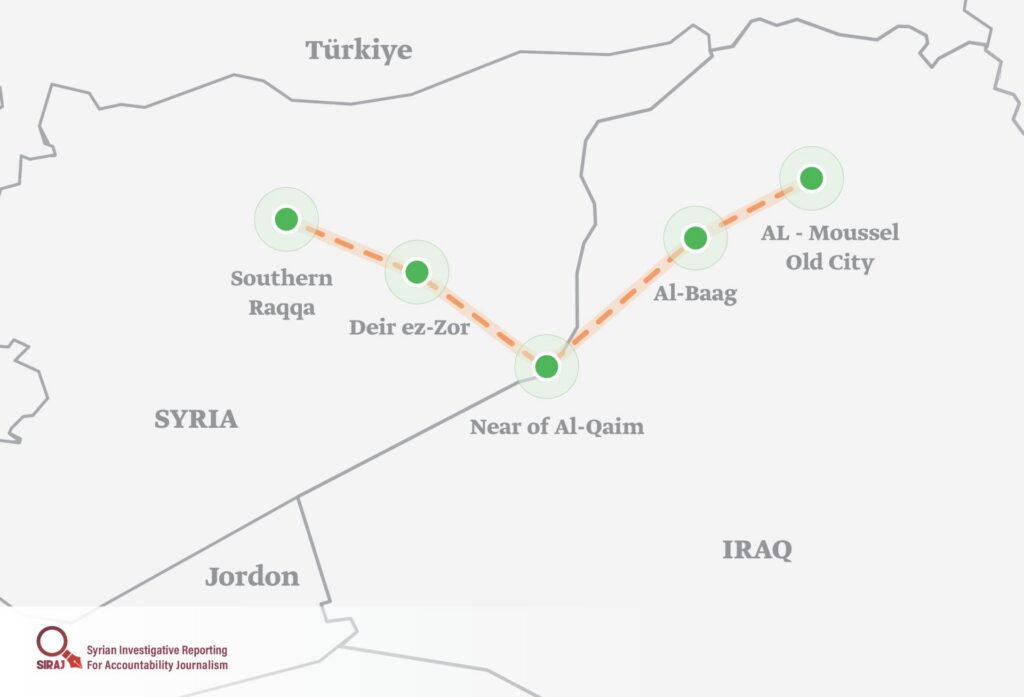
The investigative team identified the locations of the recovered caches, most of them clustered within a corridor that runs from Deir ez-Zor to Iraq’s Anbar province, the same area the group previously used to smuggle money and weapons.
The group continues to tap into its buried treasure for the purpose of rebuilding its operational capacities, though these efforts are dwarfed by the group’s vast financial network that operates globally.
The findings detailing a literal underground financial network are based on a cache of Islamic State documents stored on a hard drive that was found in a known former command post of the group. The joint investigation has verified the authenticity of the documents through a series of interviews with local and international experts as well as known former Islamic State fighters.
In September 2020, as the Islamic State group was losing the last of its major strongholds in Syria and Iraq, an internal document issued by the “wali al-Sham” (the governor overseeing the group’s Syrian territory) carried a simple order to every provincial emir and unit commander in the group: “Bury the money.”
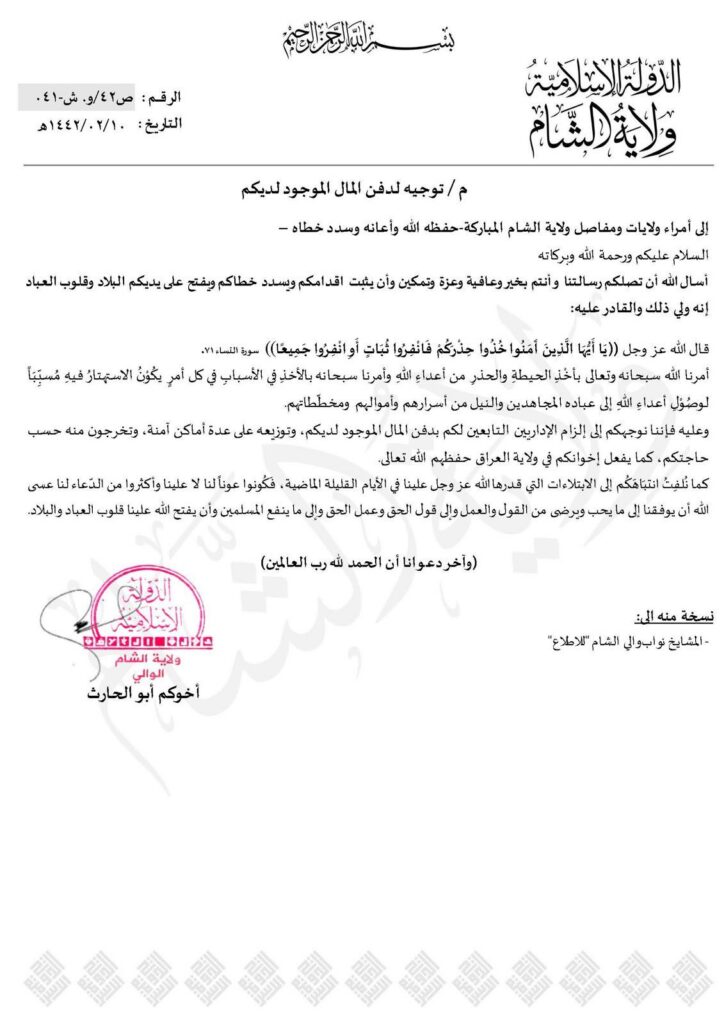
The directive concerned part of the wealth the group had amassed over years of controlling vast stretches of Syria and Iraq. It required the group’s financial officers to distribute the money across multiple secure burial sites, while keeping it retrievable when needed.
That document, along with more than 200 financial and security records obtained by the investigation team, reveals that the Islamic State group did not treat the collapse of the “caliphate” as the end of its project, but as a new phase that called for protecting financial resources and scattering them in secret caches across deserts and towns.
Over more than 20 months, the investigative team was able to document and authenticate nine major international coalition security operations in which money, gold and other precious metals hidden by the group were recovered in Syria and Iraq. The investigative team also analyzed internal Islamic State documents, expert testimony and security sources that reveal, for the first time publicly, the administrative and financial structure that governed these caches, and the role they played in preserving part of the group’s financial capacity after its territorial losses.
On the morning of April 1, 2023, there was nothing to draw the eye to the abandoned farm south of Raqqa. Barren land dotted with scattered trees, the remains of a mudbrick structure worn down by years of war — it looked just like dozens of forgotten sites strewn across the Syrian steppe.
Under the oppressive sun, members of the Syrian Democratic Forces (SDF), backed by the U.S.-led Global Coalition Against Daesh, began to dig near the edge of the farm. It was not clear what they were looking for at first, until the color of the soil changed in one corner, and it became clear that the ground had been carefully sealed years earlier. As more dirt was cleared away, the rims of metal barrels buried beneath the surface began to show.
The surprise was considerable: four full barrels concealed inside a secret pit that had been meticulously camouflaged, alongside tightly sealed bags holding close to a million dollars in cash.
When the first barrel was opened, its gold glinted in the sunlight for the first time in years. Bars and pieces of gold were carefully preserved inside layers that insulated them from moisture and dust.
This discovery was not an isolated incident, but a window into a wide network of caches and hideouts spread across the deserts of Syria and Iraq, some of which certain cells of the group still rely on for funding and survival.
The group’s loss of the Iraqi city of Mosul in July 2017 marked the beginning of the collapse of its territorial control in both countries. By January 2025, the investigation team had documented nine major operations in which caches were found containing cash, gold and precious metals the group had hidden near the end of its years of control.
According to the investigation’s findings, the value of the uncovered cash exceeded $5.6 million. Another four barrels filled with gold, some 200 gold ingots, and other currencies and precious metals totaled at least $31 million.
The parties that found these caches varied: the Global Coalition, Iraqi security services, the SDF, forces affiliated with the regime of Bashar al-Assad, Iran’s Islamic Revolutionary Guard Corps, anti-Assad Syrian factions and civilians hunting for treasure in abandoned areas.
Despite the scale of what has come to light, the evidence gathered by the team suggests that most of these discoveries were made by chance, whether during security raids and searches or as a result of information provided by former Islamic State members and detainees. The greater part of this wealth is likely still hidden, perhaps in locations now forgotten, though some of it is believed to remain a financial resource for affiliated cells and groups in different parts of Syria and Iraq.
In interviews conducted by the team with three security officials who focus on the Islamic State group and have asked to remain anonymous, as well as interviews with five former group members, all told the authors that the still-buried treasures are not mere rumor, but part of the group’s financial resources, which remain considerable years after the fall of the “caliphate.”
The hidden gold and cash remain a lifeline for the group. These assets are being used to help rebuild the Islamic State through the purchase of weapons and the creation of on-the-ground networks of fighters and allies, efforts that have been ongoing, the investigation has learned.
In April 2021, Iraqi police found a cache worth more than $1.5 million inside a house in the old city of Mosul, along with 17 million Iraqi dinars, 15 kilograms of silver and roughly half a kilogram of gold. The house had previously served as an Islamic State finance office, or “bayt mal al-Muslimin,” an Arabic term for a public treasury that traces back to the time of the original caliphate.
“After the erosion of the group’s central authority in Syria, it came to rely more heavily on a decentralized model built on small cells,” Ayman al-Dassouky, a researcher on Syria’s economy and local administration, told the investigation team. “This explains the turn to burial as a tactic to sustain operational capacity and reduce the risks of infiltration and security pursuit.”
Prior to that, the group stored its cash and gold in central locations, including inside secure vaults at the central banks of Raqqa and Mosul, areas that had come under its control.
Undiscovered caches continued to surface throughout 2025. Three million dollars were found buried in the Iraqi town of al-Baaj, more than $1.5 million in Mosul, and a cache of gold and dollars estimated at around $16 million near al-Qaim on the Syrian-Iraqi border.
“Right before the loss of Mosul,” said the Jordanian researcher Hassan Abu Hanieh, “the Islamic State set up a commission to bury the money and gold, drawing up a full strategy for it. It understood its inevitable fate once the Global Coalition intervened.”
To uncover how the group used this tactic to preserve its financial resources, our investigation drew on analysis of internal documents issued by the group’s leading figures, alongside the testimony of experts as well as interviews with security sources and local residents. The documents further show that the group developed an integrated system for managing these caches, one that included pinpointing their locations, encrypting information about them and distributing responsibility for their management across different organizational levels.
Although the documents we obtained reveal an institutional effort to bury money and gold, the role these caches still play in financing the group is debated among researchers of jihadism.
Craig Whiteside, professor of National Security Affairs at the U.S. Naval Postgraduate School, and one of the most prominent Islamic State experts, believes the group has been tapping into its resources to keep alive some semblance of operational presence.
“I know the group has had to use large amounts of its financial reserves since 2019 to sustain its members and operations, however limited they may be,” Whiteside said.
Our analysis shows that six of the nine caches were uncovered in the desert or remote areas, while the rest were found inside houses or private farms, indicating the group relied on sites that were hard to reach rather than conventional military installations.
Despite losing most of its Syrian and Iraqi territory, the Islamic State has not vanished. Amid the security vacuum that accompanied the fall of the Assad regime, the group stepped up its activity again in various parts of Syria.
The group’s efforts to preserve its financial resources also extended beyond Syria and Iraq. A former Islamic State member who was detained by the SDF at al-Sinaa prison in the Ghuwayran district of Hasakah told the investigation team that, shortly before the group’s territorial collapse, three senior leaders moved to Yemen, taking large amounts of cash and gold with them, with the aim of rebuilding the group’s cells. According to his account, they sought to take advantage of Yemen’s rugged mountainous terrain, which makes them difficult to track, as well as the country’s instability.
But the group that years ago ran something resembling a state, with security, military and financial institutions, no longer operates on that level. According to the Syrian Interior Ministry’s data on the dismantling of Islamic State group cells in several governorates, most units and cells now operate separately, using light weapons and improvised explosive devices to carry out limited-scale attacks.
The discovered money and gold are enough to pay the salaries of some 10,000 fighters for a full year, based on estimates of the group’s salaries at the peak of its activity. The verified recovered amount surpasses previous international estimates of what the Islamic State might have retained in its coffers after its demise.
In August 2024, the Combating Terrorism Center at West Point published a study estimating that the Islamic State group, after the fall of its caliphate, retained financial reserves ranging between $10 million and $30 million, while the U.S. Treasury judged that the group still held between $10 million and $20 million in liquid and cash assets inside Syria and Iraq, beyond the reach of the authorities and security services.
The value of the buried treasure lies not only in its size, which at times may not be substantial in dollar amounts, but in its ability to provide ready funding sources for small militant cells located in disparate areas, according to al-Dassouky.
“The group’s ability to make use of these hoards depends on several factors,” al-Dassouky said. “These include the continued presence of the hoards, the sleeper cells and the operational decision.”
According to interviews conducted with several security officers and former fighters in Syria and Iraq, over the years an informal network of brokers and treasure hunters has also arisen, including former Islamic State group members, motivated to find and retrieve the buried caches in exchange for a share of the proceeds.
The group’s wealth goes back to the years of its ascent, when between 2014 and 2017 it seized wide areas of Syria and Iraq. In June 2014 the group captured Mosul and took hold of hundreds of millions of dollars in cash and gold held in banks and government institutions. It also took over oil fields, mines, factories and farmland, and set up networks to sell oil, metals and antiquities on the black market.
Within a few years, and thanks to these various revenue streams, the group had become one of the richest armed organizations in the world; some studies put the size of its assets and holdings at around $6 billion by 2015.
Losing territory did not necessarily mean losing wealth.
Our analysis of the financial documents shows that the vaults and caches spread along the Syrian-Iraqi border were a major funding source after the collapse. The data shows that money transferred out of these vaults made up a significant part of the group’s operating budgets in Syria from 2019 onward.
According to internal correspondence reviewed by our team, the group also relied on forced levies, external transfers, support from sympathizers and armed robbery — along with investments and funds managed outside Syria and Iraq.
Ammar Farhoud, an Istanbul-based researcher of nonstate actors, said that the group’s financial plans go beyond stashing away its assets. These were moves taken by desperate regional commanders rather than representing overarching Islamic State strategy.
“The strategic financial solutions for IS rest on investing money and circulating it, more than on burying and freezing it,” he said.
The investigative team contacted the Syrian Interior Ministry, the SDF and the command of the Global Coalition to ask about their estimates of the size of the caches that are still undiscovered and how they are being dealt with, but received no reply by the time of publication.
Despite the importance of the caches, experts point out that most of the group’s operations rely heavily on local funding sources — such as extortion, kidnapping for ransom and smuggling — while the reserve funds serve as an additional source of support or to finance the establishment of new strongholds or expand current ones.
Whiteside noted that hidden financial reserves are a logical solution for a group that has lost the resources tied to controlling territory, but he agreed that current funding sources connected to extortion, financial networks and illicit economic activity have become more important than the buried money itself.
“I expect the other funding sources to be of greater importance today than the cash reserves or hidden assets,” Whiteside said.
He also pointed out that tracing ownership of this money and its locations is one of the biggest challenges facing security agencies, noting that part of this wealth may be vulnerable to corruption and embezzlement within the group itself, given previously documented cases of Islamic State officials who fled to other countries after embezzling large sums.
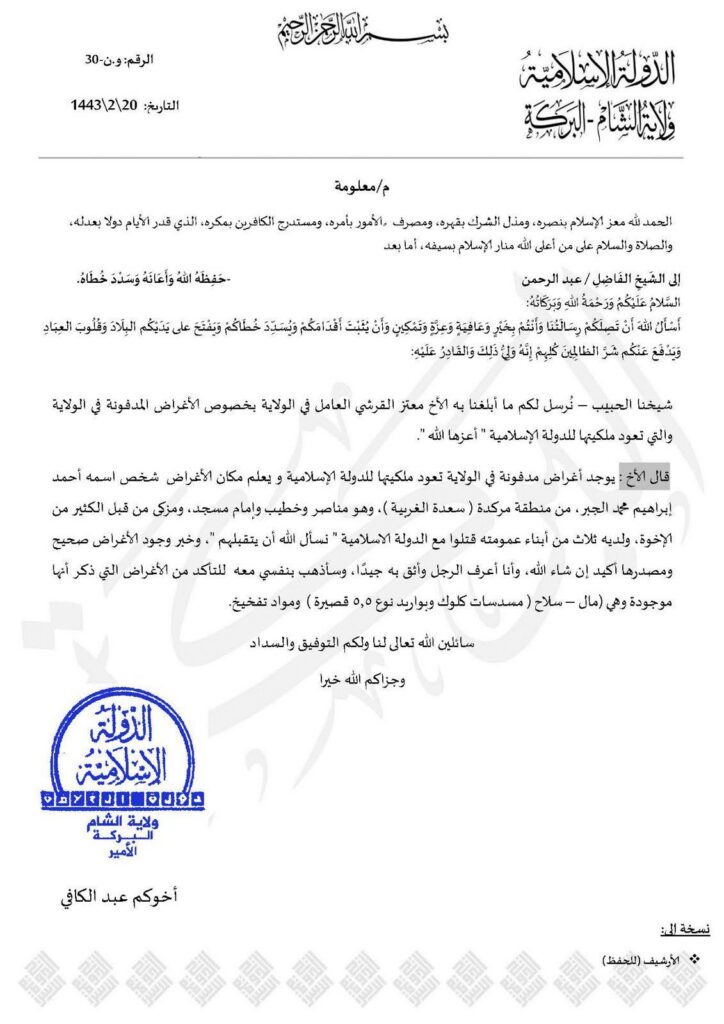
Among the documents the team obtained, one stands out for its directness, providing evidence that the burial of money and gold was a policy rather than an ad hoc occurrence. The document, issued by the wali al-Sham and dated May 14, 2021, contains a binding order to all provincial emirs and unit commanders to distribute the money across multiple secure burial sites and to retrieve it when operationally needed.
“We direct you to order your commanders to bury the money available to you, to distribute it among several safe locations, and to extract from it in accordance with your needs, as your brothers do in Iraq,” the directive, signed by Abu al-Hareth, reads.
The document shows that the group’s leadership regarded burial as a precautionary measure meant to protect money, weapons and organizational secrets from confiscation or from falling into the hands of adversaries. It also indicates clearly that this policy had already been applied in Iraq, and that it was being extended to all areas of the Islamic State’s presence in Syria, whether they were zones of direct activity or areas where sleeper cells were present.
The document also reflects a systematic institutional approach to managing assets, built on dispersing the wealth and reducing the risk of losing it should leaders fall or administrative structures collapse. It also reveals that the caches were not merely temporary hideouts, but part of a long-term strategy aimed at ensuring financial capacity even in periods of military and security retreat.
“This clear order from the highest authority in the group in Syria indicates that burying money was a fundamental part of the Islamic State’s financial strategy in Syria and Iraq,” said Khaled, a pseudonym for a security source working in northwest Syria who tracks Islamic State cells in Aleppo. “It served to disperse the wealth and reduce the chances that local parties or the Global Coalition could reach it. This also reflects the group’s determination to keep its financial operations running even under difficult conditions, which confirms its capacity and resolve to adapt and survive.”
The reference to burial as following what the group does in Iraq points, too, to a unified policy across the ranks. This indicates the strategy was carefully studied and applied across all Islamic State-controlled areas. It also suggests the group placed great importance on maintaining financial operations even amid shifting security situations.
The instructions in the document do not set fixed criteria for the sites where gold and money are to be buried, something also confirmed by experts and researchers familiar with the group’s methods. But analysis of the documents indicates that the larger caches are concentrated in the deserts and barren lands close to population centers, especially around the key centers of influence during the group’s rule.
By contrast, the dataset of documented cache discoveries in Syria and Iraq through the end of 2025, which we showcase on a map below, points to smaller caches distributed inside towns, villages and inhabited areas, and even in areas that were not directly controlled by the group.
Internal documents point to a clear hierarchy for managing these assets, dividing the caches into three main types according to the amount of value stored and the body responsible for it within the organizational chain.
The Islamic State group also succeeded in smuggling part of its money out of Syria and Iraq, and invested some of it in legitimate commercial activities, including real estate and the car trade. Estimates indicate that a portion of these assets was moved out of the country through cross-border financial networks.
The documents the team obtained reveal that the highest level of Islamic State caches was known as the central caches, facilities prepared specifically to hold large quantities of money and gold away from adversaries.
These caches consist of one or more underground rooms, built to an engineering design that ensured long-term preservation, fitted with concrete ceilings, cement walls and small ventilation pipes to prevent moisture buildup and rainwater seepage.
Unlike smaller caches, these sites were not meant for storing weapons or munitions, but were reserved exclusively for holding gold and hard currency. Nor was their construction an emergency measure imposed by military imperatives; it was part of advance financial planning overseen by the highest levels of the group’s leadership.
According to the documents, these caches lay under the authority of figures of “wali” or “caliph” rank, while the movement of money in and out of them was subject to direct oversight and periodic reports on the size of the holdings and the financial flows.
The investigation has identified three central caches of this kind, which together functioned as the main treasury, or something like the group’s “central bank,” through which the largest pool of funds was managed and from which the lower levels of the financial network were fed.
Our team’s map of the uncovered caches shows most of them clustered within a corridor running from Deir ez-Zor to Iraq’s Anbar, the same area the group previously used to smuggle money and weapons.
At a level below the central caches, the group relied on a wide network of provincial and unit caches, financial hideouts belonging to bureaucrats and financial officers in the provinces, administrative divisions and specialized units such as the security and armament units.
These caches were smaller and less complex than the central ones, but greater in number. They were usually concentrated inside the cities and villages that had seen a heavy Islamic State presence in Syria and Iraq, functioning as the financial and logistical depots that fed the daily activity of local cells, and at times holding weapons and munitions alongside the money.
The documents show that the burial process was subject to a strict administrative chain. The financial officer carried out the burial, while the bureaucrat kept the site’s information and coordinates, before this information moved gradually up the chain of command to the wali, and from him to senior leadership.
Unlike the central caches, which were built specifically for the purpose, these hideouts were simpler; they were often pits beneath houses, or metal tanks and containers buried in the gardens of homes belonging to families linked to or loyal to the group.
The documents reveal that these caches performed a function resembling “sub-banks” within the provinces, receiving money transferred from higher levels, then distributing or disbursing it according to written instructions issued by the walis and senior financial officers.
The reserves and caches kept after 2019 were not used only to support the group’s cells in Syria and Iraq; they also helped to fund and establish Islamic State branches in Africa and Asia, through transfers and support networks connected to what is known as the “General Directorate of Provinces.”
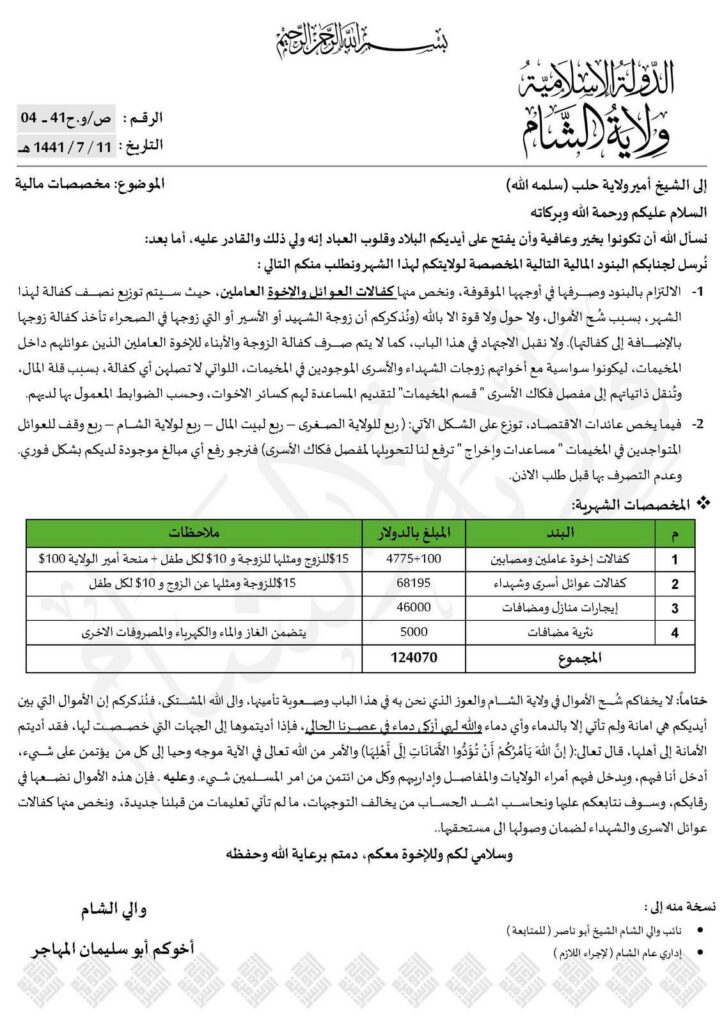
Our team reviewed a document titled “Financial Allocations,” issued by the wali al-Sham on March 6, 2020, and addressed to the amir of Aleppo. The document sets out part of the mechanism for managing money within the group: The amirs received allocations periodically, along with instructions specifying the purposes and mechanisms of spending — compensation paid out to the wives, widows and children of Islamic State fighters or bureaucrats — reflecting a financial and administrative system that kept working even after the group lost most of its territories.
Burials were not confined to the group’s central vaults or the provincial caches; they extended to Islamic State members themselves, who treated their money, weapons and valuables the same way.
The documents and testimony the team gathered indicate that many took to burying their personal savings of gold, money and weapons inside their homes or in their immediate surroundings. Some would share the locations of these caches and their markers with close family members or with other members within the same geographic or family group, in case they were killed or captured.
According to Farhoud, a significant portion of the caches found today is this type of individual hoard, rather than the group’s strategic treasury, reflecting personal or local decisions taken by officials and members during the Islamic State’s rule.
One incident the team documented reveals the importance the group attached to these caches.
On July 5, 2021, Islamic State members detained a boy from Deir ez-Zor and interrogated him after his relatives, working as hired diggers, found a cache of gold in the garden of another member’s house.
According to video recordings and internal documents we obtained, the group accused the family of taking the gold. After they denied knowing where it was, the boy’s older brother was shot dead by one of the members while trying to flee a secret Islamic State detention center.
This indicates that individual caches were not merely personal savings hidden underground, but assets that, although they fell outside the formal financial system maintained by the group, were to be protected and recovered at any cost.
Despite the long years since the collapse of the group’s territorial caliphate, its hidden financial caches continue to help some cells to endure and operate, especially in the desert areas stretching between Syria and Iraq.
The documents and testimony the team gathered indicate that this money was not merely emergency savings, but part of a financial and administrative plan aimed at ensuring the group’s survival and repositioning should it lose territory.
Yet it is difficult to ascertain the exact portion of the Islamic State’s budget the buried caches represent.
Farhoud considered the presence of sleeper cells in the lost territories natural, but noted that these cells do not work exclusively on managing the hoards. Rather, they form part of a broader economic system that includes money transfers, investments and illicit trade.
He added that the buried money is no longer the mainstay of the Islamic State’s economy, which now possesses funding sources and financial networks in other regions, including Africa, but that it can provide fast, limited support to the cells capable of reaching it.
For his part, al-Dassouky saw burial not only as a means of hiding money, but as part of an integrated logistical system. The burial sites sometimes served as supply centers holding financial resources, provisions and weapons, distributed according to the needs of the various operational areas.
As security teams, civilians and treasure hunters continue to dig in the deserts of Syria and Iraq in search of Islamic State caches, the documents the team obtained indicate that part of the group’s wealth remains unaccounted for.
For further comment on our findings, we contacted U.S. Central Command, the body responsible for U.S. security operations in the Middle East, including Syria, Iraq and the Gulf. We received a reply from Henri-Nicolas Grossman, director of the Syria and Iraq portfolio at the office of the U.S. Under Secretary of Defense for Policy (Middle East).
Grossman referred us to two public affairs officers at the office of the U.S. Secretary of Defense: Patricia Kreuzberger, a media affairs officer in the secretary’s office, and Lt. Col. Grace M. Geiger, responsible for media relations and official communications concerning the Department of Defense. We received no reply.
Become a member today to receive access to all our paywalled essays and the best of New Lines delivered to your inbox through our newsletters.

