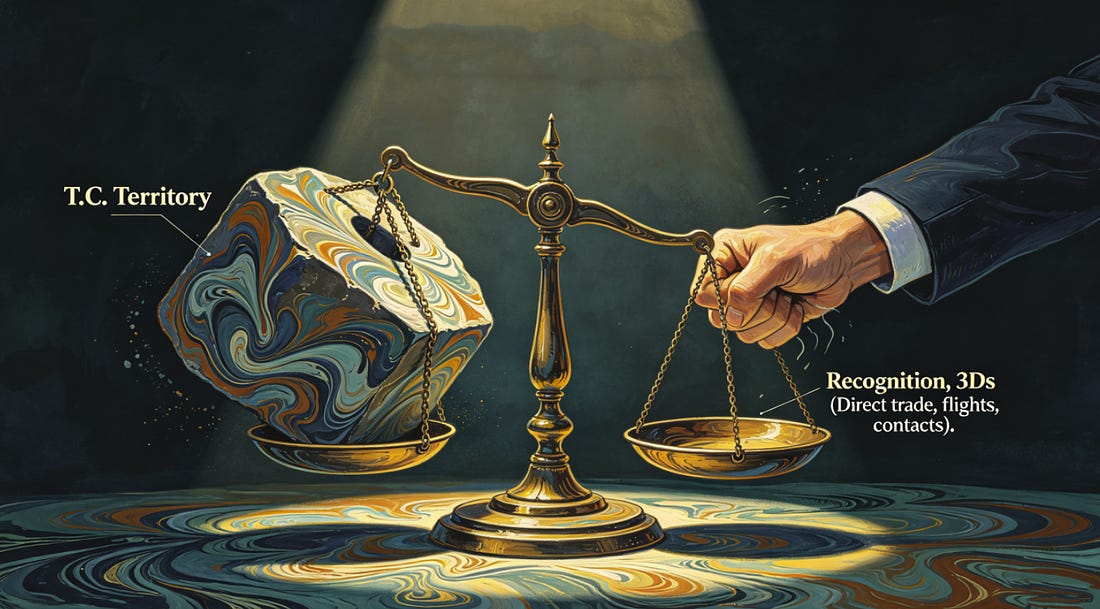
A new UN proposal for Cyprus is reportedly being prepared by Personal Representative Maria Ángela Holguín. It offers “two constituent states with political equality” - but asks the Turkish Cypriots to give up territory in exchange for diplomatic recognition; international acceptance, and what’s called the 3Ds - direct trade, flights and contacts. This is not a settlement. It is a surrender dressed up as a compromise. A note from Mustafa Niyazi:My articles are free. Always. No paywall. No ads. No sponsors. I answer to no one but you. But free does not mean costless. This mission requires resources. The archives - Ottoman, Turkish, Turkish Cypriot, British, American, Soviet, Russian, Chinese, French, Greek and Greek Cypriot - require time. The evidence requires verification. The citations require cross-checking. The sources require documentation. The testimonies require sourcing, traveling, searching, and thousands of pounds spent on books. The voices of the past require unearthing, verification, and preservation. This is independent research. It is funded by readers like you. If you value this work, become a paid subscriber to Unmapped Narratives today. Not to unlock content. To sustain the research that creates it. - Mustafa
According to reports, the UN Secretary-General’s Personal Representative, Maria Ángela Holguín, has prepared a plan for resolving the Cyprus issue, which “includes two constituent states and limited shared responsibilities, with a view to seeking political equality and functionality.” This is a significant development. For decades, the Cyprus issue has been held hostage to a particular brand of selective intransigence. Since late-1963, the island has been divided between two constituent parties: the Turkish Cypriots, supported by Türkiye on the one side, functioning on the doctrine of necessity, and the Greek Cypriots, supported by Greece, seeking to subjugate and erase Turkish Cypriot political existence. In December 1963, Greece and the Greek Cypriots executed the infamous Akritas Plan - suddenly, violently, and illegally seizing the state apparatus, occupying the government, seceding from the power-sharing agreements, and destroying the 1960 Republic of Cyprus. The Turkish Cypriots refused to accept this new status quo. The international community, however, applied the “doctrine of state continuity” to the destroyed state, and then the “doctrine of necessity,” treating the rump Greek Cypriot administration as the “legitimate government of Cyprus.” Thus began the Cyprus Problem - also known as the Cyprus issue. For decades, the Turkish Cypriots demanded a just and lasting solution based on a two-state federal framework. The most significant attempt came in 2004 with the Annan Plan - a comprehensive UN-backed settlement that Turkish Cypriots accepted and Greek Cypriots rejected. The rejection was followed by the Crans-Montana talks in 2017, which culminated in the UN-backed federal framework being effectively declared dead. After the election of a new pro-federation President in the Turkish Republic of Northern Cyprus (TRNC) last October, and the appointment of a new UN envoy shortly thereafter, correspondence resumed. But nothing new was coming. Until now. What the Proposal SaysThe reports state that the Holguín proposal includes two constituent states, with the Greeks / Greek Cypriots able to call it a “federation” and the Turkish Cypriots able to call it a “confederation.” It reportedly proposes a limited central government with five to six ministries, a rotating Presidential Council, and an effective Turkish Cypriot vote. On security, it replaces the 1960 Guarantee System with a NATO formula, with the presence of Turkish, Greek, British, French, and American troops. The core of the proposal is “land for recognition”: the historically Turkish-owned but colonially appropriated Maraş (Varosha), Güzelyurt (Morphou), and parts of Mesarya (Mesaoria) would be given to the Greeks / Greek Cypriots in exchange for international acceptance (diplomatic recognition) and political equality. A transition period of 2-3 years would see gradual territorial returns, the implementation of the already long-promised 3Ds (Direct Trade, Flights, Contacts), and natural gas cooperation. The proposal is also linked to Türkiye-EU relations, tying the Cyprus settlement to Türkiye's EU accession process. The Core Problem: “Land for Recognition”The proposal asks Turkish Cypriots to give up territory - Maraş, Güzelyurt, parts of the fertile Mesarya - in exchange for recognition and the 3Ds. This is a fundamental asymmetry.
The “Land for Recognition” formula is not a compromise. It is a one-sided concession. It is a consolidation of a centuries-long project described by Britain as a policy to “make Cyprus Greek through migration and by the pressure of taxes” accompanied with the “destruction of Mosques and mutilation of Turkish cemeteries.” It is Greek nationalism in action - supporting a modern, foreign engineered, settler colonial “majority” in its expansionist machinations: Enosis, the Megali Idea, Megalomanosis. The Questions That Must Be AskedThis inherently forces the following lines of inquiry and reactive conclusions:
Every piece of land that belongs to a Turkish Cypriot individual or vakıf (religious endowment) in the Greek-occupied south must be returned, and every piece of land that the Greeks / Greek Cypriots want “back” must first undergo a process of legal examination and protection that allows its historical owners - individual or vakıf - to maintain their ownership of the land, regardless of state sovereignty. No quarter.
International acceptance / diplomatic recognition of the Turkish Cypriot state should not be a bargaining chip. It should be unconditional and immediate.
The proposal must address the return of Turkish Cypriot lands, homes, and businesses in the Greek-occupied south.
If Turkish Cypriots are asked to give up territory, Greeks / Greek Cypriots must also concede territory or property rights - or it is not a balanced solution. A one-sided territorial concession is not a settlement - it is a surrender.
Will there be a restitution mechanism, or will Turkish Cypriot property claims be ignored as they have been for decades?
Direct trade, direct flights, and direct contacts should not be a bargaining chip. They are the minimum requirement for Turkish Cypriot economic viability. These were all recognised repeatedly in various talks, accepted and signed in agreements, demanded in advisories, commitments, “moral obligation” and regulations - especially following the 2004 Annan Plan. These questions are not rhetorical. They demand answers. The 3Ds in particular - direct trade, direct flights, and direct contacts - have been promised for over two decades. The European Council declared on 26 April 2004 that it was “determined to put an end to the isolation of the Turkish Cypriot community.” The EU Commissioner for Enlargement, Olli Rehn, stated that the EU had a “moral obligation” to break the isolation. The Green Line Regulation (2004) and the Financial Aid Regulation (2006) were adopted, but the core 3Ds were never fully implemented. They are not a new concession. They are a long-overdue fulfilment of existing obligations. Yet the Holguín proposal treats them as a bargaining chip - as if they were a gift to be given in exchange for territory. That is not a compromise. It is a surrender. This is not an anomaly. It is the recurring logic of the Cyprus issue - the victim is asked to pay, and the aggressor is rewarded. The Principle of ProportionalityIf the Greek / Greek Cypriot side demands the return of territory, the Turkish Cypriot side must demand the return of land and property - and it must be proportionate. If the Turkish Cypriots concede Maraş (Varosha) to Greek / Greek Cypriot sovereignty, then the Greeks / Greek Cypriots must concede land in the Greek-occupied south of equal and proportionate value. If the Turkish Cypriots concede Güzelyurt (Morphou) to Greek / Greek Cypriot sovereignty, then the Greeks / Greek Cypriots must concede land in the Greek-occupied south of equal and proportionate value. If the Turkish Cypriots concede parts of Mesarya (Mesaoria) to Greek / Greek Cypriot sovereignty, then the Greeks / Greek Cypriots must concede land in the Greek-occupied south of equal and proportionate value. Arguably, there must be something that is given as a confidence-building measure - something that accounts for the work of the Immovable Property Commission (IPC) and offers reciprocal remedies. The return of Turkish Cypriot properties and villages in the Greek-occupied south - abandoned and unused - more than make up for this. If the Greeks / Greek Cypriots are not willing to concede anything, then the proposal is not a settlement - it is a capitulation. The NATO Formula and SecurityThe proposal includes replacing the 1960 Guarantee System with a NATO formula - a significant concession that would fundamentally alter the security architecture of the island. The NATO formula replaces the Treaty of Guarantee with a multilateral framework. It would mean the presence of Turkish, Greek, British, French, and American troops on the island, and Cyprus joining NATO - a major shift in the island's geopolitical alignment that has clear legal and political implications on the previously existing multi-treaty bi-communal power-sharing framework. Turkish Cypriots have legitimate concerns about this. The 1960 Guarantee System, for all its flaws, provided a framework for Turkish Cypriot security. A NATO formula would place Turkish Cypriot security in the hands of an organisation that has historically prioritised Greek / Greek Cypriot interests. The 1974 intervention was a lawful exercise of treaty rights under the Treaty of Guarantee. Without a similarly robust guarantee, Turkish Cypriots would be left vulnerable to a repeat of 1963-1974 - which the Greeks / Greek Cypriots repeatedly state is the preferred situation to return to. The NATO formula does not provide the same level of assurance. And this is the part that requires the most attention: The NATO formula in the Holguín proposal is not a minor adjustment. It is a fundamental revision of the legal architecture that has governed Cyprus since 1923. It would effectively replace the Treaty of Guarantee (1960) and, by extension, the Lausanne framework (1923) that underpins it - unless it also recognises the foundational rights Türkiye has to the political future of the island. The question is whether the Menzor Thesis - or its equivalent - can be revived here. If Türkiye’s Article 16 right is explicitly preserved or re-codified, then the Lausanne framework remains intact. If it is not, then Türkiye’s original, dormant right under Article 16 could be revived, creating legal uncertainty and potentially undermining the entire settlement, while admittedly providing for a new potential framework. Turkish Cypriots cannot trust NATO to protect them. The 1963-1974 genocide was documented by the UN, confirmed by the ICRC, and affirmed by all five permanent members of the UN Security Council. NATO did nothing. The UN did nothing. The EU did nothing. Only Türkiye acted. The US threatened it. The UK warned it. The US sanctioned it. Only Türkiye protected Turkish Cypriots from annihilation. And it did so at a high cost to its own population - a cost imposed upon it through the UN, UNSC, NATO, and EU. The NATO formula would strip Türkiye of its treaty-based right to intervene - unless it is explicitly preserved. It would place Turkish Cypriot security in the hands of an organisation that has historically failed to protect them. It would undermine the Lausanne framework and set a dangerous precedent for other treaty-based security arrangements. This is not a path to peace. It is a path to vulnerability - unless Türkiye’s foundational rights are explicitly preserved. The Turkish Cypriot ReactionThe Turkish Cypriot reaction to the Holguín proposal has been swift, unified, and overwhelmingly negative. This is not the response of a “community” opposed to peace. It is the response of a sovereign nation that has learned, through bitter experience, that one-sided concessions are not a path to peace - they are a path to surrender. Here is what Turkish Cypriots are saying:
The message is clear: Turkish Cypriots are not opposed to a settlement. But they will not accept a settlement that asks them to give up territory for recognition - while asking Greek Cypriots to give up nothing. A Truth and Reconciliation Commission for CyprusOne observer, Christine Watters, has raised a profound and necessary question:
This is not new. Others have said this before. I have said this too. And she is right. A Truth and Reconciliation Commission (TRC) is exactly what Cyprus needs. But it will never be proposed or accepted by the Greek / Greek Cypriot side - because they would be the ones compelled to confess. Such a commission would require the Greek / Greek Cypriot side to admit that the 1963-1974 campaign was a genocide - a campaign the UN described as “aimed at the subjugation, if not the extermination, of the Turkish Cypriot community.” It would require the Greek / Greek Cypriot leadership, the Orthodox Church, and the Greek state to admit their role in planning and executing the genocide. It would require coming to terms with how it was not just the state, but that it was societally-driven, and it was systematic. It would require restitution for victims - compensation for the loss of their homes, lands, and lives. It would require perpetrators to confess their crimes publicly, as in the South African TRC, with amnesty for those who confess fully and truthfully. It would require memorialisation of the victims, with their suffering acknowledged in Greek / Greek Cypriot education and public life. It would require redefining Greek nationalism and historiography on the island. And it would require reconciliation - which can only begin after the truth has been told and acknowledged. This is what that would look like:
The asymmetry of accountability is glaring. The Greek / Greek Cypriot side has never admitted the 1963-1974 genocide. Its perpetrators were promoted, not prosecuted. The West accepts their narrative without question. The Turkish Cypriot side has always told the truth about what happened, but their narrative is dismissed as “Turkish propaganda,” and their victims have never received justice. They have proposed the establishment of a TRC - repeatedly, and with the view to it exposing the truth and demanding accountability from both sides, but this has been repeatedly rejected. Without acknowledgment of the 1963-1974 genocide, there can be no genuine reconciliation. The Holguín proposal asks Turkish Cypriots to give up territory without first addressing the crimes committed against them. This is not a path to peace. It is a path to surrender. What the Proposal IgnoresThe Holguín proposal is presented as a “breakthrough.” But it ignores the 1963-1974 genocide of Turkish Cypriots - a campaign the UN described as “aimed at the subjugation, if not the extermination, of the Turkish Cypriot community.” It ignores the 25,000 Turkish Cypriots driven from 104 villages - their homes, their lands, their memories. It ignores the 364 Turkish Cypriots killed before 1974 - and the thousands more displaced, starved, and besieged under conditions designed to liquidate them. It ignores the 3% of the island Turkish Cypriots were confined to - under “veritable siege,” starvation as a weapon of war (a war crime under international law). It ignores the Turkish Cypriot property in the Greek-occupied south - systematically mutilated, looted, appropriated, and never returned. The proposal asks Turkish Cypriots to give up more territory while ignoring the crimes committed against them. It is a continuation of the UN’s track record on Cyprus of rewarding the aggressor for its misdeeds, and blaming the victim and forcing it to pay for its own suffering. The Double StandardThe Holguín proposal reveals a double standard. The Greek / Greek Cypriot side (the aggressor), demands the return of territory, while the Turkish Cypriot side (the victim), is asked to give up territory. The Greek / Greek Cypriot side does not address Turkish Cypriot property, and its claims to right of return - in spite of the Population Exchange Agreement (PEA, Third Vienna Agreement, 1975) - is treated as legal and supported, while the Turkish Cypriot side is asked to accept loss of property. The Greek / Greek Cypriot side expects acceptance without conditions, while the Turkish Cypriot side is asked to earn acceptance by giving up land that historically belonged to the Turkish Cypriots anyway. The Greek / Greek Cypriot side does not concede anything, while the Turkish Cypriot side is asked to concede everything. This is not a settlement. It is a continuation of the asymmetry that has defined the Cyprus conflict for decades. What a Just Settlement Would Look LikeA just settlement would include immediate and unconditional international acceptance and diplomatic recognition of the TRNC, and immediate implementation of direct trade, direct flights, and direct contacts. It would require the return of Turkish Cypriot property in the Greek-occupied south, or just compensation, perhaps even forcing the rump Greek Cypriot administration to create its own equivalent to the IPC and allows it to be observed. Any territorial concession by Turkish Cypriots must be matched by a proportional concession by Greeks / Greek Cypriots. There must be a reasonable security framework that guarantees Turkish Cypriot sovereignty and prevents a repeat of 1963-1974. There must be acknowledgment of the 1963-1974 genocide and accountability for its perpetrators. And there must be heavy reparations paid to the Turkish Cypriots for everything that was historically done to them, and everything that was historically taken from them. If that is a non-starter, then at the bare minimum, property must be returned - proportionately and without condition. Addressing the Elephant in the Room: Türkiye’s Treaty-Bound Rights and Greece’s AbrogationAny just settlement must also respect Türkiye’s legitimate, treaty-bound rights to the island. These rights are not a matter of political convenience. They are enshrined in binding international treaties that have governed Cyprus for over a century. The Treaty of Lausanne (1923), Article 16, explicitly reserved Türkiye’s right to be heard on the future of Cyprus. Türkiye renounced sovereignty but did not renounce interest. The phrase “the parties concerned” was deliberately open-ended. Türkiye has always been a party concerned. The Treaty of Guarantee (1960) was the mechanism through which Türkiye’s reserved right under Article 16 was satisfied. It codified Türkiye’s role as a guarantor power, with the right to intervene militarily if need be to restore the constitutional order. This was not a concession to Türkiye. It was the contractual satisfaction of a legal right reserved since 1923. Greece, however, abrogated its treaty-bound rights. The 1963 coup, the 1974 coup, the repeat invasions were planned and executed by the Greek state. Greek officers commanded the Greek Cypriot National Guard. Greece seized Cyprus, installed its own puppet regimes - first the terrorist leader Makarios III, and then the terrorist gunman Nikos Sampson - and activated the Akritas Plan, Gronthos Plan, Aphrodite Plan and Iphestos for the liquidation of the Turkish Cypriots, locally known as the “final solution” to “the Turkish Problem.” Greece cannot claim the same legal or moral standing as Türkiye. Greece abrogated its treaty rights through the coups and invasions. It invaded Cyprus and installed terrorist regimes. It activated multiple plans for the liquidation of Turkish Cypriots. Greece has no legal standing as a “party concerned” in the Cyprus settlement. Türkiye, by contrast, has consistently honoured its treaty obligations. It intervened lawfully under the Treaty of Guarantee to stop a genocide. It acted to prevent the annihilation of Turkish Cypriots. Türkiye retains its legal standing under Article 16 of the Treaty of Lausanne. This asymmetry must be recognised in any just settlement. Greece is therefore not a party concerned. It is an occupying power. It exercises effective control over the southern part of Cyprus through its proxy, the rump Greek Cypriot administration. Any solution must account for this reality. The Menzor Thesis - the legal argument advanced by Turkish Prime Minister Adnan Menderes and Foreign Minister Fatin Rüştü Zorlu in the 1950s - established that Türkiye’s Article 16 right remained active and entitled it to co-determine Cyprus’s future. The 1960 settlement was the codification of this right. If that settlement is fundamentally altered, Türkiye’s original, dormant right under Article 16 could be revived. The NATO formula in the Holguín proposal would effectively replace the Treaty of Guarantee. But it cannot do so without addressing Türkiye’s foundational rights under the Treaty of Lausanne. If the Treaty of Guarantee is abolished without preserving Türkiye’s Article 16 right, then the Lausanne framework is effectively undone. Türkiye’s right to be heard on Cyprus’s future would be extinguished - not by treaty amendment, but by political convenience. This is not acceptable. A just settlement must explicitly recognise:
This could be done through:
Without this, the settlement is not a settlement. It is a surrender. The Lausanne framework is one of the foundational treaties of the modern international order. It established the borders of modern Turkey, Greece, and other Balkan states. It cannot be casually amended or ignored. Any attempt to replace the Treaty of Guarantee without preserving Türkiye’s foundational rights would be a fundamental breach of international law and would have serious geopolitical consequences. Turkish Cypriots cannot trust NATO to protect them. The 1963-1974 genocide was documented by the UN, confirmed by the ICRC, and affirmed by all five permanent members of the UN Security Council. NATO did nothing. The UN did nothing. The EU did nothing. Only Türkiye acted. Only Türkiye protected Turkish Cypriots from annihilation. The NATO formula would strip Türkiye of its treaty-based right to intervene - unless it is explicitly preserved. It would place Turkish Cypriot security in the hands of an organisation that has historically failed to protect them. It would undermine the Lausanne framework and set a dangerous precedent for other treaty-based security arrangements. This is not a path to peace. It is a path to vulnerability - unless Türkiye’s foundational rights are explicitly preserved and Greece’s abrogation of its treaty rights is formally acknowledged. ConclusionThe Holguín proposal is not a breakthrough. It is a one-sided concession disguised as a compromise. It asks Turkish Cypriots to give up territory for recognition - while asking Greek Cypriots to give up nothing. The questions before us are:
The answer is clear. For this to be a just and lasting settlement, there must be heavy reparations paid to the Turkish Cypriots for everything that was historically done to them, and everything that was historically taken from them. They should not have to reciprocate. If that is a non-starter, then at the bare minimum: if the Greek Cypriot side demands the return of territory, the Turkish Cypriot side must also demand the return of property - every piece of land that belongs to an individual or vakıf in the Greek-occupied south, as far back as it can and wants to go. No quarter. Recognition should not be conditional. It should be immediate and unconditional. The 3Ds should not be a bargaining chip. They are the minimum requirement for Turkish Cypriot economic viability. If the Greek Cypriots are not willing to concede anything - if they are not willing to return Turkish Cypriot property or to recognise Turkish Cypriot sovereignty without conditions - then this is not a settlement. It is a surrender dressed up as a compromise. The value of truth is measured by the cost of ignoring it. My name is Mustafa Niyazi, and I connect the disconnected.
This research was made possible only with the support of this community. This is 100% a reader-supported publication. No ads. No sponsors. No hidden agendas. Just you and me. 👉 How This Works and How to Support Special thanks to my paying subscribers: Birol, Roy, Taşkın, Aydın, Devrim, Senay, Birsen, Munevver, Çetin and Crazy Turk. You are the ones making this happen. A heartfelt thank you as well to my patrons: Roy. M. Your faith in this work and its mission means more than I can say. Also, a big shout out to those fueling this with teas over at buy me a coffee, especially Togs. A sincere thank you to all my subscribers - including those who support with their essential free subscriptions. Your commitment to engaging with this work is its foundation. And a massive thank you to those engaging in the vigorous and essential discourse across social platforms. Your support and engagement are deeply appreciated. If you found this article valuable, please like, share, and leave a comment. It helps out big time with the algorithm, and allows this to reach more people. Click here or on the button below to subscribe as well for notifications when new articles drop. And feel free to continue reading. You know you want to:
|






No comments:
Post a Comment