Erdogan's Sunni Noose: Turkey's Bid to Encircle Israel
      |  |
Turkish President Recep Tayyip Erdogan has launched an ambitious diplomatic offensive aimed at unifying the Sunni world under Ankara's leadership. The objective is not merely reconciliation with former rivals. It is the construction of a Sunni diplomatic and strategic "wall," or "noose," around Israel, replacing the Iranian "Shi'ite crescent" with a new configuration of Sunni power.
The Turkish-Saudi reconciliation is particularly significant. Following years of tension after the 2018 murder of journalist Jamal Khashoggi in Istanbul, Ankara and Riyadh have now moved decisively toward strategic cooperation.
Turkish and Saudi officials increasingly frame Israel as a destabilizing actor in these theaters. The emerging partnership is not merely economic; it reflects coordinated positioning against perceived external threats, with Israel explicitly cited.
Turkey and Egypt have now signed a $350 million military framework agreement covering joint weapons production, intelligence sharing, and military exercises. Turkish air defense systems and munitions are slated for delivery, and bilateral trade is projected to reach $15 billion.
As the guardian of the Suez Canal and a dominant actor in North Africa, Egypt provides logistical leverage capable of influencing maritime routes critical to Israel's economy.
On February 9, 2026, the foreign ministers of Turkey, Egypt, Indonesia, Jordan, Pakistan, Qatar, Saudi Arabia, and the United Arab Emirates issued a joint communiqué condemning what they called "Israeli expansionist policies in occupied territories" and calling for Islamic unity.
Some analysts describe an emerging "Sunni axis," or noose, influenced by Muslim Brotherhood ideology; backed by Turkish military power, financed by Qatar and Saudi Arabia, and designed, by expanding into Gaza, to encircle and finish off Israel.
The UAE, under the impressive leadership of Sheikh Mohamed ben Zayed al Nahyan, pursues a technocratic, anti-political Islam agenda that diverges sharply from Erdogan's ideological sympathies.... Still, the coalition's ultimate aim, apart from the UAE, unmistakably seems to be "containing" Israel.
Recently, Saudi media have featured openly anti-Israel and antisemitic headlines not seen in years. The kingdom appears to be totally aligning itself with anti-Israel countries such as Qatar and Turkey, while "tensions with the UAE explode."
Egypt, Israel's chilly peace partner since 1979, has reportedly expanded military infrastructure in the Sinai Peninsula in ways that should, under the supposed peace treaty, raise serious questions.
Turkish and Egyptian intelligence services are reportedly coordinating efforts to counter rival influences and restrict Israel's strategic access.
Israeli analysts increasingly describe it as the replacement of Iran's Shiite axis with a Sunni bloc influenced by the Muslim Brotherhood.
The coalition presents itself as promoting regional peace. Yet "peace" may translate into the vaporization of Israel, especially should a future Israeli government prove more pliable.
Erdogan's participation in "stabilization" efforts would significantly expand Turkish influence within the emerging Sunni crescent. Ankara's well-documented support for Muslim Brotherhood networks — which are Hamas's patrons, ideologically and financially – should raise obvious concerns.
Netanyahu's insistence that Israel determine which international actors, if any, operate in Gaza, serves multiple strategic purposes. It prevents Turkish entrenchment in Gaza, maintains Israeli control over post-war arrangements, and signals to Washington that Israel views Turkish expansionism as a long-term threat transcending personal or political relationships.
Whatever the obstacles, Erdogan's direction seems clear: a militarily and economically anchored Sunni alignment to constrict Israel's strategic space.
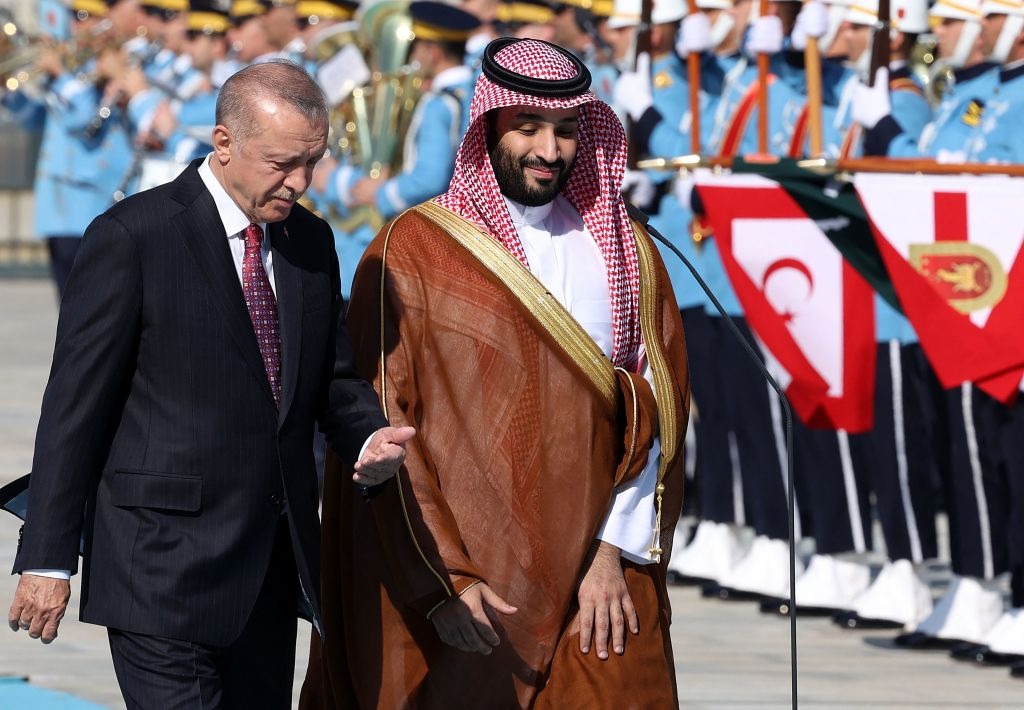
While much of the world's attention remains fixed on Iran and its Shi'ite axis, another geopolitical realignment is taking shape — more quietly, more pragmatically, and potentially just as consequential for the US, Israel and the Middle East.
Turkish President Recep Tayyip Erdogan has launched an ambitious diplomatic offensive aimed at unifying the Sunni world under Ankara's leadership. The objective is not merely reconciliation with former rivals. It is the construction of a Sunni diplomatic and strategic "wall," or "noose," around Israel, replacing the Iranian "Shi'ite crescent" with a new configuration of Sunni power.
In early February 2026, Erdogan embarked on a Middle East tour that signaled a turning point. On February 3, he visited Saudi Arabia. On February 4, Egypt. On February 7, Jordan's King Abdullah II was received in Istanbul. These meetings were not symbolic. They marked the culmination of a "normalization" process that has been unfolding since 2022, as Turkey repaired relations that were damaged by its earlier ideological support for the Muslim Brotherhood and confrontations with Gulf monarchies.
The Turkish-Saudi reconciliation is particularly significant. Following years of tension after the 2018 murder of journalist Jamal Khashoggi in Istanbul, Ankara and Riyadh have now moved decisively toward strategic cooperation. Discussions with Saudi Crown Prince Mohammed bin Salman produced major agreements, including a $2 billion Saudi investment in renewable energy projects in Turkey, targeting 5,000 megawatts of solar capacity. Defense cooperation was expanded to include technology transfers for Turkish drones and air defense systems. Bilateral trade is expected to reach $50 billion.
Erdogan has emphasized "growing strategic trust" in confronting regional instability — from Syria to Gaza. Turkish and Saudi officials increasingly frame Israel as a destabilizing actor in these theaters. The emerging partnership is not merely economic; it reflects coordinated positioning against perceived external threats, with Israel explicitly cited.
Egypt represents an even more dramatic shift. After a decade of hostility — triggered by Turkey's support for the Muslim Brotherhood following the 2013 ouster of Egyptian President Mohamed Morsi — Erdogan's visit to Cairo marked the end of a long freeze. Turkey and Egypt have now signed a $350 million military framework agreement covering joint weapons production, intelligence sharing, and military exercises. Turkish air defense systems and munitions are slated for delivery, and bilateral trade is projected to reach $15 billion.
Strategically, Egypt's participation transforms the coalition's scope. As the guardian of the Suez Canal and a dominant actor in North Africa, Egypt provides logistical leverage capable of influencing maritime routes critical to Israel's economy. Discussions between Erdogan and President Abdel Fattah el-Sisi reportedly included Gaza, Syria, and Africa—regions where both countries share concerns over the influence of Israel and the United Arab Emirates.
Jordan, long a security partner of Israel despite persistent political hostility at home, has also been drawn into closer alignment with Turkey. Joint statements have emphasized peace in Syria and Gaza and highlighted "common concerns" about regional stability. A future Erdogan visit to Amman is under discussion, underscoring Jordan's integration into Ankara's growing network.
On February 9, 2026, the foreign ministers of Turkey, Egypt, Indonesia, Jordan, Pakistan, Qatar, Saudi Arabia, and the United Arab Emirates issued a joint communiqué condemning what they called "Israeli expansionist policies in occupied territories" and calling for Islamic unity. Israeli media outlets such as Ynet interpreted the statement as evidence of a "coalition of interests against Israel," with Turkey playing the unifying role.
Some analysts describe an emerging "Sunni axis," or noose, influenced by Muslim Brotherhood ideology; backed by Turkish military power, financed by Qatar and Saudi Arabia, and designed, by expanding into Gaza, to encircle and finish off Israel. The isolated Turkish-Qatari alignment of 2017–2021 appears to have evolved into a broader strategy of economic and diplomatic influence, channeling of neo-Ottoman ambitions.
A few structural limits do remain. Saudi Arabia acts as the guardian of Sunni Islam's holiest sites and is unlikely to surrender religious leadership to Ankara. Egypt retains unmatched demographic and military weight in the Arab world.
The UAE, under the impressive leadership of Sheikh Mohamed ben Zayed al Nahyan, pursues a technocratic, anti-political Islam agenda that diverges sharply from Erdogan's ideological sympathies. Turkey's continued affinity for the Muslim Brotherhood remains a source of friction. Coordination may be pragmatic, but ideological fusion is far from complete. Still, the coalition's ultimate aim, apart from the UAE, unmistakably seems to be "containing" Israel.
Turkey-Israel relations oscillate between harsh rhetoric and pragmatic cooperation. Erdogan has publicly compared Israeli Prime Minister Benjamin Netanyahu to Hitler and accused Israel of Nazi-like policies. Economic ties, however, persist, and Eastern Mediterranean energy interests have occasionally aligned. Erdogan instrumentalizes the Palestinian cause to bolster his Islamic leadership credentials, even as Ankara avoids direct military confrontation with Israel.
The broader coalition presents more complex dynamics. Saudi Arabia had been in advanced discussions with Washington regarding conditional normalization with Israel. Those talks appear to have stalled or, most probably, collapsed. Recently, Saudi media have featured openly anti-Israel and antisemitic headlines not seen in years. The kingdom appears to be totally aligning itself with anti-Israel countries such as Qatar and Turkey, while "tensions with the UAE explode."
Egypt, Israel's chilly peace partner since 1979, has reportedly expanded military infrastructure in the Sinai Peninsula in ways that should, under the supposed peace treaty, raise serious questions. Jordan continues close coordination with Israel, even as domestic political hostility remains intense.
Would these states risk overt military alignment against Israel? Perhaps not this minute, but Erdogan's strategy does not require immediate war. It requires gradual encirclement. Nowhere is this more evident than in Africa, especially along the Red Sea coast. From Libya to Sudan to Somalia, Turkish and Egyptian intelligence services are reportedly coordinating efforts to counter rival influences and restrict Israel's strategic access.
In Libya, once divided between Turkish-backed Tripoli and Egyptian-supported Marshal Khalifa Haftar, Ankara and Cairo are now aligning to stabilize the country and limit UAE-supported militias perceived as close to Israel. In Sudan, near Egypt's southwestern border, the Sudanese civil war continues. Turkey provides logistical and intelligence support, aligning with Saudi Arabia to potentially threaten Israeli access to the Red Sea.
In Somalia, Egypt has increased its military presence to approximately 10,000 troops after Israel's December 2025 recognition of Somaliland. Turkey maintains its largest overseas military base in Mogadishu, training Somali forces and developing military infrastructure. A Saudi-Somali defense agreement strengthens this axis, positioning it near the Bab el-Mandeb Strait — a chokepoint vital to global trade and Israeli shipping. The stated objective is securing the Red Sea against "foreign military presence." The unstated implication is the containment of Israel.
This evolving configuration represents a transformation of what was once considered the "moderate Sunni camp" — historically aligned with the United States and tolerant, if not friendly, toward Israel — into a broader Islamic coalition capable of exerting diplomatic, economic and military pressure. Israeli analysts increasingly describe it as the replacement of Iran's Shiite axis with a Sunni bloc influenced by the Muslim Brotherhood.
The ultimate goal appears twofold: diplomatic isolation through forums such as the Organization of Islamic Cooperation, where Turkey advocates economic sanctions, and economic leverage via control of energy routes and maritime corridors. The coalition presents itself as promoting regional peace. Yet "peace" may translate into the vaporization of Israel, especially should a future Israeli government prove more pliable.
Against this backdrop, Israeli Prime Minister Benjamin Netanyahu has taken a firm stand. On January 19, 2026, addressing the Knesset, he declared unequivocally that there would be "no Turkish or Qatari soldiers in the Gaza Strip." His veto came days after the White House announced the creation of a U.S.-supervised "Board of Peace" to oversee Gaza reconstruction, reportedly including Turkish and Qatari representatives such as Foreign Minister Hakan Fidan.
Netanyahu did not hesitate to confront President Donald Trump publicly on the issue. He instructed Foreign Minister Gideon Sa'ar to convey Israel's objections directly to Secretary of State Marco Rubio. The disagreement underscored a red line: Israel would determine which international actors, if any, operate in Gaza.
The refusal is consistent with earlier Israeli objections to Turkish military involvement in post-war Gaza planning. Erdogan's participation in "stabilization" efforts would significantly expand Turkish influence within the emerging Sunni crescent. Ankara's well-documented support for Muslim Brotherhood networks — which are Hamas's patrons, ideologically and financially – should raise obvious concerns. Netanyahu's insistence that Israel determine which international actors, if any, operate in Gaza, serves multiple strategic purposes. It prevents Turkish entrenchment in Gaza, maintains Israeli control over post-war arrangements, and signals to Washington that Israel views Turkish expansionism as a long-term threat transcending personal or political relationships.
Meanwhile, the UAE's stance for normalization with Israel may clash with Turkey's drive for dominance. Egypt, having briefly fallen to Muslim Brotherhood rule after the 2011 overthrow of President Hosni Mubarak, remains deeply wary of a Brotherhood resurgence. Riyadh's ambitions for Sunni leadership compete with Ankara's neo-Ottoman vision.
Whatever the obstacles, Erdogan's direction seems clear: a militarily and economically anchored Sunni alignment to constrict Israel's strategic space. While Iran's crescent may be weakening under sanctions and internal strain, another structure is rising in its place. The new structure is not overtly militant. It does not advertise itself as an alliance against Israel. But through energy pacts, defense agreements, intelligence coordination, and multilateral communiqués, it seems clearly to want to reconfigure the regional balance of the Middle East.
The coming years will determine whether this Sunni wall strengthens into a unified front or weakens under competing ambitions. For Israel, complacency is not an option. The encirclement may no longer be Shiite, but Sunni — and diplomatic, at first, rather than immediately military. In geopolitics, the form of pressure matters less than its cumulative effect.
Pierre Rehov, who holds a law degree from Paris-Assas, is a French reporter, novelist and documentary filmmaker. He is the author of six novels, including "Beyond Red Lines", "The Third Testament" and "Red Eden", translated from French. His latest essay on the aftermath of the October 7 massacre " 7 octobre - La riposte " became a bestseller in France. As a filmmaker, he has produced and directed 17 documentaries, many photographed at high risk in Middle Eastern war zones, and focusing on terrorism, media bias, and the persecution of Christians. His latest documentary, "Pogrom(s)" highlights the context of ancient Jew hatred within Muslim civilization as the main force behind the October 7 massacre.

© 2026 Gatestone Institute. All rights reserved. The articles printed here do not necessarily reflect the views of the Editors or of Gatestone Institute. No part of the Gatestone website or any of its contents may be reproduced, copied or modified, without the prior written consent of Gatestone Institute.
- The 'Other Side' Turns Against the Jews, 2026-02-18
- Why Some of Trump's Muslim 'Allies' Fear a Loss of Iran More Than They Fear Iran , 2026-02-08
- 'If the Bad Guys Start Shooting, It Comes Over Greenland' vs. Europe's Strategic Myopia, 2026-01-23
- Trump, Iran and Ukraine: When Promises Meet 'Caution,' the West's Deadly Trap, 2026-01-18
- Why the West Is Split Over Political Islam, 2026-01-13

No comments:
Post a Comment