As a constitutional matter, the issue before the Supreme Court in the case of President Trump’s tariffs was a relatively easy one. If the Constitution was designed to prevent anything, it was economic rule by one-man decree. Declaring a national emergency due to foreign disputes and making the American people pay stiff import taxes as a consequence, without clear legislative authority—as Trump did last year—was never part of the Founders’ plan.
But actually acting on this truth was not so simple, especially for a conservative court majority that faced overt pressure from a president who had appointed three of them. Tariffs are the president’s signature policy and personal obsession. Before the justices listened to oral arguments last November, he had warned them that a contrary ruling “would literally destroy the United States of America.”
For the justices, then, this case posed a test of legal reasoning. But it also posed a test of personal integrity and institutional duty.
Chief Justice John Roberts passed the test. So did Justices Amy Coney Barrett and Neil Gorsuch, two Trump appointees, who, along with the Court’s three liberal Democratic appointees, struck down the tariffs.
In a 21-page opinion, Roberts wisely kept rhetorical flourishes to a minimum and let obvious constitutional truths do the work. He noted that the law Trump used last year to impose the tariffs—the International Emergency Economic Powers Act of 1977—nowhere granted the president authority to do so. To sign off on the president’s policy “would replace the longstanding executive-legislative collaboration over trade policy with unchecked presidential policymaking.” And in America, we don’t do “unchecked presidential policymaking.”
To be sure, the case wasn’t a total no-brainer. The dissenting opinion of Justice Brett Kavanaugh—joined by Clarence Thomas and Samuel Alito—showed how a smart lawyer could have interpreted the law and Constitution creatively, and permissively, enough to enable Trump’s tariffs. The reward for going along with this would have been a presidential press conference at which Trump said he was “proud” of Roberts, Barrett and Gorsuch, too, and not just the dissenters. But they resisted that temptation.
After the ruling, there was a lot of commentary about what this means for the midterm elections, for the economy, even for Trump’s possible behavior toward the justices as they sit before him while he delivers the State of the Union Address on Tuesday. It’s all interesting; and it’s all beside the point. The only thing that really matters is whether the U.S. constitutional system is going to survive the Trump years intact—and the Roberts Court’s ruling is a strong signal that it will.
Not only did the Court rein in Trump; it followed a pattern established during and after the pandemic, when it checked President Biden’s efforts to forgive student loans, bar evictions, and impose vaccine mandates, which were also rooted in strained interpretation of emergency authority. Ruling consistently between presidents of different parties enhanced the court’s legitimacy and that of the judiciary as a whole.
The progressive left has been inclined to disparage Roberts and blame him for doing Trump’s bidding in a series of recent cases that let the president freeze foreign aid, fire federal employees, and base some immigration enforcement tactics on race and language—pending resolution of the underlying lawsuits against those policies.

Unlike those interlocutory rulings, however, the tariffs ruling was “on the merits,” as lawyers say, meaning that the justices were responsible for the final, substantive outcome. When the stakes were highest, and the choices binary, the chief justice stayed true to principle. It would be nice—and, in political terms, smart—if the left changes its tune about Roberts in the wake of his courageous stand.
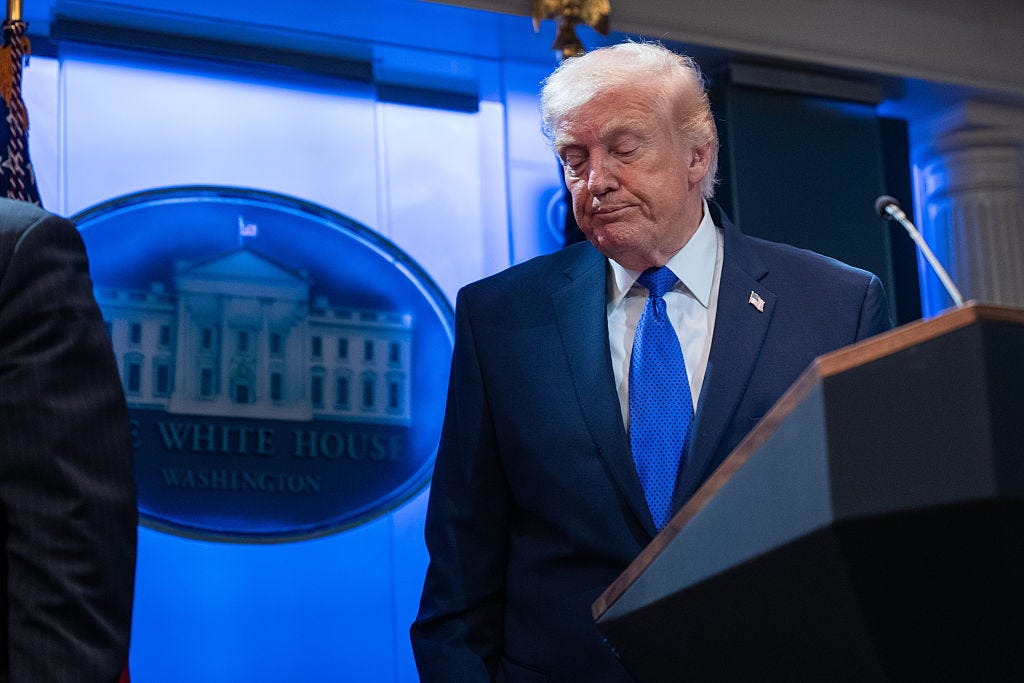
For his part, Trump ranted and raved at Roberts and the other two conservatives who voted with him, labeling them “very unpatriotic and disloyal to our Constitution.” This was shameful.
The main thing about Trump’s rage, though, is that it’s impotent. He did not call for the impeachment of the justices; he did not threaten to defy or ignore the ruling. Rather, he accepted the Court’s ruling and claimed—not incorrectly—that it still left him plenty of other ways to pursue tariffs.
You would have thought that the president might have taken the ruling as an off-ramp from a tariff policy that has achieved little except to raise costs in the United States and alienate allies abroad. In 2025, America’s merchandise trade deficit actually rose to an all-time high; though the gap with China shrank significantly, trade just shifted elsewhere. Meanwhile, American factories lost 108,000 jobs.
Trump’s tariffs are also unpopular, as shown by polls and the fact that a majority of the GOP-controlled House recently voted to end the national emergency Trump invoked to justify a 25 percent levy on Canadian goods. (This was short of the two-thirds necessary to override a presidential veto, but it was symbolically important.)
And yet the president insists on continuing his tariffs under other authorities than the international emergency statute he cited, unsuccessfully, at the Supreme Court. Yesterday he announced a 10 percent global tariff under section 122 of the 1974 Trade Act; today he raised it to 15 percent. It will expire after 150 days unless Congress extends it.
In continuing to impose tariffs, Trump’s acting on personal pique, not any clear policy rationale. His political thinking is unclear as well, since voting on extension would force members of his own party to take a controversial stand in the middle of a midterm campaign that already looks difficult for them. Trump’s response to the court looks like a losing proposition for the economy, for him, and for the Republican Party.
But at least, for now, Trump has been forced to act within the law. From the standpoint of what really counts—the institutional integrity of the United States—that’s a win.
Charles Lane is a nonresident senior fellow at the American Enterprise Institute and a columnist for The Free Press.

No comments:
Post a Comment