Showing posts with label EU. Show all posts

Monday, March 13, 2017

Trump's Conflict-Ridden World : Five Hotspots to Watch in 2017 (Ukraine/Baltics, China/Taiwan, ISIS, Israel/Palestine, Mexico)


Trump’s Conflict-Ridden World: Five Hotspots to Watch in 2017

E-mail
Print
Share This Page
Increase Text Size Text Reset Decrease Text Size

a1.trump.conflict.portrait.storyFrom Berlin to Beijing, from Tallinn to Taipei, President Donald Trump seems eager to pick fights — even among U.S. allies — without leaving the White House, where infighting among his own team has made his young administration one of the most volatile in U.S. history.
In less than a month in office, the 45th president has managed to turn the world order upside down.
He infuriated Chinese leaders by questioning America’s long-standing commitment to Beijing’s “one China” policy regarding Taiwan, provoked anger across the Islamic world by instituting a refugee order widely seen as a blanket ban on Muslims and infuriated Arabs by insisting he would move the U.S. Embassy in Israel from Tel Aviv to Jerusalem. Two weeks into the job, he even sparked outrage in Australia, one of America’s most steadfast allies, by abruptly cutting short a 25-minute phone conversation with Australian Prime Minister Malcolm Turnbull.
As if that’s not enough, he’s lashed out at Germany, indirectly called for the dismantling of the European Union and threatened to start a trade war with Mexico over the building of a massive border wall to keep out illegal immigrants.
Yet all this pales in comparison to the fallout following the forced resignation of Trump’s national security adviser, Michael T. Flynn, after it was revealed that he had discussed U.S. sanctions in a phone call with Russian Ambassador Sergey Kislyak and then lied about it to no less than Vice President Mike Pence. The White House, embroiled in controversy over the timeline of who knew what when, is now in full damage control mode.
On Feb. 14, Senate Majority Leader Mitch McConnell (R-Ky.) said it was “highly likely” that the events leading up to Flynn’s departure would be included in a broader congressional probe into Moscow’s meddling in the 2016 U.S. presidential election. Democrats smell blood and are pushing for a wider independent investigation into Trump’s ties to Russia (the FBI is already reportedly looking into contacts between Trump’s campaign associates and Moscow a year before the U.S. election).
a1.trump.conflicts.main.story
Photo: U.S. Department of Homeland Security
President Donald Trump, center, talks with Vice President Mike Pence, left, and Homeland Security Secretary John F. Kelly during a Jan. 25 visit to the Department of Homeland Security.
Leaks have gushed out of the White House at an unprecedented pace and constant chaos seems to have become the new norm. Conservative pundit Eliot A. Cohen, director of the strategic studies program at Johns Hopkins University and a noted Trump critic, suggests that precisely because the problem is one of Trump’s temperament and character, the situation will not get better.
“It will get worse, as power intoxicates Trump and those around him,” Cohen wrote recently in the Atlantic. “It will probably end in calamity — substantial domestic protest and violence, a breakdown of international economic relationships, the collapse of major alliances, or perhaps one or more new wars (even with China) on top of the ones we already have. It will not be surprising in the slightest if his term ends not in four or in eight years, but sooner, with impeachment or removal under the 25th Amendment. The sooner Americans get used to these likelihoods, the better.”
At the start of the year, many journalists and think tanks reported on possible conflict scenarios to watch out for in 2017, ranging from Islamic State attacks on Turkey to humanitarian catastrophe in Yemen to bloodshed in South Sudan, Myanmar, Afghanistan and Iraq.
But in just a span of a few weeks, Trump has upended that equation, creating new trouble-spots that could erupt in violence or cause global chaos. To make sense of it all, we have selected five areas of conflict, military or otherwise, likely to worsen in 2017 under Trump — and what experts say can be done to prevent things from spiraling out of control.

UKRAINE/BALTICS
It remains to be seen whether Trump’s connections with Russia snowball into a Watergate-like downfall. Regardless, Trump’s admiration of Russian President Vladimir Putin is well documented, as is his desire to please Moscow by lifting sanctions imposed against it by his predecessor, Barack Obama. That leaves Ukraine, still split between a beleaguered central government in Kiev and Moscow-backed rebels in the east, in the crosshairs.
The Flynn scandal may have quashed the administration’s hopes of a major rapprochement with Russia for the time being, but European leaders worry about America’s commitment to the sanctions imposed on Moscow for annexing Crimea in 2014. Europe, a major trading partner with Russia, has felt the sting of those penalties far more than the U.S. has, and without Washington’s backing, Germany and other countries may be hard pressed to convince their publics to stick with sanctions that have hurt their economies.
a1.trump.conflicts.ukraine1.story
Photo: © Evgeniy Maloletka / OSCE Special Monitoring Mission to Ukraine
The Organization for Security and Cooperation in Europe (OSCE) monitors the movement of heavy weaponry in eastern Ukraine in March 2015. A month before, Ukraine and Russia, along with France and Germany, agreed to a ceasefire under the Minsk agreement, but Kiev and Moscow-backed rebels in the east have failed to implement key parts of the deal.
But removing those sanctions would amount to rewarding the Kremlin for bad behavior, warned John Herbst, director of the Atlantic Council’s Dinu Patriciu Eurasia Center.
He said it’s no coincidence that within 36 hours of Trump’s Jan. 28 phone call with Putin — which focused mainly on working together to defeat the Islamic State — “the Russians upped the violence in Ukraine substantially.”
Herbst, who was U.S. ambassador to Ukraine from 2003 to 2006, noted that for three days, as fighting raged in eastern Ukraine that killed over two dozen civilians and soldiers, “the administration said only that, ‘We’re concerned about this.’ Only on Thursday, the fourth day of the violence, did Nikki Haley [U.S. ambassador to the United Nations] in New York slam the Kremlin for its aggression. But this slamming was never repeated by the White House. That Sunday, Trump was asked on the news if he was embarrassed by the fact that the violence went up substantially after his phone call, and he said he wasn’t.”
Observers say there is also a chance, however, that Ukraine instigated some of the violence itself.
“Kiev, too, has become less inclined to compromise as it has grown more uncertain about Washington’s policy toward the conflict,” wrote Kiev-based Isaac Webb in a Feb. 6 Foreign Policy article.
He noted that Ukraine has been making frequent incursions into the “gray zone,” the no man’s land separating government and rebel forces, increasing the likelihood of clashes. Moreover, neither side seems particularly inclined to implement the hard compromises laid out in the Minsk accords that led to the current fragile ceasefire.
“At the same time, the Ukrainian president’s office has used the escalation to remind Trump of the costs of rapprochement with Russian President Vladimir Putin: ‘The shelling is massive. Who would dare talk about lifting the sanctions in such circumstances?’” Webb wrote.
But for Trump, Ukraine — whose Russian intervention has led to nearly three years of war and about 10,000 deaths — is at best a secondary consideration, according to Herbst.
“That’s why he keeps talking about lifting sanctions if the Russians help us fight ISIS [Islamic State]. He doesn’t seem to understand that Russia is conducting a war of aggression in Ukraine, and that their aim is to weaken NATO and the EU,” Herbst told The Diplomat. “What we’re seeing right now is a fair amount of institutional pushback against this unwise policy, and not just from Sen. John McCain [R-Ariz.] and the Democrats. Even McConnell made a statement about how this is not the time to be talking about removing sanctions. Sen. Paul Ryan [R-Wis.] said the same thing. I suspect that if Trump keeps pushing, he’ll produce a serious response from Congress.”
Peter Doran, executive vice president at the Center for European Policy Analysis (CEPA), said this debate is being watched very closely throughout Eastern Europe, but especially in the three ex-Soviet republics of the Baltics: Latvia, Lithuania and Estonia.
a1.trump.conflicts.ukraine2.story
Photo: OSCE / Evgeniy Maloletka
Civilians make the dangerous crossing over a damaged bridge in Stanytsia Luhanska in eastern Ukraine on Dec. 16, 2016. Shortly after U.S. President Donald Trump took office, skirmishes broke out between government forces and Moscow-backed rebels.
“If the United States is going to be tested somewhere on its frontier of power, that test is likely to come where American capabilities are weak,” Doran told us. “Certainly NATO’s eastern flank has been one of the most neglected zones of conflict in recent memory. Since the Crimea invasion, the U.S. has scrambled to catch up with the game that Vladimir Putin is already playing very well — and winning, for now.”
As part of an agreement struck by Obama last year, NATO has already begun moving thousands of troops to shore up its defenses in Eastern Europe, with the first contingent arriving in Poland in January. But allies remain nervous whether Trump will follow through on the new deployments and other promised NATO initiatives. Indeed, during a Feb. 15 visit to Brussels, Defense Secretary Jim Mattis reiterated Trump’s longstanding threat that NATO members must contribute their fair share and spend 2 percent of their GDP on defense.
“If your nations do not want to see America moderate its commitment to this alliance, each of your capitals needs to show support for our common defense,” he warned.
At the same time, Mattis has repeatedly sought to reassure allies that the security bloc remains vital to U.S. interests.
Still, NATO allies are closely watching to see how the Russia drama will unfold. Doran said that despite the general rancor in Washington, there is “strong bilateral support” on Capitol Hill for taking a tough line toward the Kremlin, as well as a transatlantic consensus that the sanctions against Russia are there for good reason.
“Keeping the sanctions in place sends a very clear message to Russia: that the international system is governed by laws, that those laws must be respected and that these actions are not acceptable in the 21st century. Putin is a leader who respects strength and power — and removing the sanctions as a way of accommodating the Kremlin would be a serious mistake.”
CHINA/TAIWAN
Many observers assumed the initial flashpoint between China and the U.S. under a new administration would occur because of maritime disputes in the South China Sea, where Beijing has been aggressively staking its territorial claims.
But Trump’s surprise December acceptance of a congratulatory phone call from Taiwanese President Tsai Ing-wen — the first since the U.S. and Taiwan severed relations in 1979 — infuriated China and drove a wedge between the world’s two largest economies.
Even before that, the billionaire candidate blasted China for manipulating its currency and ruining the U.S. economy. Once in office, Trump promptly questioned whether the U.S. will use the one China policy — under which the U.S. acknowledges that there is a single Chinese government in Beijing — as leverage to extract concessions from Beijing, which views Taiwan as a renegade province and a core national interest.
But after receiving the diplomatic cold shoulder from Chinese President Xi Jinping for weeks, Trump toned down his anti-China rhetoric, though it’s unclear what might happen next — especially with regard to Taiwan and an even more potentially serious flashpoint: North Korea.
“Donald Trump is enabling Xi Jinping to make China great again,” quipped Robert A. Manning, a senior fellow with the Atlantic Council’s Brent Scowcroft Center on International Security.
“Trump stepped in with his initial inane, ignorant comments, thinking that since the whole world is a real estate deal, he’d put Taiwan on the table as a bargaining chip,” Manning told The Diplomat in a phone interview. “The Taiwanese were pretty indignant. It achieved the unique goal of pissing off Taiwan and China at the same time.”
a1.trump.conflict.china1.story
Photo: DoD / Mass Communication Specialist 1st Class Chad J. McNeeley, U.S. Navy
A full honors arrival ceremony welcomes then-Chinese Vice President Xi Jinping to the Pentagon on Feb. 14, 2012. Xi, now president, has bristled at Donald Trump's suggestion that the longstanding "one China" policy can be used as a bargaining chip in bilateral relations.
On Feb. 10, Trump agreed to accept the one China definition during a phone call with Xi, his first since taking office.
“The reality is, this is not a bargaining chip,” Manning said. “That’s why we’re able to have a policy with China in the first place. The idea that the Chinese would negotiate that is really dumb and deeply flawed.”
In fact, he said — and this goes back way before Trump’s election — “many of our core assumptions about China have been proven wrong, for instance the notion that as they became more integrated into the international system, they’d buy into our rules, or as they succeeded economically, we’d begin to see political reform. Actually, it’s going the other way. Given that, there will be a rethinking of China policy in any event.”
High on that policy agenda, of course, are economic issues. Yet here too, says Manning, the Trump administration has been long on rhetoric and short on facts.
“They’re right in identifying China as a troubling economic actor, but they’ve chosen all the wrong issues,” he argued. “They have not manipulated their currency in years. If you talk to 100 businessmen operating in China, 99 of them will tell you the currency issue is pretty far down on their list. The real issue of concern is China’s very nationalistic industrial policies.”
Manning cited a recent U.S. Chamber of Commerce poll which found that 80 percent of U.S. companies say they feel less welcome in China than before.
“Being frozen out — that is the central issue, and hopefully [the Trump administration] will eventually figure that out.”
But Trump may have lost his biggest source of economic leverage by abandoning the Trans-Pacific Partnership (TPP), a sweeping trade deal with 12 Asia-Pacific nations that notably excluded China. While widely expected, the move opens the door for China to push its own competing trade pact — which has far less labor, intellectual property and environmental protections — and further cement its hegemony over the region.
“By preemptively eliminating tools like economic statecraft from its foreign-policy toolbox, the Trump administration will be leaving itself with only hard power to counteract China’s ambitions,” wrote Hunter Marston in Foreign Policy magazine on Jan. 23.
Marston cited comments by Secretary of State Rex Tillerson at his confirmation hearing that the U.S. would deny China access to artificial islands it is building in the international waters of the South China Sea. White House press secretary Sean Spicer doubled down on that statement, perhaps unaware of its implications. That’s because any attempt by the U.S. to militarily bar China from those islands would require a naval blockade, which would be tantamount to an act of war.
Whether those comments were a slip of the tongue because Trump officials don’t fully grasp the issue or an intentional warning, they sent a chilling signal to China watchers.
a1.trump.conflicts.china2.story
Photo: U.S. Navy / Mass Communication Specialist 3rd Class Gerald Dudley Reynolds
A team attached to the guided-missile destroyer USS Decatur conducts drills with a Japanese Akizuki-class destroyer in the East China Sea on Aug. 23, 2016. Decatur is deployed in support of maritime security and stability in the Indo-Asia-Pacific as part of a U.S. 3rd Fleet Pacific Surface Action Group.
“Tillerson’s provocative remarks may be a rhetorical gesture, another tenuous red line, or they may signal the beginnings of a far more assertive American policy of containment aimed at curbing China’s control of the South China Sea. Either interpretation invites peril,” warned Marston.
What this means for North Korea’s nuclear ambitions remains to be seen. Trump has lamented that Beijing should do more to rein in its erratic neighbor, which fired a nuclear test and a barrage of missile launches last year. Its most recent provocation was an intermediate-range ballistic missile test that took place while Trump was visiting with Japan’s prime minister. Trump’s response was uncharacteristically muted as he sought to avoid an escalation with the North’s mercurial dictator, Kim Jong-un. But if the North fires an intercontinental ballistic missile capable of reaching the U.S., that would immediately change the calculus.
Regardless, Trump needs the cooperation of China, North Korea’s economic lifeline, to address the nuclear threat on the Korean Peninsula. But Beijing is wary of toppling Kim’s regime, fearing an influx of millions of poor refugees and a unified U.S. ally on its doorstep.
“In the past, China’s role [in North Korea] has been cited as an area of U.S.-China cooperation,” said Manning. “But there’s a real risk it will become an area of U.S.-China contention. They clearly hate North Korea, and North Korea hates them, but they’re stuck with each other. China’s biggest fear is instability on the Korean Peninsula. They don’t want to do anything that would threaten that stability, so there are limits to how far they’d go.”
To that end, some experts say it’s time to end the U.S. policy of strategic patience and engage with the North, a prospect China favors. John Delury, a senior fellow at the Asia Society’s Center on U.S.-China Relations, wrote in Foreign Affairs that the Trump administration “should negotiate a freeze of North Korea’s nuclear program in return for a U.S. security guarantee, since that is the only measure that could enable Kim to start concentrating on economic development and the belated transformation of North Korea.”
He adds: “Like it or not, North Korea’s nukes are a reality. The United States needs a new strategy for dealing with Kim — and Trump is well placed to deliver it.”
ISLAMIC STATE
During his presidential campaign, Trump vowed to crush the so-called Islamic State (also known as ISIS and ISIL) and “defeat the ideology of radical Islamic terrorism.” But that’s easier said than done — Obama essentially made the same pledge to defeat the terrorist group. Last year, Obama’s administration did, in fact, significantly degrade the group’s capabilities, dislodging it from large tracts of territory in Iraq, Syria and Libya and killing thousands of its fighters through a relentless bombing campaign. At the same time, the Islamic State has adapted into a guerilla-style insurgency still capable of recruiting lone wolves to launch spectacular attacks abroad, both in the U.S. and Europe.
Experts fear that Trump’s controversial refugee ban (also see stories "Former Iraqi Ambassador Denounces Controversial Travel Ban", "Trump's Refugee Ban Sparks Uproar at State Department" and "Op-Ed: State Department Memo on Trump's Refugee Ban Long on Rhetoric, Short on Specifics") will only add fuel to the fire, helping the Islamic State recruit disgruntled Arabs all over the world to attack the West.
In any event, “crushing” the Islamic State has little to do with ending the grinding six-year war in Syria, a war that’s cost more than 500,000 lives and sparked Europe’s worst migration crisis since World War II. Nor will a military victory over the group end the global war on terrorism that began with 9/11.
Michael Totten, a veteran foreign correspondent with more than a decade of experience in the Middle East, said Trump’s Mideast approach is doomed to fail.
“President Trump has repeatedly said he wants to partner with Russia in Syria to fight ISIS, but there are a couple of problems with that,” Totten told The Diplomat in an email.
a1.trump.conflicts.islamic.state.story
Photo: U.S. Army / Spc. Paris Maxey
U.S. Army paratroopers maneuver through a hallway as part of squad-level training at Camp Taji in Iraq in 2015 — part of the multinational effort to train Iraqi security forces to defeat the Islamic State.
“First, Russia is not fighting ISIS in Syria. Russia is propping up the [Bashar al-] Assad regime and fighting every faction in Syria except ISIS. Second, Russia is part of the Iranian/Syrian/Hezbollah axis. Syria has been a Russian client state since the Cold War, and Iran gets its nuclear material from Moscow. So Vladimir Putin is a patron and armorer of Syria, which is the biggest state sponsor of international terrorism in the Arab world, and of Iran, which is the biggest state sponsor of international terrorism in the entire world.”
Totten, winner of the Washington Institute Book Prize for his 2012 analysis of Hezbollah, “The Road to Fatima Gate,” is predictably pessimistic about Trump helping to end Syria’s horrific civil war.
“Trump wants to be tough on Iran and tough on ISIS, but he can’t do both at the same time if he climbs into bed with Vladimir Putin,” he told us, referring to Iran and Russia’s alliance in Syria.
As of late 2016, write professors Hal Brands of Johns Hopkins University and Peter Feaver of Duke University in Foreign Affairs, the Islamic State had lost control of key strongholds such as Fallujah and Ramadi in Iraq, and Manbij and Jarabulus in Syria. Iraqi forces are currently struggling to retake Mosul, while U.S.-backed militia groups in Syria are attempting to capture the de facto Islamic State capital of Raqqa. Since August 2014, the Pentagon estimates that the U.S. coalition has killed more than 45,000 Islamic State fighters.
But even if the Islamic State can be destroyed, what happens next in the Middle East?
“Remnants of the caliphate may morph into an insurgency. Al Qaeda and its affiliates will still pose a threat. Moreover, the conditions that breed jihadist organizations will likely persist across the greater Middle East,” the professors write.
They say that leaves four options. “At one extreme, Washington could abandon its military commitments in the greater Middle East on the assumption that it is U.S. interference that provokes terrorism in the first place. At the other, it could adopt a heavy-footprint surge strategy that would involve using overwhelming military force … and attempt to politically transform the societies that produce [terrorist groups]. In between lie two options: one, a light-footprint approach akin to that taken by the Obama administration before ISIS’s rise; the other, a more robust approach closer to Washington’s response to ISIS since late 2014.”
Their conclusion: None of the four options are ideal. “The least worst choice would be an approach close to the medium-footprint strategy being used to defeat ISIS today.”
A February report by Rand Corp. suggests a similar strategy and advocates viewing the group as a trans-regional threat.
“The nature of the threat suggests the need to prioritize the security of Americans in the homeland, but does not imply placing the United States on a continuous war footing,” write authors Lynn E. Davis, Jeffrey Martini and Kim Cragin.
Rather, this approach involves boosting resources for intelligence and law enforcement, as well airstrikes and special ops raids. The authors also say the U.S. must help address underlying grievances that breed radicalism, including weak states and poor governance.
“The U.S. counter-ISIL strategy overseas should be designed to improve these conditions to the extent possible, but strategists must recognize that the United States has limited leverage to affect these conditions, and improvements will require years to accomplish.”
a1.trump.conflicts.israel.palestine.story
Photo: By Bienchido - Own work / Wikimedia Commons GFDL
A panorama of Jerusalem, the contested capital of Israelis and Palestinians, shows the Temple Mount, including Al-Aqsa Mosque and the Dome of the Rock, as seen from the Mount of Olives mountain ridge next to the Old City.

ISRAEL/PALESTINE
Will Trump be the president that finally brokers peace between the Arabs and Jews?
It’s hard to say, though Trump is the first U.S. leader to have a Jewish daughter and son-in-law. His relationship with Prime Minister Benjamin Netanyahu is certainly warmer than the one his predecessor, Obama, had with Israel’s leader.
Throughout his campaign and even during the first week of his presidency, Trump vowed to move the U.S. Embassy in Israel from Tel Aviv to Jerusalem. But no such move appears imminent. That doesn’t surprise Gershon Baskin, founder and co-chairman of the Israel/Palestine Center for Research and Information.
“Trump will probably sign the order delaying the implementation of the move, mainly because the intelligence and military people will tell him that if he moves the embassy, American lives will be at risk,” Baskin told The Diplomat in a phone call from Jerusalem. “That’s what’s happened for the past 20 years, and that’s not likely to change.”
Even so, Trump is seen as more pro-Israel than any American president in recent memory. Although the president has called additional settlement construction unhelpful toward achieving peace, his pick for U.S. ambassador to Israel, Orthodox Jewish lawyer David Friedman, is an unabashed proponent of settlements who has disavowed the two-state solution and bashed liberal Jews.
The administration’s pro-Israeli bend is not necessarily a good thing, warn Dana H. Allin and Steven N. Simon, authors of “Our Separate Ways: The Struggle for the Future of the U.S.-Israel Alliance.”
In a lengthy article for Foreign Affairs, the two authors outline the dangers of Trump’s alliance with Israel’s hard right.
“Although any new administration would find the landscape daunting, the United States’ strategic interests and moral values call for continued opposition to Israeli settlements in occupied territory, a continued insistence that the Palestinians pursue their cause through peaceful means, a continued commitment to a two-state solution, and continued attentiveness to Israel’s strategic vulnerabilities,” they wrote. “In other words, the most basic requirement is to do no harm, thus following in the tradition of past presidents.”
On Feb. 15, Trump — who has suggested enlisting the help of Arab states to break the Israeli-Palestinian stalemate — met with Netanyahu in Washington and held a joint press conference.
“The body language was terrific, and their rhetoric on Iran is probably very close,” said Ariel Cohen, a senior fellow at the Atlantic Council’s Global Energy Center. “I think both Bibi and Trump are coming to the conclusion that it’ll be almost impossible to scuttle the JCPOA [Joint Comprehensive Plan of Action] on Iran, but they both want to work to enforce strictly the [nuclear weapons] agreement.”
He added: “They also want to work with Sunni Arab countries. One of the interesting challenges and opportunities is to get Arab states to recognize Israel and provide the imprimatur for some kind of long-term or permanent peace arrangement.”
But that has effectively left the Palestinians out of the equation. In fact, the president, in typical Trump fashion, jettisoned decades of diplomatic convention by declaring that he was open to the idea of a one-state solution, thereby effectively abandoning Washington’s long-term support of two states — one for Jews, the other for Palestinians — as a way of ending the conflict. “I can live with either one,” he told reporters.
Whether the Palestinians can is another matter entirely.
MEXICO
a1.trump.conflicts.mexico.story
Photo: By z2amiller - IMG_4919_2.jpg / Wikimedia Commons CC BY-SA 2.0
Mexican immigrants march for more rights in the northern California city of San Jose in 2006.
The two issues that propelled Donald Trump into the White House were trade and immigration — and Mexico is the proxy for both issues. It’s unfortunate, because until Trump’s election, the relationship between North America’s two most populous countries was quite positive.
Yet Trump’s rhetoric about building a wall (now estimated to cost $21 billion), deporting up to 3 million undocumented immigrants and slapping a 35 percent tariff on imports from Mexico hasn’t ended with his campaign. That worries Michael Shifter, president of the Inter-American Dialogue, a Washington-based think tank.
“This administration is still figuring out what it’s going to do on both immigration and trade issues,” he said. “They’ll have to do something that’s a change from the previous administration, because that’s why Trump was elected.”
But things are complicated by the fact that nobody is currently in charge of Latin America at the State Department. And while Roberta Jacobson — a seasoned diplomat who spent four years as Obama’s assistant secretary of state for Western Hemisphere affairs — is now U.S. ambassador to Mexico, she’s unlikely to stay in that position for very long.
“The question is, how far will he go?” Shifter mused. “[Secretary of State] Tillerson recently met with Mexico’s foreign minister. He and other Cabinet officials like [Secretary of Defense] James Mattis and [Secretary of Homeland Security] John F. Kelly have a better understanding about what the stakes are in the U.S. taking such an aggressive position, which could really hurt us economically. It’s already damaged Mexico in a number of ways and is playing into the election campaign of 2018. If these economic measures are applied, that’s going to make economic conditions in Mexico worse, which is likely to spur migration to the United States.” (Ironically, net migration from Mexico has been down since the 2008 recession.)
Shifter warned that Mexico — which has been “very helpful” on issues ranging from drug interdiction to stemming the flow of Central American migrants — might not want to cooperate if the U.S. government pursues policies that hurt its southern neighbor.
“The hope is that if you have responsible people like Tillerson, Kelly and Mattis in senior positions, and some members of Congress, including Republicans, begin to speak out, the basic elements of our relationship will be preserved going forward and some of the damage could be contained.”
Shifter says he has no doubt that NAFTA will be renegotiated, most likely under the leadership of Commerce Secretary Wilbur Ross.
Yet Walter Molano, writing in Latinvex, says Mexico could be the “unexpected star” of Latin America in 2017.
“Despite the rhetoric from the White House, the Mexican economy will benefit from economic revival in the United States,” he predicted. “Today, Mexico is an integral part of the U.S. industrial base. Hence, the expansion in U.S. economic activity will surely be felt south of the border.”
Molano noted that many of the companies that have announced changes to their Mexican investment plans, like General Motors and Chrysler, either received government bailouts in the past or depend heavily on federal contracts.
“It is only natural that they kowtow to the new powers in Washington,” he observed. “Still, the larger set of corporations that are not as dependent on government assistance or projects will continue to operate unabatedly, and provide a strong boost to the Mexican economy. In other words, there will be winners and losers in 2017, but Mexico could be holding the proverbial Trump card.”

About the Author

Larry Luxner is the Tel Aviv-based news editor of The Washington Diplomat.

Friday, January 27, 2017

Tuniisia's Fragile Democracy

Peripheral Vision: How Europe Can Help Preserve Tunisia´s Fragile Democracy

25 Jan 2017
            
So, what can European states do to sustain democratic stability in Tunisia, particularly in the country’s peripheral, politically fraught inland regions? To help sustain the Tunisian public’s faith in their troubled state, Hamza Meddeb recommends that the EU strengthen its bilateral cooperation with the country in key areas (the military, private sector, and civil society, for example) and extend an offer for EEA membership.
This article was originally published by the European Council on Foreign Relations (ECFR) in January 2017.

Summary
  • Six years since the revolution, the success of democracy in Tunisia depends on those parts of the country where the popular uprising began: its ‘periphery’, whose regions lag far behind the country’s economically more developed coast.
  • Tunisia’s periphery regions suffer from weak economic growth and high levels of poverty and unemployment – a legacy of decades of underinvestment.
  • Regional conflict, terrorism and organised crime have led the government to crack down on security threats in the periphery regions. This has disrupted the informal and illegal economic networks on which much of the population relies and caused it to lose faith in the government.
  • Tunisia has enjoyed extensive support from international partners since 2011 – money is not the problem. Instead, the country must strengthen its regional governance and address fragmentation at the heart of government.
  • Europeans can radically alter the terms of debate by offering Tunisia membership of the European Economic Area, galvanising change in support of its journey towards democracy and stability.
Among the countries involved in the Arab uprisings, Tunisia stands out. Its transition to democracy has experienced setbacks, but is still in train. However, for the future success and stability of Tunisia – and Europe’s southern neighbourhood – it is important to understand one simple fact, something approaching a twist of fate: Tunisia’s future lies in the very place where the 2010-2011 popular uprising first erupted. Its inland ‘periphery regions’ are home to Sidi Bouzid, the city where Mohamed Bouazizi set himself on fire in 2011, sparking the chain of events that led to the overthrow of the Ben Ali regime. Away from the economically developed coast familiar to Europeans, Tunisia’s periphery plays host to many of the afflictions that, if left unchecked, could bring to an end Tunisia’s lonely battle to establish a fully fledged democracy.
Six years on from the revolution, Tunisia’s long-neglected hinterland continues to suffer from a rampant informal economy, high unemployment, corruption and an underdeveloped private sector. Recent efforts made by the central government to improve security in the periphery, especially along the border with Libya and Algeria, have resulted in increased securitisation in these areas and upset the cross-border economy that the local population has long relied on for its livelihood. As a result, the legitimacy of post- 2011 democratic governments has withered in the eyes of the people. Meanwhile, long-standing smuggling, jihadi and tribal networks have increasingly overlapped and combined to increase instability and hinder progress towards greater socioeconomic development. The government has in turn done itself no favours thanks to its fragmented central structures, its failure to take advantage of the significant international support and investment made in Tunisia since the revolution, and its possible participation in corruption reaching from the central decision-making level down to regional and local levels.
Tunisia’s 2014 constitution represents an important achievement that seeks to build a pluralistic political system as well as an inclusive and resilient society. It recognises the problem of regional disparities and enshrines the principle of “positive discrimination” to favour disadvantaged regions – the question that sits at the heart of this paper. But how this is to be done has thus far been left ill-defined. Neither the Islamist-led coalition governments between 2011 and 2013, nor the technocrats’ government of 2014, nor the post-2014 coalition government led by Habib Essid were able to resolve these structural problems. A new coalition government led by Youssef Chahed is currently in charge of putting in place a much-needed reform agenda.
Tunisia risks seeing its periphery regions become ‘areas of limited statehood’ – areas where government authorities and institutions become too weak to enforce central decisions and where non-state actors could eventually prevail over the authority of the central government. Moreover, the country risks losing its most precious asset: its youth, which is confronted with fewer and fewer options: emigration, contraband or protest. Finally, failure to kickstart development in the peripheries will only further foster the conditions in which radical groups thrive, so proficient are they at harnessing social anger.
Europe, in turn, risks losing one of the few islands of relative stability in the Middle East and North Africa region. It is important that Europeans grasp the economic, political and social dynamics at play in the country’s peripheries and these dynamics’ relationship with the political centre. Europeans should reflect on the ways in which they can better use existing policy tools to support much-needed integration efforts. The road ahead is all the more gruelling thanks to strong vested interests that will attempt to defend the current, deficient, economic policy. And yet the endeavour remains worthwhile, because strengthening Tunisia’s national resilience is key to diminishing the risks of conflict spillover, ensuring a stable neighbourhood for Europe, and building a genuine Arab democracy.
Tunisia’s regional asymmetries
Tunisia’s interior and border regions were the hotbed of the uprising that took place in 2010-2011. They have been a major source of political instability ever since, acting as a stark reminder that regional inequality can be a potent source of nationwide tension. Conscious decisions made by successive governments since Tunisian independence have resulted in a substantial development gap between the coast and the periphery. Post-revolution governments have struggled to address these disparities, and have failed to counter ongoing corruption and meet the demands of the country’s youth population.

The legacy of history
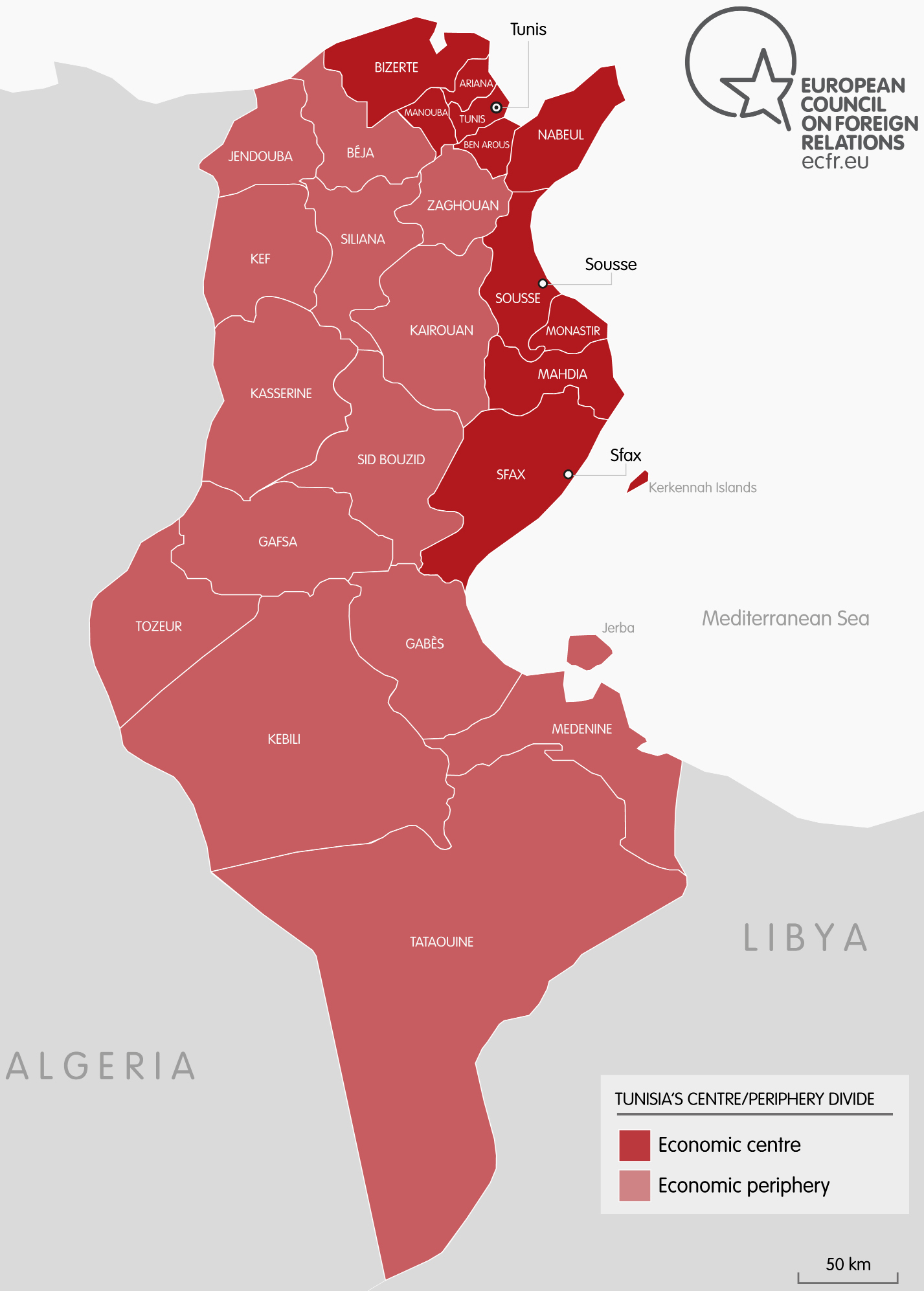
That the revolution started in the peripheries is no accident. Since Tunisia gained independence in 1956, coastal regions have consistently been promoted at the expense of the interior and border regions. This pattern of marginalisation only worsened under Ben Ali, who took power in 1987 and under whom two-thirds of public investment came to be allocated to the coastal regions. Tunisia developed as an export-orientated economy focused on tourism and low-cost outsourcing, with the bulk of infrastructure investment targeted on these regions. Investment incentives were orientated to the need to maintain competitiveness and access to international markets by tolerating low wages at the expense of agriculture and of rural areas. This deficit in infrastructure and private investment progressively reduced Tunisia’s peripheries to reservoirs of cheap labour, agrarian products and raw materials for the more developed industries and service sectors operating in the coastal regions. Approximately 56 percent of the population and 92 percent of all industrial firms are located within an hour’s drive of Tunisia’s three largest cities: Tunis, Sfax and Sousse. Economic activity in these three coastal cities accounts for 85 percent of Tunisia’s GDP. On the eve of the fall of Ben Ali, poverty was estimated at 42 percent in the Centre West and 36 percent in the North West, whereas it was at the much lower rate of 11 percent in Tunis and the Centre East.
Under Ben Ali, there was no strategy of inclusive development to redress these regional imbalances. In fact, the gap between the coast and peripheries was less the result of neglect than a consequence of deliberate political decisions. The low-cost and pragmatic mode of governing adopted by the regime was part of a bigger strategy designed to cope with fiscal and budgetary constraints. This included the deployment of patronage and intermediation mechanisms involving tribal and local elites through the Tunisian General Labour Union and the former ruling party, the Rassemblement Constitutionnel Démocratique. Clientelist networks and the security forces controlled the job market, social benefits, and the informal economy through protection from law enforcement. For instance, jobs at the Gafsa Phosphates Company (CPG) would be distributed among local patrons and regional administrations according to a quota system. In turn, the latter would redistribute these jobs among their clients on a tribal or partisan basis, or even sell them to the highest bidder. These clientelist resource distribution systems maintained a minimal and fragile stability over two decades in the Tunisian periphery while fuelling the fragmentation of local society and helping consolidate tribal identities.
After the revolution
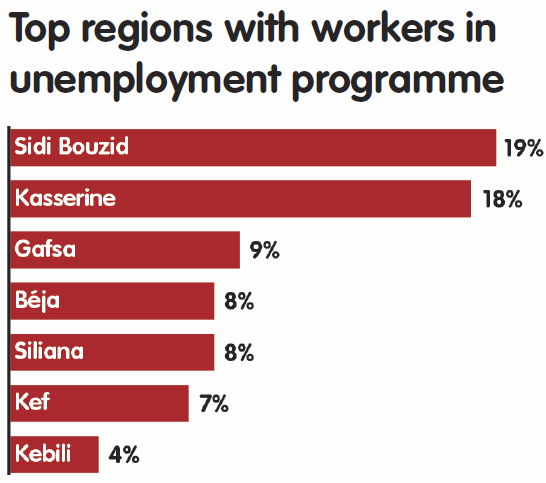
After the fall of the Ben Ali regime, many residents in the periphery regions hoped the central state would recognise its own shortcomings and would finally reverse the trajectory of marginalisation, deliver better governance, meet social and economic needs, and tackle inequality. However, the solution of successive post-2011 governments was to create a large number of public sector jobs and to roll out temporary mass employment programmes such as ‘les chantiers’. In this way, for example, CPG’s labour force grew from 5,000 in 2010 to 27,000 in 2015 and the number of workers hired through the programme leapt from 62,875 in 2010 to 125,000 in 2011. With approximately 100,000 workers in 2015, the ‘les chantiers’ is a crucial instrument in addressing the lack of economic opportunities and to manage social anger in the periphery. Centres of the popular uprising, the regions of Sidi Bouzid and Kasserine represent a total of 37 percent of people hired through it. In total, 77 percent of the workers hired through this programme are from the periphery regions.
Far from supplying sustainable economic opportunities, employment schemes offering temporary jobs contribute to ongoing patterns of subordination and marginalisation. The anaemic nature of the private sector in Tunisia has proved a great hindrance, exacerbating the economic marginality of the periphery regions’ inhabitants and reducing the new ruling elites’ options. Nonetheless, ceasing these employment schemes would likely provoke social unrest in these regions. Because government jobs are often the only hope for job security, competition rages between networks, tribes and political parties to secure these positions.
Meanwhile, 85 percent of the enterprises that provide 92 percent of private sector jobs are clustered in the coast regions: 44 percent are to be found in the Great Tunis area alone. Enterprises operating inland provide only 8 percent of private sector jobs. Foreign companies in the interior regions account for less than 13 percent of the total of foreign firms established in Tunisia. Together, public investment choices and the weakness of the private sector explain the high unemployment in the peripheries: as high as 27 percent in Tataouine, 26 percent in Jendouba, and 22 percent in Kasserine. The average national unemployment rate in 2015 stood at 15 percent. These economic inequalities have exerted a negative social impact in terms of poverty rates, which follow a similar centre-periphery divide, and in some places, particularly the Centre West, are double the national average.
In addition, corruption remains a major challenge. Since 2011, the issue has gone largely unaddressed at all levels of government – local, regional and national. Bribes remain necessary in order to get a licence to start a small business, obtain a job in an employment programme, or receive social assistance from the state. Moreover, according to some entrepreneurs, the corruption currently hindering the much-needed investment in the interior regions can be traced back to the central decision-making level. State officials, bankers and business owners participate in networks that bind them together and facilitate corrupt practices, including even securing the foreclosure of competitors’ businesses. These networks exercise control over state resources, especially bank credit and licences, and are influential within the public administration. Corruption is also a widespread feature of the state administrations at the local and regional level. Municipal and regional elections have been postponed several times, and these delays are increasing the sense of impunity among local and regional bureaucrats, which in turn creates a sort of systemic and decentralised corruption.
Finally, the post-2011 governments have so far failed to meet the demands of the increasingly frustrated youth in parts of Tunisia where socioeconomic protests remain a persistent problem. In January 2016, a wave of social unrest and violent demonstrations began in Kasserine and spread through 16 other governorates. The protests sought to condemn unemployment and denounce the corruption plaguing the regional administration. It eventually destabilised the government of the then prime minister Habib Essid. In September 2016, in the mining region of Gafsa, and the Jendouba governorate adjacent to the Algerian border, one protest against economic marginalisation and local corruption lasted several weeks. In response, the proposed short-term approaches to managing the crisis of the peripheries appear only to have increased the fault lines both within local society and between the regions, and to have fed a sense of dispossession among young people.

Sources of destabilisation
Since 2011 the government has adopted a security-heavy approach in the peripheries in an attempt to contain threats from jihadi groups and to crack down on smuggling. But security forces have themselves been drawn in to illegal activity and local populations feel let down by the government’s emphasis on security over development. A thoroughgoing rethink is needed about the connections between security and the economy in order to advance the socioeconomic situation in the periphery regions.

New conflict dynamics on old fault lines
Since 2011, the turbulent regional environment has aggravated the economic and security situation for the local population in the peripheries. Chaos in Libya, persistent pockets of terrorism in Algeria, and terrorist groups affiliated with al-Qaeda in the Islamic Maghreb and the Islamic State group (ISIS) have exploited the Tunisia-Algeria-Libya triangle to traffic weapons and jihadis. This has led the Tunisian government to adopt a heavy security-centred approach in the peripheries, the impact of which has been negative, causing the central state to lose rather than gain legitimacy. In fact, the spillover from the Libyan conflict is less of a threat to Tunisia than a reactive, security-centred approach that ensures a semblance of stability while feeding disenfranchisement.
There is a complex relationship between jihad and contraband which is important to understand in this context. It is a legacy of both the dictatorship era and of the ways in which these areas have been governed since 2011. It is also a consequence of the internal fractures inside the communities living in the borderlands.
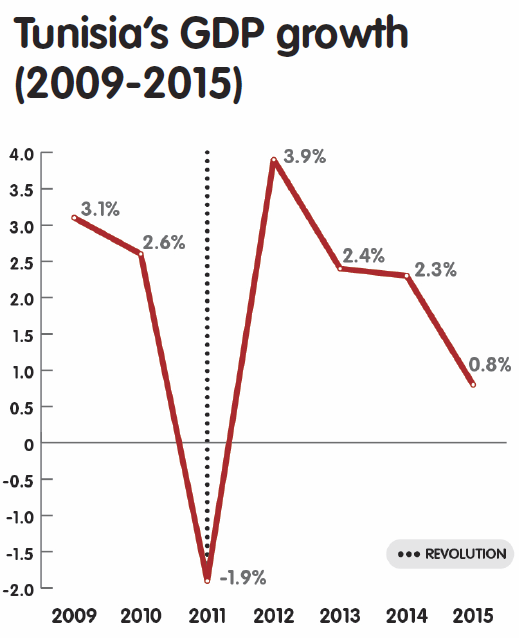
Tunisia's GDP Growth
Source: IMF
Before the revolution, both the Ben Ali and the Gaddafi regimes allowed illicit practices to take place in order to help them control the border regions. On the Tunisian side, participation in the border economy used to be a prerogative of both the clientele of the hegemonic party and the various protégés of the security services: the police, the National Guard and the customs services. On the Libyan side, the Gaddafi regime used the border resources to consolidate its power through a politics of clientelism and co-optation of tribes. Only loyal tribes were permitted to participate in this border economy. An implicit arrangement was established between regimes on the one hand and loyal tribal and smuggling networks on the other, preventing the latter from getting involved in the trafficking of weapons, drugs and jihadis in exchange for turning a blind eye to other forms of contraband.
The fall of Ben Ali and Gaddafi put an end to the arrangements that once regulated this activity, and opened up the game to new players: organised crime that sought to turn Tunisia into a staging-post between Algeria and Libya; jihadi groups looking to secure the crossing of fighters and arms between Tunisia, Algeria and Libya; and ambitious smugglers who took more risks and challenged the previously co-opted smugglers through taking advantage of the security vacuum in the border regions from 2011 onwards.
In addition to this, since 2013 attacks on the Tunisian army and security services in the border regions have shifted the debate about periphery regions from a focus on their development to one around security. This has resulted in a crackdown on the smuggling networks and cross-border trade which had been essential economic resources for the population of these regions. Since August 2013, a military-enforced buffer zone has also been in place along Tunisia’s borders. In parallel, the Algerian authorities dug a trench along the border, swiftly followed by the Tunisian government, which, in the aftermath of the terrorist attack in Bardo in February 2015, dug its own trench along the Tunisia-Libya border.
Top regions with workers in unemployment programme
Source: FTDES
In response to these multifaceted security threats, the securitisation of the borders has impacted on the peripheries’ economy and society in many ways. First, it has led to uneasy relations between the army and the security services on the one hand and the local population on the other. As local populations depend on the border economy for their living, restrictions made against cross-border trade have resulted in periodic conflict with the security services and the military.
Simultaneously, state authorities are concerned about the risk of social protest if they repress smugglers. The army has succeeded in maintaining – relatively speaking – its credibility, focusing mainly on its task of border policing (in spite of cases of soldiers’ involvement in corruption). But the interior security forces enjoy much less trust than the army does, having become “entrepreneurs of insecurity” as they extended their role beyond law enforcement to deal with social protest through negotiating bribes and selling protection. This has negatively impacted on the legitimacy of the security forces, as smugglers and traders perceived it as a way to reinvent the old arrangements through the co-optation of a happy few and the exclusion of others.
Second, the outbreak of armed conflict in neighbouring Libya in 2014 generated new uncertainty in Tunisia’s periphery regions, as competition grew between smuggling networks looking for protection in Libya. Indeed, cities in the west of Libya have always played a major “city-entrepot” role for the border economy, connecting southern Tunisian cities to the global illicit economy and ensuring supply to the Tunisian market. The border economy exerts a magnetic pull on militias attracted by the prospect of controlling and benefiting from illicit flows: approximately 15 Libyan militias are positioning along the border with Tunisia. This greatly complicates Tunisian authorities’ efforts to coordinate with their Libyan counterparts on border security.
Finally, the situation was complicated further in 2014 when jihadi groups affiliated to ISIS sought to replicate what al- Qaeda did at the Tunisia-Algeria border and establish a foothold in the Libyan city of Sabratha. The jihadi group tried to attract Tunisian jihadis who sought to flee the country, especially after the crackdown on Ansar al-Sharia, a Tunisian Salafi jihadi group, labelled a terrorist organisation by the Ennahda-led government in August 2013. These jihadi groups affiliated to ISIS tried to find an anchor in the Tunisia-Libya borderland through taking advantage of the rivalry between tribes and smuggling networks in a context of economic hardship. A review of the 26 assailants from Ben Guerdane who tried to capture this border town on 7 March 2016 revealed an overrepresentation of youth originating from the R’baya’ tribe. Historically dominated by the powerful tribe of Twazine which is in control of the cross-border trade around Ben Guerdane, the marginalisation of the R’baya’ was exacerbated by an unresolved and a long-lasting conflict over land ownership. R’baya’ smugglers, traffickers and individuals ousted from the border economy following heavy-handed security measures found in jihad a narrative that allows them to resist the state and to pursue these old tribal rivalries.
Security in the peripheries is therefore directly threatened by the exacerbation of pre-existing fault lines that feed on the dynamics of the jihadisation of local conflicts, in a context of a weak central state, economic hardship, and an emerging violence-shaped economic order.

Solving the security-economy conundrum
The tightening of controls at the Algerian and Libyan borders has resulted in the exclusion of many operators from the border economy. According to a survey by International Alert, 80 percent of the respondents living in Ben Guerdane and Dhehiba, near the Libyan border, believe that being able to cross the border is now linked to corruption more than ever. A World Bank report on the informal economy in the Tunisian peripheries highlighted the risks of increasing securitisation since 2013, noting that in the absence of concrete measures to address the economic and regulatory differences in terms of tariffs, tax levels and subsidies on either side of the border, tighter controls would increase corruption among state agents over time, and eventually undermine government control.
At the time of the popular uprisings, a number of joint projects were in train that would have helped regulate and legalise cross-border trade. But a planned free trade zone between Ben Guerdane and the border crossing of Ras Jedir, as well as the convertibility of national currencies, have never materialised. The securitisation of the borders and particularly the frequent closure of the border crossings at the Tunisia-Libya border has resulted in the suspension of cross-border trade and negatively impacted on the social and economic conditions in the periphery. Informal trade represents an important part of bilateral trade with neighbouring Libya and Algeria, accounting for more than half of official trade with Libya and for more than the total official trade with Algeria. Informal trade is one of the most important activities in the border regions. For example, a large part of the fuel consumed in Tunisia is imported from Algeria and Libya. In the governorate of Medenine, 20 percent of the working-age population works in the informal trade, approximately 83 percent of which are from Ben Guerdane.
The importance of the informal economy has increased since 2011, given the diminution of economic opportunities and the end of migration to Libya. Since the fall of Gaddafi and the deterioration of the security situation, 40,000 Tunisian workers have left Libya. For more than four decades Libya was a major destination for Tunisian seasonal workers from the periphery regions who helped meet the demand for labour in their oil-producing neighbour. The loss of these incomes has increased poverty and dissatisfaction among large swathes of the population: 10,000-15,000 families have received no income since 2011 because of the crisis in Libya.
The securitisation of cross-border trade has reinforced the prevalent perception that protest and migration are two of the dwindling options left to disenfranchised youth. In November 2016, a general strike was organised under the banner of ‘Let Ben Guerdane survive’. This protest lasted several months and received the support of neighbouring border towns. The lack of economic development leads to increased emigration, often illegal, as sadly exemplified by one of the many tragic boat capsizings that killed 12 young people from Ben Guerdane off the Libyan coast in July 2016. Meanwhile, negotiations are taking place between a Tunisian civil society delegation and the representatives of Libyan border towns in order to reach an agreement on reopening the border crossing of Ras Jedir. This follows a series of protests throughout 2016 in Ben Guerdane against the interruption of cross-border trade as well as the killing of several smugglers by the military.
The security-centred approach to ensuring stability is not a durable solution. Inhabitants of the peripheries have come to conclude that the central state views these regions as mere ‘buffer zones’ and their inhabitants as second-class citizens. They consider that calls for security are used to justify the security forces’ heavy-handedness and that they stigmatise the peripheries as hotbeds of jihadism. Many of those who feel alienated turn to Libya and Algeria for subsistence, rather than their own country of Tunisia. The experience of one young smuggler who was cut out of the border economy captures the bind many people find themselves in: “I went to the capital, Tunis, to look for a job. There, a policeman asked for my documentation. He took my ID card and told me: ‘You are from Kasserine. What are you doing here?’ I replied: ‘Do I need a visa to come to Tunis?’ It is as if we are living in two different countries.”

Reforming regional governance
The failure of the post-2011 governments to successfully implement projects and improve the economic conditions of Tunisians living in the peripheries is less to do with the support available from international partners and more to do with how Tunisia’s internal state apparatus operates. At one and the same time, Tunisia’s government is centralised yet riven by fragmentation. This, combined with its emphasis on security over socioeconomic development, has led to little progress in assisting the peripheries.

Money’s not too tight to mention
But the problem is not one of money – Tunisia has been able to rely on its international partners for support since 2011. Instead, the country needs to do several things to get its house in order: rethink its governance processes in order to implement a more coherent and coordinated development strategy; deliver the pre-existing projects which have earmarked funding; develop stronger political will to implement reforms; and introduce a new social contract that includes the population in the peripheries.
Between 2011 and 2015, Tunisia was the recipient of generous capital inflows from all the major international financial institutions, development banks, and international partners, amounting to almost $7 billion in various forms. Capital inflows received by 2015 came to almost 15 percent of GDP. In 2016, international partners reaffirmed their support: the World Bank established a new country partnership framework that will provide Tunisia with up to $5 billion in loans to help restore economic growth, create jobs for young people, and reduce the disparities between the coastal centres and the underdeveloped regions.
Also in 2016, the International Monetary Fund approved an extended fund facility of $2.8 billion across four years to support economic reform in Tunisia. Finally, during the most recent international conference to support the five-year development plan (2016-2020), Tunisia signed $4.3 billion in project-finance deals. The total financial support pledged to Tunisia by participating countries and financial institutions which took part in the conference therefore totals $14 billion, equivalent to 35 percent of GDP. The European Union and its member states remain Tunisia’s most prominent partners: the EU pledged $860 million by 2020, and the European Investment Bank promised loans of $3.1 billion by 2020.
Despite this flow of money and these cooperation mechanisms, Tunisian governments have so far failed to achieve the much-needed regional development that would considerably improve daily life and economic conditions in the peripheries. The post-revolution governments have prioritised underdeveloped regions, conferring on them 60 percent of the total of TND 1,547 million allocated to the Regional Development Programme (RDP) between 2011 and 2015. Particular attention has been given to the eight least developed regions: Jendouba, Kasserine, Kairouan, Siliana, Sidi Bouzid, Kef, Tataouine and Béja, which received 30 percent of the investment allocated to the RDP over the same period. Despite attempts to improve the completion rates for funded public projects, these have remained low and failed to meet popular expectations. In Kasserine completions stand at 47 percent, in Kairouan at 41 percent, in Sidi Bouzid at 41 percent and in Medenine at 28 percent. Meanwhile, private investments have remained targeted at the coastal regions, perpetuating the existing imbalances. The end result is that the socioeconomic situation in the peripheries has remained roughly unchanged since 2011.
Many factors explain the limited absorptive capacities of these regions. Among them are: lack of skilled and empowered staff at the local level able to manage and to follow up a large number of projects and large amounts of money; failure of the current regional development governance system to manage large budgets; unclear land tenure and property rights; a weak private sector in these regions which is uncompetitive and unable to win public contracts; security challenges and social instability that deter companies from investing in these regions and implementing local development projects; a degraded rule of law environment that limits the attractiveness of these regions to business.

Let down by the system
In March 2013 the Tunisian government set up a ‘general authority’ for the follow-up of public programmes to better ensure the delivery of public projects. This delivery unit, funded by the World Bank, is to work on the removal of administrative barriers and cutting long procedural delays. However, Tunisia needs more than a simple unit to deal with impediments to investment. It needs a development strategy for the peripheries, deploying innovative governance instruments that would improve inter-ministerial cooperation.
The long legacy of inefficient inter-ministerial cooperation has hampered the emergence of a coherent vision for regional development. As long as all the ministries and every national and regional administration fail to align or coordinate a multi-sectorial development strategy, regional development will lag. Regional administrations themselves are under dual supervision: under the supervision of the relevant national sectorial administration, and also under the control of governors – state representatives holding power at the regional level. The governors’ mission has historically been to supervise coordination between regional administrations, facilitate development and ensure security. But this mission has proved difficult to achieve. Experience instead shows that, worried about their careers, governors tend to favour security over development.
A senior state official explains the situation thus: “In Tunisia, the central level is predominant in decision-making. The problem is that there is no strategy for regional development, only sectorial policies for each region”. This view is corroborated by a European expert working on regional development: “The balance of power between the coastal regions and peripheries is so off-balance. Tunisian regions don’t have advocates who speak on their behalf. We should start from there and help these advocates emerge.”
Illustrative of this is the conflict that has pitted the state against the Association for the Protection of Jemna’s Oasis. In 2011, the residents of Jemna, a small town in the south of Tunisia, took control of state-owned land that the central government used to lease at low prices to private operators, who had formerly capitalised unfairly on their political connections. Indeed, under the Bourguiba and Ben Ali regimes, state-owned lands were regularly used to establish clientelist relationships and co-opt economic elites and prominent local figures. Operating under a cooperative economy model, without public support, investment incentives or tax deductions, the Association has developed the land, hired local workers, and reinvested revenues back into the community. However, under Youssef Chahed the government has refused to acknowledge the experiment, and is instead trying to end it. In this context, land reform, and a legislative framework that would encourage similar cooperative experiments, could promote development and job creation in these regions.

Strengthening EU-Tunisia mechanisms
Since 2011, Tunisia’s international partners have demonstrated their support for the country by pledging funding to sustain future regional development projects in Tunisia. What is required now are both reforms and the political will to back them up, as well as a genuine effort on the Tunisian side to coordinate international partners.

Improving coordination
The lack of coordination within the Tunisian authorities has been regularly noted by European diplomats who have participated in the sessions of the international coordination mechanisms. Tunisian officials frequently arrive at meetings with what one European expert called “shopping lists” in lieu of well-defined and budgeted strategies, without prior consultation or coordination of work among themselves.
Internationally, current mechanisms include the G7+ partnership, and a prospective Deep and Comprehensive Free Trade Area (DCFTA) agreement with the EU. The G7 together with EU and international financial institutions (IFI) in June 2016 launched a partnership for coordinating economic assistance to Tunisia focusing on economic and governance reform. The G7+ partnership emphasises the European Parliament resolution which called for the “adoption of regulatory frameworks aimed at facilitating the absorption of European support and of all international financial institutions”.
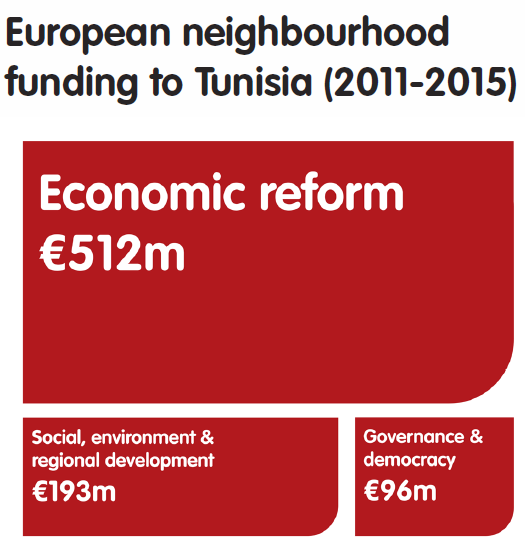
European neighbourhood funding to Tunisia
Source: EEAS
The G7+ and IFI partnership is a Tunisian-led mechanism that aims to manage compromise on structural reforms and to coordinate international partners who will, in return, encourage this process and offer financial support. Working groups dedicated to governance and economic reforms have been created, one of which, co-chaired by Tunisia and Italy, is to concentrate on regional development and decentralisation. The EU is co-chairing the working group on economic reform and governance and Germany and France are also strongly involved in this mechanism.
Coordinating international partners is all the more important for a regional development strategy given that this is a cross-sectorial issue. In 2015 bilateral aid amounted to €186.6 million and supported several programmes. Among other programmes, Tunisia received €43 million from the ‘CAP2D’ programme on decentralisation, which focuses on both territorial integration and decentralisation. Tunisia also received €32 million in December 2015 for a programme designed to enhance the employability of the inhabitants of the periphery regions. The securitisation of the borders also reflects the engagement of the EU itself and the shared commitment to border management: in addition to the bilateral engagement of European states, the EU has earmarked €23 million for the delivery of equipment, infrastructure and training for security forces.
The Tunisian government should take advantage of the support of its international partners and the existed coordination mechanisms to elaborate a long-term vision, design a regional development policy and reform governance of the periphery. But this still remains merely an aspiration. The finger is often pointed at: political divisions (within and between the parties that comprise the ruling coalition, Nidaa Tounes and Ennahda); the lack of ‘stability’ in the country due to labour mobilisation; and the ‘inexperience’ and shortcomings of new political parties and politicians. Governing parties blame ‘Hizb al-Idara’ – what they semi-jokingly refer to as the ‘party of the bureaucracy’ – for blocking reform. As one member of the ruling coalition put it: ‘Nowadays Tunisia is governed by a party coalition and a party formed by the bureaucracy. The administration is slow and conservative … it’s because there is no long-term political vision that the bureaucracy can take charge.’ High-level officials point to the absence of a clear reform agenda, a situation which allows them to choose how to sequence decisions and to put off deep reforms that could alleviate regional disparities.
In the absence of any central coordinating unit in charge of strategic thinking and action there is little to tip the balance in favour of the provisions in the constitution. Measures are needed to help coordinate the efforts of the new political elites, high-level bureaucrats and international partners on designing and implementing a cross-sectorial strategy for regional development.

Free trade is not enough
The DCFTA is currently the subject of negotiation between the European Commission and the Tunisian government. It is often presented by European officials as more of a reform-incentive tool than a simple free-trade agreement (FTA). The agreement is supposed to be more than a classic FTA, as it goes beyond simply liberalising most goods and services by also gradually integrating Tunisia into the EU internal market through convergence with EU legislation. Thus, the DCFTA is considered by European officials and decision-makers to be an instrument of the European Neighbourhood Policy whose political objectives include stability, security and prosperity beyond the EU’s borders.
The most important question is the extent to which the DCFTA could reduce regional disparities, ensure a convergence of living standards between coastal regions and the hinterland and help consolidate Tunisian democracy. This question remains unanswered and such ambiguity feeds resistance from trade unions, political parties and civil society. The European Commission argues that the implementation of the DCFTA would improve the legal environment, introduce stability for businesses and attract more foreign investment. However, there is no guarantee that these investments would benefit the interior regions and reduce regional disparities. Because of the cost of transport, coastal regions have mostly attracted industrial firms. While the EU-Tunisia Action Plan emphasises the need for greater social and economic integration with the EU in order to build a common economic area, the DCFTA does not address the matter of regional development.

Recommendations
Together with the Tunisian government, the EU and its member states can make a real difference to strengthening the resilience of the Tunisian state and society, through implementing economic, security and governance reforms. To achieve this, economic development and security, which are mutually reinforcing, need to be provided together in the peripheries, strengthening territorial integration and social cohesion overall. The EU can play a major role in encouraging the Tunisian government to concentrate on achieving this goal, bringing Tunisia more deeply into its economic orbit by helping ensure external finance and economic development are better channelled and targeted, and that government effectiveness is radically improved.

Offer European Economic Area membership
Offering Tunisia membership of the European Economic Area (EEA) could be a game-changer that helps to consolidate democracy and embed the rule of law. Critics have portrayed the DCFTA as an asymmetric deal between what could be perceived as the “giant from the north” and “poor” Tunisia. But membership of EEA, on the same footing as Norway, would emphasise the EU-Tunisia Action Plan recommendation of creating a common economic area with Tunisia and provide a framework for Tunisians to implement a transformative strategy for economic, social and regional development.
EEA membership could help Tunisia tackle its structural problems by giving impetus to the Tunisian government’s structural reforms, and, in the longer term, helping Tunisia obtain the ‘social acquis’ of the EU (thereby addressing concerns expressed by trade unions and the more left-leaning parts of the political spectrum).
Tunisia’s peripheries could take advantage of the EEA cohesion fund, which plays an important role in developing the internal market’s poorest regions. Tunisia could eventually, after negotiating this with the EEA members, benefit from the mechanisms of the so-called ‘EEA and Norway Grants’ designed to strengthen equality of opportunity, security and decent standards of living throughout the EEA. As recommended in the EU-Tunisia Action Plan, Tunisia can rely on EU expertise in the field of regional funds and the reduction of regional disparities to address the problem of regional development. A partnership should be established between the European Fund for Regional Development and the Tunisian Ministry of Development, Investment and International Cooperation. Gradual integration into the internal market would help bring about more accountable and transparent governance in Tunisian institutions, offering a democratic horizon of cooperation and helping reformist forces overcome political, administrative and bureaucratic resistance.

Help formalise the informal
Security cooperation between the EU and Tunisia, coupled with concrete measures to promote economic development and incentivise participation in the legal economy, form the key to development in the peripheries. Creating free trade zones will help ensure that development leads to lasting security, in part by proposing alternative livelihoods for smugglers, but, at worst, by finding ways to control illegal activities. The Tunisian authorities should seriously examine granting fiscal amnesty to smugglers, who would pay a fine and then switch to legal economic activity. Meanwhile, the EU can assist by using the financial support it provides to border security to reduce or, better, eradicate resistance within the parts of the security system that profit from illegal cross-border activity. EU support to the security sector must emphasise the implementation of governance and citizens’ oversight mechanisms.

Promote the private sector
The recent EU-Tunisia Action Plan is an excellent starting point for promoting the development of the private sector in the periphery – and it should be a major objective for the EU. For example, a partnership between local banks and the European Bank for Reconstruction and Development (EBRD) would provide powerful leverage for economic development. The local banks participating in this partnership should comprise the deposits and consignments fund (Caisse des Dépôts et Consignations – CDC) and the ‘bank of the regions’ (whose creation was announced in the 2016-2020 development plan but which has still not yet been established). The CDC’s mission should be extended to include an investment fund role to promote the private sector.
Meanwhile, the EBRD would play an important role as a strategic partner in the transfer of knowledge and the promotion of the private sector in agriculture, the agro-food industry, and the green economy. The presence of the massive informal sector in these regions means that micro-projects funded by micro-loans are not viable, and so funding mechanisms are needed that promote the private sector, attract big firms and investment as well as implementing infrastructure development. Alongside this, cooperative systems to run state-owned domaines and help develop agriculture should be a priority. Legislation should be introduced to protect such partnerships.

Implement an effective mechanism for positive discrimination
The 2014 constitution established the principle of “positive discrimination” towards disadvantaged regions. But no criteria have yet been defined to identify the regions that would benefit. The EBRD and European development agencies like GIZ and AFD can help formulate criteria that would favour the periphery regions without hampering the dynamism of the coast.
However, to achieve this, the absence of reliable statistics needs to be addressed. Without statistics broken down by region and locality, those disparities which have a geographical character are consistently underestimated. It will remain impossible to produce economic indicators on the wellbeing of households and local populations. EUROSTAT and other European organisations such as the Territorial Observatory (Observatoire des Territoires, France) could play a major role in advising bodies such as the Institut National de Statistiques and the Institut Tunisien de la Compétitivité et des Etudes Quantitatives.

Strengthen civil society in the peripheries
The Tunisia-EU Civil Society Support Programme covers 24 regions. But it fails to empower the civil society organisations in the periphery, which struggle to apply to EU grant programmes. A sub-granting system channelling money to smaller civil society organisations via larger organisations with more capacity could help the former play a more prominent role in local affairs. In parallel, programmes should be established for training and mentoring young entrepreneurs in order to promote entrepreneurship and for empowering local elites.

Promote the social role of the Tunisian army
It is important that the Tunisian army reconsider the terms of its presence in the peripheries. It should combine its primary mission of defending the territory with its role as a social actor. The EU should support the Tunisian army’s social role through programmes of vocational training for young people that promote employability and prevent radicalisation in the peripheries. It should also encourage the construction of military hospitals that provide care to local populations.

Encourage the creation of a policy unit to improve cross-sectorial policy planning and coordination with EU and international partners
Coordination between Tunisia and its international partners, mainly European partners, must be strengthened. A policy unit that reports directly to the head of government would help achieve this, acting as the privileged interlocutor for EU partners. It would comprise a multi-sectorial planning function and coordinate cooperation with the G7+ mechanism and with European partners, addressing the fragmentation at the heart of government.
The policy unit should include politicians, senior public officials, academics, and experts from civil society. Working as a platform, the unit would: ‘technicise’ politicians, meaning it would provide technical skills, knowledge and expertise on policy planning and cross-sectorial coordination; and it would ‘politicise’ senior public officials, meaning it would provide expert input into decision-making, organise consultations, and lead negotiations with social and economic stakeholders.

Strengthen the new European coordination mechanism
Conducting bilateral relations may seem advantageous to both Tunisia and some member states. But pooling together money and coordinating efforts would dramatically increase impact and bring greater benefit to Tunisia’s peripheries. A joint programming mechanism between European representations has been recently created. European countries should consider strengthening and expanding it to coordinate financial support. It could build in periodic contact between head of mission meetings to coordinate assistance programmes, discuss the implementation of the EU-Tunisia Action Plan, and coordinate political actions in support of the country’s transition.
About the Author
Hamza Meddeb is a visiting fellow at the European Council on Foreign Relations. He is also a research fellow at the European University Institute. His research focuses on the political economy of democratic transition in Tunisia as well as the political economy of conflicts in North Africa