Showing posts with label China. Show all posts

Sunday, March 12, 2017

Iran's strong geopolitical hand

Iran’s Surprisingly Strong Geopolitical Hand

While the short-term outlook still looks uncertain for Iran, the larger fundamentals hugely favor it.


Credit: Robert Hale Shutterstock.com

Takeaways


  • The Saudi battle with Iran is unequal because Iran brings assets to the table that Saudi Arabia lacks.
  • It matters to China that Iran has the world’s second-largest natural gas reserves and fourth-largest oil reserves.
  • Saudi Arabia might make a few friends in Beijing for now, but Iran still holds far more of the good cards.
Saudi Arabia’s King Salman hopes to exploit a window of opportunity while in Beijing to loosen China’s affiliations with Iran. But he faces long odds.

The Saudi battle with Iran is fundamentally unequal because Iran brings assets to the table that Saudi Arabia lacks.
Those assets, no matter how degraded, include a large population, an industrial base, resources, a battle-hardened military, a deep-rooted culture, a history of empire and a geography that makes it a crossroads.
Saudi Arabia’s traditional assets – including custodianship of the Muslim holy cities, Mecca and Medina, and money — will in the middle and long term not be able to compete.

Iran as an OBOR pivot point

Iran’s strategic advantage is nowhere more evident than in global competition to shape the future architecture of Eurasia’s energy landscape.
Energy scholar Micha’el Tanchum argues that Iran is pivotal to the success of China’s trans-continental, infrastructure-focused One Belt, One Road (OBOR) initiative in ways that Saudi Arabia is not.
In a study published in 2015, Mr. Tanchum suggested that it would be gas supplies from Iran and Turkmenistan, two Caspian Sea states, rather than Saudi oil that would determine which way the future Eurasian energy architecture tilts: Will it be in the direction of China, the world’s third-largest LNG importer, or in that of Europe?

Iran will choose its buyers

In that context, it matters greatly to China that Iran has the ability to capitalize on the fact that it boasts the world’s second-largest natural gas reserves and its fourth-largest oil reserves was significantly enhanced with the lifting in 2015 of international sanctions.

Enlarge Source: International Gas Union
According to Mr. Tanchum:
  • “Iran, within five years, will likely have 24.6 billion cubic meters of natural gas available for annual piped gas exports beyond its current supply commitments.”

  • “Not enough to supply all major markets, Tehran will face a crucial geopolitical choice for the destination of its piped exports.”

  • Further, he says Iran will be able to export piped gas to two of the following three markets:
    1. 1. European Union (EU)/ Turkey via the Southern Gas Corridor centering on the Trans-Anatolian Natural Gas Pipeline (TANAP)

    2. 2. India via an Iran-Oman-India pipeline, or

    3. 3. China via either Turkmenistan or Pakistan.

  • “The degree to which the system of energy relationships in Eurasia will be more oriented toward the European Union or China will depend on the extent to which each secures Caspian piped gas exports through pipeline infrastructure directed to its respective markets.”
In other words, Mr. Tanchum argued that to determine the balance of power in Eurasian energy and establish One Belt, One Road as the key determinant of Eurasia’s energy architecture, China would need to position itself as the main recipient of Iranian and Turkmen gas.

China as a natural partner

That, in turn, would enhance China’s growing economic influence in Central Asia, and further extend it to the Caucasus and the eastern Mediterranean.
China has already many of the building blocks needed to make that a reality:
  • close and long-standing relations with Iran

  • significant investment in Turkmen gas production and pipeline infrastructure

  • the construction of Pakistan’s section of the Iran-Pakistan pipeline.
Hooking the pipeline to One Belt, One Road would allow China to receive Iranian gas not only by sea on its eastern seaboard, but also in its land-locked, troubled north-western province Xinjiang.
However, Iran’s geo-political strengths are however not wholly dependent on aligning the Islamic republic with China.

Other friends keep the competition lively

With the development of Iran’s Indian-built Chabahar port and the undersea Iran-Oman-India pipeline that would potentially create an alternative Asia-to-Europe energy corridor, Iran is, according to Mr. Tanchum, well-positioned to play both ends against the middle.
In addition, it can adopt a key role in the trans-Atlantic community’s effort to strengthen relations with India as an antidote to the rise of China.

Iran’s surprisingly strong gas leverage

Iran’s geopolitical significance is further enhanced by the fact that competition for Iranian gas is very real and offers leverage.
Contrary to some assumptions, Iranian cooperation with Russia in Syria and elsewhere is opportunistic and unlikely to prove sustainable, rather than a sure thing Russia can count on for preferential economic treatment:
– Iranian-Russian competition is already visible in the Caucasus and Central Asia, which ironically mitigates in Europe’s rather than China’s favor.
– Iran is likely to deepen energy cooperation with Turkey. The intent here is two-fold: First, it is a bid to enhance its influence in that country
Second, it would help curtail Russian inroads in the Islamic republic’s northern neighbors – Azerbaijan; Turkmenistan, which is China’s principle gas supplier as well as Armenia (where Russia’s state-owned Gazprom has invested in an Iran-Armenia gas pipeline).
All of this positions Iran to be a very choosy supplier and negotiator.
In Beijing and beyond, Saudi Arabia might make a few friends for now, but in the longer run, Iran still holds far more of the good cards.
Anyone already aligned with Iran or considering such an alliance will think twice before walking away from the Islamic republic to back the kingdom.

About James M. Dorsey

James M. Dorsey is a senior fellow at the S. Rajaratnam School of International Studies and an award-winning journalist.

Friday, January 6, 2017

Will the Liberal Order Survive? by Joseph S.Nye.Jr.

Monday, December 12, 2016
Will the Liberal Order Survive?
The History of an Idea
Joseph S. Nye, Jr.
JOSEPH S. NYE JR. is University Distinguished Service Professor at the Harvard Kennedy School of Government and the author of Is the American Century Over?
During the nineteenth century [1], the United States played a minor role in the global balance of power. The country did not maintain a large standing army, and as late as the 1870s, the U.S. Navy was smaller than the navy of Chile. Americans had no problems using force to acquire land or resources (as Mexico and the Native American nations could attest), but for the most part, both the U.S. government and the American public opposed significant involvement in international affairs outside the Western Hemisphere [2].
A flirtation with imperialism at the end of the century drew U.S. attention outward, as did the growing U.S. role in the world economy, paving the way for President Woodrow Wilson [3] to take the United States into World War I. But the costs of the war and the failure of Wilson’s ambitious attempt to reform international politics afterward turned U.S. attention inward once again during the 1920s and 1930s, leading to the strange situation of an increasingly great power holding itself aloof from an increasingly turbulent world.
Like their counterparts elsewhere, U.S. policymakers sought to advance their country’s national interests, usually in straightforward, narrowly defined ways. They saw international politics and economics as an intense competition among states constantly jockeying for position and advantage. When the Great Depression hit, therefore, U.S. officials, like others, raced to protect their domestic economy as quickly and fully as possible, adopting beggar-thy-neighbor tariffs and deepening the crisis in the process. And a few years later, when aggressive dictatorships emerged and threatened peace, they and their counterparts in Europe and elsewhere did something similar in the security sphere, trying to ignore the growing dangers, pass the buck, or defer conflict through appeasement.
By this point, the United States had become the world’s strongest power, but it saw no value in devoting resources or attention to providing global public goods such as an open economy or international security. There was no U.S.-led liberal order in the 1930s, and the result was a “low dishonest decade,” in the words of W. H. Auden, of depression, tyranny, war, and genocide.
With their countries drawn into the conflagration despite their efforts to avoid it, Western officials spent the first half of the 1940s trying to defeat the Axis powers while working to construct a different and better world for afterward. Rather than continue to see economic and security issues as solely national concerns, they now sought to cooperate with one another, devising a rules-based system that in theory would allow like-minded nations to enjoy peace and prosperity in common.
The liberal international order that emerged after 1945 was a loose array of multilateral institutions in which the United States provided global public goods such as freer trade and freedom of the seas and weaker states were given institutional access to the exercise of U.S. power. The Bretton Woods institutions were set up while the war was still in progress. When other countries proved too poor or weak to fend for themselves afterward, the Truman administration decided to break with U.S. tradition and make open-ended alliances, provide substantial aid to other countries, and deploy U.S. military forces abroad. Washington gave the United Kingdom a major loan in 1946, took responsibility for supporting pro-Western governments in Greece and Turkey in 1947, invested heavily in European recovery with the Marshall Plan in 1948, created NATO in 1949, led a military coalition to protect South Korea from invasion in 1950, and signed a new security treaty with Japan in 1960.
These and other actions both bolstered the order and contained Soviet power. As the American diplomat George Kennan and others noted, there were five crucial areas of industrial productivity and strength in the postwar world: the United States, the Soviet Union, the United Kingdom, continental Europe, and Northeast Asia. To protect itself and prevent a third world war, Washington chose to isolate the Soviet Union and bind itself tightly to the other three, and U.S. troops remain in Europe, Asia, and elsewhere to this day. And within this framework, global economic, social, and ecological interdependence grew. By 1970, economic globalization had recovered to the level it had reached before being disrupted by World War I in 1914.
The mythology that has grown up around the order can be exaggerated. Washington may have displayed a general preference for democracy and openness, but it frequently supported dictators or made cynical self-interested moves along the way. In its first dec­ades, the postwar system was largely limited to a group of like-minded states centered on the Atlantic littoral; it did not include many large countries such as China, India, and the Soviet bloc states, and it did not always have benign effects on nonmembers. In global military terms, the United States was not hegemonic, because the Soviet Union balanced U.S. power. And even when its power was greatest, Washington could not prevent the “loss” of China, the partition of Germany and Berlin, a draw in Korea, Soviet suppression of insurrections within its own bloc, the creation and survival of a communist regime in Cuba, and failure in Vietnam.
Americans have had bitter debates and partisan differences over military interventions and other foreign policy issues over the years, and they have often grumbled about paying for the defense of other rich countries. Still, the demonstrable success of the order in helping secure and stabilize the world over the past seven decades has led to a strong consensus that defending, deepening, and extending this system has been and continues to be the central task of U.S. foreign policy.
Churchill, Roosevelt, and Stalin and the Yalta Conference, 1945

Until now, that is—for recently, the desirability and sustainability of the order have been called into question as never before. Some critics, such as U.S. President-elect Donald Trump, have argued that the costs of maintaining the order outweigh its benefits and that Washington would be better off handling its interactions with other countries on a case-by-case transactional basis, making sure it “wins” rather than “loses” on each deal or commitment. Others claim that the foundations of the order are eroding because of a long-term global power transition involving the dramatic rise of Asian economies such as China and India. And still others see it as threatened by a broader diffusion of power from governments to nonstate actors thanks to ongoing changes in politics, society, and technology. The order, in short, is facing its greatest challenges in generations. Can it survive, and will it?
POWER CHALLENGED AND DIFFUSED 
Public goods are benefits that apply to everyone and are denied to no one. At the national level, governments provide many of these to their citizens: safety for people and property, economic infrastructure, a clean environment. In the absence of international government, global public goods—a clean climate or financial stability or freedom of the seas—have sometimes been provided by coalitions led by the largest power, which benefits the most from these goods and can afford to pay for them. When the strongest powers fail to appreciate this dynamic, global public goods are underproduced and everybody suffers.
The mythology that has grown up around the order can be exaggerated.
Some observers see the main threat to the current liberal order coming from the rapid rise of a China that does not always appear to appreciate that great power carries with it great responsibilities. They worry that China is about to pass the United States in power and that when it does, it will not uphold the current order because it views it as an external imposition reflecting others’ interests more than its own. This concern is misguided, however, for two reasons: because China is unlikely to surpass the United States in power anytime soon and because it understands and appreciates the order more than is commonly realized. 
Contrary to the current conventional wisdom, China is not about to replace the United States as the world’s dominant country. Power involves the ability to get what you want from others, and it can involve payment, coercion, or attraction. China’s economy has grown dramatically in recent decades, but it is still only 61 percent of the size of the U.S. economy, and its rate of growth is slowing. And even if China does surpass the United States in total economic size some decades from now, economic might is just part of the geopolitical equation. According to the International Institute for Strategic Studies, the United States spends four times as much on its military as does China, and although Chinese capabilities have been increasing in recent years, serious observers think that China will not be able to exclude the United States from the western Pacific, much less exercise global military hegemony. And as for soft power, the ability to attract others, a recent index published by Portland, a London consultancy, ranks the United States first and China 28th. And as China tries to catch up, the United States will not be standing still. It has favorable demographics, increasingly cheap energy, and the world’s leading universities and technology companies.
Moreover, China benefits from and appreciates the existing international order more than it sometimes acknowledges. It is one of only five countries with a veto in the UN Security Council and has gained from liberal economic institutions, such as the World Trade Organization (where it accepts dispute-settlement judgments that go against it) and the International Monetary Fund (where its voting rights have increased and it fills an important deputy director position). China is now the second-largest funder of UN peacekeeping forces and has participated in UN programs related to Ebola and climate change. In 2015, Beijing joined with Washington in developing new norms for dealing with climate change and conflicts in cyberspace. On balance, China has tried not to overthrow the current order but rather to increase its influence within it.
The order is facing its greatest challenges in generations.
The order will inevitably look somewhat different as the twenty-first century progresses. China, India, and other economies will continue to grow, and the U.S. share of the world economy will drop. But no other country, including China, is poised to displace the United States from its dominant position. Even so, the order may still be threatened by a general diffusion of power away from governments toward nonstate actors. The information revolution is putting a number of transnational issues, such as financial stability, climate change, terrorism, pandemics, and cybersecurity, on the global agenda at the same time as it is weakening the ability of all governments to respond. 
Complexity is growing, and world politics will soon not be the sole province of governments. Individuals and private organizations—from corporations and nongovernmental organizations to terrorists and social movements—are being empowered, and informal networks will undercut the monopoly on power of traditional bureaucracies. Governments will continue to possess power and resources, but the stage on which they play will become ever more crowded, and they will have less ability to direct the action.
Even if the United States remains the largest power, accordingly, it will not be able to achieve many of its international goals acting alone. For example, international financial stability is vital to the prosperity of Americans, but the United States needs the cooperation of others to ensure it. Global climate change and rising sea levels will affect the quality of life, but Americans cannot manage these problems by themselves. And in a world where borders are becoming more porous, letting in everything from drugs to infectious diseases to terrorism, nations must use soft power to develop networks and build institutions to address shared threats and challenges.
China is unlikely to surpass the United States in power anytime soon.
Washington can provide some important global public goods largely by itself. The U.S. Navy is crucial when it comes to policing the law of the seas and defending freedom of navigation, and the U.S. Federal Reserve undergirds international financial stability by serving as a lender of last resort. On the new transnational issues, however, success will require the cooperation of others—and thus empowering others can help the United States accomplish its own goals. In this sense, power becomes a positive-sum game: one needs to think of not just the United States’ power over others but also the power to solve problems that the United States can acquire by working with others. In such a world, the ability to connect with others becomes a major source of power, and here, too, the United States leads the pack. The United States comes first in the Lowy Institute’s ranking of nations by number of embassies, consulates, and missions. It has some 60 treaty allies, and The Economist estimates that nearly 100 of the 150 largest countries lean toward it, while only 21 lean against it.
Increasingly, however, the openness that enables the United States to build networks, maintain institutions, and sustain alliances is itself under siege. This is why the most important challenge to the provision of world order in the twenty-first century comes not from without but from within.
POPULISM VS. GLOBALIZATION
Even if the United States continues to possess more military, economic, and soft-power resources than any other country, it may choose not to use those resources to provide public goods for the international system at large. It did so during the interwar years, after all, and in the wake of the conflicts in Afghanistan and Iraq, a 2013 poll found that 52 percent of Americans believed that “the U.S. should mind its own business internationally and let other countries get along the best they can on their own.”
The 2016 presidential election was marked by populist reactions to globalization and trade agreements in both major parties, and the liberal international order is a project of just the sort of cosmopolitan elites whom populists see as the enemy. The roots of populist reactions are both economic and cultural. Areas that have lost jobs to foreign competition appear to have tended to support Trump, but so did older white males who have lost status with the rise in power of other demographic groups. The U.S. Census Bureau projects that in less than three decades, whites will no longer be a racial majority in the United States, precipitating the anxiety and fear that contributed to Trump’s appeal, and such trends suggest that populist passions will outlast Trump’s campaign.
It has become almost conventional wisdom to argue that the populist surge in the United States, Europe, and elsewhere marks the beginning of the end of the contemporary era of globalization and that turbulence may follow in its wake, as happened after the end of an earlier period of globalization a century ago. But circumstances are so different today that the analogy doesn’t hold up. There are so many buffers against turbulence now, at both the domestic and the international level, that a descent into economic and geopolitical chaos, as in the 1930s, is not in the cards. Discontent and frustration are likely to continue, and the election of Trump and the British vote to leave the EU demonstrate that populist reactions are common to many Western democracies. Policy elites who want to support globalization and an open economy will clearly need to pay more attention to economic inequality, help those disrupted by change, and stimulate broad-based economic growth.
It would be a mistake to read too much about long-term trends in U.S. public opinion from the heated rhetoric of the recent election. The prospects for elaborate trade agreements such as the Trans-Pacific Partnership and the Transatlantic Trade and Investment Partnership have suffered, but there is not likely to be a reversion to protectionism on the scale of the 1930s. A June 2016 poll by the Chicago Council on Global Affairs, for example, found that 65 percent of Americans thought that globalization was mostly good for the United States, despite concerns about a loss of jobs. And campaign rhetoric notwithstanding, in a 2015 Pew survey, 51 percent of respondents said that immigrants strengthened the country.
World politics will soon not be the sole province of governments.
Nor will the United States lose the ability to afford to sustain the order. Washington currently spends less than four percent of its GDP on defense and foreign affairs. That is less than half the share that it spent at the height of the Cold War. Alliances are not significant economic burdens, and in some cases, such as that of Japan, it is cheaper to station troops overseas than at home. The problem is not guns versus butter but guns versus butter versus taxes. Because of a desire to avoid raising taxes or further increasing the national debt, the U.S. national security budget is currently locked in a zero-sum tradeoff with domestic expenditures on education, infrastructure, and research and development. Politics, not absolute economic constraints, will determine how much is spent on what.
The disappointing track record of recent U.S. military interventions has also undermined domestic support for an engaged global role. In an age of transnational terrorism and refugee crises, keeping aloof from all intervention in the domestic affairs of other countries is neither possible nor desirable. But regions such as the Middle East are likely to experience turmoil for decades, and Washington will need to be more careful about the tasks it takes on. Invasion and occupation breed resentment and opposition, which in turn raise the costs of intervention while lowering the odds of success, further undermining public support for an engaged foreign policy.
Political fragmentation and demagoguery, finally, pose yet another challenge to the United States’ ability to provide responsible international leadership, and the 2016 election revealed just how fragmented the American electorate is. The U.S. Senate, for example, has failed to ratify the UN Convention on the Law of the Sea, despite the fact that the country is relying on it to help protect freedom of navigation in the South China Sea against Chinese provocations. Congress failed for five years to fulfill an important U.S. commitment to support the reallocation of International Monetary Fund quotas from Europe to China, even though it would have cost almost nothing to do so. Congress has passed laws violating the international legal principle of sovereign immunity, a principle that protects not just foreign governments but also American diplomatic and military personnel abroad. And domestic resistance to putting a price on carbon emissions makes it hard for the United States to lead the fight against climate change.
The United States will remain the world’s leading military power for dec­ades to come, and military force will remain an important component of U.S. power. A rising China and a declining Russia frighten their neighbors, and U.S. security guarantees in Asia and Europe provide critical reassurance for the stability that underlies the prosperity of the liberal order. Markets depend on a framework of security, and maintaining alliances is an important source of influence for the United States.
At the same time, military force is a blunt instrument unsuited to dealing with many situations. Trying to control the domestic politics of nationalist foreign populations is a recipe for failure, and force has little to offer in addressing issues such as climate change, financial stability, or Internet governance. Maintaining networks, working with other countries and international institutions, and helping establish norms to deal with new transnational issues are crucial. It is a mistake to equate globalization with trade agreements. Even if economic globalization were to slow, technology is creating ecological, political, and social globalization that will all require cooperative responses.
Leadership is not the same as domination, and Washington’s role in helping stabilize the world and underwrite its continued progress may be even more important now than ever. Americans and others may not notice the security and prosperity that the liberal order provides until they are gone—but by then, it may be too late.

Saturday, December 17, 2016

Benno Zogg'un beş Orta asya ülkesine ilişkin genel değerlendirmesi (Putin's Next Steppe: Central Asia and Geopolitics)

Putin´s Next Steppe: Central Asia and Geopolitics

12 Dec 2016
All is not well in the five Central Asian states, argues Benno Zogg. Indeed, the chronic problems that traditionally plagued the region’s authoritarian regimes are now colliding with new geopolitical realities, including 1) Russia’s revived hegemonic zeal; 2) China’s growing leverage outside of Asia; 3) the shifting attitudes of Western states towards Central Asia, and more.
This CSS Analyses in Security Policy (No. 200) was originally published in December 2016 by the Center for Security Studies (CSS). It is also available in German and French.

In the five Central Asian republics, the chronic problems that plague the authoritarian regimes in power are meeting a changing geopolitical landscape: Russia after Crimea is ever more prepared to defend its influence, China’s leverage is growing, and attitudes of the West are changing after the partial retreat from Afghanistan. Events like the recent death of Uzbekistan’s president may trigger wider change.
As part of Russia’s hitherto undisputed sphere of influence, Kazakhstan, Kyrgyzstan, Tajikistan, Turkmenistan and Uzbekistan seem far from the geopolitical hotspots. Yet, due to both internal and external pressures, Central Asia will undergo great changes in the years to come and should be observed closely. The countries’ authoritarian regimes, largely legacies of the Soviet Union, have created stability for their nations through resource rents, networks of corruption and the oppression of opposition groups. The events of September 2016, however, revealed that continued stability is not guaranteed. Uzbek president Islam Karimov, who had led the nation since its independence in 1991, died at the age of 78. News of his death went unconfirmed for a week, which allowed the Uzbek elite to bargain and negotiate over his successor free from public scrutiny. Prime Minister Shavkat Mirziyoyev was declared interim president, and won the unfree elections on December 4th.
Despite the apparent smoothness of the transition in Uzbekistan thus far, the whole of Central Asia is unlikely to remain stable over the next few years. The republics suffer from several chronic problems, causing both economic instability and popular discontent: endemic corruption, weak and ineffective economic reforms, and a poor record of democracy and human rights. Moreover, governments seem incapable of solving regional issues on a bilateral or multilateral basis. Border demarcation, access to water, inter-ethnic quarrels, and cross-border terrorism and organized crime continue to cause regional tension.
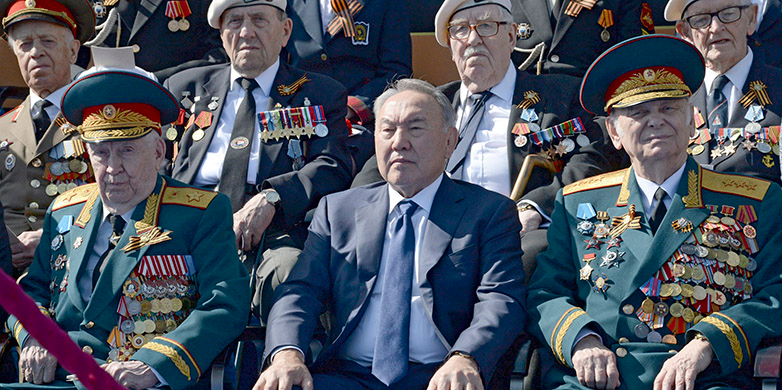
President Nursultan Nazarbayev
President Nursultan Nazarbayev (center), aged 76 and head of state of Kazakhstan since independence in 1991, is surrounded by WW2 veterans at Red Square in Moscow. Reuters
These structural factors in the region interact with broader changes in the geopolitical landscape. Since its invasion of Crimea in 2014, Russia has proved to be the most powerful game changer in the region. If Belarus or Ukraine are considered Russia’s front yard, Central Asia is its back yard. Particularly in the security realm, Russian influence is undisputed. Yet the weak Russian economy leads many to conclude that Russia is in decline, investment levels are dropping, and opportunities for the roughly four million Central Asian migrant workers in Russia are waning. Over the last decade, China has replaced Russia as Central Asia’s largest trading partner. These factors are compounded by the downsizing of NATO’s decade-long presence in Afghanistan in 2014, which altered Western attitudes towards the region.
Given these developments, unforeseen events or major shifts of power within Central Asia could trigger wider change. How would the Kremlin react if the death of Kazakhstan’s 76-year-old President Nursultan Nazarbayev brought to power a government that opposed Russian policy in the area? Would Russia choose to intervene, as it did in Crimea and Donbass? How would major powers react to a wave of terrorist attacks perpetrated by some of the 4000 Central Asian jihadist foreign fighters returning to their homeland, or a breakdown of public order in Tajikistan? Lastly, will Central Asia be the stage of a new “Great Game” between a waning Russia and waxing China?
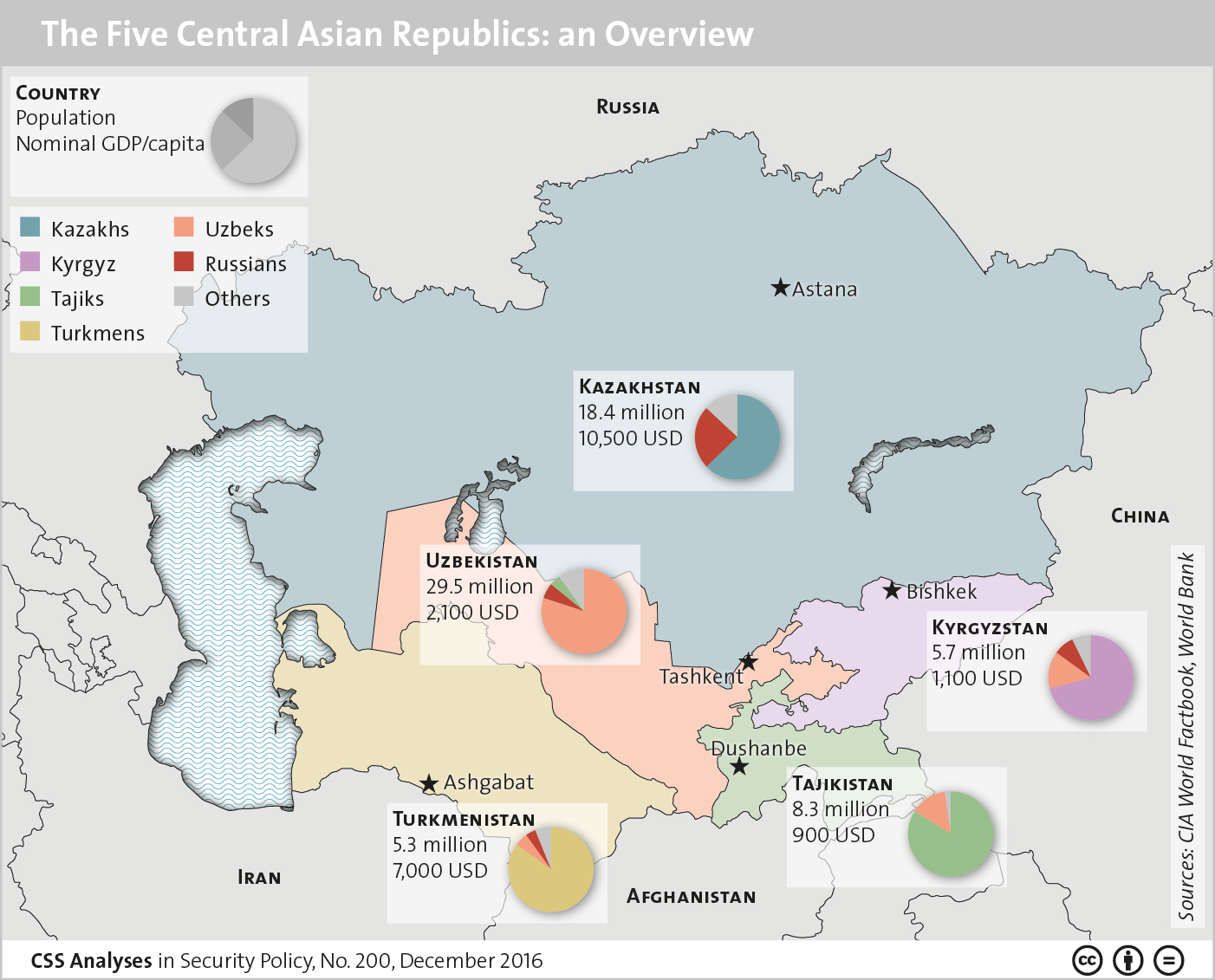
The Five Central Asian Republics: An Overview
Introducing the “Stans”
Two features help understand Central Asia: its geography and its Soviet legacy. They shape the countries’ economies as well as systems and styles of government. In terms of geography, Central Asia comprises the five former Soviet republics: Kazakhstan, Kyrgyzstan, Tajikistan, Turkmenistan and Uzbekistan. Together, they govern a rapidly growing population, currently estimated at 67 million. The region is the most landlocked in the world and covers a landmass from vast deserts and steppes to some of the world’s highest mountains. It is situated along the ancient Silk Road between Europe and East Asia, and it is thus often referred to as the heart of “Eurasia”. The region is rich in oil deposits, particularly in Kazakhstan, and gas reserves, as in Turkmenistan. The two smallest republics of Kyrgyzstan and Tajikistan are mountainous and least resource-endowed among the “Stans”.
As a remnant of their Soviet past, large parts of Central Asian economies are state-controlled, cumbersome, and lacking diversification. The region’s poorest countries, Kyrgyzstan and Tajikistan, are the world’s first and fifth most remittance-dependent countries respectively, with a large share of their labor force working in Russia. Nevertheless, over the past two decades, average economic growth rates in Central Asia have been among the highest in the world. These successes are tempered somewhat by a sharp slump since 2014, due to the economic crisis in Russia and dropping commodity prices.
The political system of the Soviet Union has largely been preserved throughout Central Asia. The predominantly Sunni states are secular. The prevalent practice of Islam in Central Asia is moderate, and radical ideology will not hold broad appeal in the near future. With the exception of democratic but turbulent Kyrgyzstan, strong autocratic leaders are in power: President Nazarbayev has led Kazakhstan since its independence; Tajikistan’s Emomali Rahmon has held office since the end of the civil war in 1997; Turkmenistan experienced a smooth succession in 2006 and continues to be a totalitarian state under Gurbanguly Berdimuhamedov; and Uzbekistan has been undergoing a succession process since September 2016. These leaders oversee state systems marred by corruption, human rights abuses, and an inability to reform. They control informal networks of power and nepotism, which in turn further weaken formal state institutions. Despite recent improvements, all Central Asian countries rank among the world’s bottom third in terms of corruption. Education systems lack funding or are abused for indoctrination purposes. Wealth is distributed unevenly, and prospects for social advancement of the growing population look dim across Central Asia.
All Central Asian republics, save for Kyrgyzstan, are republics by name only. Elections are largely a farce. Organized opposition is virtually non-existent. Occasionally, resistance has flared up in the form of Islamist terrorism. The Islamic Movement of Uzbekistan has executed several deadly bombings since its creation in the 1990s, and recently pledged allegiance to the “Islamic State” from its current base in Pakistan. In 2016, Kazakhstan experienced two allegedly Islamist terrorist attacks. The risk of further attacks emanates from both homegrown radicalization as well as global jihadism. An estimated 4000 foreign fighters from across Central Asia have been fighting in Syria and Iraq since 2012, and hundreds of them have returned. The threat of Islamist terrorism is a primary concern of Central Asian governments and is used to justify repression.
The line of succession is not officially defined in any of the authoritarian republics, which can create further instability in the turbulent times following a leader’s death. In September 2016, Uzbekistan’s President Karimov died. Prime Minister Mirziyoyev prevailed over a small group of potential successors. Major changes in the style of leadership and governance are unlikely. Following the widely publicized death of a long-term head of state, all other authoritarian Central Asian republics introduced legislation concerning succession. Turkmenistan extended presidential terms and lifted the president’s age limit, Tajikistan lowered the president’s minimum age to enable a dynasty, and Kazakhstan reshuffled its cabinet supposedly to put successors in place. Successors will have to satisfy different clans, economic elites, and the security sector. Considering the countries’ weak institutions and the prevalence of the patriarchy, any successor is likely to be another strongman from inside the system.

Regional (Non)Cooperation
Central Asia shares a common Soviet past and similar systems of government, and Russian is widely spoken as a lingua franca. As such, one could assume a certain degree of interconnectedness between the nations, a common interest among the elites in maintaining order, or even a unifying Eurasian identity. However, bilateral relations are poor, mistrust is high and intra-regional trade is low. Uzbekistan, as Central Asia’s most populous and most militarily powerful country, is at the center of these regional tensions. It is at odds with all its neighbors concerning border demarcation, and with upstream countries about their construction of hydroelectric dams. Sufficient access to water for growing populations will become even more of a flashpoint for tensions in the future. Of further concern are ethnic disputes, exemplified by the 2010 events in southern Kyrgyzstan. Clashes along ethnic lines left roughly 2000 people dead and caused the displacement of several hundred thousand people, largely Uzbeks.
There are multilateral institutions who could have proved useful in the face of such a crisis. A mission of the Organization for Security and Co-operation in Europe (OSCE) was dismissed at an early stage. The Shanghai Cooperation Organization (SCO), a regional security and economic framework including both Russia and China, did not act. The Collective Security Treaty Organization (CSTO) proved to be an emperor with no clothes when the Kyrgyz request for help faced opposition from several member states. An oft-repeated justification for international abstention was that the 2010 events were a domestic issue.
The most far-reaching multilateral organization in Central Asia is the Eurasian Economic Union (EAEU), which created a single market between Russia, Belarus, Armenia, Kazakhstan, and Kyrgyzstan. These two Central Asian members hoped to serve as a vibrant geopolitical bridge between East Asia and Europe. Progress in this regard has been limited, however, and they are dissatisfied with the current record and trajectory of the EAEU, as well as the fact that Russia is seen to treat the other members as junior partners.

Geopolitical Shifts
Russia, China, the US, and Europe – and to a lesser extent Turkey and Iran – are all actors that retain influence at the heart of “Eurasia”. Russia is the primary and most committed power, notably in the hard security realm. Moscow is interested in a stable “near abroad” and in preventing Central Asia from becoming an independent energy supplier to Europe, and treats Central Asia as within its undisputed sphere of influence. Defense ties with the republics are strong and genuine, especially with the CSTO members Kazakhstan, Kyrgyzstan, and Tajikistan, which all host Russian military bases. Over the past decade, Chinese involvement in the region has grown significantly, particularly economically. It is now the region’s primary trading partner, ahead of the EU and Russia, and increases its leverage through loans and investments as part of its One Belt One Road (OBOR) initiative (see CSS Analyses No. 195). Central Asian elites generally welcome Chinese investments, while large parts of the population are suspicious of Chinese domination and the influx of Chinese workers.
The United States’ “New Silk Road” initiative to connect Afghanistan to Central Asia has hardly materialized on the ground, and the EU’s Central Asia strategies since 2007 have had even less impact. To support the Afghanistan mission, the West de- pended on three military bases in the region, all of which had fostered close ties with the host regimes. Since NATO’s Afghanistan campaign was largely concluded by 2014, there is more room for less politicized, less securitized Western engagement. The West, Russia and China cooperate with Central Asian security services to support short-term regional stability. By engaging in this manner, these foreign powers risk further enhancing the corrupt rulers’ repressive capacities. As stability achieved through oppression is ultimately unsustainable, volatility can increase.
 
Switzerland and Central Asia
Switzerland has supported political transition processes in Central Asia since the early 1990s. In Uzbekistan, Kyrgyzstan and Tajikistan, Switzerland supports vocational education, public sector reform, private sector development, and initiatives around health and strengthening the rule of law. Across the region, Switzerland is focused on addressing one source of great political and ethnic tension: water management. Funding for Swiss cooperation in Central Asia amounted to 200 million CHF between 2012 and 2015.
Since 1992, Switzerland has led a constituency group in the World Bank and the International Monetary Fund that includes all five Central Asian republics, which the media nicknamed “Helvetistan”. Leadership of this group grants Switzerland a seat on the organizations’ executive boards.
Central Asia also provides a further source of Swiss energy. Though levels vary over the years, Switzerland imports up to one third of its crude oil from Kazakhstan.
The daughter of the former Uzbek president, Gulnara Karimova, and other members of the Uzbek elite laundered vast assets using Swiss bank accounts. Since 2012, an implicated sum of 800 million CHF has been blocked and remains disputed.
 
Acute Crises
Central Asia’s most severe problems emanate from low commodity prices and the Russian economic crisis in the wake of Western sanctions. These two dynamics created negative repercussions on all Central Asian republics, albeit in different ways. Turkmenistan’s economy is dominated by its dependence on gas rents. The state has not been able to pay some of its civil servants, even police, for months. Kazakhstan relies heavily on oil and gas revenues, and faces increased Russian economic competition due to the weaker ruble. Kyrgyzstan and Tajikistan, and to a lesser extent Uzbekistan, vitally depend on Russian aid and loans, and on remittances. Transfers are estimated to have at least halved since the invasion of Crimea, and hundreds of thousands of migrant workers have lost their jobs and returned home.
To cope with such shocks and increasing demographic pressure, Central Asian states require tough reforms: spending cuts and both the liberalization and diversification of the economy. Yet general sluggishness and the much-praised political stability hinder transformation. Reforms would face strong resistance, likely emanating from disaffected members of the elite attempting to protect their shrinking assets. Obstructions such as these could threaten the era of relative calm in Central Asia. Considering the limited organized opposition, civil society and free press, popular movements are less likely to occur, except if major events or external shocks act as catalysts. The economic crisis or the accentuation of major geopolitical rivalries could serve as such catalysts.
In view of recent Taliban attacks in Kunduz and throughout northern Afghanistan, Central Asian leaders as well as Russia, China and the West increasingly worry about an incursion into Tajikistan. Actors vividly remember Tajikistan’s brutal civil war that ended in 1997, during which many attacks were staged from Afghanistan. Up to a third of Afghanistan’s narcotics production is trafficked across Tajikistan’s porous borders. Exacerbated by these tensions, order in Tajikistan may break down in the near future. Like most cases of state collapse, the main causes would be internal however. The Tajik government is kleptocratic, incompetent and divided, and security forces are weak. The economy is ailing, offering few prospects to returning migrant workers. Discontent is mounting after President Rahmon manipulated the election in 2015 and banned the main opposition party, thus violating the power sharing agreement of 1997. In the face of looming state collapse, the 7000 Russian troops based in Tajikistan may not stand idly by. Even China, whose troublesome Xinjiang province borders Tajikistan, may consider engaging, though this would contradict their current position in support of non-intervention.

Crimea in the Steppe?
Since 2014, the Crimean invasion has represented an elephant in the room for Central Asian states. Events in Ukraine spooked elites across Central Asia for two reasons. First, regime change following popular protests is not a phenomenon they would like to see repeated in the region.
Second, the annexation of Crimea and involvement in Eastern Ukraine, in direct violation of international law, made them wary of their Russian ally. The republics are already pursuing a multi-vector foreign policy to balance the influence of major powers and to emphasize their sovereignty.
Russia is perhaps most invested in retaining influence in Kazakhstan. It is relatively stable and prosperous, with a popular ruler and nascent civil society and economic diversity. Observers have voiced concern that northern Kazakhstan, or “southern Siberia” as some Russian nationalists call it, could become a new Crimea or Donbass. The parallels with Ukraine are staggering. In Ukraine, Vladimir Putin violated the 1994 Budapest Memorandum, which also guarantees Kazakhstan’s borders. Northern Kazakhstan has a large ethnic-Russian population, the Russian language is prevalent throughout the country, and Russian media actually dominate across Kazakhstan. The government has to balance the interests of Kazakh nationalists with ethnic minorities. In a 2014 speech, Putin shocked Nazarbayev claiming Kazakhstan as an integral part of the Russian sphere of influence and negating Kazakh statehood before 1991. An intervention similar to the one that took place in Ukraine, however, remains quite unlikely. Kazakhstan cannot and will not break its genuine alliance with Russia. There is not a strong enough inducement from the EU, NATO or China to encourage such a step. Unlike in Crimea, Russia has no strong historic and cultural claim to northern Kazakhstan. There is no Russian interest to destabilize 7000 km of border with a weak Kazakhstan following a Donbass scenario either.
Nevertheless, some events could trigger a harsh Russian response, for example if Kazakhstan were to leave the EAEU – which it indicated was a possibility if the economic organization becomes primarily a political project – or if a highly nationalist or anti-Russian Kazakhstani government threatens Russian interests. With few allies and a relatively weak military, Kazakhstan would have no means of resistance. As such, Kazakhstan is both a major ally of Russia and a hostage to Russian foreign policy.
Geopolitically, Russia, China, and possibly the US may increasingly struggle for influence in Central Asia. There is, however, currently no sign of such a new “Great Game”. Central Asia is too peripheral, particularly for the US, to serve as a stage of geopolitics. Particularly in the face of strict Western sanctions, Russia is ever more dependent on cooperation and its “marriage of convenience” with China, despite mutual distrust.
In the long run, however, Chinese economic influence will eventually translate into political influence. One could imagine a scenario in which a powerful China forces a weakened Russia to give way to its ambitions in Central Asia without the use of arms, and claims it as part of China’s sphere of influence, as the back yard of its troublesome Xinjiang province. The newly-won Chinese supremacy and corresponding loss of influence for Russia would certainly trigger regional instability. As it stands, China is satisfied with the stable security environment, consistent access to energy, and sufficient economic leverage over Central Asia.
Despite its strong commitment to the region, Russia’s current crisis reduces possible incentives and the capacity for intervention to keep the republics in line. Even without increased Chinese assertiveness, to a certain extent Russia’s influence in Central Asia is bound to decline.

About the Author
Benno Zogg is Researcher at the Think Tank of the Center for Security Studies (CSS) at ETH Zurich. His areas of research interest include the post-Soviet and development and security in fragile contexts

Friday, December 9, 2016

THE END OF GLOBALİSM