
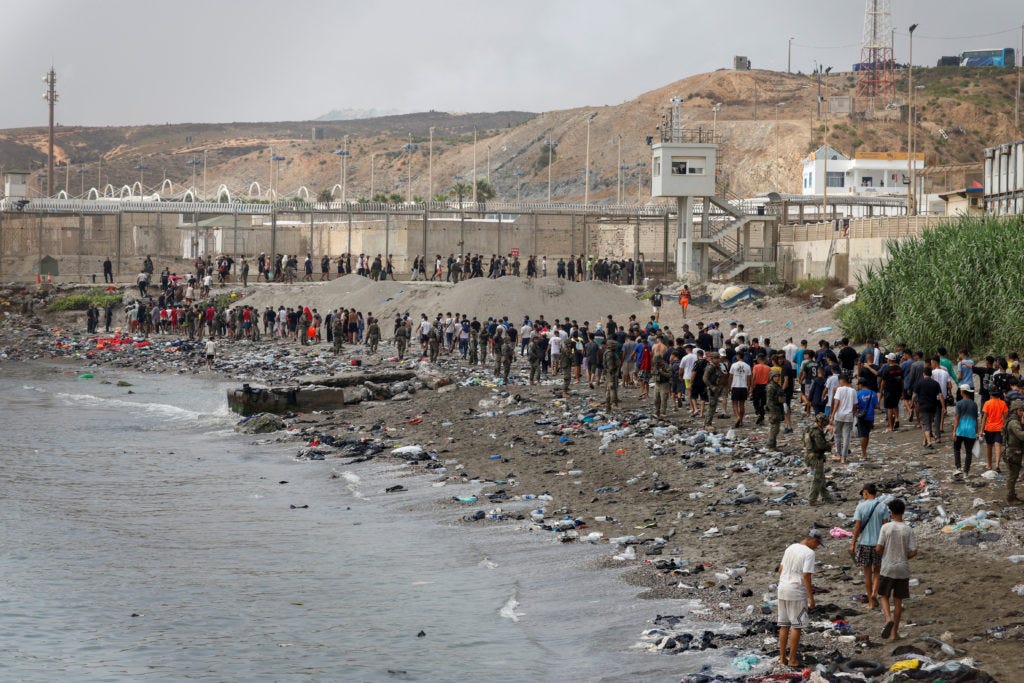
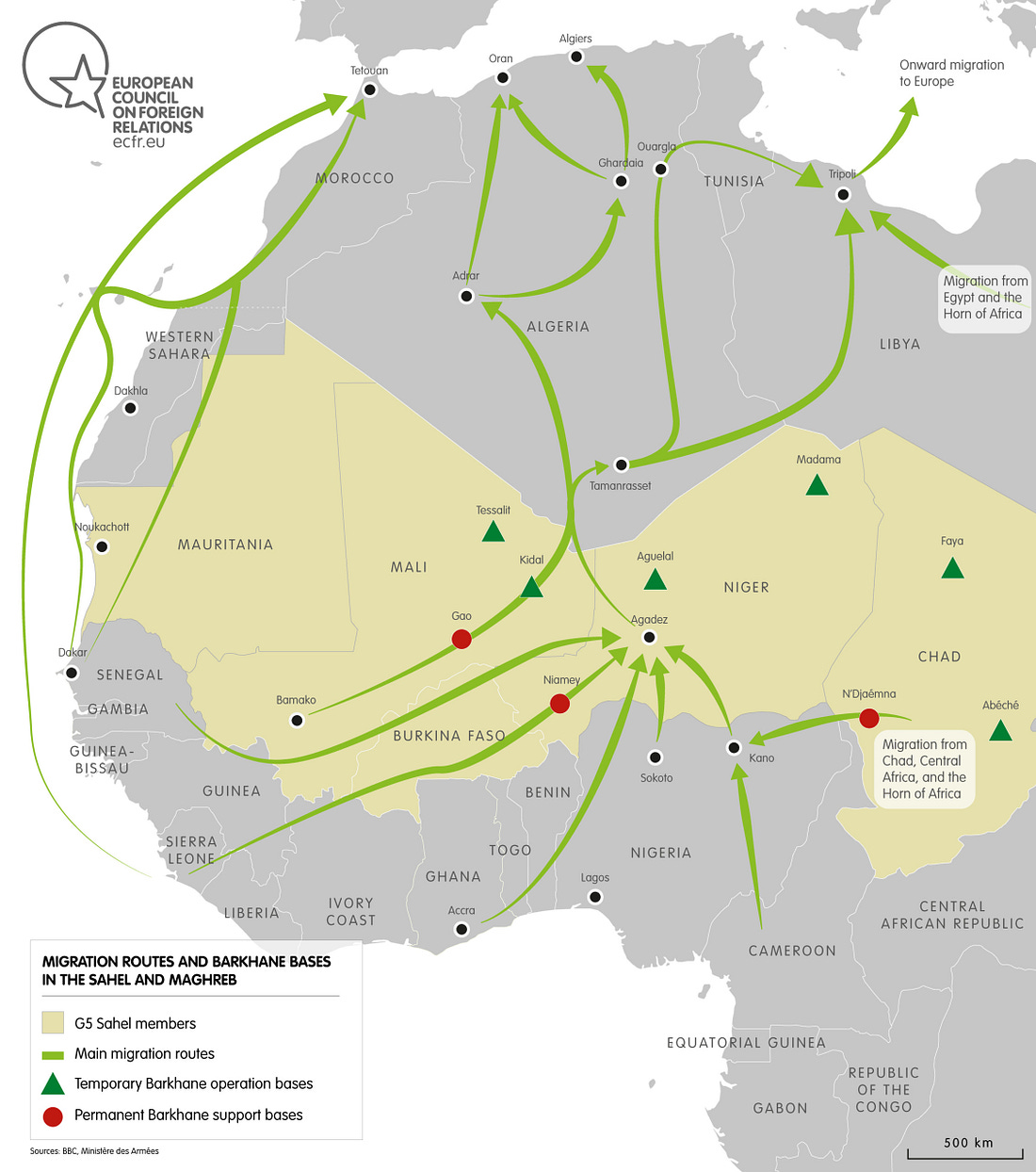
For a long time, Islamist rhetoric in Morocco has painted Europe as a kind of promised land, a place where welfare never runs out, chances are everywhere, and prosperity comes easily, with barely any effort required. The objective has always been to weaken trust in Morocco's own institutions and steer young people toward leaving. And whatever Morocco’s problems, the country is not collapsing. There is no war, no state failure, no institutional breakdown. Development is still moving through some of the biggest infrastructure and industrial efforts in modern Moroccan history: the extension of Africa’s first high-speed rail network, the expansion of Tanger Med into the continent’s leading port, and large commitments in renewables and desalination. Morocco has also built one of Africa’s most advanced aerospace sectors, with over 150 companies employing about 25,000 skilled workers and bringing in close to $3 billion a year in exports. Safran, Boeing, Airbus, and other international manufacturers run sites producing aircraft engines. Compared with many developing states, Morocco has put its emphasis on infrastructure first, on pulling in investment, and on laying the groundwork for long-term growth, then, after that, widening social benefits. Contrary to the conspiracy talk that spreads online, Morocco gains nothing from uncontrolled crossings. Some critics point to Algeria’s relationships with European governments, but every major European state keeps channels open with Algiers, Giorgia Meloni’s Italy has a notably strong relationship, while Morocco’s day-to-day cooperation has stayed consistently solid across the board. That includes strong migration frameworks with France and Germany, including a bilateral partnership signed with Berlin in 2024 that has driven higher returns, deportation arrangements with Hungary and Poland, and, most recently, close operational coordination with the United States. Last year, several thousand Sudanese and other Sahel-origin migrants also crossed the eastern border, adding to the strain already felt in Moroccan cities, it’s a pressure ordinary Moroccans regularly complain about. The chaos of the past two days only worsens Morocco’s position rather than helping it: once the impression of an open or uncontrolled border spreads, it draws in even more refugees and irregular migrants, piling additional weight onto a burden that is already substantial.
Islamist voices now invert reality and accuse the Moroccan government of orchestrating the entire episode. Many NGOs, including those in Europe with ties to Islamist groups, have amplified the falsehood by branding Morocco a “Zionist proxy.” This ignores the fact that Morocco’s position on Gaza does not favor Netanyahu: Rabat has repeatedly and firmly condemned Israeli military operations and ceasefire violations, called for an immediate and lasting halt to the fighting, demanded unrestricted humanitarian access, and insisted on a two-state solution with East Jerusalem as the capital of a Palestinian state. The timing is also interesting: general elections are set for 23 September, and Islamist operators understand that border chaos, magnified on social media, can destabilize the incumbent narrative before the vote. Morocco is further constrained by Spanish policy choices under Pedro Sánchez. Effective migration management requires reciprocity. The security budget allocated to Ceuta has remained inadequate, particularly with a regional government led by the Partido Popular (whose president, Juan Jesús Vivas, belongs to a party long hostile to Sánchez). Morocco shoulders the burden of physical presence, patrols, interceptions, and surveillance along the entire land and maritime perimeter. By contrast, Spain’s preventive spending is limited: Spain allocates roughly €60 million per year to measures aimed at preventing irregular arrivals (border technology, Frontex participation, and limited aid to North African partners), while spending more than €1.8 billion annually on reception and support for irregular migrants. A multi-year Spanish government plan of €711 million for Ceuta and Melilla through 2026, covered by El País in 2022, directed the bulk of funds to education, social services, and economic development not pure border security. This structural imbalance renders Spanish policy unsustainable as it provides more incentives to illegal crossings, not less. Morocco has no legal prerogative to extract individuals once they are inside Spanish territory, including Ceuta. Spanish Supreme Court rulings that have extended asylum protections to certain “swimmers” which were published a few weeks ago only complicate the picture further. This latest episode will primarily benefit Islamists who want Europe to fail and Morocco, denounced in their rhetoric as a "Zionist" state, to fail alongside it. Every crisis that deepens polarization, weakens European governments, and reinforces the narrative of a failing Morocco advances the ideological project they have pursued for years. |




No comments:
Post a Comment