CNN
Trump and Japanese leader
trade praise and vow to
strengthen alliance



What we're covering
• Trump’s Asia trip: President Donald Trump and Japan’s conservative new prime minister, Sanae Takaichi, have traded lavish praise on the second leg of his Asia tour.
• Economic cooperation: Trump said Japanese carmaker Toyota plans to invest in plants across the US, telling troops stationed in Japan to “buy a Toyota.” The leaders also signed a framework on securing the supply of critical minerals and rare earths, aiming to break China’s stronghold over the industry.
• Shutdown stalemate: Back in the US, there are still no signs of a breakthrough on the government shutdown. Speaker Mike Johnson fiercely defended keeping the House out of session on Monday, contending GOP lawmakers were accomplishing critical work in their districts.
Trump talks Toyota and praises 'beautiful friendship' with Japan.
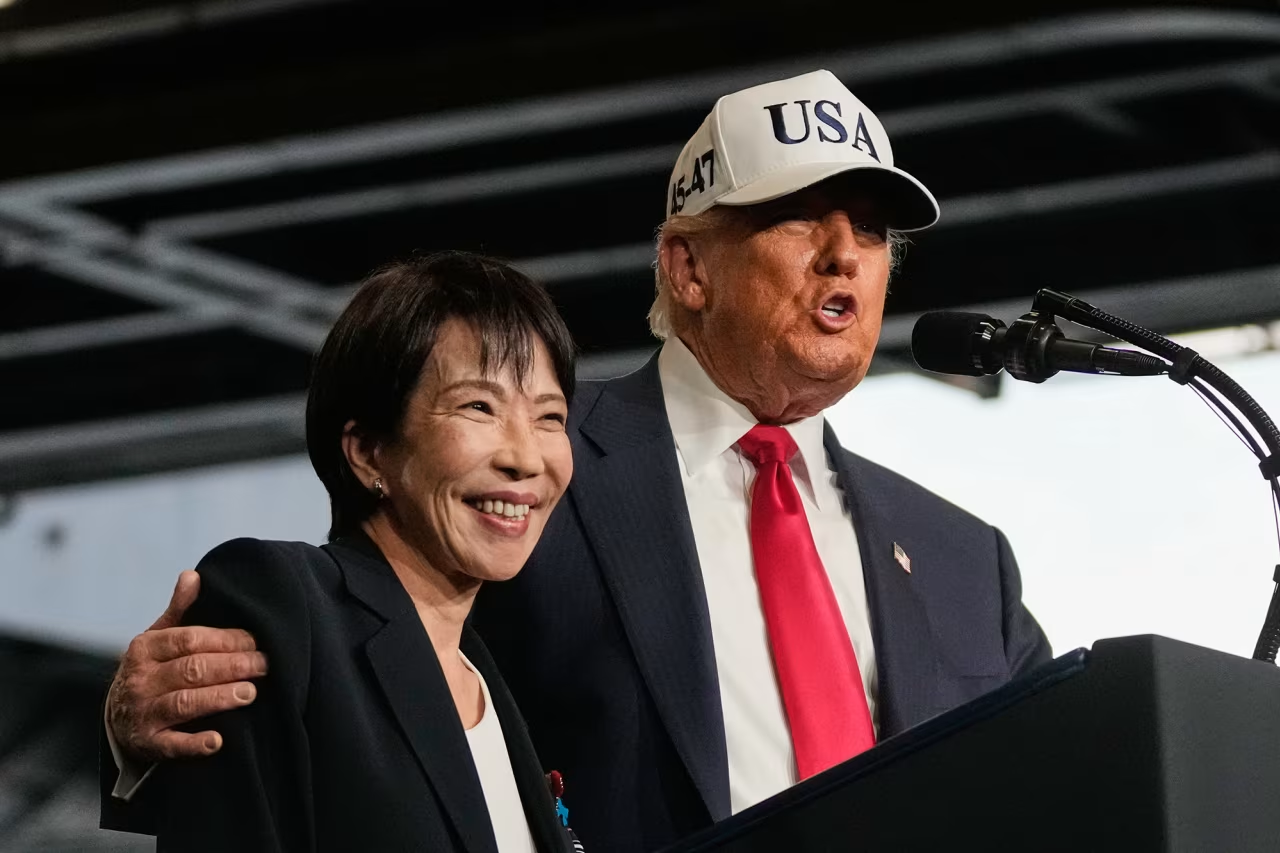
US President Donald Trump underscored close relations with Japan’s “new and incredible” Prime Minister Sanae Takaichi, as he announced fresh investment between the two nations on the latest stop of a roundtrip to Asia.
The two leaders exchanged lavish words of praise in an address to US troops at the Yokosuka Naval Base – after they spent a day strengthening ties in the capital Tokyo.
Here’s what you need to know.
- Symbolic display of unity: The US president invited Takaichi to speak as the two stood on stage in front of 6,000 US troops aboard the USS George Washington, in a strong show of force from both countries to parry rising threats from Beijing.
- “This woman is a winner”: Trump set the tone for a “relationship that will be stronger than ever before” between Washington and Tokyo, having described Takaichi as “one of the great prime ministers” after the pair met for bilateral talks on Tuesday.
- New economic trade: Japanese carmaker Toyota plans to invest in the US “to the tune of over $10 billion,” according to Trump. The moment highlighted how the White House’s aggressive tariff policy has spurred world leaders to leverage domestic investment.
- Mineral and rare earths deal: Earlier on Tuesday, the two leaders signed an agreement to bolster the supply of “raw and processed critical minerals and rare earths.” Washington has tried to cement deals with other nations to break China’s near-monopoly on rare earth resources.
- Soft diplomacy: Takaichi also gifted Trump a putter owned by assassinated Prime Minister Shinzo Abe – of whom the US president was very fond – and a golf bag signed by golfing star Hideki Matsuyama.
Why Trump mentioned Shinzo Abe when greeting Japan's new prime minister
US President Donald Trump described former Japanese leader Shinzo Abe as a “great man” as he met his protégé Sanae Takaichi, Japan’s new prime minister. CNN’s Betsy Klein tells us more:
Analysis: Trump's vision to get allies to boost defense spending aligns with what Takaichi has long pushed for

During his visit to Tokyo, US President Donald Trump praised Sanae Takaichi — Japan’s first female prime minister — as “a big deal.”
“This will be a relationship that will be stronger than ever before,” Trump said at their bilateral meeting, adding that if Japan needs any favors, the US would be there.
Aboard the USS George Washington, docked at the Yokosuka Naval Base, he also said, “This woman is a winner,” prompting her to pump her fist in the air as she spun around.
But this isn’t just political theater.
Takaichi has long pushed to raise Japan’s defence spending toward 2 % of GDP and to revise the pacifist constitution. She has advocated amending Article 9 to recognise Japan’s Self-Defense Forces as “national defense forces” and expand capabilities to allow a more active military posture.
These moves echo Trump’s own hard-line stance.
A strong bond with Trump doesn’t just boost Takaichi’s international standing. It gives her political cover at home to push through controversial defense reforms and turn Japan into the defense powerhouse she’s long envisioned, especially as tensions with China continue to rise
Trump announces Toyota investment in the US: "Go out and buy a Toyota"

President Donald Trump said that Japanese carmaker Toyota plans to invest in the United States, telling US troops aboard the USS George Washington to “buy a Toyota.”
Trump said that Japan’s new conservative prime minister, Sanai Takaichi, told him the Japanese automaker would be boosting its investment in the US as the pair met in Tokyo on Tuesday.
“I was just told by the prime minister that Toyota is going to be putting auto plants all over the United States to the tune of over $10 billion,” Trump said.
The moment underscored how Trump’s tariff policy has reshaped alliances abroad and spurred world leaders to negotiate with the US president via domestic investment.
Trump and Takaichi traded lavish praise during their summit, with Trump calling her a “winner” who will be “one of the great prime ministers.”
China urges Japan to respect "concerns" of its neighbors as Takaichi meets Trump
China urged Japan to “earnestly respect the security concerns of its neighbors” after new Japanese leader Sanae Takaichi pledged to work with her US counterpart Donald Trump to promote a “free and open” Asia-Pacific.
The phrase was introduced as a formal strategy adopted by Takaichi’s political mentor — and friend of Trump — former Japanese leader Shinzo Abe in 2016, as a counter to China’s claims in the region. It became a cornerstone of his foreign policy and was embraced by consecutive US administrations.
Both countries aim to increase their show of force in the region to counter rising threats from China, which has been steadily increasing military provocations, launching drills in the South China Sea and escalating pressure on Taiwan. Takaichi recently pledged to up Japan’s defense spending to 2% of GDP.
Japan’s brutal occupation of parts of neighboring China and Korea during World War II is still felt by many across the region today.
Japan's leader tells US troops the region faces an “unprecedented security environment”

Prime Minister Sanae Takaichi told US troops aboard the USS George Washington at the Yokosuka Naval Base that the region faces an “unprecedented security environment” and that Japan and the US would “join hands to ensure peace and security in this region.”
“Peace cannot be preserved by words alone. It can be protected only when there is an unwavering determination and action,” Takaichi said Tuesday, standing alongside President Donald Trump.
Both countries aim to increase their show of force in the region to counter rising threats from China, which has been steadily increasing military provocations, launching drills in the South China Sea and escalating pressure on Taiwan.
Takaichi said Japan was committed to “fundamentally reinforce its defense capabilities” and that the country was “ready to contribute even more proactively to peace and stability of the region.”
Trump praises Japan’s prime minister: “This woman is a winner”
President Donald Trump highlighted close ties between the US and Japan after a day spent alongside the country’s new conservative prime minister, Sanae Takaichi, whom he described as a “winner,” offering warm praise for his counterpart.
Trump invited Takaichi to the stage as he spoke to thousands of US troops aboard the USS George Washington at the Yokosuka Naval Base in central Japan.
Trump then talked about having a “beautiful friendship” with Japan.
“I have such respect for Japan and the country and now I have a really great respect for the new and incredible prime minister,” he said. “I have to say this – the first female prime minister,” Trump added, prompting cheers and applause from the servicemen in the crowd.
Takaichi, who took office last week, is seeking to build on the warm relationship Trump shared with her late predecessor and mentor, Shinzo Abe.
Earlier today, Trump told Takaichi she would “be one of the great prime ministers” as the pair met for bilateral talks in Tokyo.
“This will be a relationship that will be stronger than ever before,” he said, adding that if Japan needed any favors the US would be there.
Trump to address troops on USS George Washington in Japan
President Donald Trump has arrived at Yokosuka Naval Base in central Japan where he’s expected to a13 New Updates
ddress 6,000 US troops aboard the USS George Washington.
Trump had traveled aboard Marine One with Japanese Prime Minister Sanai Takaichi, and the two observed a welcome ceremony on the ship’s deck. Service members wore different colored shirts that designated their roles on the ship: yellow for troops who handle aircraft movements, green for troops who hook planes to catapults, and purple for troops who fuel the planes.
Trump’s visit here is part of a broader show of force in the region from both countries to counter rising threats from China – under the US “peace through strength” policy. There are 55,000 US troops stationed in Japan.
China has been steadily increasing its military provocations, launching drills in the South China Sea and escalating pressure on Taiwan – exercises that analysts say serve both as critical preparation and strategic cover for a potential future invasion of the self-governing island.
Trump recently told reporters he believes China won’t make any moves on Taiwan – but the self-ruled island will be watching the president’s expected meeting with Chinese leader Xi Jinping later this week incredibly closely.
Aboard the aircraft carrier, anticipation built as the theme from “Top Gun” played while Marine One landed. Service members have been standing for hours in preparation to see their commander-in-chief, singing along to “Sweet Caroline” and “Party in the USA” as they waited for Trump.
Japan and US to work for "free and open Indo-Pacific," Takaichi's office says, echoing Abe

Japan will work with the US to “strongly advance a Free and Open Indo-Pacific,” Prime Minister Sanae Takaichi’s office said on Tuesday after she met with US President Donald Trump, echoing a line coined by her political mentor – and friend of Trump – Shinzo Abe.
“President Trump and I agreed to strongly advance a Free and Open Indo-Pacific (FOIPC),” the post continued, below a photo of Takaichi shaking hands with Trump.
Abe coined the concept of a “free and open Indo-Pacific” in 2016, according to Japan’s government, as a counter to the claims of China in the region. It became a cornerstone of his foreign policy and embraced by consecutive US administrations.
Within Japan’s conservative ruling party, some worry Washington’s commitment to the Indo-Pacific is fading, as it demands more from allies.
China has stepped up its claims of sovereignty in the Indo-Pacific, including in strategic waterways through which trillions of global trade pass each year.
Tetsuya Yamagami admits to assassinating former Japanese Prime Minister Abe

The man accused of fatally shooting former Japanese Prime Minister Shinzo Abe in 2022 admitted to the charges in a central Japan court Tuesday, according to public broadcaster NHK.
Tetsuya Yamagami, 45, was arrested at the scene of the assassination, which stunned the world, and was charged with murder and violating the swords and arms control law.
Tuesday’s hearing was the first of several before a verdict is handed down on January 21, the court said.
Abe, Japan’s longest-serving leader, was shot with a homemade gun, police said at the time, as he was delivering a speech in support of the ruling Liberal Democratic Party candidates on a street in the western city of Nara. He had retired from office two years earlier.
Yamagami blamed Abe for promoting the Unification Church, a religious group he held a grudge against after his mother donated to it some 100 million yen ($663,218), local media reported, according to Reuters news agency.
China’s benchmark stock index hits 10-year high ahead of Trump-Xi summit
China’s benchmark Shanghai Composite Index surged above 4,000 points on Tuesday in a first since 2015, following news that trade talks between American and Chinese officials yielded a framework agreement.
The preliminary agreement reached through the latest talks in Malaysia over the weekend sets the stage for a highly anticipated meeting between President Donald Trump and Chinese leader Xi Jinping.
The rise in the index reflects investors’ relatively optimistic outlook for the bilateral summit, and it comes after major Asia stocks and US stock futures similarly reacted positively on Monday to the announcement of the world’s two largest economies reaching a framework for a trade deal.
The index has grown more than 19% this year, partly buoyed by China’s artificial intelligence and technology boom driven by the surprising success of AI models launched by Chinese start up DeepSeek earlier in the year.
Japan hosts the largest number of US forces overseas

US President Donald Trump and Secretary of Defense Pete Hegseth are visiting US troops stationed aboard the USS George Washington at the Yokosuka Naval Base, south of Tokyo.
Japan is a treaty ally of the US and hosts the largest number of overseas American troops, with about 50,000 personnel stationed in the country.
The US has been the anchor of Tokyo’s defense since the end of World War II.
In recent years, the two allies have strengthened that military relationship and rapidly accelerated security and intelligence ties in the face of mounting security threats in Asia.
Last year, the US overhauled its military forces in Japan as the two countries moved to deepen defense cooperation, a sweeping step to modernize their alliance.
Japan also signed a deal with the US last year to acquire 400 Tomahawks as part of Tokyo’s plans to increase defense spending to counter regional threats.
Earlier this month, the Japanese warship JS Chokai, an Aegis-equipped guided-missile destroyer, made its way to the US to be fitted with Tomahawk cruise missiles, the latest move by Washington and its Asian allies to beef up firepower as adversaries like China and North Korea expand theirs.
China's grip on rare earths has long been a frustration for Takaichi
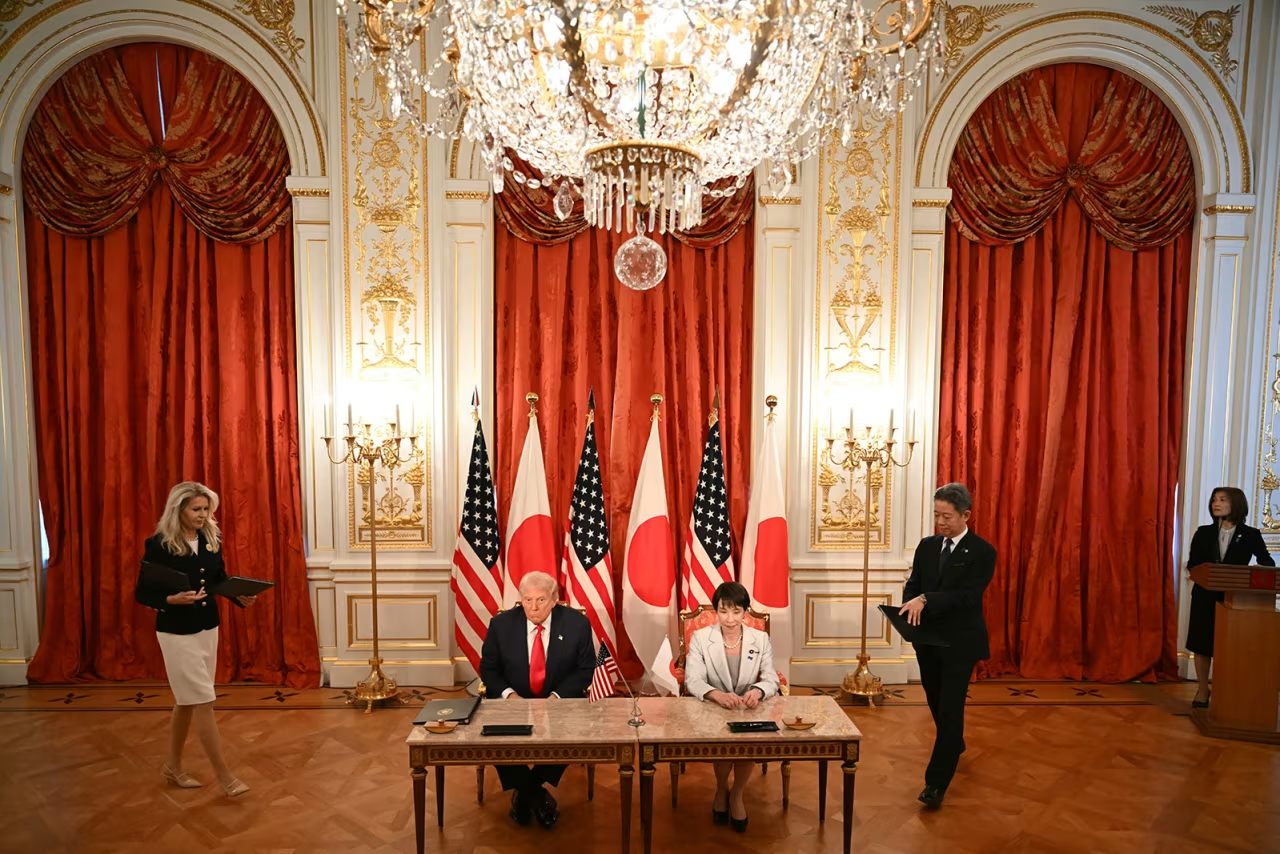
This morning, President Donald Trump and Japan’s leader Sanae Takaichi signed a framework agreement on rare earths and critical minerals.
Like the US, Tokyo is racing to secure a stable supply of critical minerals as China, the dominant rare earths producer, tightens export controls and threatens global supply.
Japan still relies on China for around 70% of its rare earth imports, according to the government-backed Japan Organization for Metals and Energy Security.
That dependency first raised alarm in Japan during the 2010 “rare earth shock.” After a Chinese fishing boat collided with a Japan Coast Guard vessel near the Senkaku Islands, Tokyo’s detained the captain and sparked a diplomatic crisis. Beijing retaliated by slashing exports of the resources, critical to the production of high-tech goods, throwing Japan’s manufacturing sector into turmoil.
Japan’s new prime minister is determined to ensure it never happens again.
A longtime advocate for economic and maritime security, she has called for Japan to develop its own rare earth supply and reduce its reliance on Beijing. As economic security minister under previous Prime Minister Fumio Kishida, she often warned about China’s grip on the critical materials—a stance in line with her reputation as one of Japan’s most outspoken China hawks.
Her approach also aligns neatly with Donald Trump’s recent attempts to break China’s stranglehold on the resources, but doing future supply deals with other nations.
American rice, Abe's putter and a Nobel nomination: Here's how Japan welcomed Trump
On the second leg of his Asia tour, US President Donald Trump met with Japan’s conservative prime minister, Sanae Takaichi, who was elected only days ago.
Takaichi heralded a “new golden age” for Japan and the US alliance. Trump told Takaichi she will be “will be one of the great prime ministers” and the US is “an ally at the strongest level.”
Takaichi is a protege of assassinated former leader Shinzo Abe, who Trump has described as “one of my best friends – one of, maybe, my closest friends in government.” He told the new prime minister, “Shinzo was a great man – he loved you.”
Trump will soon visit US troops stationed in Japan, and then heads to South Korea on Wednesday. Whether Trump will meet North Korean leader Kim Jong Un on the trip remains a mystery, though the American leader said he was open to extending his trip to do so.
Here are some of highlights:
- The leaders signed an agreement on securing the supply of critical minerals and rare earths they deem “crucial to the domestic industries of the United States and Japan.” China has a near-monopoly on global rare-earth supplies, which Beijing has weaponized in its trade war with the US. Washington has been trying to cut deals with other nations to break the stranglehold on supply.
- The leaders were served lunch during their meeting, dining on American beef and rice. Serving American rice could be seen as a gesture to win favor with Trump, who has long urged Japan to buy more US rice. He even threatened higher tariffs on Japanese exports, accusing the country of refusing to purchase American-grown rice.
- Takaichi told Trump that she had nominated him for the Nobel Peace Prize. The move has become a common tactic to flatter Trump, particularly when trade deals are on the table.
- Takaichi gifted Trump a putter owned by assassinated Prime Minister Shinzo Abe and a golf bag signed by golfing star Hideki Matsuyama. The two leaders shared a love of golf and played nine holes alongside Matsuyama during Trump’s maiden diplomatic visit to Asia in 2017.
- In a nod to the US’ 250th anniversary next year, Takaichi said Japan would donate 250 cherry blossom trees to Washington, DC. In 1909, Tokyo donated 2,000 cherry trees to the US, which were later destroyed after it was discovered they were infected with insects. A second donation of 3,020 cherry trees was made in 1912, some of which remain.
- The leaders met with the families of Japanese citizens who were abducted by North Korea in the late 1970s and 1980s. Trump also met with the families in 2019. Japan says at least 17 of its citizens were snatched by North Korean agents – alongside hundreds of unexplained cases. The abductions appear to have been part of North Korea’s espionage program.
Analysis: Trump’s tariffs have dramatically reshaped Japan and South Korea
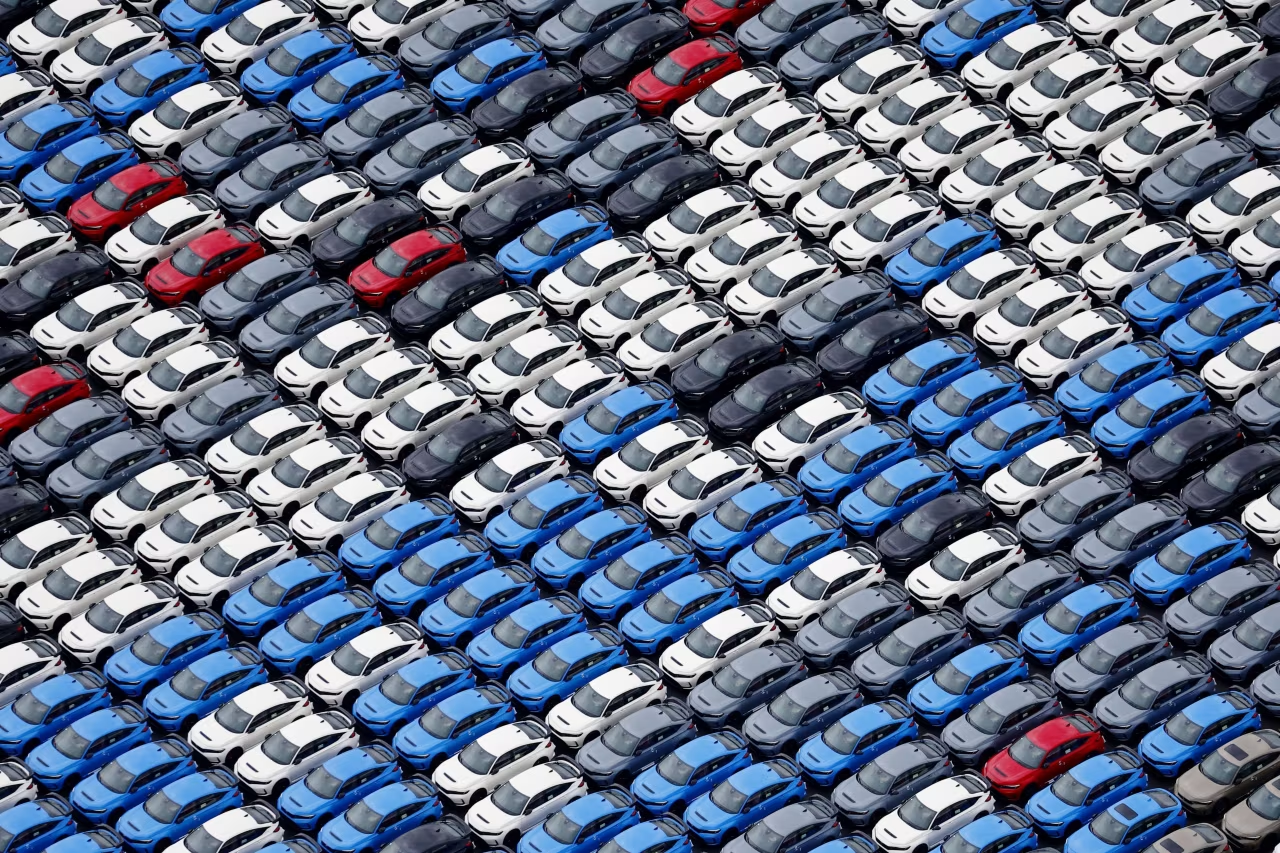
As President Donald Trump continues his Asia tour with stops in Japan and later South Korea, businesses in both economic powerhouses are closely watching to see if his meetings with their leaders will offer more clarity to their trade relations with Washington.
Even though the longtime US allies negotiated tariff rates of 15%, a lower rate than many other countries, the increase from virtually zero has dampened both economies.
Adding to the strain are the massive US investment pledges – $550 billion from Tokyo and $350 billion from Seoul – agreed upon to help secure the tariff reduction. Critics have likened these packages to US extortion, while the details of the agreements remain unclear and implementation plans are still being worked out.
In Japan, exports to the US have posted six straight months of declines by September. Still, the Japanese economy managed to defy economists’ expectations in the second quarter, recording a 1.2% annualized increase in gross domestic product. The question is whether that can continue.
Japanese companies have been lowering prices to maintain customers in the US, according to a research note published this month by Goldman Sachs economists. That’s taken a bite out of their earnings and large manufacturers see that worsening, according to an October survey published by the Bank of Japan.
In South Korea, exports, which make up more than 40% of the country’s GDP, are forecast to slow sharply this year due to Trump’s tariffs, according to government thinktank Korea Development Institute’s resarch in August.
On Tuesday, the South Korean economy reported a better-than-expected growth at 1.2%, according to data from the Bank of Korea. Still, experts warned that the country’s export-reliant economy remains vulnerable to Trump’s trade measures.
President Lee Jae Myung has said South Korea’s final trade deal with the US remains at an impasse as details of the $350 billion investment commitment have yet to be finalized. The recent ICE raid on a massive Hyundai factory in Georgia added additional friction between Seoul and Washington.
Trump will meet US troops in Japan. Here's a look at his schedule
President Donald Trump will soon visit with US troops aboard the USS George Washington, which is docked at the Yokosuka naval base, and give a speech.
He’ll dine with business leaders later in the evening.
Earlier in Japan: Trump was warmly received on Monday by Japan’s Emperor Naruhito at Tokyo’s Imperial Palace. Then earlier Tuesday local time, he met with the country’s new prime minister, Sanae Takaichi.
The president will depart for South Korea on Wednesday morning local time.

No comments:
Post a Comment