Monday, August 31, 2026

Foreign Affairs - The Road Through Damascus How Syria Can Capitalize on the Post-Hormuz Economy - Jesse Marks and Nicholas Lyall - August 31, 2026

 Foreign Affairs

The Road Through Damascus

How Syria Can Capitalize on the Post-Hormuz Economy

Jesse Marks and Nicholas Lyall

August 31, 2026


Oil trucks from Iraq on their way to the Baniyas oil terminal, Qamishli, Syria, May 2026

Orhan Qereman / Reuters


JESSE MARKS is a Research Scholar at the Center for Arab and Islamic Studies at the Australian National University.


NICHOLAS LYALL is a Senior Researcher and Policy Analyst at Trends Group in Abu Dhabi.


In early April, a convoy of 299 Iraqi fuel tankers crossed into Syria on its way to the Mediterranean port of Baniyas, one of the few remaining paths to international markets amid the closure of the Strait of Hormuz. It was the first time Iraqi oil had crossed through Syria legally since 2003, when the U.S. invasion of Iraq effectively shuttered the cross-border flow of oil from Iraq to Syria. In late April, Iraq expanded the route, reopening its northern Rabia crossing with Syria, a crossing that had been closed for more than a decade during Syria’s civil war. Between April and late July, more than 2.1 million metric tons of Iraqi fuel moved to the Syrian coast.


Before Syria’s civil war began, in 2011, the country had served as a commercial crossroads between Iraq, Jordan, Lebanon, Turkey, and the Mediterranean, connecting Gulf states to European markets. But after 2011, Syria turned into a different kind of transit hub. Trade became dominated by Iranian weapons and logistics support on their way to Hezbollah in Lebanon, as well as fuel, narcotics, and other illicit trade that filled the coffers of the country’s dictator, Bashar al-Assad, but provided few benefits for Syrians.


After Hayat Tahrir al-Sham, the militant group once led by Syria’s new president, Ahmed al-Shara, toppled the Assad regime at the end of 2024, regional trade began to trickle back in. By August 2025, as many as 327,000 trucks carrying over seven million tons of cargo crossed into Syria, according to estimates by Syria’s customs agency. Jordan, Qatar, Saudi Arabia, and Turkey began to normalize relations and do business in the country. Damascus’s new authorities moved quickly to restore the country’s ties with a wide variety of regional and international partners, with the aim of ending Syria’s economic isolation. Although significant, this is not nearly enough to rebuild the country after over a decade of civil war. In 2025, the World Bank estimated that Syria’s reconstruction would cost $216 billion, nearly ten times Syria’s projected GDP for 2024.


Syria’s leaders are now positioning the country to benefit from a resurgence of regional turmoil. Since the outbreak of the Iran war, in late February, the opportunities for new foreign investment in Syria have proliferated. Because alignment with the United States and Israel and reliance on the Strait of Hormuz carry ever-greater risks of retaliation from Iran, many countries are turning to Syria, which has a variety of well-placed land and sea routes. Syrian authorities are using the potential rush of capital and trade to create a new source of revenue, allowing the state to recast the country’s image from a source of refugees, terrorism, and regional disorder to a transit power that plays a dominant role in regional connectivity. But the speed and scale of investment could also overwhelm the institutions needed to manage it. If not properly scrutinized or fairly distributed, the rush of new investment that seems so promising now may destabilize the country’s fragile recovery.


AFTERSHOCKS


The need for better and more diversified transit through the Middle East is not new, but for nearly 15 years, Syria’s civil war made transit through the country impossible. In 2009, the Saudi and Turkish governments began discussions around redeveloping the Hejaz Railway route, built by the Ottoman Empire and largely destroyed in World War I, but they abandoned these plans with the outbreak of Syria’s civil war. Between 2010 and 2021, Syrian exports fell by roughly 90 percent. Major transit routes through the country closed entirely as the state fragmented into competing zones of control. In 2023, India, Saudi Arabia, the United Arab Emirates (UAE), the United States, and European partners proposed the India–Middle East–Europe Economic Corridor as a way to spur intraregional and interregional connectivity and integrate Israel, a node on the corridor, with its neighbors.


Disruption in the Strait of Hormuz has made expanding these projects even more urgent. In April and June of this year, the Jordanian, Saudi, Syrian, and Turkish governments agreed to redevelop the Hejaz Railway within three to four years. Analyses of comparable regional rail corridors, such as that by the Atlantic Council, estimate that the railway could initially carry around 1.5 million containers annually, potentially rising to three million with track and port capacity expansion. This proposal resonates with Shara’s loose vision, laid out at an informal EU summit in April among leaders from Europe and the Middle East, for a Four Seas and Nine Corridors initiative that places Syria at the center of a network connecting the Persian Gulf, the Caspian Sea, the Black Sea, and the Mediterranean, facilitating ground- and sea-based trade in goods, electricity, and oil. Then, in July, Iraq and Syria agreed to rehabilitate the Kirkuk-Baniyas oil pipeline, which was destroyed during the U.S. invasion of Iraq in 2003, to create a permanent Mediterranean outlet for Iraqi oil. If the pipeline goes online within its four-year estimated timeline, it could transport two million barrels per day by 2030, equivalent to roughly 60 percent of Iraq’s crude exports before the Iran war and an estimated nine percent of the total oil that moved through the Strait of Hormuz. With new routes also planned through Turkey, Iraq is positioned to route more than 80 percent of its export volume around Hormuz, ending its near-total dependence on Gulf terminals.


These trends, however, are not guaranteed to improve Syrians’ economic and political fortunes. Although Syria’s geographic position gives it geopolitical leverage with foreign actors seeking to diversify export routes, it also places the country in the middle of emerging rivalries, as Saudi Arabia and Turkey align on security, the UAE increasingly takes a commercial role in ports and logistics, and Israel attempts to prevent Turkey from establishing influence near its borders. Competition over who finances, operates, and protects these respective corridors could pull Syria into contests it is not stable enough to sustain.


Syria could get pulled into contests over trade that it is not stable enough to sustain.

Damascus has tried to limit this exposure by working with nearly every power willing to support its reconstruction and reintegration, including Qatar, Saudi Arabia, Turkey, the UAE, and the United States, as well as China and Russia. But this strategy is proving more difficult as time wears on. The influence of Syria’s greatest financial supporters is drawing Damascus toward a Qatari-Saudi-Turkish constellation. If competition over the corridors grows faster than Syria’s capacity to manage it, the country could fall victim to greater foreign control and extraction.


Israel may also prove to be a significant obstacle to Syria’s reemergence as a reliable passageway for trade. The reconstruction of the Hejaz Railway, if successful, will decrease Israel’s importance to the India–Middle East–Europe Economic Corridor and as a Mediterranean gateway for Arab states. Israel may well try to resist this development. In February, Israeli Prime Minister Benjamin Netanyahu warned of an “emerging radical Sunni axis” as Syria drew closer to Qatar, Saudi Arabia, and Turkey, and in June, Israeli Transport Minister Miri Regev warned that regional trade and energy partnerships designed to bypass Israel posed “a genuine strategic threat to national security,” placing Syria’s emergence as an alternative trade corridor within Israel’s wider threat perception. And Israel has demonstrated its willingness to use force against those countries; in 2025, it bombed a Hamas compound in Doha, carried out extensive attacks across Syria (including on air bases being scoped by Turkish military teams for deployment in Syria), and seized additional territory in the south of the country. In August 2026, Israel struck Syria’s Abu al-Duhur airbase after alleging that Damascus was preparing to permit a Turkish deployment there intended “to harm Israel,” in the words of Israeli Defense Minister Israel Katz.


Damascus, which cannot afford a war with Israel, has avoided military retaliation and sought an Israeli withdrawal by participating in U.S.-brokered negotiations. Such a tempered approach, however, may not deter Israel from expanding its illegal occupation of Syrian territory, targeting Syrian infrastructure, or fomenting instability through its ties with Syrian minorities, all of which are hampering projects critical for Syria’s recovery. As the Middle East analysts Shira Efron and Danny Citrinowicz have argued in Foreign Affairs, the attempts by Syria’s new government to counter those operations could result in Israel and Syria becoming lasting adversaries. Such attempts will also require even more support from foreign actors.


PAY TO PLAY

The growing influence of foreign powers in Syria also affects important political dimensions of the country’s reconstruction. Throughout the civil war, Assad granted countries that supported his repressive regime access to Syrian territory and economic assets. Russia built military bases and received lucrative phosphate, oil and gas, and port concessions. Iran used Syria as a land bridge to Lebanon and stationed thousands of troops in the country. Efforts to reassemble the Syrian state after Assad’s fall have unfolded under this shadow. The government led by Shara has largely ended this method of outsourcing Syrian sovereignty, ousting Iranian and Hezbollah forces from Syria, dismantling networks that sustained Iran’s military corridor in the country, and reclaiming control of formerly Russian-held military bases, although the bases will still be jointly operated. But the risk of outsourced sovereignty has not disappeared. Damascus is still grappling with a fragmented system of national governance. For years, customs administration systems across Syrian territory were governed by separate competing state and nonstate actors, chief among them the Kurdish-led Autonomous Administration of North and East Syria. Although Damascus has regained authority over the border crossings with Iraq in territory once led by the Kurdish minority, the main crossing into Turkey from that territory has yet to reopen.


To attract the funding necessary for Syria’s reconstruction, the new government has lowered the barriers for regional and international powers to access and invest in Syria’s routes, ports, and territory, projects that could serve to connect its disjointed regions. Last June, Shara signed a decree permitting foreign investors full ownership rights in most sectors, an unrestricted ability to repatriate their profits, and extensive tax and customs concessions. The decree concentrates authority over investment licenses, access to state land, and eligibility for major tax incentives in institutions closely tied to the president, giving him considerable power to determine who can invest in Syria’s postwar economy. This centralization will likely help streamline investment. But without independent oversight into such decisions, oversight that Syria has yet to establish, centralization could also revive the Assad-era practice of offering economic access as a reward for political loyalty. Such a system could make reconstruction a new source of political patronage, undermining the new government’s legitimacy in the eyes of Syrians who lose out and possibly reproducing the same inequalities that helped fracture the country in the lead-up to the civil war.


Long-term concessions give foreign companies considerable influence over critical infrastructure. The French-owned shipping company CMA CGM holds a 30-year concession of Syria’s largest port, Latakia, an arrangement that gives the Syrian government 60 percent of the port’s revenue. The UAE-based logistics company DP World will finance and build new infrastructure at Syria’s second-largest port in exchange for operational control over the facility for 30 years, after which control will return to Damascus. But it remains unclear, in the absence of any published revenue-sharing terms for this deal, how much income the state will receive, or how that income will be managed and distributed.


The scale of Syria’s reconstruction makes foreign financing difficult to resist. Although the World Bank has directed nearly $500 million in grants toward public service projects targeting electricity, water, health, and financial institutions, that will cover less than one percent of the country’s reconstruction needs. In October, Shara said that his government had attracted $28 billion in commitments from a mix of Turkish and Gulf investors during its first ten months, roughly 13 percent of Syria’s total estimated needs. The largest commitments, however, favor government-awarded infrastructure and development projects—power plants, ports, airports, telecommunications, and urban real estate—but pay little attention to restoring basic services and destroyed homes in Syria’s hardest-hit communities. Moreover, much of the sum comes from preliminary agreements.


Shara’s government has created two funds to manage the reconstruction: the Syrian Development Fund, for donations and grants for rebuilding public infrastructure such as roads, bridges, and water and electricity networks, and the Syrian Sovereign Fund, modeled after the Gulf sovereign wealth funds, to manage state assets, invest in public property, and take stakes in strategic projects. Dedicated reconstruction funds are common in postconflict states, and a sovereign wealth fund may be justified to streamline the management of fragmented, distressed, and historically poorly managed public assets. The concern, however, is that under its current formulation, the Syrian Sovereign Fund concentrates the management of public assets directly under the president without independent oversight and with limited public disclosure around its structure and management, as similar reconstruction programs in Afghanistan, Iraq, and Somalia have done. Even reforms intended to strengthen accountability are centralized under the president. The planned center for arbitrating investment and commercial disputes, for example, will sit within the Syrian Investment Authority, which is itself attached to the presidency. This architecture could give the president undue influence over which investors, regions, and communities benefit from recovery. In a country that has suffered from the state’s abuse of power and wealth since the 1960s, this pattern of control is uncomfortably familiar.


PAYING DIVIDENDS

Transportation corridors and investments cannot generate durable returns if renewed fragmentation preserves the disconnect between a strong, wealthy Damascus and a poor, underdeveloped periphery. Ultimately, whether Syria can convert foreign investment into local gains depends on whether Damascus can establish a predictable political order. So far, the government seems to be making steady gains, but it still has a long way to go. Over the past two years, Shara’s campaign to reunify the country has been violent. Fighting along the Alawite-majority coast, in the Druze-majority Suwayda region, and across the Kurdish-led northeast has deepened mistrust between the state and the communities it seeks to govern.


Renewed confrontation between Damascus and the Syrian Democratic Forces—a U.S. backed, Kurdish-led coalition that governed much of northeast Syria after pushing the Islamic State (also known as ISIS) out of the area—offered the clearest warning of renewed civil war. Although the central government and the SDF signed an agreement to merge in March 2025, disputes over military integration and Kurdish autonomy at first prevented its implementation, leading to an outbreak of fighting in January that displaced more than 170,000 people. After a U.S.-brokered cease-fire halted the government’s advance north, Damascus and SDF leadership signed an agreement that mandated the transfer of control of border crossings, oil and gas fields, and local institutions to Damascus and the integration of SDF fighters into the Syrian military. In August, after months of gradual implementation, the SDF commander Mazloum Abdi announced the coalition’s dissolution as an independent force and the end of Kurdish-led self-governance in Northeast Syria. Even infrastructure and resources under the Kurds’ de facto control is now being handed over to Damascus. On paper, the January agreement between Damascus and the SDF provides a framework for resolving informal wartime boundaries and closed routes and for harmonizing competing duties and parallel systems of governance. If the Kurdish majority living in the northeast perceives this reintegration to be insufficient or failing to preserve Kurdish rights and representation, however, they may begin to resist, obstructing Damascus’s attempts to consolidate full control over the country and its transit corridors.


The repatriation of millions of Syrians further raises the political stakes. By the end of May, an estimated 1.67 million refugees and 1.92 million internally displaced Syrians had returned to their home communities. Many are returning from protracted poverty in neighboring states to communities already struggling to meet residents’ basic needs, which has intensified competition over housing, employment, and public services and which may create new sources of local grievance and conflict as the process continues to unfold. To successfully integrate these returnees, Damascus must empower governorates and municipalities with the resources and autonomy to solve problems pertaining to service delivery, job creation, and education in real time.


To avoid reproducing a rentier economy dependent on transit fees and foreign concessions, the Syrian state must reinvest project revenues in local economies. Assad’s dependence on Iran and Russia narrowed his room to maneuver, but the new government can negotiate with Europe, the Gulf states, Turkey, the United States, and international institutions seeking access to Syria’s markets and transit routes. Competition among these partners gives Damascus leverage to negotiate terms that keep as much of the investments’ value in Syria as possible. But using that leverage effectively will require transparent agreements tied to clear state policy priorities for reconstruction and recovery. To better connect the capital with faraway cities and towns, the central government must invest in improving roads and electricity connectivity and require foreign investors to support local hiring and revenue-sharing agreements. It will also need to forge durable and equitable settlements with minority leaders and tribal communities to strengthen domestic trust.


Renewed interest in Syria as an advantageous transit point for regional trade has presented Damascus with income, relevance, and leverage at a time when it needs all three. But these resources are not immutable. Damascus’s challenge is to use the dividends from its newfound importance in regional trade to build functioning institutions, distribute resources for recovery, and overcome historical animosities. Otherwise, after decades of exclusion, Syria could return to the regional map merely as a fragile conduit for others’ commercial exploits.


Topics & Regions: Turkey Israel Syria Iraq Diplomacy Geopolitics Economics Security


Foreign Affairs - The Price of Russian Paranoia Spy Hunting Shores Up Putin’s Power—but Paralyzes the State -- Andrei Soldatov and Irina Borogan -- August 31, 2026

 Foreign Affairs 

The Price of Russian Paranoia

Spy Hunting Shores Up Putin’s Power—but Paralyzes the State

Andrei Soldatov and Irina Borogan

August 31, 2026


The Kremlin, Moscow, August 2026

Anastasia Barashkova / Reuters


ANDREI SOLDATOV is a Nonresident Senior Fellow at the Center for European Policy Analysis and Co-Founder and Editor of Agentura.ru, a watchdog of the Russian secret services’ activities.


IRINA BOROGAN is a Nonresident Senior Fellow at the Center for European Policy Analysis and Co-Founder and Deputy Editor of Agentura.ru.


They are the authors of Our Dear Friends in Moscow: The Inside Story of a Broken Generation.


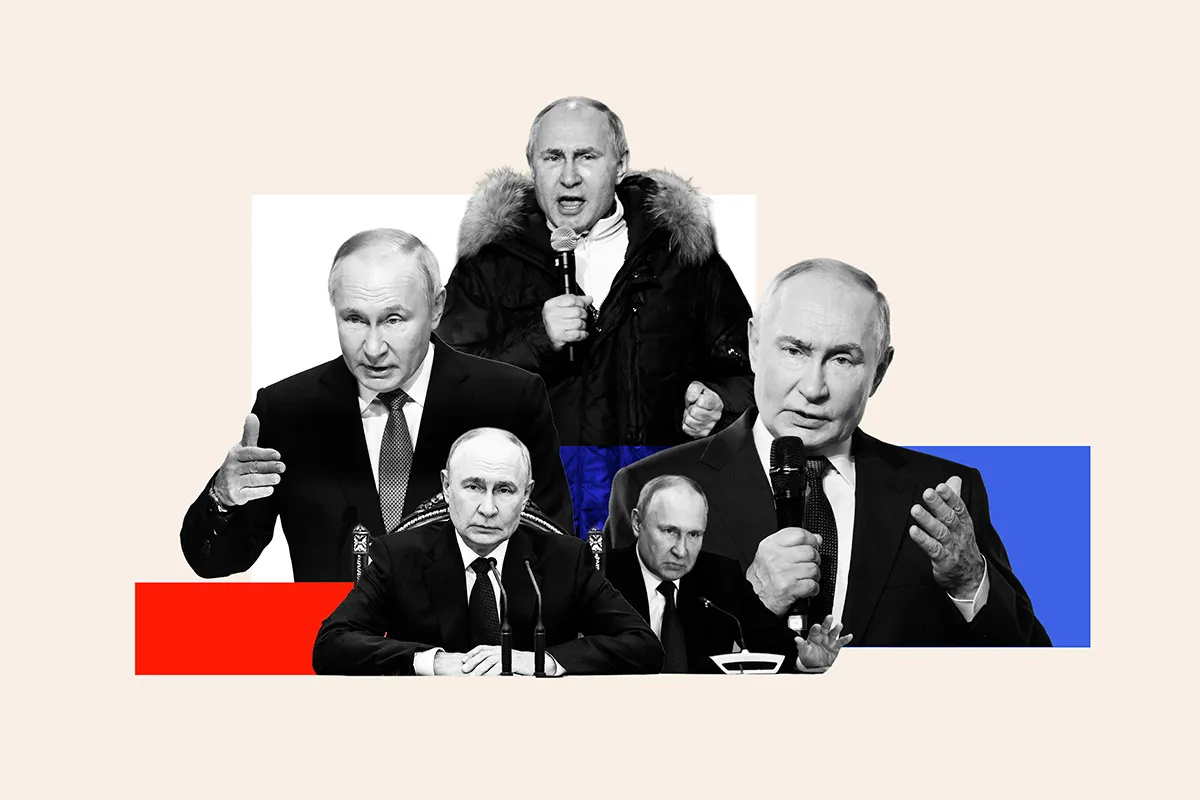
As Russia’s war in Ukraine becomes increasingly costly with no end in sight, the Kremlin has kept tightening its grip over Russian society. Along with expanding repression, including of some officials and civil servants, and the silencing of negative reporting about the war and the economy, this suffocation has included, in recent months, frequent Internet shutdowns and draconian new restrictions on social media. For Russians themselves, these measures are a stark contrast to the moderate freedoms they were allowed before 2022, when the war began.


Less apparent, though, is the dramatic shift in domestic security doctrine that undergirds these efforts. For much of the first two decades of Russian President Vladimir Putin’s time in office, the reigning model of state security was fighting terrorism and extremism. The wars in Chechnya at the start of his time in office, for example, were framed as a “counterterrorism operation.” And up until 2022, major political opponents—among them the exiled oligarchs Boris Berezovsky and Mikhail Khodorkovsky, and more recently, the opposition activist Alexei Navalny and his organization, as well as the Russian antiwar committee, launched by the opposition in exile—were branded as terrorists or supporters of terrorism.


As the war in Ukraine has become protracted, the Kremlin has needed a more aggressive strategy to keep perceived opposition figures—and ordinary Russians—in line. For the FSB, the main successor to the Soviet KGB, this has meant a change in focus from fighting terrorists to hunting down spies. Drawing on tactics perfected during the Soviet era, the security forces have led a campaign to root out any threats to regime power. And since foreign agents are potentially everywhere, the counterintelligence approach has allowed the FSB to penetrate more deeply into ordinary society, as well as into private-sector companies and state institutions themselves.


Yet rule by spy hunting and paranoia has also come with significant costs. As state institutions and private enterprises alike fear FSB repression, they have begun to withhold accurate data, avoid making decisions, and, in general, switch to survival mode. Among ordinary Russians and civil servants alike, proliferating social controls and prosecutions for treason have created a pervasive climate of mistrust and fueled a sense of paralysis. For the Kremlin, building an all-powerful security state could ultimately undermine its ability to govern.


SPIES EVERYWHERE

It is hard to overstate how widely the Putin regime has deployed counterintelligence tools since the invasion of Ukraine. First was the question of how to manage Russia’s elites, many of whom were less than enthusiastic about a direct confrontation with the West. To reassert discipline, the Kremlin not only ramped up its use of selective repression but often drew on anti-spying legislation to do so.


Selective repression had already been introduced before 2022 with the imprisonment of a number of governors, ministers, and high-ranking civil servants on charges of corruption and abuse of power. But in the years since, the security services have wielded this weapon in unprecedented ways. To date, they have arrested officials at a wide array of ministries—Digital Development, Defense, Energy, Science and Education, Industry and Trade, Internal Affairs, Transport, Culture, Emergency Situations, Development of the Far East and the Arctic—as well as members of the Moscow city government. They have also aggressively pursued charges of abuse of power, fraud, and embezzlement against employees of federal agencies such as the Penitentiary Service, the Service for Supervision of Natural Resources, the National Guard, the Deposit Insurance Agency, and the Customs Service.


The FSB has been involved in many of these prosecutions, supplying compromising information on targeted officials. Often, the targets appear to have been chosen to serve as a warning to others. Consider Maxim Parshin, a competent bureaucrat who served as deputy minister of digital communications, who was arrested in July 2023. Parshin oversaw Russia’s national import-substitution program, crucial for the war effort, and was on good terms with Russian Defense Minister Andrey Belousov. Nevertheless, to show that nobody was immune from its reach, the FSB chose to make an example of him. In October 2025, he was tried on dubious bribery charges and sentenced to nine years in jail. For other members of his ministry, it was clear that the FSB would not tolerate anything other than complete obedience.


Frequently, these prosecutions have invoked spy charges, with the FSB’s counterintelligence wing supplying the incriminating information. Yet the Department of Military Counterintelligence—formally responsible for detecting foreign spies within the armed forces—has also been involved in many cases, reflecting the growing dependence of Russian industries on military contracts.


Russian dissidents Vladimir Kara-Murza and Yulia Navalnaya in Berlin, November 2024

Lisi Niesner / Reuters


The war has also transformed the way the FSB handles perceived political opponents of the regime. During Putin’s first 20 years in power, his political opponents were rarely charged with political crimes. Instead, they were typically accused of economic offenses such as embezzlement and fraud. That strategy allowed the Kremlin to publicly deny the existence of political repression while portraying the opposition as inherently corrupt.


But that approach changed shortly after Russia’s full-scale invasion of Ukraine. In April 2022, the Commission on the Protection of State Sovereignty, which is under the aegis of the Federation Council, the upper chamber of the Russian parliament, announced plans to examine the activities of Russia’s so-called nonsystemic opposition—political groups and opposition parties that are not represented in or are excluded from the State Duma. Senators aligned with the Kremlin claimed that some of these figures were guilty of treason. In Russian law, treason is understood as a form of espionage—compromising or working against the Russian state to benefit a foreign power.


At that moment, Russian security forces had already arrested the opposition politician Vladimir Kara-Murza. In October 2022, Kara-Murza was formally charged with high treason for speaking against the war in Ukraine at public events in Lisbon and Washington, D.C. (After two years in prison, he was released in a prisoner swap arranged by the Biden administration in August 2024.)


During the first months of the war, the charge of high treason was also expanded to apply to Russians who joined the enemy. The FSB used it to launch a large-scale operation enticing young Russians into communicating with Ukrainians—or with Russian units fighting alongside the Ukrainian armed forces—and accusing them of helping the enemy. FSB officers pretending to be Ukrainians or members of Russian units fighting for Kyiv contacted Russians with known antiwar stances and lured them into agreeing to either fight for or financially support Russia’s adversaries.


One of the most striking indications of the scale of this campaign is the explosion of high treason and espionage prosecutions since the start of the war. Before the invasion, Russia averaged ten to 15 treason cases annually. Since then, the number of prosecutions under Article 275 (high treason) has exploded. According to a UN report tracing Article 275 cases between 2022 and mid-2025, there were 167 convictions in 2023, 361 in 2024, and 232 for the first half of 2025. Today, the pace may be even higher: according to the exiled Russian human rights group Pervy Otdel, there were 143 cases involving state security in the first quarter of 2026 compared with 125 over the same period in 2025; in March, courts set a new record, issuing 48 verdicts—more than one per day. The average sentence for high treason is 15 years and five months. Many of these cases would not have qualified as treason under the pre-war legal framework.


STALIN’S BIG BROTHER

Although the counterespionage strategy marks a shift for Putin’s regime, it is not new. Many of its specific tactics have long been available, and the security services can draw on decades of Soviet experience using them. Russian security forces had already absorbed a counterespionage mindset as early as the Russo-Japanese war, in 1905. That war ended in a humiliating defeat by an enemy regarded as much weaker, and many tsarist officials blamed the outcome on Japanese spies and saboteurs.


During World War I, as the Russian army’s performance once again failed public expectations, entire social and ethnic groups were accused of helping Germany: these included Jews, foreign businessmen who remained in Moscow, and ultimately the tsarina herself because of her German origins. A direct telephone line was rumored to have been laid from Tsarskoye Selo—the tsar’s residence just outside St. Petersburg—to the German general staff to pass on military secrets. Authorities also accused revolutionaries, and the Bolsheviks in particular, of working for the enemy, with the Russian Provisional Government famously denouncing Vladimir Lenin as a “German spy” months before the October Revolution.


After 1917, the Bolsheviks aimed to destroy everything they inherited from the ancien régime—except Russia’s spy mania. The intervention of Allied troops on the White Russian side in the Russian Civil War deepened Bolshevik paranoia, and Bolshevik leaders concluded that hostile powers would always seek to destroy Russia by cultivating internal enemies. The result was a fortress mentality: the belief that the Soviet state was permanently encircled by external enemies seeking to act through domestic collaborators.


The leadership of the Russian Defense Ministry in Moscow, August 2026

The leadership of the Russian Defense Ministry in Moscow, August 2026

Alexander Kazakov / Reuters

Early on, the Soviet security services developed the concept of “counterintelligence coverage”: military units, state institutions, and key Soviet industries were to be kept “covered” by counterintelligence agents to prevent foreign intelligence penetration. As a security strategy, it was expansive, stressing intrusive surveillance and preemptive action rather than reactive investigation. To be effective, it required the permanent presence of security service operatives within supervised institutions. The Kremlin considered this fully justified given the perceived existential nature of the threat. After developing it in the 1920s, the Soviets continued this strategy through World War II, Stalin’s death, and the thaw that arrived with his successor, Nikita Khrushchev.


Soviet counterintelligence doctrine even survived the collapse of the Soviet Union. When Putin became director of the FSB, in 1998, he set up the powerful new Department of Economic Security, with his close ally Nikolai Patrushev as head. Although its mandate was to bring the oligarchs to heel—a task unlike anything its predecessor, the Soviet KGB, had ever been charged with—it still drew on this long Soviet tradition. Thus, the department included counterintelligence teams to supervise industry, transport, and the financial system.


By the time of Russia’s full-scale invasion of Ukraine, counterintelligence coverage was already being used as a broader tool of social control. But the war gave the FSB the opportunity to apply it across virtually every sphere of Russian political, military, and economic life. In this sense, the FSB did not need to reinvent this strategy; it could hugely intensify and extend practices that were already embedded in Russia’s security architecture.


For the security services, counterintelligence coverage has served a double function. On the one hand, it gives Putin an effective means to ensure regime stability and strengthen his power at home. But for the FSB, the coverage has also provided an opportunity to expand its own influence across the government and the administrative state. And it also seems to be working: despite more than four and a half years of war, the elites have been harassed into complete obedience, and there are hardly any signs of open dissent.


NO NEWS IS BAD NEWS

Yet the spy-hunting approach has created a paradox. The same practices that have allowed the Kremlin to relentlessly tighten its political control are also undermining the state’s capacity to govern. For one thing, in its effort to turn any perceived political threat into a potential act of treason, the state no longer relies on legal norms but on secret FSB assessments, which often form the basis of prosecutions. And in the face of this unaccountable state, Russian bureaucrats, the elites, public institutions, and private organizations have resorted to self-censorship and are increasingly reluctant to release information about potentially unpopular facts or events.


Russian industries’ ties to the military have exacerbated the situation. As wartime demand grows, private companies often feel compelled to take part in military ventures or dual-use projects that serve military aims. But these contracts bring with them counterintelligence oversight, which in turn may expose industry leaders to accusations of high treason if they fall behind schedule or run over budget. The FSB can now be unleashed to discipline them, in Stalinist fashion. On July 30, for example, the FSB’s department of counterintelligence coverage of industry arrested the deputy CEO and two top executives of Gazprom Energoholding, a subsidiary of Gazprom that is the largest operator of electric and thermal power assets in Russia, with 80 power plants across the country. The arrests, ostensibly for bribery, have sent a stark warning to Gazprom and the entire oil and gas industry, which faces a growing crisis of production and distribution as a result of war disruptions.


Facing similar scrutiny, Russian research institutions have become reluctant to share any information with external actors. Data that would ordinarily be considered benign—research findings, statistics, assessments, technical evaluations—are now treated as potential security liabilities. At the same time, universities, think tanks, and research centers have radically curtailed cooperation and contacts with foreign counterparts, not only because of Western sanctions, which have tightened visa rules and increased travel costs but also out of fear of the security services. In June 2025, Putin signed a law requiring all Russian organizations pursuing scientific, scientific-technical, and technology development that involves foreign participation to submit detailed reports to a database run by the FSB. Participation in such projects is also contingent on FSB approval.


The logic of relentless security oversight has also radically curtailed the release of even routine statistics. In 2025, the Federal State Statistics Service (Rosstat) ceased publishing the country’s demographic data. This year, Rosstat stopped providing data on the salaries of civil servants, teachers, and doctors; on Russians’ spending on housing and utilities; and on household income and expenditure. In doing so, Rosstat followed the example of at least 14 other state agencies that have stopped publishing statistics since the start of the full-scale war. The prosecutor general’s office has stopped updating crime data; the Treasury has ceased publishing detailed budget information; and the central bank has restricted disclosure of international reserves. Meanwhile, the government has extended the ban on publishing oil and gas production statistics that has been in effect since April 2023, and it has allowed banks and listed companies to withhold financial information. Officials’ annual income declarations, a standard requirement before the war, have disappeared altogether.


Sometimes the lack of data has been directly apparent in Kremlin statements. Take the drastic energy shortages in Crimea. Local reporting this summer has shown that gasoline is in stock in only one to two percent of gas stations—contrary to what Putin announced in mid-July, when he assured Crimeans that a “protected system” was being put in place to provide the peninsula with a steady supply of gas, a system that “the enemy would find really difficult to reach.” In fact, there is no evidence of any such system, and it seems likely that Putin has not been briefed on the actual situation.


BITING THE HAND

Ever since the full-scale invasion of Ukraine, when faced with a trade-off between greater control and more effective governance, the Kremlin has consistently chosen greater control. As a result, many of the ministries and agencies that are crucial to the war effort and keeping the economy afloat under sanctions—including the Ministry of Defense and the Ministry of Digital Development, in charge of the national program of import substitution for Western technologies—have themselves become targets of selective repression.


It should hardly be surprising, then, that Russia is experiencing a severe shortage of cloud computing and data-storage infrastructure. Both require rapid national solutions to Russia’s data center crisis, which is driven by obsolete equipment and energy grid limits. And because of sanctions, these issues can no longer be addressed in the usual way, by acquiring newer technology in the West. So companies and investors are hesitating to invest—out of fear that the solutions they would suggest, involving international technology, would trigger an FSB backlash.


This has been one lesson of working with Cloudflare, the American technology company many Russian websites previously relied on. Cloudflare is popular in Russia because it helps websites load more quickly by connecting users to the nearest server. Since the summer of 2025, however, Russian censors have been trying to limit access to Cloudflare services. And the situation has gotten much worse since June 2026, when the FSB accused Cloudflare of working with U.S. intelligence. That accusation, which could imply further arrests, has put a chill on the entire Russian telecom industry.


Undeniably, the counterintelligence model has helped the Kremlin achieve its immediate political goals. But these advantages have come at a steep price. Officials stop reporting problems before they become crises. Regional authorities avoid initiative unless explicitly ordered. Researchers, statistical agencies, and businesses withhold information that could attract official scrutiny. And civil servants throughout the government set aside efficient administration in deference to anticipated orders from above.


For the Kremlin today, the risk of elite paralysis is real: it now extends beyond the research and expert community to top officials and leaders of the industries in Moscow and the regions. By eroding the feedback loop that every stable government—even the most authoritarian—needs to stay in power, the Putin regime is becoming less capable of understanding the real condition of Russia. And that could, in the long run, make Putin far more vulnerable to a true political crisis.


Topics & Regions: Russia Ukraine Politics & Society Civil & Military Relations


CNN 3.2M Followers - A power struggle in Iran could decide when Trump’s war ends - Story by Analysis by Mostafa Salem, CNN • August 31, 2026 - 1d • 5 min read

 CNN

3.2M Followers

A power struggle in Iran could decide when Trump’s war ends

Story by Analysis by Mostafa Salem, CNN • 1d • 5 min read


More than four decades ago, after months of setbacks in the war against Saddam Hussein’s Iraq, thousands of young Iranian troops launched a surprise offensive that turned the tide.


But rather than consolidate victory, the then-supreme leader, Ayatollah Ruhollah Khomeini, wanted more: To topple the Iraqi dictator, who was drawing increasing support from Washington, and demonstrate to future enemies that war with Iran will exact a heavy cost.


The Iraq conflict was a pivotal moment in shaping the modern Iranian state. Khomeini’s decision turned it into a six-year war of attrition that killed hundreds of thousands, one of the bloodiest conflicts in the region’s modern history. And now, years on, the question of whether to press on or cut a deal is once again facing Iran.


The revolutionaries who led the offensive dominate the seats of power in Tehran. To them, the current US-Israeli war, like the conflict with Iraq, was an imposed war whose outcome would not be determined by which side was most powerful – but which one would endure. On the other side, a more moderate camp senses a chance to consolidate Iran’s gains in talks that have made little progress.


After six months of war, the deadlock has left the Islamic Republic bitterly divided, while its ultimate arbiter, Supreme Leader Mojtaba Khamenei, remains in hiding.


Winning the peace

Tehran’s competing politicians maintain publicly that Iran has emerged triumphant in the war.


Yet, a deep ideological schism remains over what victory for the Islamic Republic should look like.


On one side stand pragmatists and technocrats led by President Masoud Pezeshkian, Parliament Speaker Mohammad Bagher Ghalibaf and Foreign Minister Abbas Araghchi.


They back a conclusive agreement, pointing to a war-battered economy, an exhausting US naval blockade and damage to the nation’s infrastructure.


USS Abraham Lincoln conducts US blockade operations related to the Strait of Hormuz on April 16 in the Arabian Sea. - US Navy/Getty Images

© US Navy/Getty Images


They have publicly warned that the window to settle the conflict from a position of strength is closing. They speak for Iranians who believe that ending the 47-year conflict with Washington is the surest way to ease the country’s domestic crises and keep the Islamic Republic alive by breaking its global isolation.


“The war must end at some point,” Pezeshkian said this month. “It would be better to end it today, while we are in a position of strength and dignity, and the entire world acknowledges our victory.”


On the other side stand hardline conservatives. Their ideology centers around a distrust of a Washington they see as hell-bent on destroying the Islamic Republic. For more than half a century they’ve warned against US intentions, and now they stand vindicated against their moderate opponents by Trump’s war.


They also accuse sitting officials of being “Western-oriented” and of trying to influence public opinion toward a deal by exaggerating domestic issues.


“They see the US as a deeply untrustworthy actor… and (have) been burnt so many times by Trump himself that they think that this is exactly what will happen again,” Sanam Vakil, the director of the Middle East and North Africa program at London’s Chatham House think tank told CNN.


“In their minds, by not losing (the war), they’ve won, and they’re not just trying to win out with a better deal from Washington, but they’re looking for internal longevity in their competition with their opponents.”


They see Pezeshkian as a weak president who took office by chance after his hardline predecessor died in a helicopter crash. And his signature beside Trump’s on the June ceasefire agreement has ostracized him further, empowering their campaign to blame him for the shattered economy and the failed deal with Washington.


People walk past shops and browse for goods at the Grand Bazaar in Tehran on August 24, 2026. Oil prices fell on August 24 as investors braced for details of a US plan to isolate the Iranian economy that President Donald Trump billed as the "most crushing" financial operation ever against Tehran. - AFP/Getty Images


So deep are the divisions that hardliners have accused officials of deliberately mismanaging the economic crisis to pressure an exhausted public into accepting a deal. Some allege that the government has engineered fuel shortages to make an agreement unavoidable, others go further, accusing moderates of staging a coup.


“Economically, are we really in a dead end, or are you just projecting a dead end?” asked hardline lawmaker Mohammad-Manan Raisi. “It has all been blamed on the war, while it is not all related to the war.”


What do the hardliners want?


The hardliners point to failed past deals with the US, including a nuclear agreement signed in 2015 with the Obama administration that Trump later tore up, and they cite the two times that the US attacked the Islamic Republic amid negotiations.


This camp wagers on the Islamic Republic’s endurance, and claim that a policy of confrontation supported by armed regional proxies, missiles, drones and Shia religious belief has guarded the country more effectively than the diplomacy championed by the “Western-oriented” politicians.


“Hardliners concluded they will achieve no deal with Trump and perhaps they’re now just living in the war between the wars,” Vakil said. “They think that they can wear Trump down and they can play for time to weaken him by extending economic pain.”


Diesel and gas prices are displayed at a Allsup's gas station on August 13, 2026 in Nortrees, Texas. US President JD Vance said that top US priority was no long Iran's nuclear program but to bring gasoline prices down. - Brandon Bell/Getty Images


A hardline lawmaker described those advocating for a deal with the US as standing against former Supreme Leader Ayatollah Ali Khamenei – killed in US-Israeli strikes at the beginning of the war.


“They want to prepare public opinion to accept an agreement and a humiliating peace,” Kamran Ghazanfari told parliament on Thursday, referring to those in favor of diplomacy with the US.


“Yet the enemy has repeatedly shown that no matter how many concessions we make to it, no matter how much we retreat before it, it will never be satisfied and will continue to demand other things from us, and it will settle for nothing less than our complete surrender.”


‘Trump isn’t helping’


As Iran’s pragmatists play a high-stakes poker game with Washington, hardliners’ warnings against a deal with the US have gained force amid an erratic strategy from Trump’s and uncertainty about his commitment to a potential agreement.


“Trump is not helping. He says he wants to make Iran great again then threatens Iran in the next tweet, and that fans the flame of paranoia within the Iranian system,” Vakil said.


An American flag is reflected off bulletproof glass as U.S. President Donald Trump watches the end of the NTT INDYCAR Series on August 23 in Washington, DC. - Mike Kropf/Getty Images


The conservatives, who have elements controlling newspapers, state broadcasters, protesters on the street and followers in the military, believe Trump is using diplomacy to prepare for another military campaign and that “every time they go down the road of diplomacy” with Trump he “betrayed them,” she added.


Mojtaba Khamenei has remained quiet amid the divide. It appears that he understands that choosing a side on negotiations with an unreliable Trump could harm his office just as he is working to secure legitimacy.


On Friday, he praised the government’s performance under pressure but urged officials to address the country’s weaknesses without dwelling on them publicly, warning that doing so could embolden Iran’s enemies and demoralize its allies.


With no one to rein them in, hardliners are pressing ahead with their campaign against a deal.


“Our martyred Imam (Ali Khamenei) warned them dozens of times – how do they not understand?” said Ghazanfari about his domestic opponents. “They speak in a way that reeks of nothing but capitulation and surrender.”


Additional reporting by Aida Karimi


For more CNN news and newsletters create an account at CNN.com


CNN

Visit CNN


Newsweek - Opinion - Iran Is Facing Its Soviet Moment and Possibly Its End - August 30, 2026 - By Joseph Epstein

 Opinion

Iran Is Facing Its Soviet Moment and Possibly Its End | Opinion

CONTINUE

0:14 / 0:49

Joseph Epstein
By Joseph Epstein

Director of the Turan Research Center and Senior Fellow at the Yorktown Institute

to see more of our trusted coverage when you search.

On September 13, 1985, Saudi oil minister Ahmed Zaki Yamani announced that his country would stop propping up the price of crude. Prices collapsed, and the Soviet Union lost roughly $20 billion a year in hard currency—“money without which the country simply could not survive,” in the estimate of Yegor Gaidar, later Russia’s acting prime minister. Gaidar dated the collapse of the Soviet Union to that announcement.

Tehran is now in a weaker position than Moscow was in that autumn. The Islamic Republic is exporting almost no oil, its currency has lost nearly a third of its value since March, and it is rationing water and electricity to its own capital.

Treasury Secretary Scott Bessent announced a sweeping new sanctions campaign last week, Operation Economic Outcast, aimed at what remains of the regime’s revenue, with the stated objective of severing “every economic lifeline that sustains this tyrannical regime until Tehran stands alone.”

Read More on Opinion

The Soviet case is the best available guide to what that kind of pressure can accomplish against a government already failing, and to how long it takes.

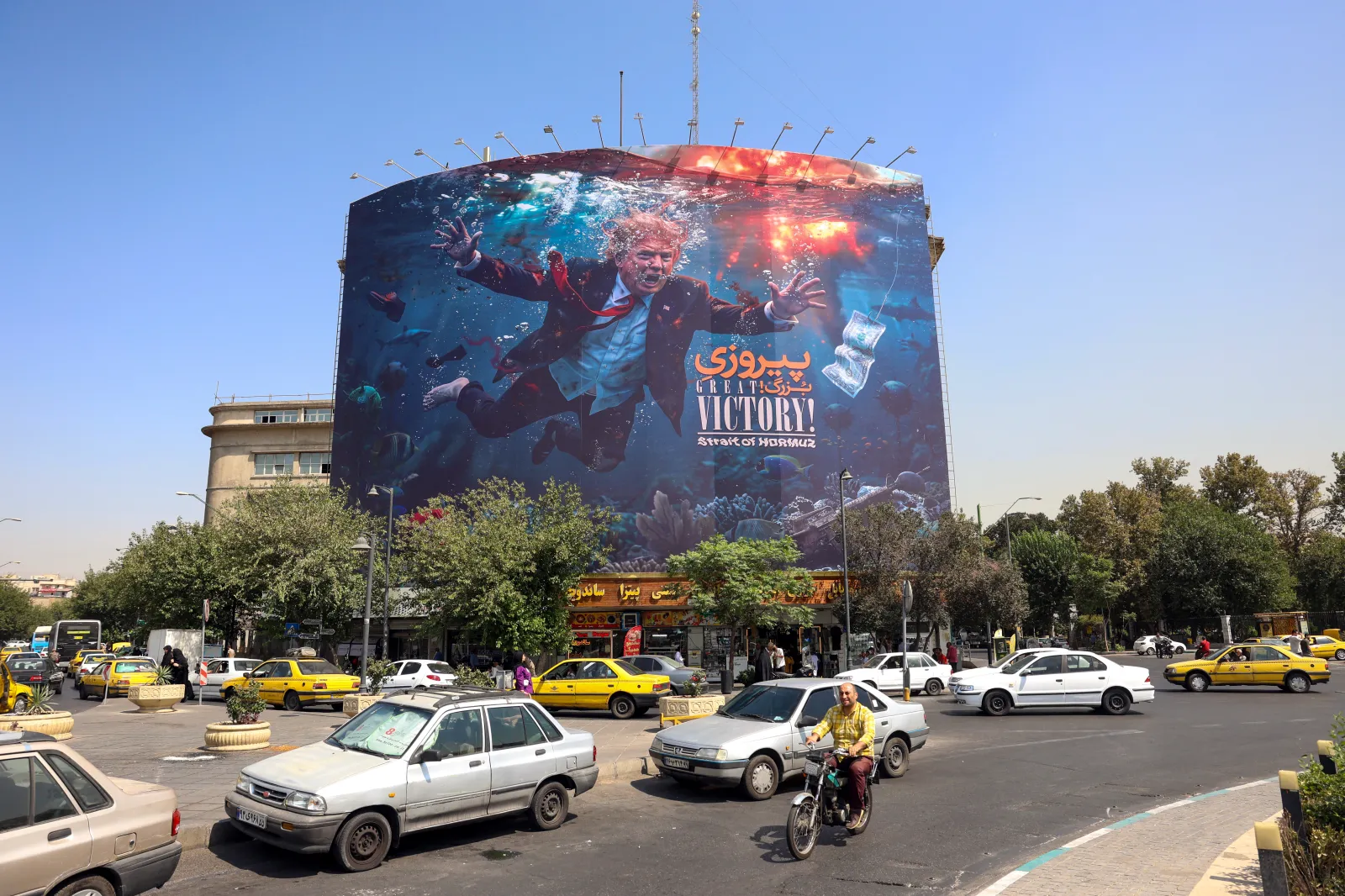
Motorists drive past an anti-US billboard in Tehran on August 24, 2026.
Motorists drive past an anti-US billboard in Tehran on August 24, 2026. | Photo by AFP via Getty Images

The pressure on Iran is already extraordinary. The rial traded at 2.02 million to the dollar on Sunday, down from 1.53 million in March, a 32 percent depreciation in under six months. Inflation is running near 90 percent by the Iranian government’s own Statistical Center, and the International Monetary Fund expects the economy to contract 5.4 percent this year.

Oil exports have stopped almost entirely: central bank governor Abdolnaser Hemmati has conceded that “we are not exporting oil,” tanker trackers have logged no Iranian supertanker crossing the Strait of Hormuz since July and floating storage has drained from 105 million barrels to fewer than 40 million.

The rest of the ledger is no better. Iranians are living with rolling blackouts and water rationing. Hezbollah is degraded, Hamas is gone, Assad has fallen, and the nuclear program is buried.

The supreme leader was killed in February and replaced by his son, a succession that satisfies no faction inside the system and commands no loyalty outside it. Four decades of regional adventurism and economic mismanagement have left the Islamic Republic weaker than at any point since 1979.

What makes this moment different is not the sanctions themselves. Washington has been designating Iranian entities for two decades with modest results. It is the architecture—three pressures applied at once, each closing an exit the others leave open. The U.S. Navy has been interdicting Iranian cargo since July, and Central Command reports redirecting 65 commercial vessels, disabling three and boarding two.

On August 19 the United Arab Emirates imposed an indefinite trade embargo after accusing Iran of firing ballistic missiles at its territory, closing the corridor through which roughly a third of Iran’s imports flowed—$21 billion in 2024, more than China and Turkey supplied combined—and through which Iranian firms had for years moved money past American sanctions.

Bessent’s designations then went after what was left: gold, aviation, shipping, digital assets. Retired general Mark Kimmitt called the Emirati embargo “even more significant than the embargo being put on by the United States.”

Any one of these Tehran could survive. Together they foreclose reconstruction. A regime cut off from the sea, from its warehouse in Dubai, and from the financial plumbing that served both cannot rebuild what the war destroyed—not the air defenses, not the missile plants, not the proxies, and not the nuclear program. That is a different objective from punishment, and it is the one worth pursuing.

What the loss of oil revenue did to Moscow is worth stating precisely, because it was not bankruptcy. The Soviet state paid its soldiers and its secret police until the end.

What it could no longer do was act. Grain production had stagnated while some 80 million people moved into the cities, and without oil revenue the Kremlin had to borrow from Western banks to feed them. “We are buying the grain because we cannot survive without it,” Soviet president Mikhail Gorbachev conceded.

When the Politburo weighed crushing Solidarity in Poland, and later reasserting control over the Baltics, its creditors made the price clear and Moscow backed down. The empire had become something the Soviet Union could not afford.

Washington saw the vulnerability and pressed it. National Security Decision Directive 66, signed in November 1982, targeted what President Ronald Reagan’s aides called Moscow’s strategic triad of technology, trade and credit, on the premise that energy exports funded everything the Kremlin did abroad.

None of which is to hand American policy total credit for 1991. Afghanistan drained Moscow’s treasury and its legitimacy, central planning had failed on its own terms long before Reagan took office in January 1981, and the nationalisms rising in the republics were beyond the Kremlin’s power to contain.

Economic pressure does not bring down a healthy regime. It adds weight to a system already under strain and narrows the choices available to the men running it.

The economic route works slowly and invisibly, which is why Washington chronically undervalues it. In 1985, Norman Podhoretz published an essay in Foreign Affairs titled “The Reagan Road to Détente,” accusing the most anti-Communist president of the century of drifting toward the accommodation with Moscow he had campaigned against.

Podhoretz, who died in New York last December at 95, was a serious man making a serious argument, but he was wrong. The campaign that was working produced no summits, no headlines, and no visible results for years.

The measure of success is not a surrender ceremony or a date on which the regime falls. It is a government in Tehran that cannot afford to rebuild what was destroyed in February, cannot pay to reconstitute Hezbollah, and has to weigh the cost of every convoy and every centrifuge against a treasury it has no way to refill.

Moscow reached that point in 1986 and spent five more years pretending otherwise. Iran is closer to it now than it has ever been.

Joseph Epstein is the director of the Turan Research Center.