Sunday, March 11, 2018

The New New Cold War by John Feffer

The New New Cold War

 
by John Feffer
When an epoch ends, as the Cold War did between 1989 and 1991, it takes some time to come up with a name for the new order. For some years, the world lived in a “post-Cold War” era. That phrase was supposed to capture the optimism of a new beginning as well as the uncertainty that accompanies any great transition.
“Post-Cold War” didn’t last long. The horrors of Yugoslavia, Rwanda, and Somalia in the 1990s were a grim reminder that the confrontation between the Soviet Union and the United States wasn’t the only source of instability and violence in the world. Instead of disappearing, NATO not only discovered new missions for itself but began a seemingly inexorable march eastward during the Clinton years. New tensions emerged between Beijing and Washington.
By December 1994, The Economist was already using a new phrase to describe this brave new world: “post-post Cold War.”
Plenty of pundits came up with their own phrases to describe the post-1989 reality. There was the rise of the Pacific Rim, the EU-ification of the globe, the division of the world into three currency zones (yen, euro, dollar), and the descent into civilizational clashes. In the early 2000s, the BRICS emerged, along with a new vision of multipolarity. In the mid-2000s, Thomas Friedman pushed his thesis that the “world is flat.” By the end of the 2000s, Fareed Zakaria was talking about a post-American world, a “rise of the rest.”
Nothing has stuck, for the post-post Cold War reality has outpaced the attempts of pundits to define it.
And now, if you had the misfortune of falling into a coma just before the Soviet Union collapsed in 1991 and only happened to wake up last year, you might actually think that you haven’t missed much at all.
Both Russia and NATO are conducting large-scale military exercises — “Zapad” vs. “Aurora” — across from each other along the Eastern European border. In his annual address to parliament last week, Russian President Vladimir Putin described a new generation of hypersonic nuclear missiles that would render U.S. anti-ballistic missile system as porous as cheesecloth (actually, given its technical difficulties, the system is already little more than a shamanic invocation).
In December, meanwhile, President Donald Trump authorized the largest commercial sale of weaponry to the Ukrainian government and then followed up this month with the provision of precisely the heavy equipment — Javelin anti-tank missiles — that Ukraine lamented were not part of the December package.
As of mid-February, a street outside the Russian embassy in Washington, DC has been re-named Boris Nemtsov Plaza, after one of Vladimir Putin’s assassinated opponents. This might remind old-timers of the decision back in 1985 to rename the segment of 16th Street outside the Soviet embassy Andrei Sakharov Plaza, after one of the prominent Soviet dissidents.
Thirty-three years, and only the names of the streets have changed.
Let’s be clear. This is not simply a “new Cold War.” That phrase emerged rather quickly in the 1990s, with no less a figure than George Kennan declaring the Senate vote in 1998 on NATO expansion “the beginning of a new cold war.”
No, this is, like the post-post Cold War, the “new new Cold War.” Perhaps, as I wrote back in 2014, the Cold War will eventually be viewed like the 100 Years War, an epic struggle across more than a century with the occasional lull that fools observers into believing that peace has come. But for the time being, let’s treat this recrudescence of conflict between Moscow and Washington as something different from that old ideological struggle between capitalism and communism or the narrower disagreements over European security architecture in the 1990s.
This new new Cold War — between a United States nostalgic for its glory days of the 1950s and a Russia equally nostalgic for the same period of time — is potentially very dangerous indeed.
Yes, much of the responsibility for this conflict lies with the more powerful party, the United States. As I pointed out in that same 2014 article, “If the United States had disbanded NATO, pushed for nuclear abolition, and helped to create a new security architecture for Europe that included Russia, the Cold War would have died a natural death. Instead, because the institutions of the Cold War lived on, the spirit of the enterprise lay dormant, only waiting for the opportunity to spring forth.”
But let’s dispense with two equally ridiculous notions. This uptick in tensions does not in any way “prove” that the Russiagate allegations are fallacious. And not all critiques of Russian actions — from the wars on its periphery to its actions in the far abroad — should be read as somehow a covert desire to see a return of the Cold War.
Defusing this new new Cold War will require a much more clear-eyed view of Vladimir Putin and the future trajectory of Russia.
First the Stakes
Today’s Russia isn’t the major military force that the Soviet Union once was. Sure, it comes in as the third largest spender in the world, but that’s actually not as impressive as it sounds. In 2016, the United States was responsible for 36 percent of total global military spending. China was number two at 13 percent. And Russia managed a mere 4.1 percent, just a nose ahead of Saudi Arabia.
Of course, $70 billion in annual spending still translates into a lot of firepower. And until recently, Russia had actually been behind Saudi Arabia in fourth place. In 2016, it boosted its share of military spending as part of the overall budget to over 5 percent, its highest since 1991. Meanwhile, the Kremlin presides over one of the two largest nuclear arsenals in the world.
Vladimir Putin has not only embarked on a serious modernization of the Russian military — begun in 2011 at an estimated price tag of $670 billion and including $28 billion by 2020 to upgrade the nuclear triad — but considers military force to be a key element of statecraft. The seizure of Crimea and the war in eastern Ukraine illustrate the relative importance of diplomacy and military in Putin’s thinking, while military force has positioned Russia as a player in the Syria conflict where it can now assert its vaunted diplomatic role.
Although it has plenty of conventional and nuclear firepower, Russia has also developed its “asymmetrical” capabilities — cyberwarfare, disinformation campaigns, and the maskirovka (deception) operations that attempt to conceal Russian involvement (as with the “little green men” in Ukraine). Russia cannot hope to achieve “full-spectrum dominance” worldwide. But it can certainly control its “near abroad” and play a spoiler role elsewhere.
Under Donald Trump, meanwhile, the United States is starting from a much more well endowed base and surging from there. Trump wants to up the Pentagon budget to $700 billion in 2018 and $716 for 2019. As analyst William Hartung points out, that’s an additional $165 billion for two years — which is more than what the Russians will spend overall during the next two years. “It brings total spending on the Pentagon and related programs for nuclear weapons to levels higher than those reached during the Korean and Vietnam wars in the 1950s and 1960s,” he writes, “or even at the height of Ronald Reagan’s vaunted military buildup of the 1980s.”
At one point, Trump called for a massive increase in the U.S. nuclear arsenal. With the latest version of the U.S. nuclear strategy released in February, he has settled for something a little different — and even more dangerous: more usable nukes.
The Obama administration, for all the contradictions of its nuclear policy, at least took steps to reduce the usability of nuclear weapons. Not so the Trump administration. It wants more “low-yield” nuclear weapons in order to incorporate them into actual war planning — as in “limited nuclear attacks.” This is supposedly in response to Russia’s similarly lowered threshold for the use of nuclear weapons — Moscow’s purported “escalate to de-escalate” strategy — but that in fact is a misreading of Russian nuclear doctrine.
The National Security Strategy, released in December and showing the imprint of National Security Advisor HR McMaster, reserves some choice words for Russia. The NSS groups Russia with China as the twin hegemonic threats to U.S. global power. It asserts that:
Russia is investing in new military capabilities, including nuclear systems that remain the most significant existential threat to the United State, and in destabilizing cyber capabilities. ­Through modernized forms of subversive tactics, Russia interferes in the domestic political affairs of countries around the world. The combination of Russian ambition and growing military capabilities creates an unstable frontier in Eurasia, where the risk of conflict due to Russian miscalculation is growing.
Them’s fighting words!
Finally, the Trump administration has not relinquished the overall U.S. foreign policy of fighting anywhere and everywhere in the world. It promises to scale back on programs that particularly irked the Kremlin — such as democracy promotion through the auspices of the National Endowment for Democracy and its attendant institutions — but otherwise it has upped U.S. military commitment in Afghanistan and Syria. And it seems to be angling to expand the conflict with Iran, a key Russian ally.
So: new capabilities, new strategies, new fears, new rhetoric. The bromance between Trump and Putin has obviously not yielded an improvement in U.S.-Russian relations.
But please: This has little to do with Russiagate.
Russiagate and the Cold War
Russia tried to influence the U.S. elections. But it remains unclear how effective it was and how closely it worked with the Trump campaign. I’ve written about why I think this somethingburger comes with all the fixings.
But let’s put that controversy to one side for the moment to focus on a different kind of assertion: that Trump’s current stance toward Russia somehow “proves” that there was no coordination between the two at some point during the campaign or between the election and inauguration.
Let’s hear from “rogue journalist” Caitlin Johnstone, who has cultivated a following on Medium with her anti-Russiagate rants:
You need to plug yourself into Louise Mensch and Rachel Maddow ramblings so extensively that you can contort your sense of reason to the point where it looks perfectly rational to believe that Putin was omniscient enough to know that Trump could defeat all primary opponents and take the fight to the heir apparent Hillary Clinton back when virtually no one else imagined such a thing was possible, recruited his team reportedly at the cost of billions of dollars, poured all kinds of intel and resources into ensuring Trump’s election using hackers and bots to influence American opinion, only to get a U.S. president who is, when it comes to facts in evidence, already just a year into his administration demonstrably more hawkish towards Russia than his predecessor was.
It takes a certain chutzpah to complain about other people’s “ramblings” with a sentence as serpentine as that one. But let’s ignore the stylistic excesses and focus instead on the twisted logic.
Putin’s omniscience is not at issue. The Kremlin has backed all sorts of long shots without any guarantee that they will pay off in the short term or even over the long run. Putin knew what he didn’t like: a U.S. foreign policy consensus that generally backed NATO expansion, democracy promotion, and U.S. military interventionism. Trump seemed to offer something different. Plus, supporting Trumpism helped drive various wedges into the U.S. political system.
Has Trump proven to be more hawkish than Obama?
Well, yes, he has authorized the arms sales to Ukraine and has promised a new round of sanctions against Russian cyber entities. He has proven to be a disappointment to Moscow in his opposition to the Iran nuclear deal and his support for a surge in Afghanistan.
But in other respects, Trump has been more accommodating of Russia in Syria, has not raised issues of human rights with Putin, and has consistently taken Putin’s word on the various Russiagate issues. Other foreign policy positions that Trump has taken probably warm Putin’s heart as well, such as his scrambling of transatlantic relations, his withdrawal from the Trans Pacific Partnership, and his broadsides against immigration. So, it’s a mixed bag.
But the real problem is the projection backward of a result that was indeed very hard to predict. Trump has been the very definition of unpredictability — as a businessman, as an “entertainer,” as a husband, and yes, as a political figure. The fact that Trump has taken certain hardline positions against Russia can’t be taken, ex post facto, as proof somehow that Putin wouldn’t have bothered to put the energy or resources into supporting Trump because he must have anticipated that outcome. If Putin lacked the omniscience to know that Trump would get elected, he obviously couldn’t predict what the president would do in office either.
I imagine — and I’m just guessing here — that Putin feels that:
  • He got pretty good bang — a lot of American political chaos and a reduction of the U.S. global hegemonic footprint — for not a lot of bucks.
  • S.-Russian relations still suck, but given the power of the Blob in Washington, any real improvement from the Obama years would have been the real long shot.
  • At least Trump is proving to be useful from a domestic point of view. Putin can use the American military build-up to justify his own continued modernization and burnish his own credentials as the strongman that Russia desperately needs in these perilous times.
And you thought that only the American military-industrial complex ran on foreign threats?
From Critique to Cooperation
There might be a few critics of Russia who would be happy to throw another bag of ice onto the new new Cold War between the world’s two largest nuclear powers. Former UN ambassador John Bolton comes to mind, or perhaps the ever-lunatic former Pentagon official Frank Gaffney.
But the notion that covering Russiagate or critiquing Russian policies represents a desire to disrupt U.S.-Russian relations even further is far-fetched. Media critic Norman Solomon makes an even more logic-defying leap in an AlterNet piece from January: “Narratives scapegoating Russia now have an extremely powerful grip on the USA. The consequences include heightened U.S.-Russia tensions that absolutely mean heightened risks of nuclear war and worsening threats to democratic discourse at home.”
Nonsense. U.S.-Russian tensions existed prior to the 2016 election and have far more to do with NATO expansion, Russian moves in Ukraine, disagreements over Syria, and Putin’s own efforts to dispatch his domestic critics. An investigation into Russian activities in the U.S. presidential campaign, which has already yielded any number of revelations (though you can dispute the impact of those activities), is an entirely legitimate exercise in a democracy.
To connect these critiques of Russian behavior to an increased risk of nuclear war and threats to democracy at home is an extraordinary overstatement. It’s the actions of the two leaders that are contributing to the increased risk of nuclear war. And can you cite any examples of how Russiagate investigations have threatened democratic discourse in the United States? Okay, Glenn Greenwald no longer appears on the Rachel Maddow show. But he seems to have taken this “McCarthyism” in stride by appearing before larger audiences on Fox.
There’s no dispute, however, that U.S.-Russian relations are at a nadir. So, the question must be: what to do?
First, as during the original Cold War, let’s come up with some ground rules. Back then, you could support arms control and disarmament activities and still criticize the Soviet Union for its human rights record, its foreign policy, and the lousy chocolate it produced. It pains me that this kind walk-and-chew-gum distinction must again be made with respect to Russia, but so be it.
Next, during the Cold War, activists in the east and the west teamed up in support of peace and human rights on both sides of the divide. It’s essential that peace activists pursue something similar today. Neither East nor West, neither Trump nor Putin!
Third, let’s focus on making Eastern Europe — the broader swath that includes the eastern members of the European Union as well as Ukraine and Belarus — a zone of peace. Let’s start with the easy part, places like the Czech Republic, Slovakia, and Hungary, which are EU members but maintain good relations with the Kremlin.
I’m no fan of the leaders of those countries, but let’s leverage their influence. These countries would lose the most from any escalation in tensions between Washington and Moscow. They must take the lead in creating a new kind of security forum for addressing the tensions of the new new Cold War. Bulgaria and Serbia would certainly join. Poland and Romania would be tougher sells.
Once that’s in place, let’s move on to Ukraine and come up with a solution that can satisfy both Kiev and Moscow. It might mean bidding Crimea goodbye — a move I’ve compared to cutting off your arm to get out of an impossible situation — but that would be a small sacrifice for the territorial integrity of the rest of Ukraine plus peace and security for the region.
Is this something that Putin and Trump can pull off? I have my doubts. But these guys won’t be in power forever. The Cold War has been around, in various permutations, for a long time. It will take patience, organizing, compromises, and some luck to bury it once and for all.
Reprinted, with permission, from Foreign Policy In Focus. Photo: U.S. troops drill in Estonia (U.S. Army Europe via Flickr).
Print Friendly, PDF & Email

avatar

John Feffer

John Feffer is the the editor of LobeLog and the director of Foreign Policy In Focus at the Institute for Policy Studies. He is also the author, most recently, of the dystopian novel Splinterlands (Dispatch Books). He is a former Open Society fellow, PanTech fellow, and Scoville fellow, and his articles have appeared in The New York Times, Washington Post, Los Angeles Review of Books, Salon, and many other publications.

Nikki Haley : Turning UN diplomacy into a ticket to the White House

Candidate Haley

The portrait that emerges is of a retail politician turning U.N. diplomacy into a ticket to the White House.

Over the winter holidays, the U.S. Mission to the United Nations got around to hanging the official portrait of Ambassador Nikki Haley alongside the images of President Donald Trump and Vice President Mike Pence in its lobby in New York.
But there was something, or someone, missing. In the spot where the portraits of America’s previous top diplomats, Hillary Clinton and John Kerry, once hung was an unused picture hanger. The U.S. secretary of state, Rex Tillerson, had been essentially airbrushed out of this American diplomatic tableau.
The elimination of America’s top diplomat from the mission’s lobby gallery highlighted the contentious nature of relations at the top of the president’s diplomatic team, as well as the unique nature of Haley’s tenure as U.S. ambassador.
The first Republican Cabinet-level U.N. ambassador since the end of the Cold War, Haley has rejected the traditional chain of command that grants the secretary of state the primary policymaking role, and she has made it clear she will accept nothing less than to be Tillerson’s equal. Her voracious pursuit of the spotlight, meanwhile, has elevated her national profile and strengthened her prospects for higher political office should she decide, as many suspect she will, to pursue the American presidency.
“Overall, the consensus in Republican national security circles is that she has done herself a huge favor by taking this position and going to New York,” says Daniel Vajdich, a Republican foreign-policy expert who advised the presidential campaigns of Mitt Romney and Ted Cruz. “She can be a very popular candidate in 2020 or 2024.”
In the course of a year, the former South Carolina governor has transformed herself from a diplomatic dilettante into the highest-flying foreign-policy luminary in the Trump administration. Every week brings glowing reviews — CNN called her a “breakout star” — of her blunt performances, and talk of a future as a presidential contender in the post-Trump era. Time magazine put Haley on its cover, honoring the Indian-American diplomat for being among “women who are changing the world.”
She has routinely outmaneuvered and eclipsed Tillerson as the most visible spokesperson for American foreign policy, and she’s secured a place at the table in discussions of the biggest national security issues of the day, from Iran to North Korea. She has even dared to defend the right of women who claim to have been sexually abused by Trump to have a fair hearing — and survived.
Her performance at the United Nations, however, has received more mixed reviews from current and former U.S. officials, as well as diplomatic counterparts who have worked closely with her over the past year.
Haley, they say, has achieved concrete successes, prodding a reluctant China to support a pair of tough sanctions resolutions on North Korea. She has fended off White House threats to bankrupt the United Nations and warmed the hearts of allies from Turtle Bay to Capitol Hill with her withering condemnations of Russian President Vladimir Putin and Syrian leader Bashar al-Assad. But Haley has also presided over highly controversial Middle East policies that have deepened America’s international isolation even as they have bolstered her political standing at home.
Colleagues who once cheered her as the administration’s pragmatist, a vital bridge between the White House and the U.N., see her increasingly as a political opportunist who has placed her pursuit of the presidency above her efforts to maintain America’s alliances and its standing in the world.
“It’s become increasingly obvious she is running for something, which is fine,” says one U.N. Security Council diplomat, who predicts her stance on Jerusalem would win her votes should she decide to run in the 2020 U.S. presidential election.
But that, the diplomat, says, “means she is up to more than promoting the U.S. interest at the U.N.”
“It’s become increasingly obvious she is running for something, which is fine,” says one U.N. Security Council diplomat, who predicts her stance on Jerusalem would win her votes should she decide to run in the 2020 U.S. presidential election.

Haley declined to be interviewed for this story. But a spokesperson from the U.S. Mission to the United Nations challenged any suggestion that she was pursuing the White House job. She devotes much of her time to tackling “critical foreign-policy issues” from North Korea to Iran and Israel “because they consume much of the U.N.’s time,” according to the official, who responded to a list of written questions on the condition of anonymity. She has also promoted human rights, reform of the U.N.’s multi-billion dollar peacekeeping enterprise, and increased aid to Syrian refugees “because its the right thing to do.” Haley, the official adds, “is focused on enacting President Trump’s agenda at the United Nations and representing the American people to the best of her abilities.”
As for the missing Tillerson portrait, the official says: “We should hope we haven’t gotten to the point where pictures in our lobby are an actual thing a publication like FP would report on. That would take the palace intrigue obsession to a new level.”
Above: Then-Governor Nikki Haley takes a selfie with a fan during the Republican National Convention on July 20, 2016. (Jabin Botsford/The Washington Post via Getty Images) Top: Haley answers questions at the White House on April 24, 2017. (Cheriss May/NurPhoto via Getty Images)
Nimrata “Nikki” Haley, the 46-year-old daughter of immigrants from Punjab, India, charted a remarkable rise to political prominence in South Carolina politics. In January 2011, she became the first woman and first member of a minority group to reach her state governor’s mansion.
Haley was buoyed by a critical endorsement from former Alaska Gov. Sarah Palin at the height of the Tea Party movement. But her particular brand of conservatism in South Carolina stood as an affront to Trumpism. Still, her popularity in the party marked her as a potential candidate for vice president.
Unabashedly pro-trade (South Carolina’s economic resurgence was built with the help of foreign carmakers such as BMW, Volvo, and Mercedes), Haley had promoted a more inclusive strand of Republicanism that seeks inroads into growing minority communities. “Republicans need to remember that the fabric of America came from these legal immigrants,” she said during the Republican presidential primary.
Her national profile rocketed in the summer of 2015, after she ordered the removal of the Confederate flag from the South Carolina statehouse. Delivering the GOP’s response to then-President Barack Obama’s State of the Union address in January 2016, she pleaded with Americans to resist the temptation “to follow the siren call of the angriest voices.”
Even as she accepted Trump’s offer to serve at the U.N., Haley distanced herself from the new president on multiple key foreign-policy fronts, carving out an approach that hewed closer to Republican foreign-policy leaders in the Senate, including Bob Corker, Lindsey Graham, and John McCain. She pilloried Russia, denouncing Putin as an untrustworthy rival and dismissing the prospects of working productively with Assad in the war against the Islamic State.
“I think she picked up the mantle for conservatives not represented in this administration, and she is to be their champion, because they are going to be back in power later,” says one senior foreign-policy advisor to President Trump.
Having staked out a seemingly independent platform, Haley’s arrival in New York in January 2017 came as a relief to the U.N. community, which feared Trump aimed to kneecap multilateral institutions as part of his “America first” drive. In her confirmation hearing, they noted, Haley had exhibited a level of pragmatism that put her colleagues at ease. She opposed the imposition of “slash and burn” budget cuts proposed by the White House that would have devastated U.N. operations, and she highlighted the need to preserve important alliances.
After her confirmation, Haley confided to staff that Trump had provided her with a personal assurance that she would have a free hand to set foreign policy, marking a sharp break with tradition. Haley may have arrived on her first day at U.N. headquarters warning her diplomatic counterparts that she would be “taking names” of foreign delegations that crossed the United States, but that threat was dismissed by colleagues as bluster aimed more at a energizing a domestic political base than a real imperative.
Haley’s European colleagues noted that her core positions from Russia to Syria and Ukraine aligned neatly with their own, making her a potential partner who might soften the contours of the president’s controversial policies. “She couldn’t have been better from our point of view,” says one U.N. Security Council member. “She positioned herself comfortably at our end of the administration’s spectrum.”
That she had little diplomatic experience might actually serve as an advantage. “She doesn’t know enough about foreign policy to know what is her foreign policy,” the diplomat says. “I think essentially, because of ignorance, she was very open to advice.”
“She doesn’t know enough about foreign policy to know what is her foreign policy,” the diplomat says. “I think essentially, because of ignorance, she was very open to advice.”

Arriving at the U.N.’s headquarters at Turtle Bay in late January 2017, Haley won over the career staff with a commitment to lighten their workload. Her predecessor, Samantha Power, had gained a reputation as a stern taskmaster, pressing her team to work late hours and through the weekends. During her first town hall meeting with staffers, Haley said that she expected staffers to check out every night at a reasonable hour. If they couldn’t finish their work on time, they could simply pick up the next day.
“She cut overtime and told staff to be smarter with their time to get the job done,” her spokesperson says. “Previously staff had no family time, and Ambassador Haley has always felt that if your family life is good, your work will be productive.”
Haley also dispatched her advisors to come up with ideas, signaling a willingness to listen to her staff. One career staffer asked a political aide of the new ambassador: “What is Haley interested in?” The response was: “You tell us.”
The process resulted in the selection of five key priorities that would define Haley’s tenure: North Korea, Iran, Syria, U.N. reform, and humanitarian relief for the world’s neediest. Haley, a staunch pro-Israel politician, also made a personal commitment to counter what she characterized as deeply rooted anti-Israel bias at the United Nations.
At the same time, Haley proved to be a more elusive leader. She ended Power’s practice of convening a meeting each morning with senior staff and experts. Career staff used to have access to Power’s daily schedule, but Haley’s is kept secret.
Most of the mission’s work was channeled through a small coterie of Haley loyalists, many of whom worked for her in South Carolina, including Jon Lerner, a former pollster who heads up Haley’s Washington office, and David Glaccum, her chief of staff.
Haley’s spokesperson says that she communicates daily with career and non-career staff and “considers all of their expertise and opinions.”
Despite her foreign policy limitations, her political skills and her close relationship to the president have earned her admiration from colleagues. A seasoned retail politician, she has a knack for translating complex diplomatic quandaries into simple language that is accessible to Main Street. And she has proved adept at maneuvering through the Trump administration, a skill that has, they feel, kept a hostile White House at bay.
But her way of working has also put her on a collision course with Tillerson, particularly on one of the most critical aspects of U.S. foreign policy: the Joint Comprehensive Plan of Action, better known as the Iran nuclear deal.
Haley holds up photos of victims of chemical attacks in Syria during a meeting of the U.N. Security Council in New York on April 5, 2017. (Drew Angerer/Getty Images)
Since his inauguration, Trump has sought to extricate the United States from the landmark 2015 Iran nuclear deal, which placed strict limits on Tehran’s nuclear program in exchange for billions of dollars in sanctions relief. Under U.S. law, the president is required by Congress to certify whether Iran is in compliance with its obligations under the nuclear pact every 90 days.
Trump twice grudgingly certified to Congress, in April and July, that Iran had met its commitments under the deal. But he had grown frustrated with Tillerson — who supported certification — for failing to provide him with a plausible case for backing out of the nuclear pact that he had denounced as an “embarrassment to the United States.”
Over the summer of 2017, Trump tasked a White House team of loyalists with devising a strategy that would allow him to decertify the pact when it came up for review in October. In August, Haley wrote an email to White House national security advisor H.R. McMaster asking if she could take a more high-profile role in advancing the president’s Iran cause; he gave her the green light.
Over the following weeks, Haley pulled together a small group of close political advisors, including Lerner and Carrie Filipetti, to draft a major foreign-policy speech on Iran, which she delivered on Sept. 5, 2017, at the American Enterprise Institute. But Haley prevented her own experts at the U.S. Mission to the United Nations from briefing her on the nuclear pact or reviewing the speech for errors before it was delivered. Haley also bypassed the rigorous interagency vetting process that usually accompanies the preparation of a major foreign policy speech, according to one official familiar with the matter.
Instead, Haley’s team has relied heavily on conservative individuals and think tanks, including former U.S. Ambassador to the U.N. John Bolton and the Foundation for Defense of Democracies, to provide a steady diet of briefings and policy papers on Iran.
Last summer, Bolton pressed Haley to trigger confrontation with Iran that could be used as a pretext for walking away from the Iran nuclear deal. The plan, according to one official, was to press the intelligence agencies to declassify intelligence suggesting improper activity is occurring in Iranian military bases. She would take that information to the International Atomic Energy Agency and press it to conduct an inspection.
“He went to her, sat her down and said: ‘Here is an idea: you should push this,” says an official familiar with the meeting. “We thought she got it, but she still hasn’t done it.”
Haley’s spokesperson says that Haley has spoken many times with Bolton, and that she values his counsel, but said the “depiction of his advice about Iran is entirely inaccurate.”
The spokesperson also denies Haley had sought a larger role on Iran from McMaster: “The president has spoken with Ambassador Haley frequently about Iran policy and has encouraged her to be outspoken about Administration policy toward Iran’s dangerous conduct.”
Haley’s AEI speech didn’t explicitly recommend the president renounce the Iran nuclear pact, but it provided a scathing account of what she saw as its shortcomings. She also provided a defense for pulling out of the deal if that the president decided to do so.
The speech achieved three important goals for Haley: It placed her at the center of one of the administration’s most important foreign-policy crises — one that was traditionally managed by the State Department, bolstered her relationship with the president, and distinguished her from Tillerson, who has emerged as her chief competitor for Trump’s ear.
But the statement was sloppy, riddled with mistakes and mischaracterizations that could easily have been picked up by experienced staffers, according to current and former U.S. officials.
For instance, Haley claimed, incorrectly, that the Obama administration had asserted the deal would eliminate Iran’s nuclear program. The deal envisioned that Iran would develop a peaceful nuclear energy program subject to international monitoring by the International Atomic Energy Agency. She also confused a heavy water production plant for a reactor, according to Richard Nephew, a former State Department official who helped negotiate the nuclear deal. Nephew annotated the speech to point out mistakes. The Cato Institute, meanwhile, published its own critique of the speech titled “Nikki Haley’s Alternative Facts on Iran.”
Haley “suggested that Iran could have hundreds of covert nuclear sites which cannot be inspected under the deal, but offered no evidence for her assertion,” according to the report’s author.
Haley’s spokesperson says the Iran speech was “fully vetted by the NSC, and contained no inaccuracies. For every critic of the speech, we can provide you with experts who praised it.”
State Department spokesperson Heather Nauert also challenged the assertion that Haley bypassed the interagency vetting of Haley’s speech. “We were aware” of it, she told FP.
Her defenders downplayed the importance of any errors in the speech, noting that she is a politician, not a policy wonk, and that she has been effective where it counts: applying pressure to Iran on a range of fronts.
They cite a visit she paid to Vienna last August to press Yukiya Amano, the director-general of the International Atomic Energy Agency, to carry out inspections of Iran’s military sites. Supporters of the pact see it as a provocation aimed at manufacturing a confrontation between Iran and the international nuclear agency, which has so far found Iran in compliance with its obligations under the nuclear accord.
But critics of the Iran deal, including the White House, have been pushing for such inspections on the grounds that they would provide greater assurances that Iran isn’t hiding anything. Haley has also won praise from conservatives for her effort to declassify intelligence allegedly linking Iran to the illicit supply of ballistic missiles that Shiite Houthi rebels in Yemen fired at Saudi Arabia last year.
“She has been the most articulate voice in the administration in describing not only the fundamental flaws with the [nuclear pact], but also in reiterating at various forums the overall nature and gravity of the Iranian threat” says Mark Dubowitz, the CEO of the Foundation for Defense of Democracies. “I think her performance in New York has been consistently good on Iran.”
But Haley’s personal advocacy of controversial White House positions, such as the threat to ditch the Iran nuclear deal, carries potential diplomatic risks, and nowhere has this been more evident than her approach to Israel.
On Dec. 18, 2017, Haley faced off alone against the world, exercising the U.S. veto at the U.N. Security Council in defense of Trump’s provocative decision to recognize Jerusalem as the capital of Israel. The U.S. vote, she told the U.N.’s principal security body, had been cast in “defense of American sovereignty.”
The image of Haley raising her hand in defiance of the world’s powers constituted a compelling piece of political stagecraft that earned her plaudits from American conservatives, evoking the memories of Daniel Patrick Moynihan and Jeane Kirkpatrick, former U.S. envoys known for delivering blistering broadsides against America’s foreign critics.
But it was a questionable piece of diplomacy that left the world’s superpower isolated in a chamber of its own creation, at odds with some of America’s closest friends and allies, including Britain, Italy, France, Japan, and Ukraine. The humbling 14-1 vote against the United States was also unnecessary, according to Security Council diplomats from five countries.
In the days preceding the vote, Haley made little effort to cajole, threaten, or persuade her Security Council diplomats to vote against the Jerusalem resolution. While she dispatched an email to some colleagues underscoring the importance of the issue to the United States, there weren’t, as a U.N. Security Council diplomat recalled, the “barrage of phone calls” to ambassadors and their capitals that would typically precede an important vote. The State Department did not even send out formal diplomatic notes — known as demarches — to Security Council capitals seeking support. Only at the final hour did Haley make clear Washington would exact a cost for countries that opposed the United States.
“I am looking at you,” she told her council colleagues in a closed-door meeting just minutes before the vote. “The U.S. won’t forget, we will remember each and every one of you, we take this personally, we won’t forget what you did today when you will come at us asking for money or support.”
The threat, which would be echoed in a series of sharp public comments by Haley and Trump over the following days, was issued too late to sway the votes, as delegates had already received their voting instructions. Haley’s low-key strategy raised speculation among some of her colleagues that she had either seriously miscalculated the depth of opposition or that this was the outcome she sought. A second U.N. Security Council diplomat put it bluntly: “Haley wanted it that way.”
Indeed, one close American ally, Ukraine, that had voted in favor of the Jerusalem resolution in the Security Council reversed course after Haley turned up the heat. On the eve of a vote on a similar measure before the U.N. General Assembly, which adopted the nonbinding resolution by a vote of 128 to 9, Ukraine joined 21 countries who didn’t show up for the vote. Thirty-five others abstained from the vote. As a reward, those who didn’t vote in favor of the resolution, including Ukraine’s U.N. Ambassador Volodymyr Yelchenko, were honored by Haley with an invitation to a lavish “friendship” reception at the U.S. Mission to the United Nations, complete with a live jazz band.
A second council diplomat confided that his government would likely have abstained if Washington had pulled out all stops and mounted a full-fledged pressure campaign in his capital. “For sure, they could have turned us,” the diplomat tells Foreign Policy. “It wasn’t inevitable we wound up voting in favor of it.”
Haley’s spokesperson says Haley and the administration “actively contested the Jerusalem vote, both in the Security Council and the General Assembly,” and that her office “undertook many forms of outreach to make sure member states knew our position during both votes.”
U.S. Secretary of State Rex Tillerson, left, and Haley listen as Chinese Foreign Minister Wang Yi speaks during a Security Council meeting on North Korea in New York on April 28, 2017. (Eduardo Munoz Alvarez/Getty Images)
While the U.N. has undoubtedly proved an effective launching pad for raising her political profile, Haley’s politicking has also gotten her into trouble on occasion. In October 2017, the U.S. Office of Special Counsel accused her of violating the Hatch Act, which prohibits presidential advisors from using their official positions to influence the outcome of elections, by retweeting a presidential tweet in support of a South Carolina congressional candidate.
At other times, her lack of experience has led to awkward situations. In December of last year, Haley was successfully pranked by a Russian comedian impersonating Polish Prime Minister Mateusz Morawiecki, underscoring the limits of her command of the issues. When the fake Morawiecki asked Haley whether she was concerned about Russian intervention into the island nation of Binomo, a fictional island nation in the South China Sea, Haley said, “Yes, yes.”
And her embrace of increasingly hard-line positions on the Middle East, where she championed administration efforts to cut aid to Palestinian refugees, and Iran, where she has emerged as a sharp critic of the nuclear deal, has heightened concern among colleagues.
National security experts from both parties say that the depth of her knowledge of foreign-policy matters remains relatively shallow — about “one inch deep,” quips one Republican national security specialist.
But they remain grateful that she has rejected the isolationist rhetoric of the Trump presidential campaign, assuring lawmakers in her Senate confirmation hearing that: “I will bring a firm message to the U.N. that U.S. leadership is essential in the world.” Her uncompromising stance on Israel and Iran is also popular in Republican political circles.
“I think she understands that these are positions that will attract money from the Republican donor community, which responds very favorably to these hard-line positions on Israel and Iran,” Vajdich, the Republican foreign-policy expert, says.
“This is a very useful piece of evidence that says she is very much gearing up for the future, and at least leaving her options open. What she does at the United Nations is clearly intended to be a resume-builder and a platform for what she does in the future.”
“I think she understands that these are positions that will attract money from the Republican donor community, which responds very favorably to these hard-line positions on Israel and Iran,” Vajdich, the Republican foreign-policy expert, says.

More troubling is that her small team of political advisors made little effort to forge close working ties with Tillerson’s inner circle. In her first months in New York, Haley sought clearance on a range of policy issues from then-presidential counselor Steve Bannon, then-deputy national security advisor Dina Powell, and the president himself. Later, Haley worked through McMaster and forged relationships with the president’s daughter Ivanka Trump, on humanitarian issues, and son-in-law Jared Kushner, who has emerged as a close ally on the Middle East.
“Because I am a Cabinet member, I primarily work with Gen. McMaster at the [National Security Council],” she told the House foreign affairs committee last year. “I work more with the NSC than I do with the State Department.”
The arrangement, combined with her public speaking skills, has given her greater influence in interagency battles over policy, but it has deprived her of the vast diplomatic reinforcements the State Department’s career diplomats can provide and strained relations between the president’s two most influential diplomats. Tillerson is frequently absent at events she organizes.
The depth of their estrangement was obvious last fall when they were forced to share the stage at the U.N. General Assembly’s general debate, the world’s preeminent annual gathering of world leaders. The two attended the Sept. 20, 2017, session on Iran’s nuclear deal with separate entourages. The following day, Haley scheduled a press conference to brief reporters on the president’s activities at the same time that Tillerson was delivering a speech before the U.N. Security Council on the need to curb nuclear proliferators like North Korea.
But Tillerson’s absence at the administration’s signature event — a high-level meeting chaired by Trump on U.N. reform — was perhaps the most glaring. McMaster and White House chief of staff John Kelly were the only cabinet members to join her and the president for the session.
The relationship is even worse than it appears from the outside, and Haley and Tillerson have clashed from the beginning, says a Middle East analyst with close ties to the White House. “Her concern is she’s a Cabinet member,” the analyst says. “His concern is she works for him.”
A Trump foreign-policy advisor puts it more bluntly. “Tillerson is stumbling, and the White House has been in a state of chaos for much of the first year,” says the Trump source. “So Nikki just decided, absent a direction, ‘I’m just going to fill the void.’ She is grabbing the bull by the horns. Good for her.”
Haley’s spokesperson says that Haley had made it clear to President Trump “that she would only take the position if he could confirm it would be a cabinet-level position” and that she could participate in “policy making as an equal member of the national security team, and the president readily agreed.”
The official adds that while it is often difficult to align two cabinet members’ schedules, the two have worked together, and that she hosted a luncheon for Tillerson at the U.S. Mission to the United Nations in April 2017. Tillerson, the official adds, was issued an invitation to the president’s U.N. reform meeting, but he did not attend.
While the U.N. reform meeting may have drawn attention to splits in the president’s national security team, the fact that Haley had assembled a high-level delegation in support of the United Nations chief was viewed by colleagues there as a godsend, a sign that an often hostile American president was beginning to reconsider his views about the international body.
The reform meeting and the White House luncheons are “examples of Nikki Haley having delivered on bringing the president closer to the United Nations,” says João Vale de Almeida, the European Union’s ambassador to the U.N. As for Haley, “she is much more of a U.N. person today than when she first arrived. She is much more a part of our family than she was in the beginning.”
Still, Haley has faced criticism from colleagues, and some of her own staff, who feel she has placed a priority on organizing high-profile events heavy on symbolism but light on substance.
Before the reform meeting, the U.S. Mission sent out a one-page memo to governments seeking their support for the U.N. chief’s reform policies, complete with a list of 10 reform initiatives Washington favored, including the need to strengthen oversight and accountability over U.N. spending.
An effort to lure China into co-sponsoring the event faltered after Beijing asked to amend the text to highlight the importance of sustainable development. Haley refused. Some of her career staffers expressed skepticism over the U.S. initiative, saying it created the impression that the White House was driving the secretary-general’s U.N. reform effort.
“It invited scrutiny from those countries who see it as part of Western plot,” says one official. The response from Haley’s political team was “too bad,” the official says.
Even more disappointing was the lack of follow-up on what had been touted as a top American priority. Haley has moved on to other crises, the White House has yet to appoint an ambassador for management and reform, and there have been few, if any, interagency discussions about how to advance the reforms.
“Nothing came out of it,” the official says.
Haley’s spokesperson disputes that account, saying that Haley and her team “engage actively on a daily basis with the Secretary General, his team and other key U.N. member states.” The United States, the official says, did consider requests for amendments by members who participated in the reform event, but those changes had to be presented by a deadline; China apparently didn’t make it.
Several of Haley’s colleagues confirm that she has faded into the background in U.N. reform talks, but they view her initiative in this area as a diplomatic accomplishment. Trump, who once looked to sideline the world’s most prominent multilateral organization, has publicly endorsed the U.N. chief’s efforts to improve the U.N.
“She doesn’t care what people think of her in the U.N. bubble,” the U.N. Security Council diplomat adds, referring to her stance on Jerusalem. “She didn’t win any votes in the U.N. Security Council, but when the vote for 2020 comes, this will be a winning issue.”

FP’s senior national security coorespondent Dan De Luce contributed to this report.
Colum Lynch is Foreign Policy’s award-winning U.N.-based senior diplomatic reporter. (@columlynch)

Friday, March 9, 2018

Trump's Nuclear Posture Review

President Trump´s Nuclear Posture Review

9 Mar 2018
            
Nuclear deterrence may remain the top priority set out by the Trump administration’s “Nuclear Posture Review”. However, Oliver Thränert highlights that the administration’s nuclear policy has turned away from the Obama-era policy of reducing the salience of nuclear arms and renouncing new nuclear capability development. Further, as President Trump is dismissive of the concept of arms control, Thränert also warns that there is an increasing danger that the return of great-power rivalry with Russia and China could result in a nuclear arms race.
This CSS Analyses in Security Policy was originally published in March 2018 by the Center for Security Studies (CSS). It is also available in German and French.
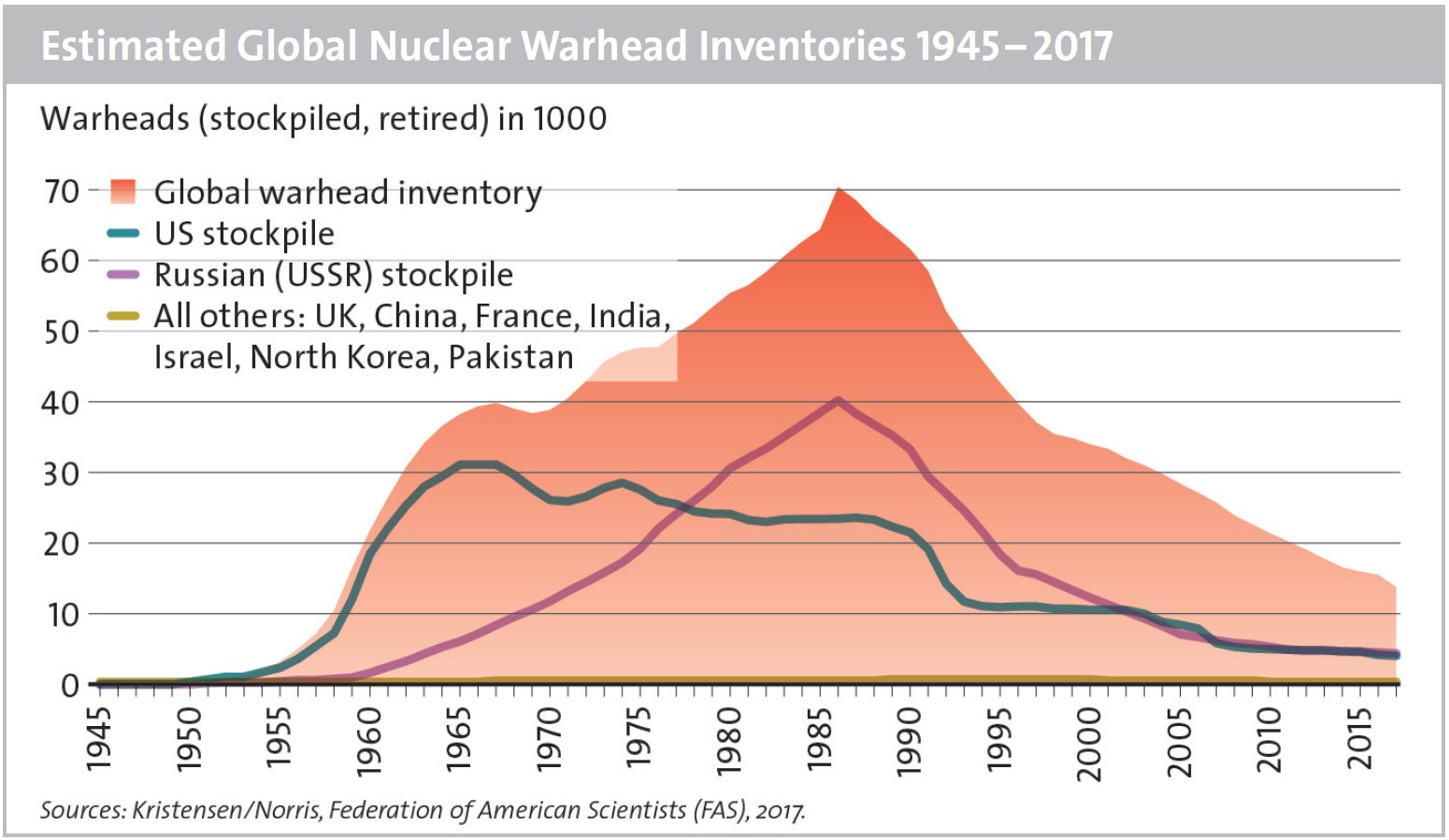
The US nuclear arsenal currently consists of about 4,480 warheads. About 1,740 of these are deployed. In his recently published Nuclear Posture Review, US President Donald Trump highlighted his priorities regarding the country’s nuclear weapons posture for the duration of his presidency.
There is a longstanding tradition for newly elected US presidents to develop a dedicated government paper on the future of the country’s nuclear arsenal, known as the “Nuclear Posture Review” (NPR). The first NPR was carried out on the orders of then US president Bill Clinton; later, Congress requested that presidents George W. Bush and Barack Obama publish NPRs of their own. Donald Trump delegated the NPR to his defense minister, James Mattis. It calls for the US nuclear arsenal to be modern, robust, flexible, resilient, and ready to deter the threats of the 21st century and to offer reassurance to Washington’s allies.
The NPR is a guideline for all decisions relating to the US nuclear arsenal, which includes not only the warheads proper, but also their delivery systems including missiles, bomber aircraft, submarines, and cruise missiles, as well as the underlying infrastructure, including command, control, and communication as well as research and development.
On the one hand, there are continuities in US nuclear policy under both Obama and Trump. The strategic nuclear triad of land-based, sea-based, and airborne delivery systems will be preserved, and the program for their modernization will continue. Like his predecessor, Trump will continue to base US nuclear arms in Europe and to pursue the policy of nuclear sharing with European NATO allies. On the other hand, there are some obvious and noticeable differences. Obama regarded nuclear proliferation and the specter of nuclear terrorism as the main challenges. He wanted the US to deal with them by reducing the reliance on nuclear weapons. Moreover, arms control was a main part of US nuclear policy under Obama. Trump – following up on his National Security Strategy as published in December 2017 – has highlighted the return of great-power rivalry, including in the sphere of nuclear policy. Against this background, Trump is aware of the need to develop flexible nuclear options, and thus rejects Obama’s policy of reducing the role of nuclear weapons in US security policy as far as possible. At the same time, Trump does not care much for arms control, again unlike his predecessor. Therefore, Trump’s NPR contains no suggestions for managing the nuclear great-power rivalry.
   
Image courtesy of US Department of Defense/Wikimedia.
Obama’s Nuclear Policy
In his speech at Prague Castle on 5 April 2009, Obama announced concrete steps toward a world without nuclear weapons. However, he also stated that as long as such weapons existed, the US would maintain a “safe, secure and effective arsenal” of its own.
According to the NPR of April 2010, the main threat was nuclear terrorism. Furthermore, since Iran and North Korea had violated the Nuclear Non-Proliferation Treaty (NPT), the proliferation of nuclear arms was assessed as another growing threat. Therefore, it was in the US interest to strengthen the NPT, which would require progress on nuclear disarmament. The US wanted to contribute by reducing the importance of nuclear weapons for its own security. A dialog for mutual stability would be initiated with Moscow. One part of these efforts was the New START treaty on limiting US and Russian strategic nuclear weapons, which was signed in the same year.
After intense internal debate, the Obama administration refrained from renouncing the first use of nuclear weapons. The main reason was that this might have diminished the credibility of US nuclear security guarantees in the eyes of some allies. According to Obama’s NPR, the US would only use nuclear weapons under extreme circumstances to defend vital US interests or those of its allies. The US would not use or threaten the use of nuclear weapons against non-nuclear countries that complied with the NPT. Moreover, the US would work to create the conditions for a feasible nuclear no-first-use policy. This meant strengthening the military’s conventional capabilities.
The classic nuclear triad of land-, air- and sea-based weapons was to be maintained, with the land-based intercontinental missiles each now carrying just one instead of multiple warheads. Additionally, all sea-based nuclear cruise missiles were to be decommissioned. In order to avoid a nuclear arms race that would weaken the NPT, the US refrained from developing new nuclear warheads and limited itself to “life extension programs” for its atomic weapons. Regardless, however, existing delivery platforms, i.e., missiles, submarines, and nuclear-capable military aircraft would have to be replaced. A multi-billion-dollar procurement program was therefore passed.
A Changing Environment
Since April 2010, there have been massive shifts in the international environment. The US and NATO on the one side and Russia on the other have once again become opponents in the wake of Russia’s annexation of Crimea in 2014 and its military intervention in Ukraine. Additionally, China is challenging Washington’s allies with an expansive strategy in Asia and building up its nuclear arsenal. The situation is further aggravated by North Korea’s ascent to become a nuclear power. The possibility that Pyongyang may already be able to destroy US cities with nuclear weapons creates new challenges for the US. Against this background, it came as no surprise that the Trump administration’s NPR would assign a much more important and robust role to nuclear weapons than had been the case during the Obama era.
The transition in nuclear matters from Obama to Trump had already been suggested by the National Security Strategy published by the White House in December 2017. Whereas Obama tried to reduce the role of nuclear arms as far as possible, Trump highlighted the US nuclear arsenal as the foundation of his strategy for maintaining peace and stability and deterring aggression against the US.
Threat Picture
Generally, the threat assessment presented in the Trump NPR is a grim one. Since 2010, it notes, no potential adversary has followed suit in mirroring US efforts to reduce the salience or the number of nuclear weapons. On the contrary, it states, “they have moved decidedly in the opposite direction.”
Also unsurprisingly, the Trump administration’s NPR adopts a tough tone with regard to Russia and China. Both powers, it claims, want to change the post-Cold War order. Moreover, it asserts that both challengers are pursuing asymmetric strategies to counter conventional US capabilities. The Trump document declares that Moscow is modernizing its nuclear systems at all levels, has many tactical nuclear arms at its disposal, and is in violation of the INF Treaty’s ban on intermediate-range nuclear weapons. What is more, Russia might be developing strategies for winning confrontations through nuclear escalation. According to the report, Moscow does not believe that the US is prepared to respond to Russian use of tactical nuclear weapons with strategic nuclear weapons of its own. China too is modernizing and expanding its nuclear capabilities, the NPR charges. The nuclear threat from North Korea rounds off the picture. The document asserts that Pyongyang’s nuclear program constitutes the most immediate proliferation threat to international security and stability. Finally, it continues, Iran has by no means given up on its nuclear weapons plans despite the agreement on limiting its atomic program. The Trump NPR claims that Iran would be able to build a nuclear weapon within about one year of a decision to do so.
Overall, the paper depicts the future as being fraught with insecurity. On the one hand, these fears relate to geopolitical factors: States might change their opinion of the US, or short-term power shifts could create imbalances in the international system. Also, the government of a nuclear-armed state could collapse, or a series of states could go nuclear in a rapid “proliferation cascade”. On the other hand, there are also insecurities relating to future technological advances that could suddenly render the US nuclear forces or their command-and-control system highly vulnerable to attack.
The Role of US Nuclear Weapons
Deterring potential adversaries from any nuclear weapons use remains the top priority of US nuclear policy. Furthermore, non-nuclear attacks must be deterred, allies must be reassured, US aims must be enforced should deterrence fail, and the country’s ability to ensure its safety in an uncertain future must be preserved. Despite initial worries to the contrary, the US under Donald Trump continues to affirm its commitment to the long-term goal of abolishing all nuclear weapons. However, it also asserts as “a bedrock truth” that nuclear weapons will continue to play a critical role in deterring nuclear attack and preventing large-scale conventional warfare against the US or its allies for the foreseeable future.
Going forward, the US would still “only consider the employment of nuclear weapons in extreme circumstances to defend the vital interests” of the US and its allies. The document says Washington will not use or threaten to use nuclear weapons against non-nuclear weapons states that are in compliance with their obligations under the NPT. In doing so, the Trump administration is adhering to the wording used by the Obama administration. However, the new nuclear document emphasizes that “[e]xtreme circumstances could include significant non-nuclear strategic attacks […] on U.S. or allied nuclear forces, their command and control, or warning and attack assessment capabilities.” Although the document does not explicitly say so, some observers argue that the Trump administration is considering nuclear strikes as a response to cyberattacks that inflict significant damage.
Graphic
The threat assessment, according to the NPR authors, highlights the need for a flexible nuclear strategy that includes tailored responses to a broader range of adversaries. The US, they claim, would strive to end any conflict and to restore deterrence at the lowest level of damage possible. However, its adversaries must understand that non-nuclear aggression or first use would “result in unacceptable consequences for them.” As a result, US policy retains some ambiguity regarding the precise circumstances that might lead to a US nuclear response, as well as the option of deploying those forces at any time and promptly.
Russian misperceptions that the US would be unwilling to respond to a limited nuclear aggression in a regional scenario with nuclear escalation of their own must be “corrected”, the NPR states. Therefore, the US nuclear arsenal must be expanded to include low-yield options. The authors claim that such a step “is not intended to enable, nor does it enable, ‘nuclear war-fighting,” but would instead raise the nuclear threshold, to maintain the unlikeliness of a use of such weapons. China, too, must be given to understand that any limited use of nuclear weapons would be unacceptable for the US. Regarding North Korea, the NPR leaves no room for ambiguity: There is no scenario, the authors state, in which the North Korean regime could use nuclear weapons and hope to survive. Neither should Tehran expect to find a plausible scenario in which it could gain an advantage through a strategic attack.
Armaments Programs
Like its predecessors, the Trump administration is committed to maintaining the nuclear triad and stationing dual-capable aircraft as well as matching nuclear warheads in Europe. Armaments programs begun under Obama are to be continued. Citing the need for more flexible and tailored nuclear options, Trump has rejected as inappropriate the policies of his predecessor, Barack Obama, who had renounced the development of new nuclear capabilities.
Specifically, over the coming years, the 14 Ohio-class submarines equipped with Trident nuclear missiles will be replaced by 12 Columbia-class boats. The 400 land-based Minuteman intercontinental rockets will be replaced from 2029 onwards by a new Ground-Based Strategic Deterrent (GBSD). Likewise, the 46 B-52H bombers carrying cruise missiles as well as the 20 B-2A bombers will be retired from the mid-2020s onwards, to be replaced by the new B-21 bomber. Furthermore, the US air fleet will take delivery of a new long-range cruise missile, the Long-Range Stand-Off (LRSO) weapon.
Furthermore, the fighter jets of the types F-15E and F-16, which are also stationed in Europe, will be replaced by the F-35A. These jets have both conventional and nuclear use. The Trump administration particularly emphasizes the modernization of the largely ageing US nuclear infrastructure, for example command and control. The US have to be capable to meet new challenges with well-educated personnel and the technology required, the NPR reads.
Probably the most controversial measure is the plan to equip a small number of existing sea-borne nuclear warheads with a low-yield option. Here, Trump is returning to plans that George W. Bush had pursued in similar fashion, but for which Congress had refused the necessary funds. Critics maintain such smaller nuclear weapons could make a nuclear war more likely, since it could lower the threshold for the use of such weapons. A long-term program will reverse the Obama administration’s policy by developing a modern nuclear-armed sea-launched cruise missile (SLCM). The apparent aim is to reassure US allies in Asia in the face of threats from North Korea and China. The total number of deployed US nuclear warheads will reportedly not be increased.
The perceived advantages of the new, sea-borne systems are seen in the fact that the US is thus not dependent on the support of its allies for strengthening regional deterrence. Neither, it is argued, would Washington be in violation of the INF Treaty, which only prohibits land-based intermediate-range systems. At the same time, the planned SLCMs are presented as a response to Russia’s INF violations. Should Russia return to compliance, reduce its non-strategic nuclear arsenal, and end “other destabilizing behaviors”, the US might reconsider its pursuit of a new SLCM.
Arms Control
Even under President Trump, the US is not abandoning nuclear arms control altogether. As the document lays out, arms control can foster transparency, mutual understanding, and predictability. However, arms control treaties must be verifiable and enforceable. It is here that the authors identify past deficiencies, as evidenced by Russia’s violation of the INF Treaty.
The US continues to acknowledge the NPT as the cornerstone of efforts to prevent nuclear proliferation. Washington will continue to support the Comprehensive Nuclear Test Ban Treaty Organization Preparatory Committee as well as the related International Monitoring System for the detection of nuclear weapons tests, even though the agreement has not entered into force and the US does not intend to ratify it. The document further explains that the US will not resume nuclear explosive testing, unless necessary to meet geopolitical and technological challenges or to ensure the safety and effectiveness of the US nuclear arsenal. The US calls on all other states possessing nuclear weapons to declare or maintain a moratorium on nuclear testing. Washington has already implemented all reductions that it agreed to under the New START Treaty and will continue to abide by this agreement with Russia, which limits the numbers of strategic nuclear weapons on both sides. The US also reserves the option of extending the treaty until 2026. At the same time, it rejects the Nuclear Weapons Ban Treaty, which has been opened for signature since 2017, claiming that it has “polarized the international community” and could damage the security of the US and its allies.
Nuclear deterrence remains the guiding principle under President Trump. However, the White House has turned away from the Obama-era policy of reducing the salience of nuclear arms. Since Trump is also dismissive of the concept of arms control, there is an increasing danger that the great-power rivalry with Russia and China could also result in a nuclear arms race.
About the Author
Dr Oliver Thränert is head of Think Tank at the Center for Security Studies (CSS) at ETH Zürich. He is, amongst others, the author of “No Shortcut to a European Deterrent” (2017)
For more information on issues and events that shape our world, please visit the CSS Blog Network or browse our Digital Library.

Tuesday, March 6, 2018

How to address climate-related security risks

Stockholm International Peace Research Institute
6 March 2018
Issues, events and publications in international security, arms control, non-proliferation and conflict
SIPRI ESSAY

European Union steps up its efforts to become the global leader on addressing climate-related security risks

On 26 February 2018 the European Union (EU) adopted its latest Council Conclusions on Climate Diplomacy following a Council Meeting of Foreign Ministers in Brussels. These Council Conclusions are much more action-oriented than those adopted previously. They illustrate not only that the EU is stepping up its efforts to become a leading global actor when it comes to fulfilling the 2016 Paris Agreement on Climate Change, but also that the EU is now placing far greater emphasis on the need to address and mitigate security risks posed by climate change. This essay discusses what is new in the recent Council Conclusions and puts these updates into context. It also discusses the key steps required for the EU to strengthen its work to mitigate climate-related security risks.

The Council Conclusions adopted in February 2018 are the latest in a series of conclusions on climate diplomacy adopted by the EU since 2011. For the EU, climate diplomacy chiefly refers to actions undertaken by the European Commission, the EU Foreign Affairs Council and the European External Action Service (headed by the High Representative of the Union for Foreign Affairs and Security Policy) to shape international cooperation on climate change. A key area in the EU’s work on climate diplomacy relates to the security risks posed by climate change. The EU acknowledged relatively early on that climate change also has security implications. The European Security Strategy of 2003 mentions climate change, but it was not until the report in 2008 by the High Representative and the European Commission that the EU explicitly identified climate change as a ‘threat multiplier’ for security and stability across the globe. The EU Global Strategy of 2016 frequently refers to climate change and stresses that it ‘exacerbate[s] potential conflict’ due to desertification and land degradation, as well as its impact on water and food security. In addition, the Global Strategy notes that the EU should assist partner countries in terms of climate action, for example through the development of renewable energy and technological transfers, as well as climate change mitigation and adaptation. In 2017 a joint communication from the High Representative and the European Commission suggested that the EU should integrate environmental, climate and disaster risk assessments into its conflict prevention early warning systems. Thus, the recently adopted Council Conclusions can be seen as the latest step in a process through which the EU seeks to identify security risks posed by climate change and tailor policy responses to address and mitigate those risks. Two aspects of this are worth further consideration here: the emphasis in the Council Conclusions on multilateralism and the more nuanced and action-oriented discussion on the security risks posed by climate change.

The Paris Agreement is crucial to understanding the latest Council Conclusions, and especially the strong wording in defence of multilateralism. Multilateralism as a principle has been frequently mentioned in past Council Conclusions on Climate Diplomacy, but now the EU ‘underlines […] the crucial importance of a shared rules-based global order, with multilateralism as its key principle and the United Nations at its core’ and ‘emphasises the unprecedented urgency to step up global efforts to halt and reverse climate change’. There is little doubt that these statements are directed towards the administration of US President Donald J. Trump specifically with regard to its announcement in 2017 that the United States (the world’s second largest emitter of greenhouse gases—responsible for around 14 per cent of global emissions) would seek to withdraw from the Paris Agreement, and its general dismissal of the multilateral system (with the UN at its core). By contrast, in the recently adopted Council Conclusions, the EU pledges to deliver on its commitments to the Paris Agreement and to help partner countries to do so as well—therefore emphasizing the need for multilateralism.

The Council Conclusions also show a clear qualitative shift in the EU’s statements on the security risks posed by climate change. The EU ‘recognises that climate change has direct and indirect implications for international security and stability’ and that climate change acts as a threat multiplier. While this wording is not new, the Council Conclusions add more refined and nuanced statements than issued previously on how the impacts of climate change can contribute to loss of livelihoods, reinforce environmental pressures and disaster risk, force displacement of people, and exacerbate the threat of social and political unrest. Moreover, the Council Conclusions provide concrete suggestions on how to respond to climate-related security risks. They note, for example, that development responses need to become more conflict sensitive, while security policies need to become more climate sensitive. Furthermore, they point to the need to integrate effective responses to climate-related security risks across EU policy areas (ranging from climate action and resilience building to preventive diplomacy and improved risk assessment). In addition, the Council Conclusions support strengthening the UN Security Council’s role in climate risk assessment and even suggest that institutional changes to the UN system should be explored in order to achieve this. Interestingly, these suggestions to a large extent echo recent policy recommendations developed by the research community.

The Council Conclusions adopted in February 2018 represent a welcome step towards closing the gap between identifying climate-related security risks and taking action to respond to and mitigate these risks. A strong voice from the EU in global climate politics and diplomacy is needed—perhaps now more than ever. Nonetheless, the EU needs to deliver on the promise of making its conflict prevention and early warning systems ‘climate sensitive’. The EU’s focus on resilience building in partner countries seems promising in this regard, although it is too early to assess the effects. The EU also needs to consider how to strengthen the cooperation with other regional organizations and local partners since much of the relevant work in terms of risk assessment and mitigation will most certainly be done at the regional or local level. Finally, the Council Conclusions firmly support the initiative of the High Representative, Federica Mogherini, to hold a high-level meeting in Brussels in June 2018 on climate and security. This could be a good opportunity for participants to discuss practical solutions on how to make the EU and its partners better equipped to deal with climate-related security risks.

A full listing of footnotes is available on the online version on the SIPRI website.

About the authors

Niklas Bremberg is a Senior Research Fellow at the Swedish Institute of International Affairs and researcher at the Department of Government, Uppsala University.
Dr Malin Mobjörk is the Director of SIPRI's Climate Change and Risk Programme.

IGNORING HISTORY AND SNUBBING LAW, DUTCH PARLIAMENT RECOGNIZES “ARMENIAN GENOCIDE”

By Ferruh DEMİRMEN, Ph.D.


Diplomatic Observer – March 2018

The lower House of Representatives (Twe­ede Kamer) of the Net­herlands approved a motion on  February 22nd to recognize “Armenian geno­cide” relating to the 1915 events in Ottoman Anatolia. The decision was taken ostensibly for “moral reasons.”
Considering the solemnity of their decision, one would think that the morally motivated Dutch parlia­mentarians would have taken time to debate the issue. But that, evi­dently, was not the case. The par­liamentarians officially took only 6 days to reach their decision.

Solid support

The vote on the motion in the 150-member parliament was 142 in favor and 3 against. So, the support for the motion was overwhelming. Both the ruling and opposition par­ties backed the motion. The three nay votes came from the Denk (“Turkish”) party.

Comparing the voting with that in the Bundestag, where the “Arme­nian genocide” motion was app­roved in 2016 with 153 in favor, 1 against, and 1 abstention, but with only 156 members out of total 640 participating in voting, the relative support for the genocide motion in the Dutch Parliament was far greater than that in the German Parliament.

Likewise, when the French lawma­kers adopted “Armenian genocide” in 2011, the relative support both in the National Assembly and the Senate was much lower.

Why, then, such strong pro- Armenian, anti-Turkish sentiment in the Dutch Parliament? It is most likely that such sentiment stems
from the country’s turn to a relati­vely conservative mindset in reac­tion to extremist Islam activities in Europe in recent years (e.g., the growing popularity of the anti- Islam, anti-immigrant Dutch poli­tician Geert Wilders). Traditionally, Dutch people are known for their tolerant and liberal outlook.

The Turk-bashing frenzy of recog­nizing the “Armenian genocide” in the Austrian, Luxembourg, German and Czech parliaments recently may have also influenced the Dutch vote.

Whether and to what extent the currently highly strained relations between Turkey and the Nether­lands, and the unfortunate “Fas­cists, Nazi remnants” epithet direc­ted at the Dutch, had a role, is a matter of speculation.

Whatever the reason, however, Dutch politicians should know that recognizing the “Armenian genoci­de,” amounts to a pronouncement that the Ottoman Turks were guilty of a heinous crime, and is a pretty serious undertaking. The Armeni­an question is a complex historical issue with underlying legal rami­fications. How conscious or know­ledgeable were the Dutch politici­ans vis-à-vis their solemn responsi­bility? Not much, it appears.

Sidelining history

Regarding history, did the Dutch politicians know that the “Arme­nian genocide” is baseless becau­se the Ottoman government had no intent to harm the Armenian refugees during the 1915 Reloca­tion, that the event was merely an inter-communal strife, that the so-called “Andonian files” and the infamous “Hitler Quote” are fakes, that “Ambassador Morgenthau’s Story” lacks credibility, that the claimed killing of 1.5 million Arme­nian refuges by Ottoman Turks is an obscene exaggeration, and that the Armenian narrative of the 1915 events shamelessly ignores the massacre of more than half a mil­lion civilian Muslim (and Jewish) victims at the hands of Armenian revolutionaries during 1910-1922?

What about the 1923 Manifesto of Hovannes Katchznouni and the 1919-1921 Malta Tribunal? – two topics the genocide proponents diligently avoid?

We can also safely assume that the Dutch politicians knew nothing about the Algemeen Handelsblad article of May 25th, 1920, where the war correspondent, in alluding to the inter-communal warfare ravis­hing Anatolia, and observing that “there are two sides to every truth” describes how the stories coming from the war zone are twisted the West in favor of the Armenians due to religious prejudice, and how he witnessed “Turkish settlements … killed down to the last man … in a bestial form.”

Snubbing law

But the “Armenian genocide” alle­gations are not just about history. In rushing to judgment, Dutch parliamentarians have ignored the 1948 UN Convention on Genocide, with its stipulation that the crime of genocide can only be established by a competent court.

There is no court verdict on the “Armenian genocide.” None.

The European Court of Human Rights (ECHR), in its 2013 and 2015 rulings on the Switzerland v. Perin­çek case, and France’s Constituti­onal Council, in its January 2016 decision, recalled the controversial aspect of “Armenian genocide,” making a distinction between the Armenian claims and the court-proven Holocaust, and underlining that parliaments - and govern­ments, municipalities, etc. – have no authority to pass judgment on the crime of genocide.

The International Court of Justice (ICJ) also reminded us, in its 2015 Croatian v. Serbia decision, that for a violation to be called genocide, there must be specific intent (dolus specialis). Mere harm or killing can­not be called genocide. The specific intent factor cannot be proven for the 1915 events in Anatolia. What can be proven, in fact, is just the opposite.

Given these facts, one must ask: What led the erudite Dutch parlia­mentarians to ignore these judicial rulings in their rush to judgment? Politicians can perhaps be forgi­ven for their ignorance of history. But what about the legal underpin­nings?

It is bitterly ironic that the Dutch politician Joel Voordewind, who introduced the genocide motion in the parliament, and who, boasting, “Our country houses the capital of international law after all,” played the guardian-angel of law, sadly deserted all pretenses of deferen­ce to law when the right moment came. Yes, the ICJ is in The Hague, and the Strasbourg-based ECHR is not far away.

Dutch parliamentarians should also ponder why the Armenian side, instead of peddling its genocide claims incessantly, does not take its case to a tribunal of law. What is the Armenian side afraid of? Archival evidence?

Hypocrisy

The Dutch Parliament’s vote also brought forth hypocrisy on the part of the Dutch government. Well aware of the judicial imperatives, the Dutch government ostensibly took the high ground and declared that the parliament’s decision is not binding on the government, and that it would not formally recognize “genocide.” “The government would show restraint,” said a Fore­ign Ministry spokesperson.

How convenient. Are we to assume that the executive and legislative branches in the Netherlands do not speak to each other? Do they live on different planets?

Certainly there must have been talks between the two branches before the parliamentary vote, and the government knew what was to transpire. After all, the PM Mark Rutte’s own party in the parlia­ment, People’s Party for Freedom and Democracy (VVD), fully sup­ported the genocide motion.

Interestingly, the German govern­ment took the same “not me” pos­ture when the Bundestag recog­nized the “Armenian genocide.” When it comes to the Armenian question, evidently there is no shor­tage of hypocrisy.

And given his posture when he visited Bosnia in June 2015, Pope Francis, the paragon of rectitude, is no exception.

The Dutch government also made it known that as per the supplemen­tary motion adopted by parliament, a high-level official would attend Armenia’s genocide remembran­ce day on April 24th. It dutifully added, however, that this attendan­ce should not be taken as recogniti­on of “Armenian genocide.”

How sincere is such statement? Certainly, a visit like this would mean tacit recognition of “Armeni­an genocide.”

Conclusion

With history far from their forte, and with a cavalier attitude towards the law, in recognizing “Armenian genocide” the Dutch parliamentari­ans, like their other European colle­agues before them, failed dismally in embracing justice and fairness.

Have these politicians ever given consideration how their action, vilifying Turks, would impact the 485,000 people of Turkish origin in the Netherlands?

And have they given any thought to Armenian JCAG/ASALA ter­rorism that took the lives of more than 70 innocent people including 40 Turkish diplomats in the 1970s through 1990s? Three of these ter­ror acts took place on Dutch soil.

The allegation of “Armenian geno­cide” has no historical and legal basis, and the recognition granted to such allegation is no more than the product of Armenian propagan­da driven by ethnic and religious prejudice, even hatred, feeding on anti-Turkish, anti-Islam rhetoric.

Is it a mere coincidence that the chief champion of the genocide motion in the Dutch parliament, Mr. Voordewind, is a member of the Christian Union party (CU), an evangelical Protestant group that bases its policies on Bible? Can one say religion has played no role in the parliament’s voting?

After all, when the Armenian side pushes for recognition of “genoci­de”, it never fails to mention that Armenians were the “First Christi­an Nation.”

The Dutch politicians should have also been more prudent when they voted on the genocide resolution. It brought back the memories of the Srebrenica massacres in 1995 as a Dutch battalion under UN command stood by passively. The Srebrenica massacres have been officially designated genocide.

What should Turkey do about such unfounded charges? A good start, it appears, is to take the “genocide” resolutions to the UN or ECHR and seek their annulment.

An effective campaign to educate the domestic and foreign public, followed by the construction of a memorial, perhaps in the city of Van, dedicated to the memory of more than half a million Muslims that perished at the hands of Arme­nian revolutionaries during the WWI era, should be the next step.

And finally, if the Dutch parliamen­tarians had a genuine concern for humanity, they could have remem­bered the Khojaly massacre on its 26th anniversary. Committed by Armenian armed forces in 1992, the event was a modern-day pog­rom and ethnic cleansing of horrific cruelty, resulting in the killing of at least 613 Azeri civilians, including 106 women and 63 children. n

39

2018

Monday, March 5, 2018

Mohammed bin Salman's London Visit

Tempering Expectation with Realism in Mohammed bin Salman’s London Visit

e73cc176dadb4491a58617bf595875d3_18
by Kristian Coates Ulrichsen
Crown Prince Mohammed bin Salman’s March 7 visit to London provides a fleeting opportunity for Britain’s embattled government to put aside for a day the chaotic uncertainty of the torturous Brexit negotiations and pursue its plan to build a “Global Britain” once withdrawal from the European Union is secured. Prime Minister Theresa May and her Cabinet are expected to prioritize trade and investment over human rights and the humanitarian catastrophe in Yemen in their talks with Saudi Arabia’s millennial strongman and talk up the (remote) prospects for a listing of five percent of Saudi Aramco on the London Stock Exchange. But while Mohammed bin Salman sees his London stop as but a prelude to his far larger-scale visit to the United States later in March, for May’s beleaguered premiership it represents an awkward litmus test of the outreach to Gulf States that is a component of its shaky post-Brexit vision.
It is hardly surprising that the British government has chosen the Gulf to try and offset the spiraling upheaval over post-Brexit Britain’s place in the world. The Gulf is one of the few areas where Britain holds an advantage, partly through the legacy of British protection of the ruling sheikhs during the nineteenth and much of the twentieth centuries, but additionally through the soft asset of the British royal family, which is regularly deployed to fellow monarchies. UK policymakers adopted a “Two Kingdoms dialogue” with Saudi Arabia in the late 2000s to emphasize their shared royal heritage, even if subsequent results proved underwhelming. Regular visits to the Gulf by Prince Charles and Prince Andrew, as well as the close relationship of senior Gulf leaders, such as the emirs of Bahrain and Kuwait, with Queen Elizabeth, also enable Britain to project a degree of soft power that most of its trade rivals find hard to match.
Indeed, since taking office in 2010, initially in coalition with the Liberal Democrats, Conservative governments under David Cameron and Theresa May concentrated heavily on strengthening commercial relationships with the Gulf States and rebuilding historic ties that were perceived to have suffered during the 13 years of Labour government (1997-2010) under Tony Blair and Gordon Brown. Cameron’s first overseas visit as prime minister in 2010 was to the United Arab Emirates (UAE), followed by a bilateral UAE-UK Taskforce. Cameron lobbied the UAE intensively in an ultimately futile attempt to secure a Typhoon fighter contract for BAE Systems and became a virtual cheerleader for Dubai’s successful campaign to host Expo 2020. The British government additionally launched a UK government review of the Muslim Brotherhood after coming under heavy pressure to do so by the UAE and Saudi Arabia, which both designated the group and many of its affiliates as terrorist organizations in 2014.
The Conservative government’s “mercantile” post-2010 foreign policy has come in for criticism by opposition and human rights groups in the Gulf for seemingly prioritizing trade and investment over political and human rights issues. Nor has it been uniformly successful, as the BAE Systems example illustrates, while British ties with Saudi Arabia, the UAE, and Bahrain were strained by political criticism of government crackdowns after the Arab Spring. Nevertheless, the sustained ministerial focus on trade relations did bring British-Gulf relations closer together, and Theresa May’s presence in Bahrain in December 2016 as the invited guest at the Gulf Cooperation Council’s annual summit seemed to portend a glowing new chapter in ties with the six-member GCC.
The challenge for May’s government is that the election of Donald Trump has focused GCC attention on Washington, DC in a major way. Saudi and especially Emirati leaders reached out to the Trump administration to try and shape its thinking about regional affairs while their Qatari counterparts responded to the Saudi-Emirati blockade in June 2017 by intensifying their own outreach in the US. Protagonists on both sides of the bitter Gulf squabble have realized that the battle to win hearts and minds will be won or lost in DC, especially as the White House prepares to redouble its search for a mediated solution to the nine-month dispute. Mohammed bin Salman also will look to the Trump administration to support a push for a Saudi nuclear program and the maintenance of pressure on Iran. The hard truth for May and Foreign Secretary Boris Johnson is that the attention of the Crown Prince likely will be focused on Washington rather than London, particularly as there appears to be little geopolitically the British government can offer Saudi Arabia.
British interests have been hit harder than most other international partners of the Gulf States by the fracturing of the GCC. Immediately after May became prime minister in July 2016 hopes were high that Britain could negotiate a free trade agreement with the GCC, and Saudi officials indicated the same month that preparatory talks were already underway. Such an agreement would have boosted the beleaguered British government’s efforts to produce a quick win to show it could thrive outside the European Union, especially after initial hopes that Britain could reach similar FTAs with other partners such as Australia or Canada foundered. From the GCC perspective, a trade deal with the United Kingdom likewise would have contrasted sharply with the longstanding failure to seal a similar agreement with the EU as on-off talks collapsed in acrimony in 2009 and have yet to be restarted.
Mohammed bin Salman’s short stop in London is more likely to draw attention to Britain’s diminished place in the world rather than represent the breakthrough Boris Johnson called for in a paean of praise to the Saudi leadership published in Al Sharq Al Awsat, a Saudi-owned London-based newspaper. British interests in the Gulf may instead advance more concretely through a quieter yet incremental concentration on the buildup of British military partnerships in the Gulf. Britain and Bahrain signed a landmark agreement in 2015 for a British base that signified the return of the Royal Navy to the Gulf for the first time in 44 years while in 2017 Britain reached agreement to use naval facilities at the Omani port of Duqm. Already in 2018, the Royal Air Force has announced the creation of a joint Typhoon squadron with the Qatari Air Force, and the British ambassador to Kuwait has indicated that Britain might establish a small yet permanent military presence in that country as well.
These measures are guaranteed to resonate in the highly security-centric environment in the Gulf and offer Britain a lower-key yet more tangible prospect of success than the attempt to woo Mohammed bin Salman or lay the foundations for a “Global Britain” more aspirational than realistic.
Kristian Coates Ulrichsen is a Fellow for the Middle East at Rice University’s Baker Institute for Public Policy. Photo: Mohammed bin Salman and Teresa May.