Showing posts with label GCC. Show all posts

Tuesday, January 10, 2017

Rafsanjani :The death of the Ayatullah Machiavelli

Published on January 9th, 2017 | by Eldar Mamedov1

Rafsanjani: The Death of the Ayatollah Machiavelli


by Eldar Mamedov
In October 2013, I was part of a delegation of the Social-Democratic Group of the European Parliament (EP) to Iran. The trip, which took place shortly before the Geneva nuclear interim agreement was reached between the P5+1 and Iran, was meant as a confidence-building measure between the EU and Iran, aimed at widening the space for diplomacy and re-establishing connections after Mahmoud Ahmadinejad’s toxic presidency. As such, it was the first official visit from the EP to Iran after a seven-year hiatus provoked by a string of misunderstandings, petty politicking and overbidding from both sides, but mostly due to the Ahmadinejad administration’s poisonous rhetoric and flagrant human rights violations, which made it politically unfeasible for mainstream European politicians to visit the country.
Among the Iranian officials that the delegation, led by the then-Social-Democratic-Group President Hannes Swoboda, met with in Tehran was the Ayatollah Ali Akbar Hashemi Rafsanjani. At that time, Rafsanjani was the head of the Expediency Council, an institution he’d created to mediate between the different branches of power in Iran. More importantly, he was imbued with the mystique of someone who, together with the late Ayatollah Khomeini, was perhaps the most consequential leader of the Islamic Republic. Rafsanjani was the ultimate powerbroker, whose political skills and acumen prompted Ali Vaez, the Iran expert at the International Crisis Group, to call him the “Ayatollah Machievelli.” Rafsanjani did not defy expectations.
On a personal level, in a marked contrast to some decidedly dour characters representing the Islamic Republic, he came across as a gregarious man clearly at ease with a European delegation that comprised several female MPs. He was keenly aware of his place in the history of the Islamic Republic. For instance, he spoke at some length of his role as the “Commander of Reconstruction,” as his supporters called him, during the years following the end of the Iran-Iraq war when he served his two terms as Iran’s president (1989-1997). Like other Iranian officials meeting their Western counterparts, he didn’t fail to complain about the West’s backing of Saddam Hussein during that war, or the support that the radical Iranian cult Mojaheddeen-e Khalq (MEK), bitterly opposed to the Islamic Republic and removed from the EU terror list only in 2009, still enjoys in some quarters in the EU and the US.
This latter point had an intense personal connotation for Rafsanjani. Like other top figures of the newly minted Islamic Republic, including the current Supreme Leader Ayatollah Khamenei, he was a target of an assassination attempt by the MEK in a massive terror blast in 1981. Later, in a culmination of a bloody power struggle, the authorities massacred thousands of real and alleged MEK prisoners in what surely remains a stain on the history and reputation of the Islamic Republic.
Yet overall in that meeting with the European MPs Ayatollah Rafsanjani lived up to his reputation as a moderate and a proponent of engagement with Europe. He spoke fondly of the days when, in his role as the president, he negotiated the normalization of relations with Germany. This détente included an end to assassinations of the Iranian dissidents in Europe—another dark chapter in the history of the Islamic Republic, in which Rafsanjani was deeply involved – and the beginning of what was known as a “critical dialogue” between the EU and Iran. Despite many false starts in his long career—such as a bold effort to reach out to the United States in 1996 by offering Conoco, an oil major, a $1 billion deal to develop offshore Iranian oil and gas fields, only to be punished with new sanctions by the Clinton administration—Rafsanjani was quite forward-looking and confident that at least Iran’s ties with Europe stood a fair chance of prospering.
Subsequent events have proved him half right. European diplomacy, spearheaded by the High Representative for the EU Foreign and Security Policy Federica Mogherini, played an important role in achieving the Joint Comprehensive Plan of Action (JCPOA). It continues to play this role through Mogherini’s chairing of the Joint Commission tasked with overseeing the implementation of the JCPOA. European politicians and businesses are busy exploring venues of cooperation with their Iranian counterparts. Iran Task Force, established in the Mogherini-led European External Action Service (EEAS), coordinates the outreach of the EU institutions and confidence-building through concrete projects in areas as diverse as aviation safety and banking. In October 2016, the European Parliament adopted a forward-looking and detailed report emphasizing mutual respect, a relationship of equals (extremely important notions for the Iranians of any persuasion), and further engagement with Iran. And the Council of the EU, the bloc’s main foreign policy decision-making body, has ratified this approach by adopting its own Conclusions in November 2016.
These developments reflect a certain level of institutionalization of the EU engagement with Iran. The strategy is to create a dense network of connections and interdependencies that would make the survival of the relationship less reliance on single individuals. In this sense, although the EU certainly has reasons to lament Rafsanjani’s passing as an influential Iranian advocate for rapprochement, it won’t change much in the way the EU engages Iran. If anything, the disappearance of a strong ally of the moderate president Hassan Rouhani, up for a re-election in April 2016, and the uncertainty associated with the Trump presidency, should mobilize the EU to double down on its commitment to normalize relations with Iran.
One area where Rafsanjani’s hand will clearly be missed is regional security and relations with the Persian Gulf states. In its Global Strategy, adopted in 2016, the EU announced its intention to pursue a balanced engagement with both Iran and the Gulf Cooperation Council (GCC). Unlike the US, the EU is well placed to mediate between regional actors, especially Iran and Saudi Arabia, to end their proxy wars. Rafsanjani had ties with top GCC leaders and was respected by them as an elder statesman. His passing definitely removes a powerful advocate of lowering tensions with Saudi Arabia and other GCC states. More assertive elements, tied to the Revolutionary Guards, might benefit as a result. This will make the EU’s task more difficult.
Ultimately, only time will tell whether Ayatollah Rafsanjani´s passing is more than a mostly psychological blow to the supporters of closer relations between Iran and the West. That it is not immediately seen as threatening to upend the rapprochement already testifies to the ground covered since that memorable EP visit to Iran in October 2013. Iran´s foreign policy is in the steady hands of the Rouhani administration and its foreign minister Javad Zarif. The death of Rafsanjani, however, also reminds us that the legacy of moderation and pragmatism can only be safeguarded if it is constantly built upon. That will be the main challenge in the coming months.
Photo: Akbar Hashemi Rafsanjani announcing his candidacy in 2013 election.
This article reflects the personal views of the author and not necessarily the opinions of the European Parliament.
Print Friendly


About the Author

avatar
Eldar Mamedov has degrees from the University of Latvia and the Diplomatic School in Madrid, Spain. He has worked in the Ministry of Foreign Affairs of Latvia and as a diplomat in Latvian embassies in Washington D.C. and Madrid. Since 2007, Mamedov has served as a political adviser for the social-democrats in the Foreign Affairs Committee of the European Parliament (EP) and is in charge of the EP delegations for inter-parliamentary relations with Iran, Iraq, the Arabian Peninsula, and Mashreq.

Sunday, October 30, 2016

Iran's conventional missile program

Precision Fire: A Strategic Assessment of Iran’s Conventional Missile Program

26 Sep 2016
For over 30 years, one of Iran’s highest priorities has been to acquire greater missile capabilities. Well, despite having largely accomplished this end, Tehran still isn’t satisfied. Today, Bilal Saab and Michael Elleman explore its ambitious plans to expand the size, range and accuracy of its missile assets even further.
This article was originally published by the Atlantic Council’s Brent Scowcroft Center on International Security on 14 September 2016.
Preface by Zalmay Khalilzad
Dating back to the war of cities between Iraq and Iran, which terrorized civilians living in Baghdad and Tehran, the acquisition of more robust missile capabilities has been one of Iran’s highest priorities. And it has been largely successful. Iran now has the ability to threaten cities and large military facilities across the Middle East with conventional munitions using its missiles as a delivery system. Iran’s missile program, its proxies such as Hezbollah in Lebanon and the various Shia militias in Iraq and elsewhere, and its cyber capabilities are giving Tehran important advantages in its struggle with its regional rivals both in the sectarian conflict and in its efforts to achieve regional hegemony.
However, Iran is not satisfied with what it has achieved. It has ambitious plans for expanding the size, range, and accuracy of its missile capabilities. As Iran’s forces grow, it will be in a position to threaten not only military targets in the region more effectively, but also countries beyond the Middle East, including those in Europe and eventually even the United States. Iran could use its medium-range missiles to deliver non-conventional warheads, including nuclear weapons, across the Middle East should it decide to do so. Many Iranian officials are expressing their unhappiness with the Joint Comprehensive Plan of Action. Tehran’s abandonment of the nuclear agreement before it expires cannot be ruled out.
The Iranian missile program has been a source of significant concern for regional powers, including Israel, as well as Europe and the United States. The prospect for increased Iranian capabilities raises serious questions such as:
What should the United States, its partners, and others do to limit the growth of Iranian missile capabilities?
How will improved Iranian capability impact regional stability, as the range Iran can target with conventional or non-conventional warheads such as nuclear weapons increases?
How does Iran’s missile program fit into its longer-term strategy for regional hegemony?
What risks do enhanced Iranian missile capabilities pose for US forces in the region and for the United States’ commitment to the security of its regional partners?
What steps should regional powers threatened by the Iranian program take to defend themselves and, based on their inadequate response up to now, how likely is it that they would do so in the future?
“Precision Fire: A Strategic Assessment of Iran’s Conventional Missile Program,” written by Bilal Y. Saab and Michael Elleman, deals with these important questions. It is an excellent primer on Iran’s conventional missile program.
Zalmay Khalilzad is president of Gryphon Partners and former US permanent representative to the United Nations, US ambassador to Iraq (2005–07), and US ambassador to Afghanistan (2003–05).
The Islamic Republic of Iran’s conventional missile program has always been a source of concern for the United States and its European and Middle Eastern allies and partners. However, such concerns have not compelled Washington to treat this threat with a greater sense of urgency and come up with immediate policy responses.1 Indeed, had Iran’s conventional missiles been a strategic priority for the United States, US officials would have probably used the recent nuclear talks with their Iranian counterparts to try to work out a deal that would also curb Tehran’s missile program (whether or not that would have succeeded is a different matter altogether, of course).
Instead, to the chagrin of several Middle Eastern partners, the White House decided not to overwhelm the nuclear negotiations, distinguish unconventional military challenges posed by Iran from conventional ones, and sign a separate nuclear accord. Three main factors help explain why Iran’s conventional missile program has not caused US threat perception levels to rise considerably, yet:
First, the United States’ forward-deployed presence in the Gulf is an enormously powerful deterrent against potential overt Iranian aggression, and is robust enough to neutralize any conventional threat posed by Iran. That Washington’s Arab Gulf partners have considerable military and specifically missile defense capabilities of their own tilts the military balance and augments the deterrent against Iran even further.
Second, Iran’s existing arsenal of missiles, though the largest in the Middle East, is technologically inferior and inaccurate. Its primary purpose has been to deter an Israeli attack against Iran, and possibly to intimidate neighbors and influence their defense spending and strategies, not necessarily to attack them. Iranian officials have been explicit about the role ballistic missiles play in their country’s defense strategy, as recently specified by Brigadier General Hossein Dehqan, who stated that “Iran’s missile capacity is defensive, conventional and deterrent.”2
Third, these missiles, despite what some Iranian generals have claimed recently, cannot currently traverse continents and reach the US homeland. On February 9, 2016, Director of National Intelligence James R. Clapper warned the US Congress that Iran has the “means and motivation to develop longer-range missiles, including intercontinental ballistic missiles (ICBMs).”3 However, whether that would happen in months, years, or a decade remains very much unclear. When asked by Chairman of the Subcommittee of Strategic Forces Mike Rogers in a hearing on March 19, 2015, about current estimates of Iran’s ICBM capabilities, Adm. William Gortney, head of US Northern Command, replied: “. . . we assess Iran will not be able to deploy an operational ICBM until later this decade at the earliest.”4
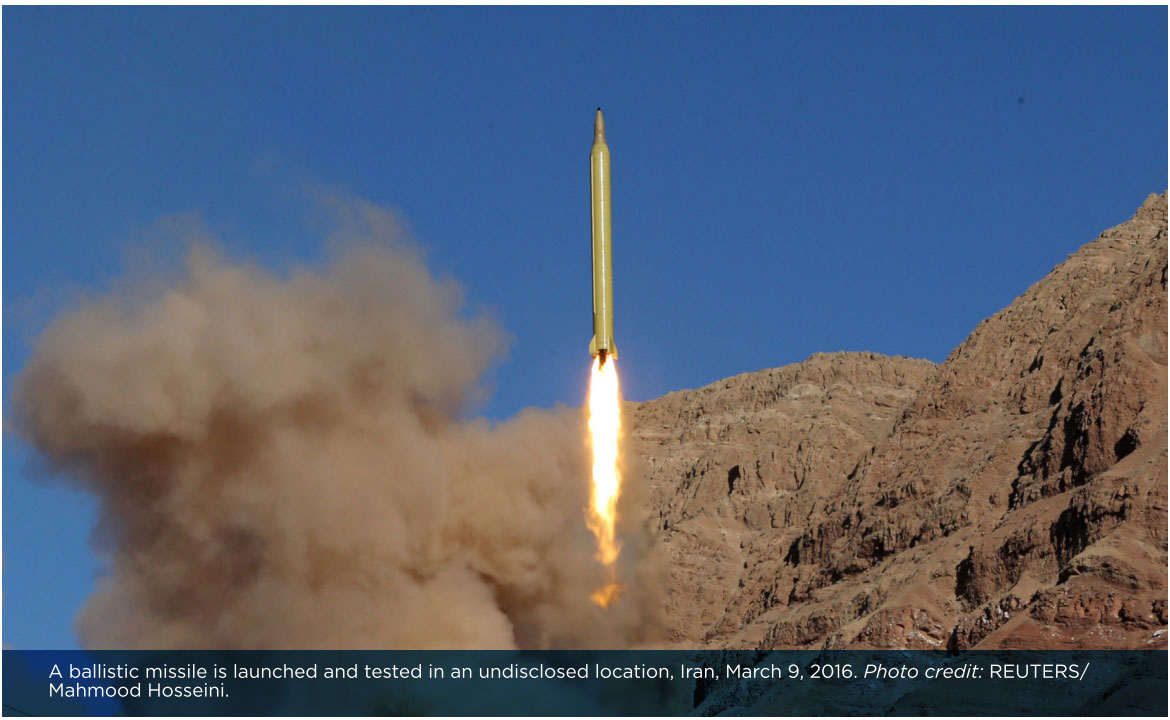
A ballistic missile is launched and tested in an undisclosed location, Iran
A ballistic missile is launched and tested in an undisclosed location, Iran, March 9, 2016. Photo credit: REUTERS/ Mahmood Hosseini.
These three reassuring factors notwithstanding, the pace with which Iran’s conventional missile program has been developing in recent years suggests that the country’s missiles could become much more accurate, and thus deadly, within a few years, potentially providing Tehran with a new set of military options and a higher degree of operational flexibility. This would force (and most probably already has forced) the Pentagon to strategize and plan for a range of Iran-related military contingencies in the region like never before. As the utility of Iranian missiles expands beyond deterrence and possibly enters the realm of offense, the likelihood of military crises and kinetic flare ups in the Gulf rises.
Intentions Versus Capabilities
Intentions are as important as capabilities in world politics. Indeed, were Iran ruled by a more moderate and responsible leadership, its conventional missile program would have been less of an issue. Instead, Iran’s regional policies since 1979 suggest that Tehran has revisionist tendencies. A large nation with a civilizational role and a proud history, Iran has aspirations that extend beyond its borders, and Tehran often harks back to memories of the Persian Empire to bolster support for these ambitions.
Even though Tehran has learned to live with US regional hegemony, refraining more often than not from crossing red lines, US military power in the Middle East is a source of frustration to the country’s mullahs and generals, who often describe Washington’s military footprint in the region as unwelcome and unnatural, supposedly designed to subjugate the Iranian nation and prevent it from achieving its full potential.
Although Iran’s patience with the United States’ regional presence is likely to endure, Tehran will continue to do everything in its power to divide and exploit weaknesses among the United States’ Arab Gulf partners and indirectly increase the costs of the United States’ operations in the Gulf until Washington leaves or shrinks its presence. Regional hegemony, pursued pragmatically, gradually, and with the fewest costs, remains Iran’s ultimate ambition in the Middle East.
It is through this prism that one should assess any military challenge that Iran’s weapons pose to US interests and the regional order, including its improved missile capabilities. These missiles are, and have always been, part of a broader political strategy and military doctrine of Tehran, meant to protect the clerical regime and export the principles of the Islamic Revolution. Although, strictly speaking, they would be classified as conventional weapons, these missiles could equally be used to augment Iran’s existing asymmetric capabilities.
Why Missiles?
Tehran’s pursuit of missiles and long-range artillery rockets began soon after Iraq’s invasion of Iran in 1980. During the war, Iraq repeatedly attacked Iranian cities, petroleum facilities, and other strategic assets with Soviet-supplied aircraft and Scud-B missiles. Lacking reliable access to the skilled technicians and spare parts needed to maintain and operate its Western-supplied aircraft, Tehran had limited capacity to respond to the increasing pace of Iraqi assaults on its population centers.
Iran’s post-revolution regime was therefore driven to acquire missiles and rockets from willing suppliers for its counter-strike capabilities. In 1985, in response to yet another barrage of Iraqi missiles, Iran retaliated with Scud-B attacks, which shocked the Iraqi regime and large portions of its populace. Then-Iraqi leader Saddam Hussein promptly agreed to suspend missile launches against Iranian cities, if Tehran demonstrated similar restraint. Although the ceasefire did not last, the Iranian regime reasoned that its Scud-Bs had fundamentally altered Saddam’s strategic calculus, and that ballistic missiles are a powerful deterrent and vital to the defense of the Islamic Republic. This view remains today, with missiles a cornerstone of Iran’s deterrence and defense posture.
After the war, missile acquisition remained a regime priority, with Tehran turning primarily to North Korea for its more immediate needs, and to China to support its longer-term requirement of greater self-sufficiency. Iran purchased two to three hundred Scud-B and -C missiles, with the latter having the range needed to threaten the Arab Gulf monarchies and US forces stationed in the region. In the mid-to-late 1990s, Tehran began purchasing medium-range Nodongs from Pyongyang to fulfill the perceived need to target Israel, Turkey, and western Saudi Arabia. The Shahab-3/Nodong’s range was increased from about one thousand to sixteen hundred kilometers in the 2000s by modifying the airframe and incorporating other minor improvements, resulting in the Ghadr. By roughly 2005, Iran could threaten, intimidate, deter, and retaliate against any of its regional foes.
Iran also operates an ambitious space program, which has to date attempted to loft a series of small satellites into orbit using the two-stage Safir rocket. At least eight launches were conducted, with only three or possibly four successes. A second-generation launcher, the Simorgh, will likely be used to boost larger satellites into space. The Safir and Simorgh could, in principle, be modified for use as ballistic missiles, though no country has converted a satellite launcher into a missile.
Iran, however, is not capable of independently producing the liquid-fueled Scud and Nodong missiles. Instead, it must import liquid-propellant engines to support extraterritorial strikes. Creating an indigenous missile-production capacity has been a long-term aim of the Islamic Republic, which drove Tehran to secure the industrial infrastructure and technical know-how from China for the manufacture of solid-propellant artillery rockets. Iran leveraged the experience accrued producing heavy rockets to develop and manufacture larger solid-propellant rocket motors. In 2008, Iran began flight testing a two-stage, medium-range ballistic missile based on solid-fuel. The Sajjil-2 missile remains under development, though its existence animates Iran’s resolve to become less reliant on imported technologies for its key strategic capabilities.
Poor Accuracy, for Now
The military utility of Iran’s current missile stockpile is severely limited by the poor accuracy of its most advanced systems. For instance, Iran’s Shahab-1 missiles (Scud-Bs) carry one-ton, high-explosive warheads and have an estimated accuracy on the order of eight hundred to one thousand meters circular error probable, or CEP. CEP is defined as the radius of a circle, within which one-half of the warheads are expected to land. For the Shahab-1, this translates to a probability of mission success between one-in-one-hundred and one-in-one-thousand for a soft target, such as unprotected humans or exposed aircraft. For hardened targets, the probability drops to as low as one-in-ten-thousand.5 From the perspective of military planners, to destroy with moderate confidence a single, fixed-point military target, Iran would have to allocate a very significant percentage, if not all, of its missile inventory to just one mission.
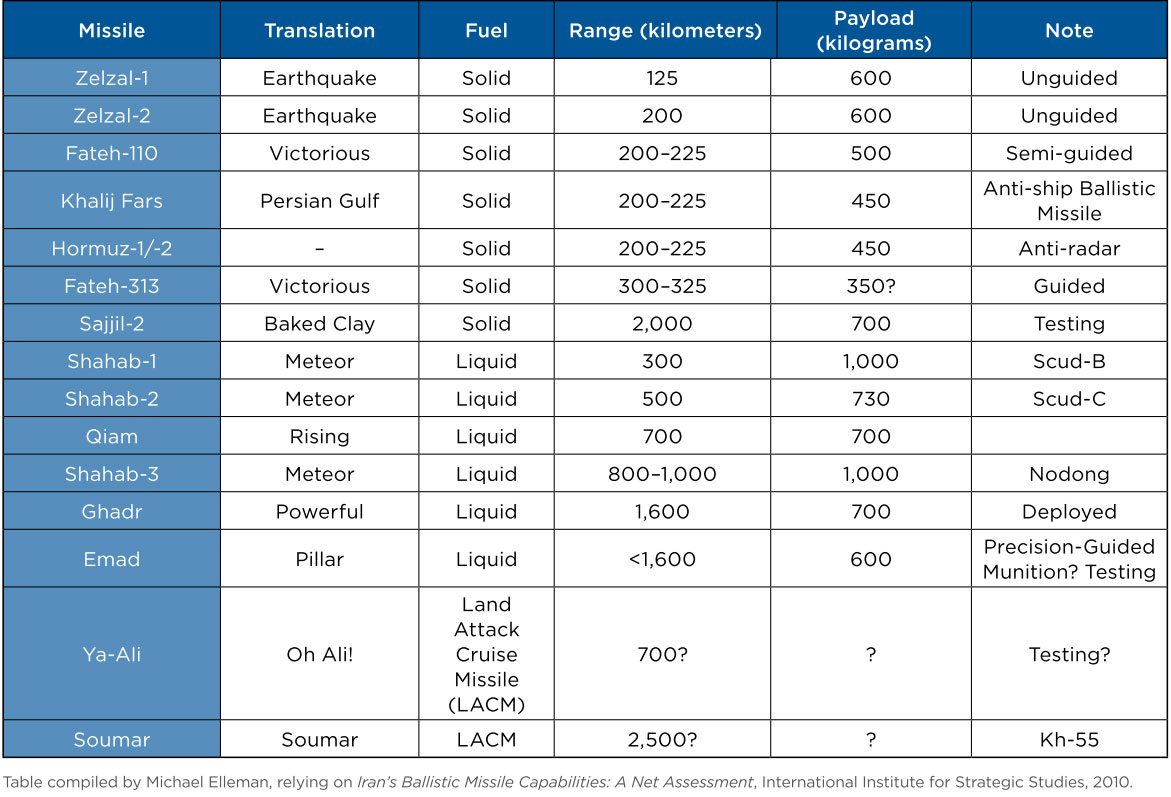
Table 1. Iran’s Current Missile Arsenal
Iran’s Current Missile Arsenal
Table compiled by Michael Elleman, relying on Iran’s Ballistic Missile Capabilities: A Net Assessment, International Institute for Strategic Studies, 2010.
Pursuit of Greater Precision
Iranian decision makers seem to understand that deterring attack by threatening to punish potential adversaries and their supporters may not be sufficient. The acquisition of missile defenses by neighboring Gulf states has probably amplified Tehran’s worries. Consequently, Iran has spent the past decade refocusing its missile development efforts away from increasing range to enhancing the precision and lethality of its missiles.
Fateh-110 missiles
Fateh-110 missiles on display at the Iranian armed forces parade in 2012. Photo credit: Wikipedia.
Iran’s pursuit of greater precision is best evidenced by the evolution of the Zelzal (Earthquake) artillery rocket. The first-generation Zelzal is unguided and terribly inaccurate, with half of the rockets missing the intended target by more than three kilometers. Improvements in Zelzal accuracy were achieved by spin-stabilizing the rocket, though this measure produced modest results.
About a dozen years ago, Iran began developing the Fateh-110, a semi-guided rocket. The designers appear to have incorporated a simple navigation and guidance system, and four aerodynamic control surfaces mounted just below the rocket’s warhead section. The navigation unit, which senses deviations in the rocket’s pitch and yaw, are likely used to maintain a pre-programmed orientation (i.e., angle of attack) during the boost and ascent phases of flight. If implemented effectively, the flight stabilization system should significantly reduce the Fateh-110’s lateral dispersion; range dispersion, while improved, is still affected by inconsistencies in the rocket motor’s performance. While a significant improvement in accuracy, the first generation of the Fateh-110 still lacks the precision needed to reliably strike military targets.
In principle, Iranian engineers could enhance the navigation, guidance, and control system of the Fateh-110 so that it continuously corrects deviations along its full trajectory, including final approach to the target. The missile would necessarily have to fly within the atmosphere to maintain positive aerodynamic control over its entire path to the target. Thus, the Fateh-110, like other missiles of this type, including Russia’s Tochka (SS-21) and the United States’ ATACMS systems, cannot exceed an altitude of roughly thirty-five to forty kilometers if they are to achieve high levels of accuracy, a constraint that limits the achievable range to roughly 200 to 250 kilometers. Only Kuwait, portions of Iraq, and the eastern emirates of the United Arab Emirates (UAE) are within the Fateh-110’s range. Iran’s development of the Fateh-313, with a maximum range of about three hundred kilometers, cannot reach most targets in Bahrain, Qatar, Saudi Arabia, and western UAE, including Dubai and Abu Dhabi, unless launched from islands in the Gulf.
Despite working for a dozen years to improve Fateh-110’s accuracy, progress has been limited. During the Great Prophet-7 war games in 2012, for example, Iranian forces launched more than a dozen rockets and missiles toward a mock airfield. Most of the missiles were Fateh-110s, though a few Shahab-1 (Scud-B) missiles were also fired. Iranian television aired video showing the warheads impacting the intended target. A few months later, Jane’s Defence Weekly published a report that included satellite imagery of craters distributed throughout a mock airfield and outside its imaginary boundaries.6 The location of some of the craters seen in the satellite imagery corresponds with the impacts shown in the televised video, suggesting that the Jane’s information accurately reflects events during the war game. Assuming the airfield’s center was the aim point for the Fateh-110s fired, the spatial distribution of the impacts indicates a CEP of between 800 to 1,100 meters, depending on the calculation method employed, assuming an aim point at another location within the airfield boundaries does not improve the calculated CEP estimate. Not surprisingly, perhaps, the CEP value for the Fateh-110 is reasonably consistent with the theoretical predictions based on manufacturing deviations and other contributors to inaccuracy.
The Fateh-110’s CEP of eight hundred to one thousand meters is on par with that for the Shahab-1 missile. Because the lethal effects of a missile warhead weighing between five hundred and one thousand kilograms is limited to about fifty meters, it is easy to understand why the missile is not expected to land close enough to kill or destroy a specific target. As with the Shahab-1, the Fateh-110 is unlikely to succeed unless the target is very large, like an airfield or military base. Iran will likely need many more years, and scores of flight tests, to reduce the CEP to below two hundred meters. A militarily effective short-range missile will not be available before 2020, and probably much later.
Nonetheless, development of the Fateh-110 family of missiles, including the optically guided, anti-ship Khalij Fars and the anti-radar Hormuz systems, as well as the Fateh-313, suggests that Iran seeks to produce and field highly accurate missiles capable of shaping the outcome of future military conflicts. In principle, Iran could improve the accuracy of its larger missiles by incorporating Global Positioning Satellite receivers into the guidance systems of its current arsenal. However, such modifications would improve accuracy by only 20-25 percent, not enough to alter their military utility. Substantial improvements require post-boost phase control systems, or terminal steering to the target. The test launch of the medium-range Emad missile in 2015 suggests that Iran holds ambitions to enhance missile accuracy of its medium-range missiles. The Emad appears to be a Ghadr missile, with a separating warhead capable of steering itself toward a target after it re-enters the atmosphere. It is in its first phase of development. It will require very different technologies relative to the Fateh-110 to achieve the design objectives. Based on the time required for other countries to develop an accurate ballistic missile with a range of more than three hundred kilometers, Iran will not possess an arsenal of accurate medium-range missiles before 2025, perhaps longer. Extensive foreign assistance from China or Russia could shorten the timeline, however.
A Shift in Military Doctrine?
If the pattern to prioritize improved precision over increases in missile range continues, it would mark a discernable shift in Iran’s missile doctrine, from one that relies solely on punishing would-be attackers by striking highly valued targets, such as cities, to a strategy that aims also to deny potential foes their military objectives and possibly even launch limited attacks against them.
The doctrinal evolution, if it is real, is consistent with Iran’s overarching military strategy, which is primarily defensive, but with precision-guided missiles, could entertain offensive tactics. The “mosaic defense” strategy, authored by General Mohammad Ali Jafari, commander of the Iranian Revolutionary Guards Corps, establishes three asymmetric, operational tactics to impede conventional military advances by an attacker. Proxies provide a forward-based fighting force, guerrilla warfare at sea threatens enemies and impedes a navy-supported invasion, and the implicit threat of extraterritorial attacks with ballistic missiles deters adversaries. An arsenal of accurate, highly lethal ballistic missiles supports all three elements of Iran’s asymmetric approach to warfare. Heavy-artillery rockets and short-range missiles, if they can deliver ordnance precisely, are capable of substantially raising the costs of enemy access to territory along Iran’s borders.
Short- and medium-range ballistic missiles threaten key ports that service the navies of the Arab Gulf states and external powers, including the United States, the United Kingdom, and France, and anti-ship cruise missiles can harass ships deployed within Gulf waters. Ballistic missiles striking air fields with precision could disrupt the sortie generation rate, so vital to US and Arab Gulf fighting strategies. Finally, missiles that reliably avoid potential collateral damage caused by inaccuracies could be used to strike key military and civilian infrastructure with less risk of backlash for the international community. These capabilities assume Iran succeeds in developing highly accurate missiles.
Evidence to date suggests Iran is improving the precision of its missiles, but not enough to generate its desired military outcomes. This will undoubtedly change as Tehran continues to master the necessary techniques needed to achieve greater missile accuracy, as well as the critical enabling technologies, such as real-time targeting and damage assessment capabilities. While Iran is at least five years away from establishing an arsenal of increasingly accurate and lethal missiles, the United States and its Gulf partners must now begin identifying and developing military strategies to mitigate their impact.
Military Contingencies
Existing, US-led deterrence structures in the Gulf against Iran would neither weaken considerably nor become obsolete should Iran acquire precision-guided ballistic missiles. Overwhelming US, British, and French firepower in the region (assuming these countries do not drastically draw down or totally pull out from the region in the future) would still cause Iran to think twice before attacking any of its neighbors.
But with potentially more accurate missiles, Iran could plan limited attacks to achieve strategic objectives, without inviting massive and swift retribution by Washington. Planning for such potential contingencies and understanding what Iranian objectives they might serve is important to get ahead of Tehran and deny it any strategic opportunities. So how could Iran take advantage of its potentially enhanced missile capabilities while averting direct war with Washington?
Iran might seek to create policy conundrums for Washington by attempting to strike specific targets in the Gulf over which the United States might not retaliate. Consider this: if Tehran ever launched an attack against any US military asset in the region, Washington would strike back forcefully (where and how might depend on what the Iranians hit in the first place). But would a similar outcome ensue if Tehran struck an Arab Gulf city or value target, such as oil installations or water desalinations plants? The Arab Gulf states would certainly hope that the United States would intervene immediately and teach Iran a very painful lesson, but US military involvement might not be so automatic, and would depend on various factors including the risk of escalation, the extent of the initial damage Iran had caused, and the very nature of the circumstances that led Tehran to attack in the first place. When direct US interests are not harmed, it is never easy or straightforward for the United States to decide to use lethal force and possibly go to war against a foreign nation on behalf of partners with whom it does not have a formal alliance or defense pact.
An even more complicated scenario is if Tehran were to fire a couple of precise shots (whenever it does acquire more accurate missiles) against, for example, military radar installations in Riyadh or Abu Dhabi, and as a result, cause serious damage to either country’s missile defense system. Would Washington lash out against Tehran then? Perhaps, but again, not necessarily, and compared with the previous scenario one could make the argument that the likelihood of US intervention would be even lower. In this contingency, Washington would definitely pause and think harder about risk-reward calculations, in the interest of, once again, avoiding escalation and preserving regional stability. However, in these second and third scenarios, Washington would face the daunting task of trying to reassure and coordinate with anxious and threatened regional partners who might (and most probably will) decide to retaliate and go on their own if they perceive any American hesitancy or lack of commitment. It is those potential differences in interest, strategy, and tactics between the United States and its regional partners that Tehran would seek to manipulate, and it is those gray zones that it would most likely focus on in potential limited war plans.
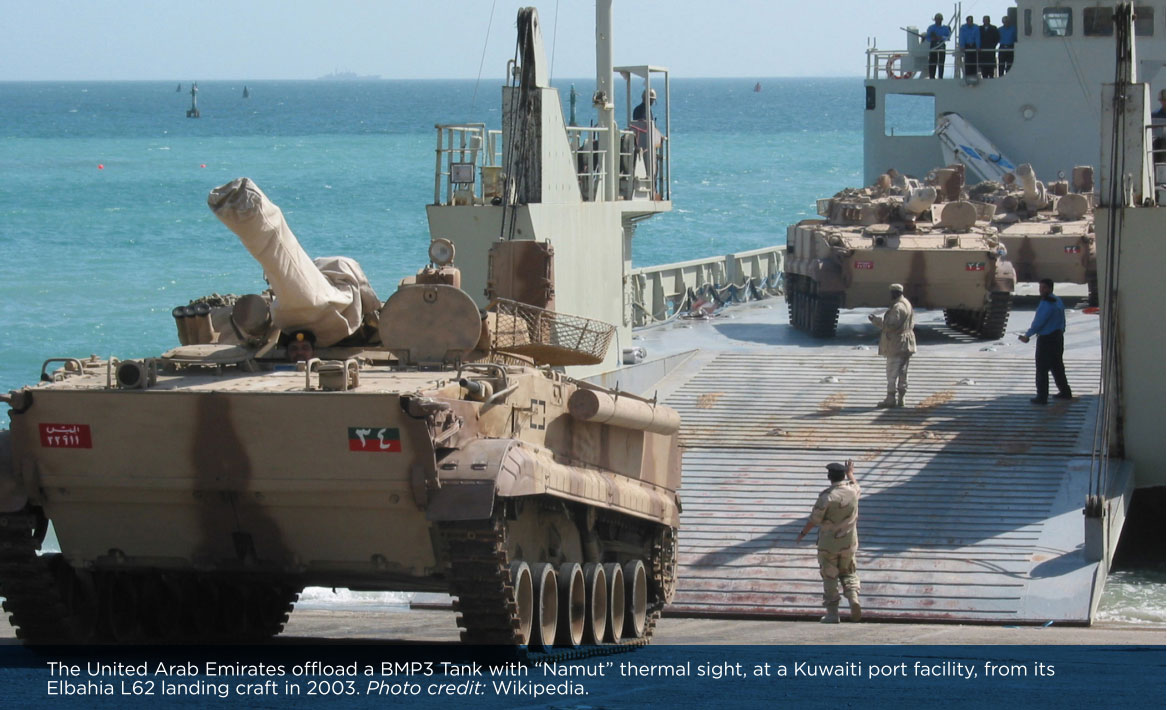
The United Arab Emirates offload a BMP3 Tank
The United Arab Emirates offload a BMP3 Tank with “Namut” thermal sight, at a Kuwaiti port facility, from its Elbahia L62 landing craft in 2003. Photo credit: Wikipedia.
Again, the purpose of such surgical strikes for Iran would not be to degrade the military capabilities of its Arab Gulf adversaries, but would be, more importantly, to test the resolve or threshold levels of Washington, the coherence of the Gulf Cooperation Council (GCC), and the unity of the US-Gulf partnership. Another potential goal would be to politically destabilize the intended target and cause enough panic and chaos domestically to allow Iranian proxies already operating in the country to make a serious move by either launching a coup or facilitating a popular insurrection against the government. In other words, in the first few critical moments of the crisis following missile launch, Iran would immediately seek to create new and favorable facts on the ground that would serve its long-term interests, and that Washington would find extremely difficult to reverse.
Missile Defense Integration
This is why missile defense in the Gulf, and particularly the goal of integrating this capability, is so critical. That the Arab Gulf states have considerable missile defense capabilities reduces the likelihood of Iran achieving any of its previously mentioned aims (at least not in the very beginning of the crisis) by increasing the raid size required for an attack to penetrate, which would allow these states to “hold the line” until the United States (possibly) steps in militarily. While Arab Gulf missile defense is not foolproof and extremely unlikely in the foreseeable future to negate the potential advantage of offensive Iranian precision-guided ballistic missiles, it does provide flexibility to Riyadh and Abu Dhabi, for example, in terms of military and diplomatic strategy. It also buys them time, reduces their vulnerability, and puts the burden of escalation in an emerging crisis on Iran.
However, Arab Gulf missile defense integration will remain an illusion without greater trust and closer political relations among the United States’ regional partners.7 Even if Washington overhauls its export control regime, adopts a more strategic approach to foreign military sales, and provides all the software and hardware needed to develop its Gulf partners’ capabilities, Arab Gulf politics will continue to obstruct missile defense integration. Effective missile defense in the Gulf requires first and foremost a fully integrated intelligence, surveillance, and reconnaissance system and a shared early-warning system. But GCC nations do not agree on what such a system should look like and they do not share nearly enough information. Imagine this hypothetical scenario: Iran fires a missile at any target in Saudi Arabia and the first Gulf country to intercept it is Qatar. Given the rivalry and recent tensions between the two, would the Qataris “take the shot”? It is not entirely clear.
Missile defense integration requires serious political commitment on the part of the Arab Gulf states to conducting cooperative exercises, including high-level, tabletop, scenario-dependent gaming exercises involving the senior military leadership of each GCC member, and preferably in partnership with the United States. The Arab Gulf states would also benefit from thinking collectively about concepts of operations, tactics, techniques, and procedures.
But such efforts are not happening on a consistent or periodic basis, whether in Washington or in the region (with the notable exception of a senior-level exercise held by Kuwait on May 23-25 of this year), and it is not just because there are organizational and institutional challenges or intellectual and analytical shortcomings among Gulf military leadership and staff. In addition to mistrust, the real issue is that GCC members do not even perceive the Iranian threat in the same way. Nobody expects the Arab Gulf states to unite or agree on all issues. The ship of GCC unity sailed a long time ago. But there is a big difference between disagreement and mistrust, and this is a clear case of the latter.
It will already be extremely difficult for the Arab Gulf states’ missile defense systems to keep up with the increasing accuracy of Iran’s missiles. Cementing Iran’s advantage in the future even further is the absence of an integrated missile defense structure in the Gulf, perhaps calling into question the strategic premise of Arab Gulf missile defense altogether, given its exorbitant financial costs and uncertain overall contribution to national security.
Conclusion
Conventional wisdom suggests that in the presence of a major US, British, and French military deterrent in the Gulf, there is little reason to worry about any conventional weapon Iran might acquire. Iran is neither careless nor irrational, and therefore is less likely to pick a fight with a much more powerful set of adversaries. However, the profound socio-political changes that are sweeping across the Gulf and the broader Middle East have introduced a degree of unpredictability that could challenge future regional security. This could be enabled by a reduced US desire to get involved militarily in the Middle East, the growing political and military involvement of major powers such as Russia and China, and far-reaching political and generational changes in the Arab Gulf countries that are likely to impact future security and defense policies.
In a post-nuclear-deal era, Iran might be emboldened to test Washington’s informal security commitments to its Gulf partners as it has never done before. Although it will most probably continue to avoid clashing militarily with the United States and its regional partners, it might exploit its potentially superior missile capabilities to experiment with contingencies that would create tough policy dilemmas for Washington.
Notes
1 Though it has compelled the United States to push hard for the long-term goal of ballistic missile defense cooperation and integration in the Gulf.
2 Alalam, “Iran warns Israel of military deterrence, missile might,” May 25, 2014, http://en.alalam.ir/news/1597338.
3 James R. Clapper, Director of National Intelligence, “Worldwide Threat Assessment of the US Intelligence Community,” Statement for the Record, Senate Armed Services Committee, February 9, 2016, p. 8, http://www.armed-services.senate.gov/imo/media/doc/Clapper_02-09-16.pdf.
4 Hearing On “Fiscal Year 2016 National Defense Authorization Budget Request For Missile Defense Programs,” March 19, 2015, p. 113, https://www.gpo.gov/fdsys/pkg/CHRG-114hhrg94227/pdf/CHRG-114hhrg94227.pdf.
5 Iran’s Ballistic Missile Capabilities: A Net Assessment, International Institute for Strategic Studies, 2010.
6 Jeremy Binnie and Andy Dinville, “Satellite imagery shows accu-racy of Iran’s ballistic missiles,” Jane’s Defence Weekly, October 31, 2012.
7 Bilal Y. Saab, “Why the Persian Gulf Isn’t Ready for Joint Se-curity,” Defense One, June 19, 2014, http://www.defenseone.com/ideas/2014/06/why-persian-gulf-isnt-ready-joint-security/86800/?oref=d-river.
About the Authors
Bilal Y. Saab is senior fellow and director of the Middle East Peace and Security Initiative at the Brent Scowcroft Center on International Security at the Atlantic Council.
Michael Elleman is consulting senior fellow for missile defence at the International Institute for Strategic Studies.
For more information on issues and events that shape our world, please visit the CSS Blog Network or browse our Digital Library

Friday, October 14, 2016

Dynamics of Middle East Peace Process and the US

Dynamics of Middle East Peace Process in the Era of US Hegemony 1950-2000

10 Oct 2016
Because the US was able to exert unrivalled influence on international affairs in the second half of the 20th century, successive American administrations were able to pursue and consolidate their own interests at the global level. Nowhere was this more obvious than in the Middle East, argues Samer Bakkou. As a result, American power still permeates nearly every aspect of the area’s established peace processes.
This article was originally published in Volume 10, Issue 2 of the Central European Journal of International and Security Studies (CEJISS) in September 2016.
This article begins with the observation that the US has over the course of the 20th century, exerted an unrivalled influence on international affairs. In exerting this influence, which is manifested within various dimensions (military, economic and technological), successive American administrations were able to pursue and consolidate their own interests at the international level of governance. In this respect, it is telling that both advocates and critics of American power agree upon the extent and ultimate goal of American power. In this work, I will further elaborate on this theme of American hegemony, with specific reference to the Arab-Israeli conflict. I argue that American power permeates nearly every aspect of the established peace processes.

Introduction and Background
The US’s role in the Middle East has substantially increased in recent years. This is reflected in a number of ways, particularly in the role the US has played in establishing the basis for the Arab-Israeli peace process. In this instance, US hegemony appears almost as the underpinning foundation or grounding principle. Although it is important to recognise the limitations of US power,1 in the Middle East it appears almost as a form of galvanisation, a coat that protects domestic or regional units of government from the harsh abrasions of contemporary Middle Eastern politics. The US military is currently based in six Middle Eastern states, including Saudi Arabia (the wealthiest), Egypt (the most populous) and Israel (the most powerful militarily). Given the sheer scope of its influence, it is unsurprising that the US government has dedicated so much time and effort to the resolution of the Arab-Israeli conflict.2
While the exertion of US power may produce a number of common benefits, it is clear that this power is not disinterested and that, to a substantial extent, it protects and furthers America’s regional interests. Yet, even this power has its limits; peace is not currently on the agenda in the Middle East. The best prospect at present is the management or temporary suspension of violent hostilities. In addition, popular distrust of American motives and intentions continues to present a substantial obstacle to American goals and objectives in the region.3
Although my predominant emphasis is on American power, I will also examine the Cold War struggle between the US and the Soviet Union. This confrontation was particularly important for the Middle East, primarily because the superpowers heavily influenced this region. These external powers both created political realities and sought to co-opt local realities for their own ends and purposes. Political interactions tended to closely resemble patron-client relationships.
During the Cold War, successive American administrations retained a close and abiding interest Middle East affairs—American oil interests being the paramount consideration and priority. Various American presidents, such as Eisenhower, explicitly voiced the concern that political turbulence in the region would adversely impact the American economy, whether in the form of higher oil prices or supply disruptions. Oil would subsequently emerge as a major priority and determinant of US regional policy.
In the contemporary era, it is clear that the US has had an unrivalled opportunity to impose its own strategic and political priorities on the region.4 This control has not conformed to the practices and structures of an empire, but has instead utilized subtler mechanisms and techniques. This cannot be said to be a purely military form of power, but also a political and economic one; to an equivalent extent, it cannot be said to correspond to direct domination or control. US power in the region is hinged upon the understanding that force cannot provide a sufficient justification in and of itself; force, in other words, provides an insufficient basis upon which US power can be legitimised.5
Over the course of the 20th century, various US-sponsored peace initiatives (Camp David, Oslo I, and Oslo II),6 inextricably linked American interests to a frequently elusive ‘peace.’ From my perspective, the most interesting element of this is not the success (or lack thereof) of these efforts, but rather the American superpower’s frequently evidenced ability to switch between different peace initiatives. Repeated failure has led to neither disengagement nor disinterest, but rather renewed impetus and momentum.7

The Effect of Economics on the Peace Process
In order to comprehend the various ways in which US power has influenced the Middle Eastern peace process, it is first necessary to examine the world order, which was in place during the Cold War. Broadly speaking, and with the partial exception of the nonaligned movement,8 this order could be categorised as bipolar. This arrangement originated with the Yalta Conference of 1945, which established a pattern of political relations that would last for the next 45 years. While this stalemate did not establish peaceful relations, it did provide the basis for relative and partial stability.
The reason this stability was only partial was that it forestalled direct hostilities between the two superpowers; it did not prevent—in fact, it actively encouraged—a state of affairs in which these mutual hostilities were projected onto the Third World. In various contexts across the globe, indirect superpower competition assumed ideological,9 cultural, economic and military dimensions. The developing world appeared almost as small pegs, trapped within the small gap that divided the two encompassing worldviews. In subsequently pursuing their respective ideological and geopolitical ends, the US and the Soviet Union reconfigured regional alignments of power and fought proxy wars.
As a country that had positioned itself in direct opposition to colonialism, the US was well placed to benefit from the collapse of European empires in the aftermath of WW2. Former colonial powers became dependent on US support and assistance, a development that the Marshall Plan (1948) vividly underlined. After WW2, the international liberal order became inextricably intertwined with, and indeed inseparable from, US power. This power assumed a number of dimensions: political, economic and ideological. In this last respect, the US utilised human rights and democratic discourse in order to present itself as the defender of the free world. This freedom was not articulated within the vernacular of national struggle and independence, but rather presented itself in the form of capitalism and open economic systems. In a very specific and particular sense, the US therefore emerged as the defender of the free world.10
Observers inevitably drew attention to the fact that this ‘freedom’ was inextricably interwoven with the interests and priorities of the American state. The difference between the former colonial masters and their American successor was essentially a difference of degree rather than of kind; the Americans could be said to be taking over from where their predecessors left off.11 In further underlining this point, Thompson observes that the ‘liberation’ of independent states served as a means through which American power was consolidated. To put it slightly differently, ‘containment’ of the Soviet threat furthered America’s thinly concealed desire for political and economic hegemony.
For historical and political reasons, Americans have tried to keep their influence in the region from appearing colonial; consequently, it must present peace and the spread of democratic ideals as its intention. In this understanding, long-term Middle East stability and the resolution of the Israeli-Palestinian conflict are inextricably linked.12 However, it is understood that the two are far from co-terminus.  One analyst suggests that ‘stability’ is merely a code word, attuned to the ears of foreign investors and global managers. 
The Middle East holds particular importance by virtue of its oil resources, which are both economically and politically significant. It is not merely that American influence over these resources is an integral component of American power; rather, it is that this influence simultaneously prevents challenges to American hegemony from emerging and consolidating. In the post-WW2 era, US policymakers viewed the Middle East both as a source of power and as a material prize. Economists have observed that the largest consumer of a collective must take the lead in organising production, or it is unlikely others will make any attempt to produce goods. By extended analogy, if the US wishes to attain global access, it must maintain political peace, especially in the Middle East, since a significant portion of the world’s wealth is found there. However, while the US is the most powerful military state and can police political agreements, this interference is liable to damage its domestic economy.13
In the decades after WW2, the interrelation of the economic and political aspects of America’s geopolitical strategy would become still more pronounced.14 Paul Kennedy stressed this essential interrelation—in his view, military power must be supported by wealth and established wealthy interests require power in order to obtain and secure wealth. This necessitates a parsimonious balancing of possession and means, as an imbalance in favour of the latter will conceivably diminish the former (the military-industrial complex serves as a clear example). Systemic imperatives necessitate that state planners must remain alert to the dangers of over-extension and the need to manage critical resources, which lie beyond immediate territorial borders.15 Noam Chomsky has consistently emphasised the role which elite economic interests play within America’s foreign policy. In his view, the congruence of interest between America’s political and economic elite established the basis for a world order which would further their shared interests and priorities.16
The contradiction between liberal ideology and the imperatives of a rapacious economic system would be starkly evidenced in the years following WW2. The spread of US hegemony clashed openly with the political and economic priorities of newly independent states. In other respects, as revisionist accounts of the Cold War so clearly convey, liberal ideology became a powerful tool through which the US promoted its own economic and political interests. The Cold War was an essential accompaniment to, and even condition for, the spread of American power and influence.17 This hegemonic liberalism essentially corresponds to the set of political and economic arrangements that emerged in the aftermath of WW2. The US assumed the role of guarantor of political and economic stability, upon the understanding that it would be accorded a certain unquestioned privilege.
The Intertwining of Peace and Trade
The US’s status as a superpower was reinforced by the collapse of the USSR. Its hegemony over the Middle East can be traced to the reluctance of other international powers to directly challenge its pre-eminence. US pre-eminence may also be attributed to a set of tacit understandings between different international actors –in some cases, the US will demur to Chinese or Russian interests.
In taking the lead in Arab-Israeli negotiations, the American government has historically promoted the principle of ‘land for peace’. The 1979 peace agreement between Israel and Egypt was understood to enshrine this principle and to provide a basis for a consensus among moderate Arab states. Nevertheless, critical American observers have argued that existing peace agreements ultimately militate against the prospect of a more comprehensive settlement.18
In the absence of political agreement, the US has established a range of economic and trade relations with pro-US Middle Eastern states. The establishment of these relations can be traced back to the broadly neo-liberal premise that heightened levels of economic interdependence and interaction will establish the basis for a more lasting peace in the Middle East. Trade brings about cultural exchange, political dialogue and diplomatic exchange.19
The US trade representative has openly stated that trade and economic liberalisation at every level is the ultimate aim of the US government. This viewpoint enjoys broad support among the political elite of many Middle Eastern states, although there is a clear concern with regard to American hegemony. Among the general Arab public, the promotion of neo-liberalism is liable to be viewed as culturally incompatible and a front for US interests. Under US plans, the ‘New Middle East’ (in reality the Gulf Co-operation Council (GCC) countries) will become a competitive economic power.20 Over the past four decades, US commercial interests in the Middle East have steadily grown.
The United States is among the top five trading partners of each GCC country. More than 700 US-affiliated companies operate in the region and employ more than 16,000 Americans. 21 Private sector investments by US companies in these countries account for half of the total world investments in the region. Oil-producing nations, which require capital items for ambitious development strategies, also import from the US.22
At the crossroads between Europe, Asia and Africa, the Middle East is rapidly becoming a mega market, with the potential to embrace more than one billion people. Middle Eastern countries have provided substantial investment capital to both the private and the public sectors of the US and other industrial economies for almost twenty years. The GCC has played a key role in supporting the US dollar. In addition, it has also invested billions of dollars in US treasury securities; this has facilitated a low and stable US interest rate.
The use of trade in the service of the Israeli-Palestinian peace process has been conspicuously less successful. In 1995, President Clinton sought to bring about heightened levels of economic interaction between each of the key protagonists. He proposed to expand the existing Free Trade Agreement between the United States and Israel, and to expand the agreement to include the Palestinian territories, Jordan and Egypt. Clinton’s attempts to coerce the respective partners and Congress into agreeing to this proposal ultimately proved to be unsuccessful. Clinton enjoyed more success in bringing about the Qualifying Industrial Zones, which were introduced in 1996.23

Oil in Peace Process Mobilisation: The Role of the US
The 1859 discovery that oil could function as an energy source marked the beginning of a new era, both in America (where the discovery was made) and worldwide. The exploitation of oil soon became a prerequisite for large-scale industrialisation and modernisation. In the contemporary world, oil from the Persian Gulf provides a large market for various crucial sectors of industrialised economies, including construction, engineering and military equipment sales. The use of oil has opened up hitherto unknown dimensions of strategy on the ground, in the air and under the sea. Therefore, oil shortages have become threats to national or international security and countries with oil production capabilities assume pre-eminent economic, political and strategic importance.24
In the aftermath of WWI, the British and the French governments divided the Middle East in accordance with their own interests. During the interwar period, the British and American governments frequently found themselves in direct competition for petroleum resources25—strenuous efforts were made to secure key oil resources, contain Soviet influence and ensure the free flow of oil.26 By the beginning of WW2, the US government had gained concession from its British counterpart on petroleum interests in Kuwait, Saudi Arabia, Bahrain and Iraq. The release of Saudi oil was the most important of these concessions. The first agreement between the American firms, which were subsequently to become known as ARAMCO, (Arabian-American Oil Company), and Saudi Arabia occurred between 1933 and 1935. An American official in the region was quick to acknowledge the potential strategic significance of this concession.27
After 1948, the surge of petroleum supplies would, in the imagination of American policy planners, took second place to Israel’s security needs. The essential reasoning behind this prioritisation was not difficult to grasp—petroleum shortages have the potential to undermine both international and domestic security.28 It was during this same period that the oil reserves of the Gulf states contributed to a political re-evaluation. The political implications reverberate to this day in Cantore’s observation that: ‘Gulf oil, as well as the security of allied states are the focal point of United States policy.’29
The post-WW2 reconstruction of Europe placed substantial demands upon Middle Eastern oil reserves. In the aftermath of WW2, US strategy in the region became increasingly focused upon threats to this supply. This was clearly illustrated in 1953, when the CIA executed a plan to remove Mohammad Mossadegh, the Iranian nationalist leader. The US attempt to balance Arab political opinion and the needs of its Israeli client state became increasingly difficult following the Suez Canal Crisis of 1956, when the Arab nationalist movement became a pronounced obstacle to US control over regional oil resources.30
The post-WW2 reconstruction of Europe placed substantial demands on Middle Eastern oil reserves, and further underlined the level of US dependence on foreign oil supplies. By the time of the 1973 oil crisis, imports made up more than one-third of domestic requirements (35 per cent). At the same time, internal oil production was nearing peak capacity.31 Within two weeks of the outbreak of the 1973 Yom Kippur war, the Saudi government imposed an embargo on oil supplies to the Netherlands and the US, an action that was taken in protest against continued US support for Israel. This initial action was followed, in September of the same year, by a 25 per cent reduction of the pre-war production rate. Arab members of OPEC made it clear that the embargo would be removed when Israel withdrew from occupied territories.32
The oil shortage focused attention on the vulnerability of supply and played a key role in transforming oil supply into a key American interest.33 After the crisis, oil also assumed a heightened political significance for the Saudis. Prior to 1973, King Faisal, the Saudi monarch, had been reluctant to utilise oil in this manner. However, the policy immediately bore fruit, with Kissinger’s shuttle diplomacy resulting in a disengagement agreement between Israel and Syria. President Carter’s attempt to establish peace between Egypt and Israel was also a response to the oil threat (although it should be noted that the Camp David Accords were far from unanimously accepted by most Arab states).34  In obvious contrast, the Nixon administration considered the direct seizure of key oil fields.
The result of the following embargo and shortages was a significant rise in prices, which created a lengthy recession in the West. It was also the end of the Saudi practice of distinguishing between oil decisions and political issues. Perhaps perversely, the 1973 crisis ultimately proved to be beneficial to national interest: Foreign exchange reserves or ‘petrodollars’ were subsequently invested in the US economy. As a consequence of foreign investment, oil producers acquired a vested interest in ensuring the integrity of the major industrial economies.35 The Saudis and other major oil producers came to realise that artificially elevated prices injure the long-term competitiveness of oil as an energy resource. This point is further reiterated by the fact that the Saudis increased oil production in the summer of 1979 (in response to decreases in Iranian output), the autumn of 1980 (in response to the outbreak of the Iran-Iraq war) and in 1991 (in response to the first Gulf War).
The integrity of Persian Gulf oil supplies would subsequently reemerge as a key strategic priority for the US. This was epitomised by the Carter Doctrine of 1980, which explicitly declared America’s willingness to use force in defence of its regional interests36 (something, which the 1991 Gulf War would well-illustrate).  Carter emphasised this commitment by establishing a rapid deployment force. The subsequent development of CENTCOM (The United States Central Command) enabled the US to further consolidate its existing ties. These ties were to be particularly useful in the management of regional hostilities (such as the ‘Tanker Wars’) and external subversion (whether Russian or Iranian).
During this period, Joseph L Lieberman, the prominent US senator, explained that the US had multiple reasons for ensuring regional stability—and economic motivation was at the forefront.37 The major challenge for the US in this respect is that key regional goals (free access to oil and the commitment to Israel’s security) are frequently opposed; it is not difficult to identify instances in which the two directly contradict each other. This is the inevitable conclusion of the perpetual failure of the peace process.

The Influence of Oil on Political Decision-Making
Political and social unrest in the region continues to exert a negative impact on international energy markets and oil prices. A number of the world’s largest oil and gas facilities (both production and export) are currently based in the Middle East. Approximately 40 per cent of oil trades and 20 per cent of natural gas exports come from the region.
In the Arab oil monarchies, such as Bahrain and Saudi Arabia, state formation took place under Western patronage in small and immobilised tribal societies. The main contemporary threat to these regimes comes from the emergent middle classes. Historically, the political vulnerability of these regimes has been contained by traditional (patriarchal and Islamic) sources of legitimacy. By the mid-1970s a further stage in the state-building process, which penetrated all levels of society, had occurred: the establishment of bureaucratic structures, modern forms of communication and forms of political association (including political parties). The impetus had been the threat of war, the explosion in oil revenues and superpower support. More recently, the broad distribution of oil-financed benefits and the instrumental adaptation of local identity38 have played an essential role in co-opting the middle classes and preventing the emergence of oppositional mass movements. At the regional level of governance, Western power and influence has played an essential role in maintaining state security.
The subsequent over-development of the Gulf state, epitomised by the funnelling of economic resources into unproductive military expenditure, imposed further economic constraints and impediments. These domestic ripples were further exacerbated by US intrusion during the post-Gulf War era. This exemplifies the subtle interplay between internal and external influences, an interplay that local actors must continually take into account and adapt to the same extent; it helps to explain why the “domestic” security of states such as Saudi Arabia has become so reliant upon external actors and agencies.39
As a major source of oil and natural gas production, the Middle East is vital to global energy markets. Current regional unrest has shut down some energy production and raised uncertainties about future supply from the region. Some regional producers are seeking to reassure global energy markets, amid fears that unrest could spread to major producers or disrupt regional commerce. A disruption in any one part of the market affects oil prices everywhere, regardless of its production or consumption site. Although natural gas markets are similarly affected, they are not as significant as oil markets. At present, Europe is being impacted to the greatest extent by events in the Middle East.40
It is frequently argued that the US should be more forceful in imposing a solution and that its main constraint in this respect is its special relationship with Israel. Other factors include the autonomy of local agents and the fact that low intensity conflict does not, in the absence of an escalation to regional conflict, present a clear or obvious threat to US national interests. In this respect, the US does not have an obvious preference with regard to the final settlement of the Israeli-Palestinian conflict. Borders, identity and the refugee issue are only pressing priorities for those who inhabit the region. For this reason, there is an obvious difference in the factors that will feature in the cost-benefit analyses of local and external agents.41

Conclusion
This article has shown the political implications that derive from US hegemony. The US is, in the absence of countervailing challengers, firmly entrenched as the predominant international power. In the aftermath of WW2, the US was able to make pronounced changes and adjustments to its own economic, political and strategic priorities. In the course of this essay, I have shown oil to be a political resource as well as an economic one. The hegemonic position of the US has allowed the nation to further extend its influence through the inauguration of various peace initiatives. The Israeli-Arab and Israeli-Palestinian peace processes can be seen as sub-sets of this established hegemonic system.
The exertion of American power within the region has frequently given rise to countervailing political responses, which seek to limit or curtail American influence (any analysis of the emergence and development of political Islam must to take one example, first acknowledge the spread of American cultural and economic values). A further set of complications and tensions clearly derive from America’s two main strategic regional priorities – namely the support of Israel and unhindered oil supplies.
However it is also clear that a regional peace settlement can only be achieved through American influence - this explains why both regional and international actors look to America to take the initiative on this front. Far from fulfilling this expectation, internal tensions and contradictions within American strategy more frequently rise to a clear paradox: peace as war; war as peace. As I have sought to illustrate, if we are to begin to engage with this paradox in its full significance, then we must first acknowledge the unique character of the US-Israel relationship; a relationship which has almost no contemporary or historical analogies, save perhaps that of Sparta being cast in the service of Rome.
Notes