2 hours ago -
Rubio delivers MAGA's foreign policy doctrine in Munich

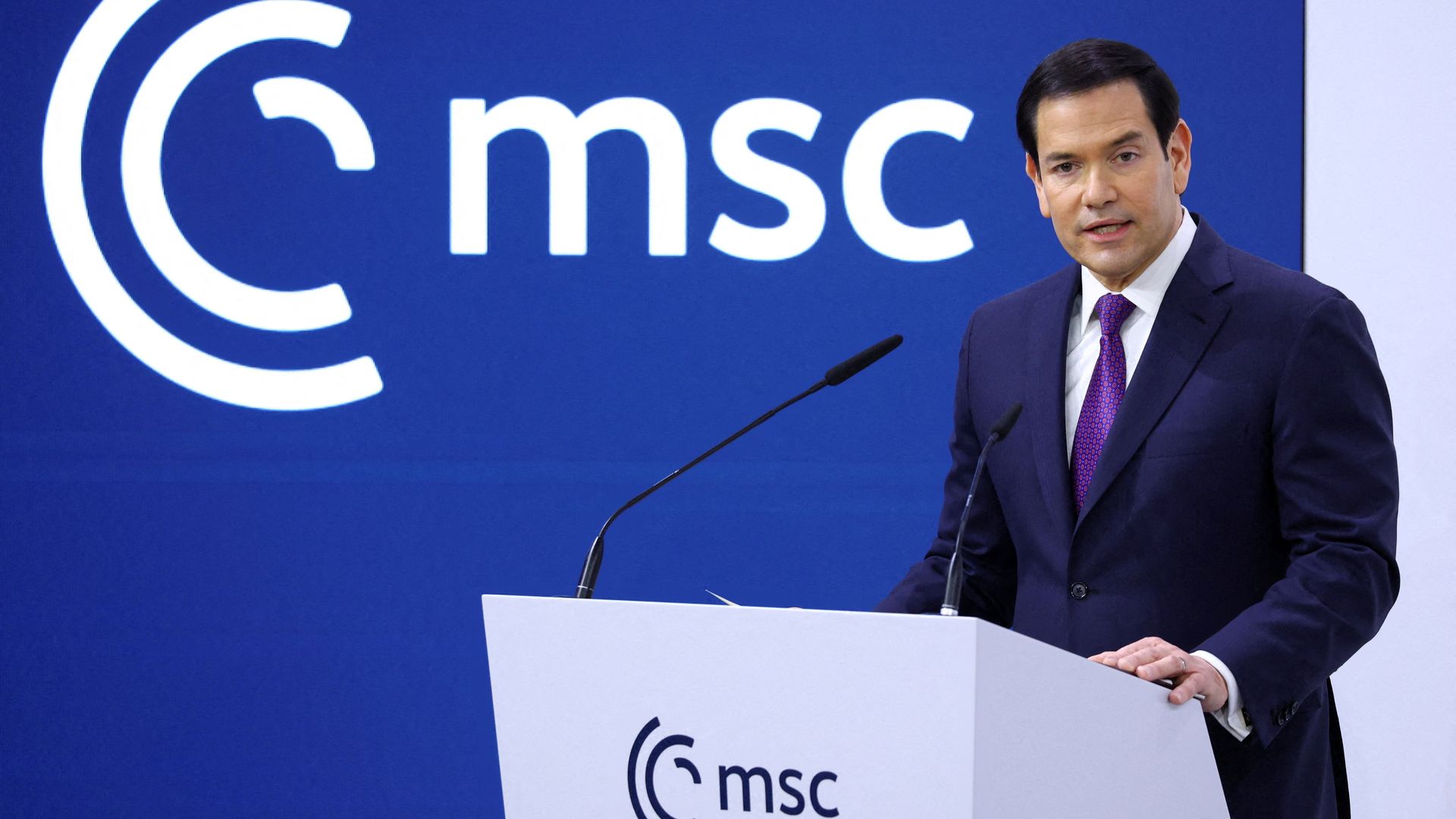
Secretary of State Marco Rubio speaks at the Munich Security Conference in Germany on Saturday. Photo: Thilo Schmuelgen/Reuters
Secretary of State Marco Rubio made the future of MAGA's foreign policy clear in a speech Saturday: In Germany, he warned the Munich Security Conference of the dangers of mass migration, while emphasizing the shared heritage between Europe and the U.S.
- Rubio's Make the West Great Again message dovetailed in substance with Vice President Vance's address at the same conference last year. But it was softer in tone and loftier in rhetoric, earning Rubio applause instead of the shock that greeted Vance.
Why it matters: Taken together, the two Munich speeches by Rubio and Vance articulate President Trump's global vision, albeit more cogently and eloquently. And the twin addresses chart the course of Republican foreign policy for years to come.
- Vance and Rubio are Trump's ideal standard-bearers: The two appear likelier than ever to run together on a ticket to succeed Trump in two years.
The big picture: The Trump-Vance-Rubio doctrine is shorn of what Rubio called the "dangerous delusion" of a world peacefully united by the myth that free trade frees people, or that the international order is truly "rules-based."
- It's a vision of national sovereignty, mutual self-interest, strong military power and foundational civilizational values in a multipolar world.
Zoom in: Unapologetic opposition to mass migration tied together the Munich speeches of Rubio and Vance — as it did virtually every one of Trump's presidential campaign stem-winders for the past decade.
- It amounts to a wholesale rejection of progressives, on both sides of the Atlantic, who view immigration as more of a fundamental good and see criticism of migration as racist.
- "Controlling who and how many people enter our countries — this is not an expression of xenophobia," Rubio said. "It is not hate. It is a fundamental act of national sovereignty. And the failure to do so is not just an abdication of one of our most basic duties owed to our people. It is an urgent threat to the fabric of our societies and the survival of our civilization itself."
Zoom out: Rubio's need to "revitalize an old friendship" underscored just how much European leaders have been shaken by Trump's tariffs and criticisms of NATO — as well as Vance's speech last year.
- "We are part of one civilization — Western civilization," Rubio said. "We are bound to one another by the deepest bonds that nations could share, forged by centuries of shared history, Christian faith, culture, heritage, language, ancestry, and the sacrifices our forefathers made together for the common civilization to which we have fallen heir."
- Rubio didn't just rhetorically carry the baton passed to him by Vance the year before, he blended Trumpism with Reaganism by lamenting how, in 1945, the "great Western empires had entered into terminal decline, accelerated by godless communist revolutions and by anti-colonial uprisings that would transform the world and drape the red hammer and sickle across vast swaths of the map in the years to come."
Between the lines: Rubio never mentioned China by name. But he suggested America's biggest strategic competitor has disproportionately benefited from trade and deindustrialization policies that hollowed out manufacturing.
- "In this delusion, we embraced a dogmatic vision of free and unfettered trade," Rubio said.
- But he added: "Some nations protected their economies and subsidized their companies to systematically undercut ours — shuttering our plants, resulting in large parts of our societies being deindustrialized, shipping millions of working and middle-class jobs overseas, and handing control of our critical supply chains to both adversaries and rivals."
- Rubio criticized "climate cult" greenhouse gas limitations as one-sided, because "our competitors exploit oil and coal and natural gas and anything else — not just to power their economies, but to use as leverage against our own."
The fundamental question, Rubio said, is "what exactly are we defending, because armies do not fight for abstractions."
- "Armies fight for a people; armies fight for a nation. Armies fight for a way of life. And that is what we are defending: a great civilization that has every reason to be proud of its history, confident of its future, and aims to always be the master of its own economic and political destiny."
Between the lines: That could mean de-emphasizing the United Nations, as the U.S. uses more military power unilaterally.
- Rubio noted that without the UN, Trump brokered a "fragile peace" in Gaza, brought Ukraine and Russia to the negotiating table, removed Venezuela's indicted leader, and bombed Iran "to constrain the nuclear program of radical Shia clerics."
The bottom line: "While we are prepared, if necessary, to do this alone," Rubio said, "it is our preference, and it is our hope, to do this together with you, our friends here in Europe."
- Go deeper ... Exclusive: Pentagon threatens to cut off Anthropic in AI safeguards dispute.

No comments:
Post a Comment