Thursday, July 5, 2018

Nuclear disarmament of North Korea

North Korea presents nuclear disarmament’s biggest challenge yet

Precedents, from Iraq to the former Soviet Union, offer only very limited lessons
SIEGFRIED HECKER, a professor who used to run America’s nuclear laboratory at Los Alamos, recalls the most recent of the seven trips he has made to North Korea, in 2010. His hosts were showing off their sprawling Yongbyon atomic-energy complex. With a blend of shyness and defiance, they displayed an astonishing spectacle: a hall with 2,000 brand-new centrifuges, machines that enrich uranium, either for electricity or nuclear bombs.
Apparently assembled in another, unsuspected site, they had appeared in Yongbyon since Mr Hecker’s previous trip in 2008. This implied that, besides its existing plutonium-based technology, the country could make nuclear bombs from uranium. He was also shown the beginnings of a light-water reactor that could produce more plutonium. The message: “We have more nuclear capacity than you think, and you’ll never know how much…”

Latest stories

See more
North Korea’s arsenal has since grown. Estimates range from 20 to 60 warheads, and its latest test was apparently of a hydrogen bomb, 100 times bigger than the earliest devices. It has also made strides in developing missiles; one tested last year could have reached America. The whole nuclear and military complex may involve 100 sites besides Yongbyon. The world’s knowledge is sketchy. A well-connected American think-tank, the Institute for Science and International Security, recently spelled out a long-mooted suspicion. As well as Yongbyon, it said, there seemed to be an older, undisclosed uranium-enrichment site, which it named as Kangsong.
So diplomats and nuclear scientists take a deep breath as they contemplate the “denuclearisation” of North Korea, an undefined goal reaffirmed at the summit between Kim Jong Un and President Donald Trump on June 12th. In Pyongyang this week Mike Pompeo, America’s secretary of state, is trying to put flesh on those flimsy bones. Even if the two sides can agree on a definition of denuclearisation, it will present bigger challenges than any previous exercise in managed disarmament.
Larger arsenals have been dismantled elsewhere, but in kinder political climates. And well-run programmes have monitored pariah states suspected of coveting the deadliest of weapons. But none involved an arsenal or a nuclear-fuel cycle as lethal, big or elusive as North Korea’s.
The world has a well-tried set of mechanisms for coping with such situations. They include the Nuclear Non-Proliferation Treaty (NPT) and the Vienna-based nuclear inspectorate, the International Atomic Energy Agency (IAEA). These structures would be tested by any deal with North Korea; but history suggests they can morph in surprising ways if the will exists.
Broadly, the NPT is a deal between five recognised nuclear powers and other signatories. In exchange for abjuring nuclear weapons, these other signatories are promised access to civil nuclear power, if they can show (with the IAEA’s help) that it will not leak to military uses. North Korea left the NPT in 2003, after America accused it of pursuing a secret nuclear-arms effort. It cannot rejoin until all its atomic weapons have been dismantled. So one dilemma is whether any rewards should be offered for steps along that road.
The only country to have built nuclear weapons and then renounced them, gaining NPT membership and respectability, is South Africa. But it had just six bombs and its state was transparent compared with North Korea’s. Also, it faces no external threats. With apartheid crumbling, its white rulers were eager to renounce illicit weapons. They began dismantling in early 1990 and by September 1991 they were ready to call in the IAEA for tough inspections, which were completed in two years.
An inspector calls
North Korea, by contrast, already has a dismal history with the IAEA. Its inspectors began working there in 1992, to be thrown out the following year and readmitted a year later. Co-operation ceased in 2009, after multilateral negotiations broke down and North Korea started producing plutonium again. The IAEA’s director, Yukiya Amano, says his people stand ready to go back to Pyongyang. But they will need far greater access than they ever enjoyed before if their efforts are to be meaningful.
During the years of intrusive inspection which followed the 1991 Gulf war in Iraq, the agency also played a vital role (see article). And under the deal struck in 2015 to curb Iran’s nuclear activities, from which America has just pulled out, IAEA inspectors have enjoyed access to the Iranian nuclear cycle of which Korea-watchers only dream. That deal also allows for short-notice inspections; the IAEA says that at least until America’s withdrawal, the Iranians were co-operating quite well. But the agreement had noisy critics; some military sites were out of bounds, and it did not touch delivery systems, as any deal with North Korea must.
And there is another snag. The IAEA can trace the flow of nuclear fuel from one facility to another and pinpoint where materials might have been diverted to bomb-making. But once nuclear weapons are made, the Vienna agency bows out. Only the five authorised nuclear states can help dismantle and remove nuclear weapons.
The most ambitious effort of that kind was the destruction and evacuation, after 1991, of parts of the former Soviet nuclear arsenal in Ukraine, Belarus and Kazakhstan. This was an initiative by the world’s nuclear giants: America and newly democratic Russia. They agreed that the Soviet arsenal must be slashed and regrouped in Russia. America acquiesced in its monopoly over the Soviet strategic legacy.
Hundreds of long-range missiles and silos were destroyed. The warheads were taken to Russia and neutralised. Uranium was extracted and much of it sold to America. The Soviet system for transporting sensitive materials by rail made this easier. By 1996, the effort was complete; an arsenal of 1,800 warheads was no longer in Ukraine.
Two American senators, Sam Nunn and Richard Lugar, masterminded the legislation which helped neutralise the residual threat from the Soviet weapons of mass destruction (WMD): chemical and biological as well as nuclear. Among their best ideas was an initiative to find benign jobs for re-employed weapon scientists.
Vice-President Mike Pence conferred last month with Mr Nunn and Mr Lugar. The American-Russian amity that underpinned their work has gone. An obvious partner in any effort to neutralise and evacuate North Korea’s nuclear bombs and material would be China.
A less auspicious precedent has also been mentioned as a template for North Korea. The dismantling of Libya’s ramshackle nuclear programme (along with chemical weapons and efforts to make biological ones) started in December 2003 and was completed in 2004. Libya’s leader, Muammar Qaddafi, craved respectability and sanctions relief. American aircraft carried documents and equipment, including parts of centrifuges and missiles, to a laboratory in Tennessee. But Libya was years away from making any complete bombs. John Bolton, America’s national-security adviser, caused consternation in Pyongyang when he suggested in April that Libya might be a useful model. He since added that again, components from a lethal arsenal might be flown to Tennessee.
Nuclear scientists say that airlifting Korean bombs could be acutely risky. Disassembling and transporting nuclear warheads could trigger explosions, albeit probably not nuclear ones. As a minimum it will need close co-operation between the scientists who made them and at least one member of the existing nuclear club.
The other reason why talk of Libya horrifies North Korea is the fate of Qaddafi. Overthrown in 2011 with the help of Western air power, he was captured, raped with a bayonet and shot by Western-backed rebels. The pariahs of the world took note. Still, Mr Bolton made clear on July 1st that one aspect, at least, of the Libyan operation was worth copying: its speed. He said Mr Pompeo would be talking to the North Koreans about dismantling all their WMD and ballistic-missile programmes “within a year”. Mr Pompeo has mooted a slightly longer timetable: by January 2021.
If “dismantling programmes” means renouncing the capacity for further development, this could indeed be done in a year or two. For example, reactors that produce plutonium could be paralysed; and missile-testing sites destroyed, as Mr Trump (wrongly) claimed was happening already. But verifiably dismantling the existing arsenal and deploying inspectors across all sites would take much longer; Mr Hecker and others have suggested a decade.
Mr Bolton’s brisk approach leaves some analysts gasping. “If you knew everything they had, if they were fully committed and if you had unlimited resources, something might be achieved quite rapidly,” says Tom Plant of RUSI, a London think-tank. “But all those conditions are hypothetical.”
This article appeared in the International section of the print edition under the headline "How to disarm North Korea"

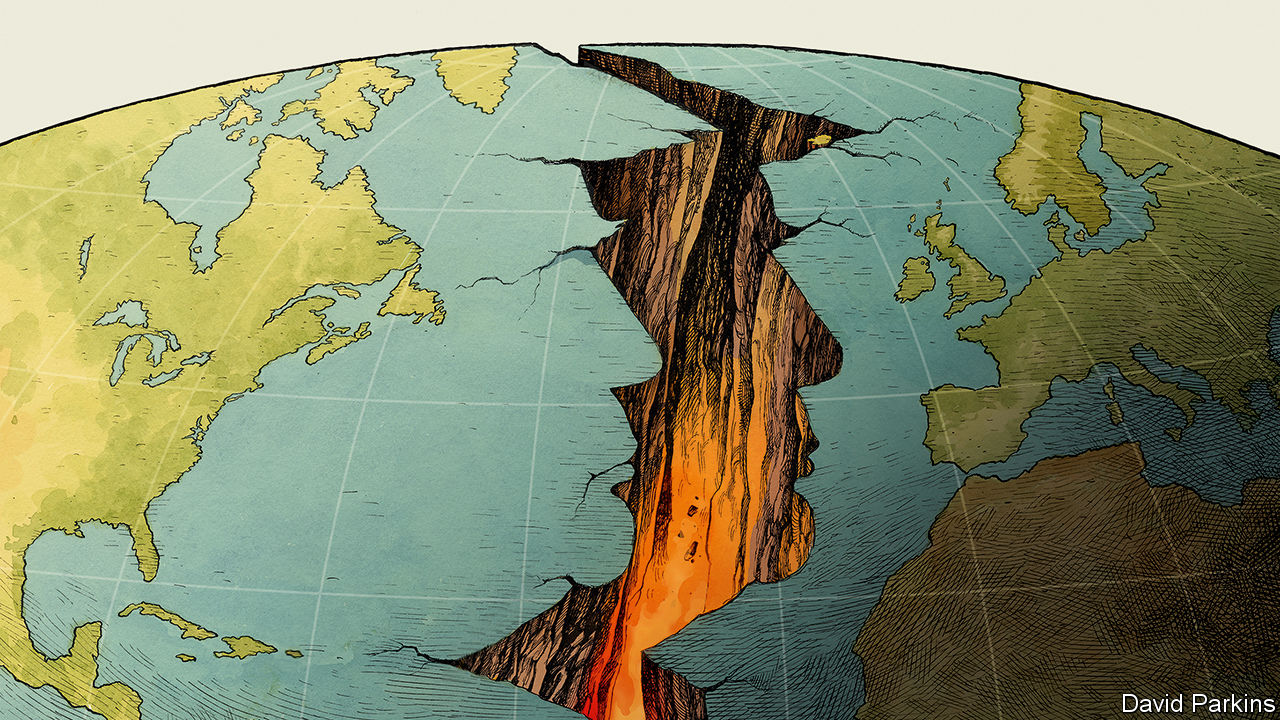
Transatlantic rift (The Economist)

Transatlantic rift
The Western alliance is in trouble
That should worry Europe, America and the world
AMERICA did as much as any country to create post-war Europe. In the late 1940s and the 1950s it was midwife to the treaty that became the European Union and to NATO, the military alliance that won the cold war. The United States acted partly out of charity, but chiefly out of self-interest. Having been dragged into two world wars, it wanted to banish Franco-German rivalry and build a rampart against the Soviet threat. After the Soviet collapse in 1991, the alliance anchored democracy in the newly liberated states of eastern Europe.
Today, however, America and Europe are separated by a growing rift. The mood before the NATO summit in Brussels on July 11th and 12th is poisonous. As President Donald Trump accuses the Europeans of bad faith and of failing to pull their weight, they accuse him of crass vandalism. A second summit, between Vladimir Putin and Mr Trump in Helsinki on July 16th, could produce the once-unthinkable spectacle of an American president treating his Russian opponent better than he has just treated his allies.

See more

Even if the two summits pass off without controversy—as they might, given how Mr Trump delights in confounding his critics—the differing priorities, divergent beliefs and clashing political cultures will remain. The Western alliance is in trouble, and that should worry Europe, America and the world.
Every alliance has its tensions, but the Western one is strained on a bewildering number of fronts (see article). Mr Trump, and his generals, are exasperated by the feeble efforts of many NATO members to honour their promise to raise defence spending towards 2% of GDP by 2024. The American right tends to condemn European support for the Iranian nuclear deal (which Mr Trump quit), and what it sees as a bias against Israel. And policymakers from both parties think that, as the world’s attention shifts to Asia, whining, sanctimonious Europeans deserve less of their time.
As if that were not enough, Mr Trump fatuously accuses the EU of being “set up to take advantage of the United States” and chastises it for unfair trade. Meanwhile, Europe is divided. Italy has a new populist coalition that is pro-Putin. So, increasingly, is Turkey, a member of NATO (but not the EU) which is hostile to the liberal democratic values that bind the alliance. Worse could be in store. A Labour government in Britain under Jeremy Corbyn, who has a long history of opposing the use of arms by the West, would treat America with deep suspicion; he could even try to leave NATO.
SACEUR punch
This newspaper believes that the Western alliance is worth saving. In a dangerous and increasingly authoritarian world, it can act as a vital source of security and a bastion of democracy. But the alliance does not have a God-given right to survive. It must continually earn its place. The question is: how?
The first step is not to make the job harder. Europe should do everything it can to resist Mr Trump’s instinct to lump trade with security. Wrapping them up together will only make the West less secure as well as poorer.
Next, supporters of the alliance need to be practical. That means paying up. Mr Trump is right to complain about countries like Germany and Italy, which spent just 1.22% and 1.13% of GDP on defence in 2017. Indeed, he could go further. Too little of defence spending is useful—over a third of Belgium’s is eaten up by pensions. More should go on R&D and equipment.
For America’s allies, being practical also means keeping up. Collaboration in areas like cyber-security will make the alliance more valuable to America. More urgently NATO must continue to sharpen its response to the tactics of misinformation and infiltration that Russia used in Crimea and eastern Ukraine. Politics waxes and wanes. Lost military understanding is hard to rebuild. Exercises that cement NATO’s remarkably close working military relations are more vital than ever.
And being practical means sticking together. Negotiating over Brexit, the EU is minded to shut Britain out of the union’s security structures because it will no longer be a member. Given Britain’s military experience, its arms industry and its intelligence agencies, that is self-defeating. Instead, the EU’s members should seek to bind Britain in by, for example, promoting the European Intervention Initiative, proposed by France, which aims to create a force that can act in crises. Once America would have seen such a plan as a threat to NATO. Today it would stand both as insurance and as a sign that Europe is willing to take on more responsibility.
Fighting for the mind
Last is the battle of ideas. If NATO and the EU did not already exist, they would not be created. Since the Soviet collapse, the sense of threat has receded and the barriers to working together have risen. Yet that does not make the transatlantic alliance “obsolete”, as Mr Trump once claimed. America’s alliances are an asset that are the envy of Russia and China. NATO is an inheritance that is all the more precious for being irreplaceable.
The need for security remains. Russia is not the Soviet Union but, as a declining power, it feels threatened. It has modernised its forces and is prepared to deploy them. The need to anchor European democracy remains, too. As authoritarianism creeps up on Poland and Hungary, the EU and NATO can once again help limit its advance. And there is the extra benefit of how Europe helps America project power, by providing bases, troops and, usually, diplomatic support.
NATO is more fragile than Mr Trump thinks. At its core is the pledge to treat an attack on one member in the North Atlantic region as an attack on them all. His vacillation and his hostility to Europe weakens that promise, if only because it reveals his scorn for the idea that small countries have the same rights as big ones. Asia is watching, as is Mr Putin. The more Mr Trump bullies his allies, the more the world will doubt America’s security guarantees. Because great powers compete in a grey zone between peace and war, that risks miscalculation.
Mr Trump believes he is a master negotiator in pursuit of a stronger America. With Europe, as with so much else, he gravely undervalues what he is giving up.

This article appeared in the Leaders section of the print edition under the headline "Transatlantic rift"

Patriotic Mobilisation in Russia

NEW REPORT FROM CRISIS GROUP(JUNE 04, 2018)

Patriotic Mobilisation in Russia

What’s new? In recent years, the Kremlin has pursued a policy of patriotic mobilisation – encouraging national pride, commemorating past military victories and promoting a vision of Russia as a reborn global power. While hardly unique to Russia, this project is notable for its scale and its connection to Russia’s newly assertive foreign policy.
Why does it matter?  For President Vladimir Putin, patriotic mobilisation is a means of shoring up his rule and building popular support for military interventions in Russia’s near and far abroad. It can escape the Kremlin’s control, however, notably with far-right movements that turn love of country into ethnic chauvinism and perpetrate violence.
What should be done? Rising patriotic sentiment – like assertiveness abroad – is likely a feature of Russian politics today. Western countries should endeavour to understand its roots in post-Cold War grievances and engage the full spectrum of Russian society. The Kremlin should stop accommodating far-right nationalist groups lest they push Russian policy in dangerous directions.

Wednesday, July 4, 2018

Report by Bruce Fein on the so called Armenian Genocide


Email Newsletter icon, E-mail Newsletter icon, Email List icon, E-mail List iconSign up for our Email Newsletter

ABOUT US
The objective of the Assembly is to coordinate the activities of member Turkish American associations and individual members of the Assembly for the purpose of presenting a more balanced view of Turkey and of the Turkish people, and emphasizing the importance of enhanced understanding between Turkey and the United States. [more]
BECOME A MEMBER
By becoming a member you will be part of a network of Turkish-Americans and friends of Turkey who care about the historic relationship between the two peoples and who are aware of the crucial role each one of us plays in strengthening the relationship and promoting an accurate and fair picture of Turkey and Turks. [Join ATAA]
So-called Armenian Genocide
An Armenian and Muslim Tragedy? Yes! Genocide? No!
By Bruce Fein*

I. Both Armenians and Muslims in Eastern Anatolia under the Ottoman Empire experienced harrowing casualties and gripping privations during World War I.Hundreds of thousands perished. Most were innocent. All deserve pity and respect. Their known and unknown graves testify to President John F. Kennedy's lament that "Life is unfair." An Armenian tombstone is worth a Muslim tombstone, and vice versa. No race, religious, or ethnic group stands above or below another in the cathedral of humanity. To paraphrase Shakespeare in "The Merchant of Venice," Hath not everyone eyes? hath not everyone hands, organs, dimensions, senses, affections, passions? fed with the same food, hurt with the same weapons, subject to the same diseases healed by the same means, warmed and cooled by the same winter and summer...If you prick anyone, does he not bleed? if you tickle him, does he not laugh? if you poison him, does he not die?
These sentiments must be emphasized before entering into the longstanding dispute over allegations of Armenian genocide at the hands of the Ottoman Turks during World War I and its aftermath. Genocide is a word bristling with passion and moral depravity. It typically evokes images of Jews dying like cattle in Nazi cyanide chambers in Auschwitz, Bergen-Belson, Dacau, and other extermination camps. It is customarily confined in national laws and international covenants to the mass killing or repression of a racial, religious, or ethnic group with the intent of partial or total extermination. Thus, to accuse Turks of Armenian genocide is grave business, and should thus be appraised with scrupulous care for historical accuracy. To do less would not only be unjust to the accused, but to vitiate the arresting meaning that genocide should enjoy in the tale of unspeakable human horrors.
It cannot be repeated enough that to discredit the Armenian genocide allegation is not to deny that Armenian deaths and suffering during the war should evoke tears in all but the stone-hearted. The same is true for the even greater number of contemporaneous Turkish deaths and privations. No effort should be spared to avoid transforming an impartial inquest into the genocide allegations to poisonous recriminations over whether Armenians or Turks as a group were more or less culpable or victimized. Healing and reconciliation is made of more magnanimous and compassionate stuff.
In sum, disprove Armenian genocide is not to belittle the atrocities and brutalities that World War I inflicted on the Armenian people of Eastern Anatolia.
I. Sympathy for All, Malice Towards None "War is hell," lamented steely Union General William Tecumseh Sherman during the American Civil War. The frightful carnage of World War I confirmed and fortified that vivid definition.
The deep pain that wrenches any group victimized by massacres and unforgiving privation in wartime, however, frequently distorts or imbalances recollections. That phenomenon found epigrammatic expression in United States Senator Hiram Johnson's World War I quip that truth is the first casualty of war. It is customary among nations at war to manipulate the reporting of events to blacken the enemy and to valorize their own and allied forces. In other words, World War I was no exception, about which more anon.
II. The Armenian Genocide AccusationThe Ottoman Turks are accused of planning and executing a scheme to exterminate its Armenian population in Eastern Anatolia beginning on or about April 24, 1915 by relocating them hundreds of miles to the Southwest and away from the Russian war front and massacring those who resisted. The mass relocation (often mischaracterized as "deportation") exposed the Armenians to mass killings by marauding Kurds and other Muslims and deaths from malnutrition, starvation, and disease. After World War I concluded, the Ottoman Turks are said to have continued their Armenian genocide during the Turkish War of Independence concluded in 1922.
The number of alleged Armenian casualties began at approximately 600,000, but soon inflated to 2 million. The entire pre-war Armenian population in Eastern Anatolia is best estimated at 1.3 to 1.5 million.
A. Was there an intent to exterminate Ottoman Armenians in whole or in part?
The evidence seems exceptionally thin. The Government's relocation decree was a wartime measure inspired by national self-preservation, neither aimed at Armenians generally (those outside sensitive war territory were left undisturbed) nor with the goal of death by relocation hardships and hazards. The Ottoman government issued unambiguous orders to protect and feed Armenians during their relocation ordeal, but were unable because of war emergencies on three fronts and war shortages affecting the entire population to insure their proper execution. The key decree provided:
"When those of Armenians resident in the aforementioned towns and villages who have to be moved are transferred to their places of settlement and are on the road, their comfort must be assured and their lives and property protected; after their arrival their food should be paid for out of Refugees' Appropriations until they are definitively settled in their new homes. Property and land should be distributed to them in accordance with their previous financial situation as well as current needs; and for those among them needing further help, the government should build houses, provide cultivators and artisans with seed, tools, and equipment."
"This order is entirely intended against the extension of the Armenian Revolutionary Committees; therefore do not execute it in such a manner that might cause the mutual massacre of Muslims and Armenians."
(Do you believe that anything comparable has been issued by Yugoslav President Slobodan Milosevic to his troops in Kosovo?)
The Ottoman government prosecuted more than one thousand soldiers and civilians for disobedience. Further, approximately 200,000 Ottoman Armenians who were relocated to Syria lived without menace through the remainder of the war.
Relocation of populations suspected of disloyalty was a customary war measure both at the time of World War I and through at least World War II. Czarist Russia had employed it against Crimean Tatars and other ethnic Turks even in peacetime and without evidence of treasonous plotting. The United States relocated 120,000 citizens and resident aliens of Japanese ancestry during the Second World War despite the glaring absence of sabotage or anti-patriotic sentiments or designs. Indeed, the Congress of the United States acknowledged the injustice in the Civil Liberties Act of 1988 which awarded the victims or their survivors $20,000 each.
In sum, the mass wartime relocation of Ottoman Armenians from the Eastern front was no pretext for genocide. That conclusion is fortified by the mountains of evidence showing that an alarming percentage of Armenians were treasonous and allied with the Triple Entente, especially Russia. Tens of thousands defected from the Ottoman army or evaded conscription to serve with Russia. Countless more remained in Eastern Anatolia to conduct sabotage behind Ottoman lines and to massacre Turks, including civilians. Their leaders openly called for revolt, and boasted at post-World War I peace conferences that Ottoman Armenians had fought shoulder-to-shoulder with the victorious powers. Exemplary was a proclamation issued by an Armenian representative in the Ottoman parliament for Van, Papazyan. He trumpeted: "The volunteer Armenian regiments in the Caucasus should prepare themselves for battle, serve as advance units for the Russian armies to help them capture the key positions in the districts where the Armenians live, and advance into Anatolia, joining the Armenian units already there."
The Big Five victors -Great Britain, France, the United States, Italy, and Japan acknowledged the enormous wartime service of Ottoman Armenians, and Armenia was recognized as a victor nation at the Paris Peace Conference and sister conclaves charring the post-war map. Armenians were rewarded for their treason against the Ottoman Empire in the short-lived Treaty of Sevres of 1920 (soon superceded by the 1923 Treaty of Lausanne). It created an independent Armenian state carved from large swaths of Ottoman territory although they were a distinct population minority and had always been so throughout the centuries of Ottoman rule. The Treaty thus turned President Woodrow Wilson's self-determination gospel in his Fourteen Points on its head.
The Ottoman government thus had overwhelming evidence to suspect the loyalty of its Armenian population. And its relocation orders responded to a dire, not a contrived, war emergency. It was fighting on three fronts. The capital, Istanbul, was threatened by the Gallipoli campaign. Russia was occupying portions of Eastern Anatolia, encouraging Armenian defections, and aiding Armenian sabotage. In sum, the mass relocation of Armenians was clearly an imperative war measure; it did not pivot on imaginary dangers contrived by Ottoman rulers to exterminate Armenians.
The genocide allegation is further discredited by Great Britain's unavailing attempt to prove Ottoman officials of war crimes. It occupied Ottoman territory, including Istanbul, under the 1918 Mudros Armistice. Under section 230 of the Treaty of Sevres, Ottoman officials were subject to prosecution for war crimes like genocide. Great Britain had access to Ottoman archives, but found no evidence of Armenian genocide. Scores of Ottoman Turks were detained on Malta, nonetheless, under suspicion of complicity in Armenian massacres or worse. But all were released in 1922 for want of evidence. The British spent endless months searching hither and yon for evidence of international criminality- even enlisting the assistance of the United State yet came up with nothing that could withstand the test of truth. Rumor, hearsay, and polemics from anti-Turk sources was the most that could be assembled, none of which would be admissible in any fair-minded enterprise to discover facts and to assign legal responsibility.
None of this is to deny that approximately 600,000 Ottoman Armenians perished during World War I and its aftermath. But Muslims died in even greater numbers (approximately 2.5 million in Eastern Anatolia) from Armenian and Russian massacres and wartime privations as severe as that experienced by relocated Armenians. When Armenians held the opportunity, they massacred Turks without mercy, as in Van, Erzurum, and Adana. The war ignited a cycle of violence between both groups, one fighting for revolutionary objectives and the other to retain their homeland intact. Both were spurred to implacability by the gruesome experience that the loser could expect no clemency.
The horrifying scale of the violence and retaliatory violence, however, were acts of private individuals or official wrongdoers. The Ottoman government discouraged and punished the crimes within the limits of its shrinking capacity. Fighting for its life on three fronts, it devoted the lion's share of its resources and manpower to staving off death, not to local law enforcement.
The emptiness of the Armenian genocide case is further demonstrated by the resort of proponents to reliance on incontestable falsehoods or forged documents. The Talat Pasha fabrications are emblematic.
According to Armenians, he sent telegrams expounding an Ottoman policy to massacre its Armenian population that were discovered by British forces commanded by General Allenby when they captured Aleppo in 1918. Samples were published in Paris in 1920 by an Armenian author, Aram Andonian. They were also introduced at the Berlin trial of the assassin of Talat Pasha, and then accepted as authentic.
The British Foreign Office then conducted an official investigation that showed that the telegrams had not been discovered by the army but had been produced by an Armenian group based in Paris. A meticulous examination of the documents revealed glaring discrepancies with the customary form, script, and phraseology of Ottoman administrative decrees, and pronounced as bogus as the Protocols of the Elders of Zion and the Donation of Constantine.
Ditto for a quote attributed to Adolph Hitler calculated to liken the Armenians in World War I to the Holocaust victims and to arouse anger towards the Republic of Turkey. Purportedly delivered on August 22, 1939, while the Nazi invasion of Poland impended, Hitler allegedly declared: "Thus for the time being I have sent to the East only my Death Head units, with the order to kill without mercy all men, women, and children of the Polish race or language. Who still talks nowadays of the extermination of the Armenians."
Armenian genocide exponents point to the statement as evidence that it served as the model for Hitler's sister plan to exterminate Poles, Jews, and others. Twenty-two Members of Congress on or about April 24, 1984 in the Congressional Record enlisted Hitler's hideous reference to Armenian extermination as justification for supporting Armenian Martyrs' Day remembrances. As Princeton Professor Heath W. Lowry elaborates in a booklet, "The U.S. Congress and Adolph Hitler on the Armenians," it seems virtually certain that the statement was never made. The Nuremburg tribunal refused to accept it as evidence because of flimsy proof of authenticity.
The gospel for many Armenian genocide enthusiasts is Ambassador Henry Morgenthau's 1918 book, Ambassador's Morgenthau's Story. It brims with assertions that incriminate the Ottoman Turks in genocide. Professor Lowry, however, convincingly demonstrates in his monograph, "The Story Behind Ambassador Morgenthau's Story," that his book is more propaganda, invention, exaggeration, and hyperbole than a reliable portrait of motivations and events.
According to some Armenian circles, celebrated founder of the Republic of Turkey, Atatürk, confessed "Ottoman state responsibility for the Armenian genocide." That attribution is flatly false, as proven in an extended essay, "A 'Statement' Wrongly Attributed to Mustafa Kemal Atatürk," by Türkkaya Ataöv.
Why would Armenian genocide theorists repeatedly uncurtain demonstrative falsehoods as evidence if the truth would prove their case? Does proof of the Holocaust rest on such imaginary inventiveness? A long array of individuals have been found guilty of participation in Hitler's genocide in courts of law hedged by rules to insure the reliability of verdicts. Adolph Eichmann's trial and conviction in an Israeli court and the Nuremburg trials before an international body of jurists are illustrative. Not a single Ottoman Turk, in contrast, has every been found guilty of Armenian genocide or its equivalent in a genuine court of law, although the victorious powers in World War I enjoyed both the incentive and opportunity to do so if incriminating evidence existed.
The United Nations Economic and Social Council Sub-Commission on the Prevention of Discrimination and Protection of Minorities examined the truthfulness of an Armenian genocide charge leveled by Special Rapporteur, Mr. Benjamin Whitaker, in his submission, "Study of Genocide," during its thirty-eighth session at the U.N. Office in Geneva from August 5-30, 1985. The Sub-Commission after meticulous debate refused to endorse the indictment for lack of convincing evidence, as amplified by attendee and Professor Dr. Ataöv of Ankara University in his publication, "WHAT REALLY HAPPENED IN GENEVA: The Truth About the 'Whitaker Report'."
B. If the evidence is so demonstratively faulty, what explains a widespread credence given to the Armenian genocide allegation in the United States?
As Napoleon once derisively observed, history is a fable mutually agreed upon. It is not Euclidean geometry. Some bias invariably is smuggled in by the most objective historians; others view history as a manipulable weapon either to fight an adversary, or to gain a political, economic, or sister material advantage, or to satisfy a psychological or emotional need.
History most resembles truth when competing versions of events do battle in the marketplace of ideas with equally talented contestants and before an impartial audience with no personal or vested interest in the outcome. That is why the adversarial system of justice in the United States is the hallmark of its legal system and a beacon to the world.
The Armenian genocide allegation for long decades was earmarked by an absence of both historical rigor and scrupulous regard for reliable evidence and truth. The Ottoman Empire generally received bad reviews in the West for centuries, in part because of its predominant Muslim creed and military conquests in Europe. It was a declared enemy of Britain, France, and Russia during World War I, and a de facto enemy of the United States. Thus, when the Armenian genocide allegation initially surfaced, the West was predisposed towards acceptance that would reinforce their stereotypical and pejorative view of Turks that had been inculcated for centuries. The reliability of obviously biased sources was generally ignored. Further, the Republic of Turkey created in 1923 was not anxious to defend its Ottoman predecessor which it had opposed for humiliating capitulations to World War I victors and its palsied government. Atatürk was seeking a new, secular, and democratic dispensation and distance from the Ottoman legacy.
Armenians in the United States were also more vocal, politically active and sophisticated, numerous, and wealthy than Turks. The Armenian lobby has skillfully and forcefully marketed the Armenian genocide allegation in the corridors of power, in the media, and in public school curricula. They had been relatively unchallenged until some opposing giants in the field of Turkish studies appeared on the scene to discredit and deflate the charge by fastidious research and a richer understanding of the circumstances of frightful Armenian World War I casualties. Professor of History at the University of Louisville, Justin McCarthy, and Princeton Professor Heath Lowry stand at the top of the list. Professor McCarthy's 1995 book, Death and Exile: The Ethnic Cleansing of Ottoman Muslims, 1821-1922, is a landmark. Turkish Americans have also organized to present facts and views about the Armenian genocide allegation and other issues central to United States-Turkish relations. But the intellectual playing field remains sharply tilted in favor of the Armenians. Since public officials with no foreign policy responsibilities confront no electoral or other penalty for echoing the Armenian story, they generally acquiesce to gain or to solidify their standing among them.
The consequence has been not only bad and biased history unbecoming an evenhanded search for truth, but a gratuitous irritant in the relations between Turkey and the United States. The former was a steadfast ally throughout the Cold War, and Turkey remains a cornerstone of NATO and Middle East peace. It is also a strong barrier against religious fundamentalism, and an unflagging partner in fighting international terrorism and drug trafficking. Turkey is also geostrategically indispensable to exporting oil and gas from Central Asia to the West through pipelines without reliance on the Russian Federation, Iran, Afghanistan or other dicey economic partners.
Finally, endorsing the false Armenian genocide indictment may embolden Armenian terrorist organizations (for example, the Armenian Secret Army for the Liberation of Armenia) to kill and mutilate Turks, as they did a few decades ago in assassinating scores of Turkish diplomats and bombing buildings both in the United States and elsewhere. They have been relatively dormant in recent years, but to risk a resurgence from intoxication with a fortified Armenian genocide brew would be reckless.
III. Conclusion
The Armenian genocide accusation fails for want of proof. It attempts to paint the deaths and privations of World War I in prime colors, when the authentic article is chiaroscuro. Both Muslims and Armenians suffered horribly and neither displayed a morality superior to the other. Continuing to hurl the incendiary charge of genocide on the Turkish doorstep obstructs the quest for amity between Armenia and the Republic of Turkey and warmer relations between Armenians and Turks generally.
Isn't it time to let the genocide allegation fade away and to join hands in commemorating the losses of both communities during World War I and its aftermath?
Letter from Mr. E. Vartanian, an Armenian-American Volunteer in the Russian Service, to His Brother-in-law in Egypt; Dated 9th /22nd July,1915, and Published in the Armenian Journal "Houssaper," of Cairo.
" We have been here three days. Some of us are going to be sent to Erivan; the rest of us are starting in two days for Van.
The enthusiasm here is very great. There are already 20,000 volunteers at the front, and they are trying to increase the number to 30,000. Each district we occupy is placed under Armenian administration, and an Armenian post is running from Igdir to Van. The Russian Government is showing great goodwill towards the Armenians and doing everything in its power for the liberation of Turkish Armenia.
When we disembarked at Archangel the Government gave us every possible assistance. It even undertook the transport of our baggage, and gave us free passes, second class, to Petrograd. 
At Petrograd we received an equally hearty welcome, and the Governor of the city presented each of us with a medal in token of his sympathy. The Armenian colony put us up in the best hotels, entertained us at the best restaurants, and could not make enough of us. This lasted for five days, and then we continued our journey, again at the Government's expense, to Tiflis.
Everywhere on the way the population received us with cheers and offerings of flowers. Just as we were leaving Archa gel, a young Russian lady came with flowers and offered one to eaeh of us. I also saw a quite poor man who was so moved by the speech in Russian that one of our comrades had made, that he came and put his tobacco into the pipe of a comrade standing next to me, and kept nothing for himself but a bare half-pipeful. A third, an old man, was so moved by the speech that he began to cry and nearly made off, but a little while after I saw him standing in front of the carriage window and, with a shaking hand, holding out a hard-boiled egg to our comrade the chemist Roupen Stepanian. Probably it was his one meal for the day.
And so at every step we found ourselves in the midst of affecting scenes. At Petrograd Railway Station the crowd was enormous. There was an Armenian lady there who offered each of us a rose. There were boys and young men who wept because they could not come with us. At Rostov a young Russian joined our ranks. He was caught more than once by his parents at the stations further down the line, but he always succeeded in escaping them and reioining us. We have christened him Stepan.
When we arrived at Tiflis, we marched singing to the offices of the Central Armenian Bureau, with our flag unfurled in front of us, and the people marched on either side of us in such a crowd that the trams were forced to stop running.
That is enough for to-day. My next letter shall be written from Armenia itself..
Please say nothing to my sister about this resolution that I have taken. I hope, of course, that she would know how to sacrifice her affection for her brother to her love for the nation and for liberty.. I should curse any of my relations who lament my resolution; they would have committed treason against the nation. There are five of us brothers; was it not imperative that at least one of us should devote himself to the cause of a national emancipation ? Let us keep up our courage, realise the urgency of the moment and do our duty. "

Tuesday, July 3, 2018

Special briefing by US State Dept.director of policy planning on Iran


07/02/2018 01:24 PM EDT

Special Briefing
Brian Hook
Press Briefing Room
Washington, DC
July 2, 2018


MS NAUERT: Welcome to all of you, and thanks for coming in. I know a lot of you have an interest in what we’re doing with regard to Iran and our diplomatic efforts going forward. So keeping that in mind, we asked Brian Hook, our director of policy planning, to come down and give you a few minutes’ briefing on where things stand right now.
So I’ll welcome Brian Hook. I’ll call on you take a few questions and then we’ll go on about our day, and I’ll see you tomorrow at our briefing then. Brian, go right ahead.
MR HOOK: Thank you, Heather. Good morning.
QUESTION: Morning.
MR HOOK: I’d like to update you on the progress we’re making to advance the President’s Iran policy. It has been almost two months since President Trump announced our withdrawal from the Iran deal and a little over one month since Secretary Pompeo laid out a roadmap for achieving a better deal.
The Secretary outlined a clear and compelling vision for a better future for the Iranian people. This future can only be realized, though, if Iran meets 12 demands to become a normal country. Normal countries don’t terrorize other nations, proliferate missiles, and impoverish their own people.
As Secretary Pompeo has said, this new strategy is not about changing the regime, it is about changing the behavior of the leadership in Iran to comport with what the Iranian people really want them to do. A key part of our strategy is a campaign of maximum economic and diplomatic pressure. The first part of our sanctions will snap back on August 4th[1]. These sanctions will include targeting Iran’s automotive sector, trade in gold, and other key metals. Our remaining sanctions will snap back on November 6th[2]. These sanctions will include targeting Iran’s energy sector and petroleum-related transactions and transactions with the Central Bank of Iran.
After leaving the deal, Secretary Pompeo and Secretary Mnuchin decided to create joint teams of senior officials to visit every region of the world. These teams were launched on June 4th and have already visited 13 countries in Europe and East Asia. Our diplomatic teams from State and Treasury are bringing with them a message of cooperation and coordination. Many countries around the world share our interests in countering terrorism, halting the proliferation of missiles, and promoting peace and stability in the Middle East. We want to work with these countries to build a strong global effort.
At each stop, the teams from Treasury and State explain the full snapback of our sanctions and warn governments and the private sector of the risks of continuing to do business with Iran. More than 50 international firms have already announced their intent to leave the Iranian market, particularly in the energy and financial sectors.
We have been clear with countries and companies around the world that we are bringing severe economic pressure on Iran until the regime changes its destabilizing policies. In the coming days, Treasury Under Secretary Mandelker and I will lead a delegation to the Gulf as our global diplomatic efforts continue.
As I mentioned earlier on the energy front, sanctions are set to be re-imposed on November 4th. Our focus is on getting as many countries importing Iranian crude down to zero as soon as possible. We are also working with oil market participants, including producers and consumers, to ensure market stability. Banking sanctions will also snap back on November 4th, and we will be aggressively enforcing these provisions to lock up Iran’s assets overseas and deny the Iranian regime access to its hard currency.
Our sanctions do not now, nor have they ever, targeted humanitarian goods. Our sanctions pressure the Iranian regime into changing its behavior and they do not target the Iranian people. The United States does not sanction the export of food or medicine to Iran.
In addition to building a campaign of strong economic pressure, Secretary Pompeo has also made it a priority to stand with the Iranian people, who are the longest-suffering victims of the Iranian regime. The average Iranian today is struggling to afford basics like water, bread, and eggs. At the same time, the Iranian regime is squandering millions of dollars on violent misadventures abroad. These serve no purpose other than to prolong pain and suffering of men, women, and children in Iran and elsewhere in the Middle East.
Iran’s economy is getting worse. Foreign direct investment is falling, and the rial hit an all-time high against the dollar last week. On June 28th, the rial was trading at 85,000 to the dollar on the unofficial market. That is twice the official exchange rate of 42,500. The initial windfall the regime received after the Iran deal never benefited the Iranian people. The Iranian economy is too distorted by corruption and the IRGC’s pervasive presence in most key sectors. Rather than create an economy that works for the Iranian people, the regime refuses to meet standard international banking practices. Iran accordingly remains on the blacklist for failing to prevent money laundering and terror financing.
Supreme Leader Khamenei seems all too aware that economic reform would expose just how much his economy facilitates war, terrorism, and crime. Since the President’s May 8th announcement, the United States has designated two Iranian financial networks that support terrorism. One network involved a currency exchange scheme going through the UAE, and we worked very closely and very well with the Emirati Government to shut it down. The other network involved the Iranian central bank governor and an Iraqi bank. It is no wonder that international banks and firms refuse to enter the Iranian financial system.
The Iranian people are rightly frustrated with the regime, and they are expressing their frustration in nationwide protests and in smaller acts of defiance throughout the country. As the regime continues to crack down on these legitimate calls for reform in Tehran, Khorramshahr, and elsewhere with more repression and even greater violence, the United States stands with the Iranian people. Since withdrawing from the Iran deal, the United States has sanctioned 53 individuals and entities for human rights abuses, proliferation activities, or acts of terrorism, and we will continue to do so. We designated Sadeq Larijani, the head of the judiciary, which demonstrates that we will target those responsible for human rights abuses at the highest levels of the Iranian Government. A people with as rich a history and as deep a culture as the Iranian people deserve a government that treats them with dignity.
Lastly, I will be traveling to Europe at the end of this week for meetings with the political directors from Germany, France, and the United Kingdom, and that will continue very close consultations we’ve had with the Europeans. The Secretary is in regular touch with his E3 counterparts, with governments around the world to discuss the way forward on Iran, and that will continue in the coming weeks. Happy to take any questions. I think Heather’s going to --
MS NAUERT: Yeah. Start with – we’ll start with AP. That’s our tradition here. Go right ahead.
QUESTION: Thanks for this briefing. We heard the President Sunday warn the U.S.’s European allies of sanctions should they continue trade with Iran. I’m just wondering, was that the tenor of your discussions with the U.S.’s European allies on your recent trip to Europe, and have you heard back from any of those allies in response to the President’s words yesterday?
MR HOOK: Well, we will not hesitate to take action when we see sanctionable activity, and that is consistent with our policy of economic and diplomatic isolation against Iran. We do work – as I said, these road shows of Treasury and State officials, they’ve been to Europe. They haven’t been to all of Europe, but they’ve been to part of Europe, been to Asia. Those will continue. But our teams at Treasury are in very close consultation, we’re in close consultation with not just Europe but with all countries who are affected by the re-imposition of our sanctions.
MS NAUERT: Lesley from Reuters.
QUESTION: Yes. Hello, Brian.
MR HOOK: Hi, Lesley.
QUESTION: I was wondering, the President also said over the weekend that he had asked King Salman of Saudi Arabia to – that he’d increase – to increase oil production by 2 million barrels. Can you please give us – have the Saudis agreed to that, number one? Number two, what do you think the market reaction is going to be to that? Would it press down – push down prices and will it make up for the shortage coming up? And number two, is that 2 million barrels per day?
MR HOOK: Well, I’d refer you to the White House for a specific readout on the Saudi reaction to the phone call the President had with the king. Our goal – with respect to the energy sanctions, our goal is to increase pressure on the Iranian regime by reducing to zero its revenue from crude oil sales. Now, we are working to minimize disruptions to the global market, but we are confident that there is sufficient global spare oil production capacity.
MS NAUERT: Next one, Dave from AFP.
QUESTION: Thank you. Thanks, Brian.
MR HOOK: Dave.
QUESTION: India and I believe Turkey have explicitly said that they will continue to import Iranian oil. Can you be precise about the kind of consequences they will face or their corporations and banks will face if they do this?
MR HOOK: We are not looking to grant licenses or waivers, because doing so would substantially reduce pressure on Iran. And this is a campaign of imposing pressure. And so we are not looking to grant licenses or waivers broadly on the re-imposition of sanctions, because we believe pressure is critical to achieve our national security objectives.
We are prepared to work with countries that are reducing their imports on a case-by-case basis. But as with our other sanctions, we are not looking to grant waivers or licenses.
MS NAUERT: I’m sorry, I forgot your name.
QUESTION: Alicia.
MS NAUERT: Alicia Rose, go ahead.
QUESTION: Sure. Thank you so much. You – on the cutting crude oil from Iran, which countries have already agreed to cut oil imports from Iran, and what has been the reaction from countries in your discussions?
MR HOOK: Well, the – I gave a statistic earlier about the number of countries that have announced that. I can get you a specific number, or a more specific description later.
QUESTION: (Off-mike.)
MS NAUERT: Nike from VOA.
QUESTION: Thank you so much, Heather. If I may, I would like to ask about the diplomatic efforts to bring China on board after U.S. ended JCPOA. Because China is a signatory of JCPOA, and the Government of China had expressed opposition of U.S. position to withdraw from JCPOA. What do you say to the Chinese Government? And would Chinese companies that continue to do business with Iran or buy oil from Iran be subject to U.S. sanctions? Thank you.
MR HOOK: Our diplomacy has been focused around mostly consultations with Europe, France, and Germany. Those are our allies. And so we work very closely with allies. We – in Secretary Pompeo’s speech that he gave about a month ago, he listed all of the countries that we want to work with. We believe that China and Russia and the other countries who are part of the Iran deal are tired of the terrorism that Iran is causing. They don’t support the proliferation of missiles around the Middle East. They don’t support just how – this vast proxy network of terrorism.
And so we believe that most countries around the world share our goals. If you go through the list of the 12 objectives that Secretary Pompeo outlined, those objectives were a global consensus prior to the Iran deal. And so you’ve seen China vote repeatedly in a number of UN Security Council resolutions, and those resolutions stated objectives that are perfectly consistent with the 12 objectives that Secretary Pompeo laid out.
And so when we sit down with countries, we are beginning from a position of broad agreement on wanting to deter Iran’s destabilizing activities in the Middle East and its support for terrorism. No one supports Iran’s terrorism in the world except perhaps Assad. And so we feel like we have enormous agreement with countries around the world on what we need to do to deter Iran’s violence.
MS NAUERT: Michelle – Michelle --
QUESTION: You mentioned the waivers, case-by-case --
MS NAUERT: We’ve got to move on. Sorry. Two questions left. Michelle, go right ahead.
QUESTION: Well, it doesn’t sound like there’s enormous agreement in Europe as to how to go about this. And you mentioned that you’re not looking to grant waivers, but does that mean that you’re not ruling them out as well? And also, with Rouhani in Europe now, what do you expect will be accomplished in that? I mean, do you think that – that and the goal of moving forward with the sanctions on Europeans, is that just solidifying opposition to the way the U.S. is going about this?
MR HOOK: President Rouhani, as you’ve seen reported in the press, will be visiting Switzerland and Austria as part of their ongoing efforts to work with the Europeans. It is interesting that he will be traveling to Vienna. This is – this month of July is the 29th anniversary that Iranian operatives, using diplomatic cover, assassinated the head of an Iranian Kurdish dissident group and two others. And so we will be, in the near term, reminding people of Iran and the violence that they have – a lot of their attacks, assassinations, bombings, cyber attacks, kidnapping, hostage-takings, hijackings, small arms attacks, from 1979 to 2018, and we will be discussing that in every region of the world.
And so when you have somebody like Rouhani going to Europe to try to bring the Europeans, it’s a very sad history of violence that Iran has committed against Europe since 1979. And it’s important for Europeans to remember the kind of regime that they’re dealing with.
MS NAUERT: And --
QUESTION: And you’re not ruling out waivers, did you say?
MS NAUERT: Michelle, we’ve got to go. Final question, Nadia.
QUESTION: Thank you, Heather. As you just mentioned, a significant component of the Iran strategy is to counter its activities in the region. Have you seen any change since the withdrawal from the agreement, especially the support for the Assad regime or their activities in Yemen?
MR HOOK: Well, if you look at Iran and Syria, and Iran and Yemen, they are backing all the wrong people. And by backing them, that has contributed to enormous suffering and violence in the region. When you – we’ve put out a number of statements that summarize what Iran has been doing in Syria. They have been backing – these Iranian-backed forces are perpetuating the Assad regime’s brutality against the Syrian people, and it’s inciting instability that spills into neighboring countries. And so this is the expansionist sort of policy that Iran has been pursuing, and a lot of the money that they received under the Iran deal has been used to fund these activities that has destabilized the Middle East, especially in Syria and Yemen.
MS NAUERT: Thank you everybody, we’ve got to go. Thanks, Brian.
MR HOOK: Thanks.

[1] The following is on the record to Brian Hook: The first part of our sanctions will snap back on August 6. These sanctions will include targeting Iran’s automotive sector, trade in gold, and other key metals. The remaining sanctions will snap back on November 4. These sanctions will include targeting Iran’s energy sector and petroleum-based transactions, and transactions with the Central Bank of Iran.
[2] The following is on the record to Brian Hook: The first part of our sanctions will snap back on August 6. These sanctions will include targeting Iran’s automotive sector, trade in gold, and other key metals. The remaining sanctions will snap back on November 4. These sanctions will include targeting Iran’s energy sector and petroleum-based transactions, and transactions with the Central Bank of Iran.