Is Greece Replacing Turkey as the US’s Main Strategic Ally in the Region?

There is a massive logistical shift of US military power toward Greece underway, and it is happening largely under the radar. While much of the world is absorbed by daily diplomatic dramas and the unfolding consequences of the war in Iran, the Pentagon is quietly redrawing the map of American presence across the broader region.
Historically, the US maintained close military ties with Turkey. For over seventy years, Turkey served as NATO’s indispensable eastern anchor. The strategic significance of Anatolia’s geography made it the primary staging ground for American power projection into the Middle East and the Black Sea—first against the USSR and now in relation to Russia.
The history of the strategic military partnership between US and Turkey
Looking back at the historic military alliance between the US and Turkey, it’s clear that Turkey’s location—straddling the crossroads of Europe and Asia—made it the ultimate staging ground for American power projection. It served as the perfect launchpad for monitoring the Middle East, controlling maritime traffic in and out of the Black Sea, and anchoring NATO’s southeastern frontier.
This partnership was highly operational. The crown jewel of the arrangement was always Incirlik Air Base in southern Turkey. Throughout the Cold War, Incirlik was arguably America’s most critical forward operating base. It hosted US nuclear weapons, launched U-2 spy plane missions deep into Soviet airspace, and operated essential radar stations to track missile activity.
Notably, even after the collapse of the Soviet Union, the base remained invaluable to the United States. Whenever the Pentagon needed to project force into the Middle East—whether during the Gulf War, post-9/11 operations, or the complex air campaigns against ISIS in Syria and Iraq—Turkish bases were the primary jumping-off points. Their proximity allowed US fighter jets and drones to reach active combat zones far faster than from any other location in the region. For decades, the logic in Washington was straightforward: to operate effectively in such a volatile part of the world, you absolutely needed Ankara on your side.

When things started to shift: Greece as a key US military ally in the region
However, the situation has been gradually changing for years. The U.S. is now actively building a highly sophisticated military footprint in Greece, establishing a strategic alternative so it doesn’t have to rely so heavily on Ankara in times of a regional crisis.
Why this pivot? The answer comes down to a serious breakdown in trust. The turning point was the failed Turkish coup in July 2016. During the chaos, Turkish authorities cut commercial power to Incirlik Air Base and locked down the perimeter, amid widespread suspicion among Erdogan supporters that the coup was US-driven.
This was a major signal to Washington: US combat missions were grounded within seconds, exposing just how vulnerable the United States was by putting all its eggs in Turkey’s basket.
Trust suffered another severe blow when Turkey purchased Russian S-400 missile defense systems. The S-400 system cannot be integrated into NATO’s air defense network because it is built on completely different technology and does not share the alliance’s secure systems. However, the main concern is that if it operates alongside NATO aircraft, it can gather detailed radar data on them, including advanced jets. That information could potentially be accessed by Russia, allowing it to better understand how to detect or track NATO aircraft, which raises serious security concerns for the alliance.
US officials made it clear that such Russian hardware cannot coexist with advanced American technology, leading Washington to remove Ankara from the F-35 stealth fighter program and impose sanctions. The message was unmistakable—the United States could no longer count on Turkey as it once had.
Souda Bay, Crete
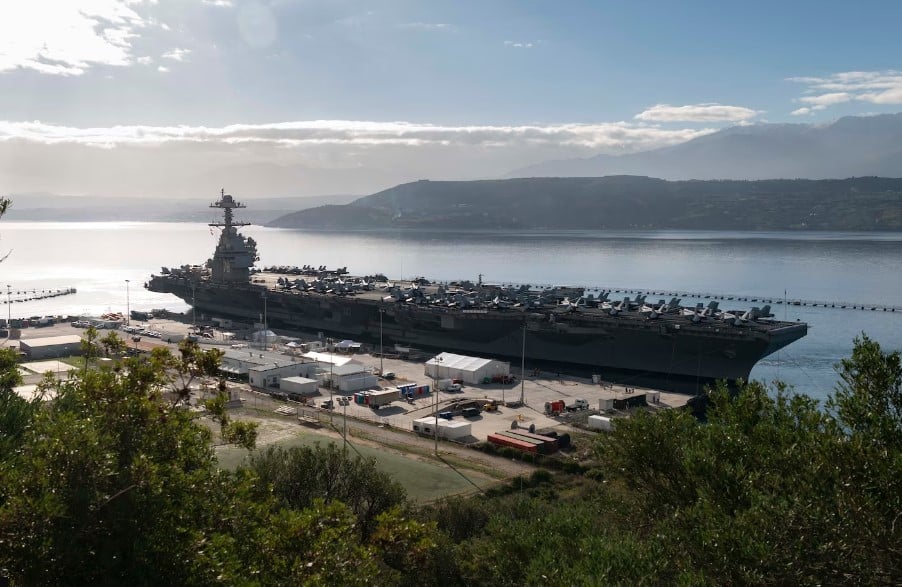
To address this vulnerability, the Pentagon began seeking alternatives. In recent years, it has invested heavily in the Souda Bay military base on Crete, transforming it into a maritime powerhouse.
With the continuous expansion of Pier K-14, massive nuclear-powered aircraft carriers can now dock directly, turning this Cretan outpost into the operational epicenter for the American fleet across the region. Souda Bay reduces critical logistics time, enhances the safety of US forces, and provides the freedom to operate across the Mediterranean and monitor North Africa—without relying on an increasingly unpredictable ally who flirts with Moscow and Tehran and repeatedly threatens Israel.
Alexandroupolis

Another key concern is the Bosphorus Strait. Historically, control of this narrow waterway has given Turkey a decisive advantage in moving heavy armor into the Black Sea, a strategic leverage dating back centuries to the Ottoman era. To bypass this dependency, the US has steadily upgraded the deep-water port of Alexandroupolis in northeastern Greece. The port has essentially become a “Bosphorus Bypass,” allowing the US military to operate quickly and efficiently across the broader Eastern European region without relying on Turkey.
Heavy military equipment can now be unloaded from transport ships directly onto commercial trains in Thrace and shipped onward to Bulgaria, Romania, and Poland— no Turkish straits, no unpredictable leadership, and no trust issues. Alexandroupolis has already facilitated the movement of thousands of pieces of gear for heavy brigade deployments, particularly in support of Ukraine during its war against Russia. This small Greek city has proven it can be a game-changer for Southern and Eastern European military logistics.

Larissa and Volos Stefanovikio Air Base
At the same time, Greece is emerging as a serious hub for air power and surveillance. The country hosts a permanent fleet of MQ-9 Reaper drones at Larissa Air Base in central Greece, keeping constant watch over the Aegean and Black Sea—not just for Athens, but for its allies as well. Further south, bases at Stefanovikio near Volos regularly hosted rotations of American Army aviation. Another notable factor is increasing hardware alignment. Greece is purchasing Black Hawk helicopters, making joint training operations between Greek and US forces practically seamless.
F-35 supersonic stealth strike fighters and Andravida Air Base

The contrast in the skies is striking. While Turkey operates an aging fleet of F-16s, Greece recently signed a deal for twenty advanced F-35 stealth fighters and has upgraded most of its fleet to the new F-16 Viper standard. Andravida Air Base is already being prepped for complex fifth-generation warfare simulations, and it’s only a matter of time before the formidable Hellenic Air Force receives its first 5th-generation aircraft from the US.
ExxonMobil and the Vertical Corridor
This isn’t just about military hardware. There is also a significant economic and energy dimension. The US security umbrella out of Souda Bay provides the stability for energy giants such as ExxonMobil to invest billions in ultra-deepwater natural gas exploration south of Crete, strengthening Greece’s maritime sovereignty in the broader Mediterranean.
Additionally, the new “Vertical Corridor” of pipelines, fueled by the upgraded port facilities at Alexandroupolis, will transport American liquefied natural gas north from the Aegean into the EU and Ukraine. This effectively bypasses Turkish territory and the Russian TurkStream pipeline, providing Europe with a major boost in energy independence from Russia.
What is becoming increasingly clear is that the US presence in Greece functions as the ultimate strategic insurance policy in a region defined by volatility. Turkey remains a major land power with significant regional influence, but its own decisions are gradually isolating it from Western defense networks. Greece, in contrast, has stepped up as the Eastern Mediterranean’s new logistical super-connector, offering Washington exactly what it needs—a reliable, liberal partner capable of navigating the unpredictable decades ahead.

No comments:
Post a Comment