Sunday, November 22, 2026

CNN World - Iranian attacks in the Strait of Hormuz are at the highest levels since the conflict began - By Billy Stockwell and Farida Elsebai - 1 hr 52 min ago ( November 22, 2026)

 CNN  World

Iranian attacks in the Strait of Hormuz are at the highest levels since the conflict began

By Billy Stockwell and Farida Elsebai

1 hr 52 min ago  ( November 22, 2026) 


A liquefied petroleum gas tanker can be seen burning in the Strait of Hormuz off the Musandam Peninsula, Oman, on Tuesday. Lewis Pugh Foundation/AP

Reported attacks on shipping in and around the Strait of Hormuz are at the highest levels since the Iran war began, maritime data shows, as Tehran seeks to re-exert its control over the critical waterway amid falling oil prices.


In October, the number of attacks reported to the Royal Navy-affiliated United Kingdom Maritime Trade Operations (UKMTO) exceeded 30 for the first time since the US-Iran war began in late February.


As of Sunday, at least 22 attacks were reported in November, the second highest figure since the war began, according to a CNN analysis of UKMTO data. The reporting area covers the Strait of Hormuz, the Persian Gulf and the Gulf of Oman.


Before October, the number of reported attacks in the region averaged around 10 per month. Numbers vary, but data from the International Maritime Organization also points to October as having the highest number of confirmed incidents so far this year.


Since the conflict began, the strait has become a heavily contested frontier, with attacks there disrupting oil and gas shipping and sparking global economic fallout.


Iran began trying to halt traffic in the wake of the US-Israeli attacks that launched the war. In response, the US imposed a blockade on Iranian ports, and as CNN previously reported, Gulf producers have found ways of getting ships through the strait.


Commercial traffic through the channel – through which a fifth of the world’s oil passed before the war – remains at a reduced level when compared to the 2025 baseline.


As global oil prices fall and the Iran’s domestic crude revenues come under increasing strain, Tehran has been stepping up attacks, with experts saying the country is losing its leverage over the waterway and could escalate attacks further in an attempt to force concessions from Washington.


No need for a deal, Trump says

The International Energy Agency attributes the recent decline in oil prices to a recovery in Gulf exports. Prices also fell after the US midterm results as concerns over fresh US military action in the Middle East subsided.


“Markets appear to be increasingly assuming that a return to full-scale war is unlikely and that oil supplies will gradually recover,” Hamidreza Azizi, a senior Iran analyst at the International Crisis Group (ICG) think tank, told CNN. “But that assumption could change quickly if Iran decides to intensify the confrontation.”


A man pumps fuel at a gas station on November 10 in Miami, Florida. Joe Raedle/Getty Images

Meanwhile, Iran’s domestic oil revenues are falling sharply as the US blockade of Iranian ports continues to stifle the country’s supply of oil to global markets, according to maritime data tracking service Kpler.


“Iranian oil on water outside the (US) blockade zone has hit zero as the last cargoes discharged in China earlier this month. Consequently, Iran’s oil revenues could drop to zero by mid-December,” Kpler reported in late October.


US President Donald Trump said this month the US doesn’t “need a deal” with Tehran and ordered Vice President JD Vance to turn his focus elsewhere.


“We don’t need a deal with Iran. Those days have long since passed!” Trump posted on Truth Social. “We’ve got their money, Hundreds of Billions of Dollars, and we’ve got their Strait!”


He later indicated he wouldn’t hesitate to resume military strikes in Iran if necessary.


Three tankers struck in Hormuz since Friday

During the latest attacks, projectiles struck three tankers exiting the strait on Friday and Saturday, according to Marisks, a maritime risk management company.


Marisks did not confirm who was behind the attacks, though it said Iranian involvement was “assessed as likely.”


Related vertical video

TrumpIranDealVVTHUMB.jpg

pool


Trump says Iran is ‘bullsh*tting’ on effort to end war


Fire erupted aboard the Captain Leon, a Marshall Islands-flagged chemical and oil tanker, after it was struck at the bow 3 p.m. UTC (10 a.m. ET) on Friday. All crew were reported safe, Marisks said.


The Torkel, a Hong Kong-flagged crude oil tanker, caught fire after being hit in the stern at 5 a.m. UTC on Saturday (midnight ET on Saturday). Less than an hour later, the Arina, also Hong Kong-flagged, was struck in the engine room by a missile.


The attacks demonstrate the “continued critical threat” to commercial shipping in the region, Marisks said, particularly through the “southern corridor” near Oman’s coastline which Iran vehemently opposes.


CNN’s Eleni Giokos, Laura Sharman, Nadeen Ebrahim and Alayna Treene contributed reporting.


EURONEWS - COP31 climate deal in doubt after European Union rejects draft - By Nathan Rennolds - Published on 22 November 2026 - 8:50 GMT+1,Updated 12:58

 EURONEWS 

COP31 climate deal in doubt after European Union rejects draft

ShareCommentsAdd Euronews on Google
Copyright Copyright 2026 The Associated Press. All rights reserved.
By Nathan Rennolds
Published on ,Updated

The latest draft again failed to mention fossil fuels, which have become a flashpoint at the talks.

The European Union has formally rejected the latest COP31 draft deal, saying it cannot accept an agreement that does not mention fossil fuels.

Darragh O'Brien, the climate and energy minister for Ireland, which holds the rotating EU presidency, said the EU and its member states "object" to the draft because it "does not meet the moment."

"We will not endorse a cover decision, or an Antalya Pact, that does not even mention fossil fuels, which is the key driver of climate change," O'Brien said.

Panama also rejected the proposed deal.

The announcement could see the chaotic and late-running climate talks collapse.

A new COP31 draft agreement had been published early on Sunday as nations continued to struggle to reach an accord.

The new draft kept a much-sought goal to electrify the global economy but again failed to mention fossil fuels, deepening divisions at the UN conference - which is being held in Antalya, Turkey.

The latest text needed consensus approval from almost 200 nations at a closing session on Sunday.

An EU official had told the AFP news agency that the draft was a "backwards" step and warned that there was a "very real possibility" of the talks ending without a deal.

"I am more pessimistic today than I was yesterday," they said.

"The situation is difficult, and the outcome is uncertain. The oil-producing countries are putting up a fierce fight," a German official added.

Planet-heating fossil fuels have become a flashpoint at the talks, which come amid soaring energy prices and simmering global tensions stemming from the Iran war.

A draft deal unveiled earlier this week had called for a sped-up phasing out of fossil fuels. But a second version released on Thursday removed all mentions of the energy sources, forcing negotiators back to the bargaining table.

A group of countries including France and Panama had released a letter on Friday insisting that a deal include "a clear transition away from fossil fuels."

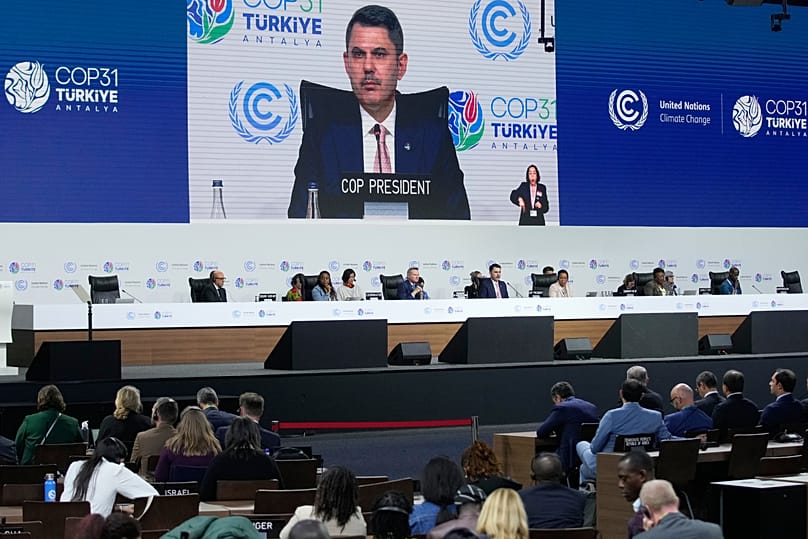
COP31 President Murat Kurum, center, speaks during a plenary session at the COP31 U.N. Climate Summit, Friday, Nov. 20, 2026, in Antalya, Turkey.
COP31 President Murat Kurum, center, speaks during a plenary session at the COP31 U.N. Climate Summit, Friday, Nov. 20, 2026, in Antalya, Turkey. Copyright 2026 The Associated Press. All rights reserved.

The latest offering acknowledged a previous global deal to transition away from fossil fuels but stopped short of naming them explicitly.

It also kept a contentious push to expand carbon capture and storage, a technology backed by the fossil fuel industry but criticised by opponents as costly and ineffective at reducing emissions.

"We are very disappointed with how the text looks," Michael Joseph, the environment minister of Antigua and Barbuda, told AFP.

"I can't honestly say that I'm okay with it passing" as it is, Joseph said, adding that the draft was "quite silent" on fossil fuels.

Additional sources • AFP

NEWSWEEK - News Article - Winners and Losers From Trump, Xi and Putin’s Summit to Decide World’s Fate Published - Nov 19, 2026 at 09:10 AM EST updated Nov 19, 2026 at 03:03 PM EST

NEWSWEEK -  News Article

Winners and Losers From Trump, Xi and Putin’s Summit to Decide World’s Fate

1:06

0:00 / 1:06

to see more of our trusted coverage when you search.

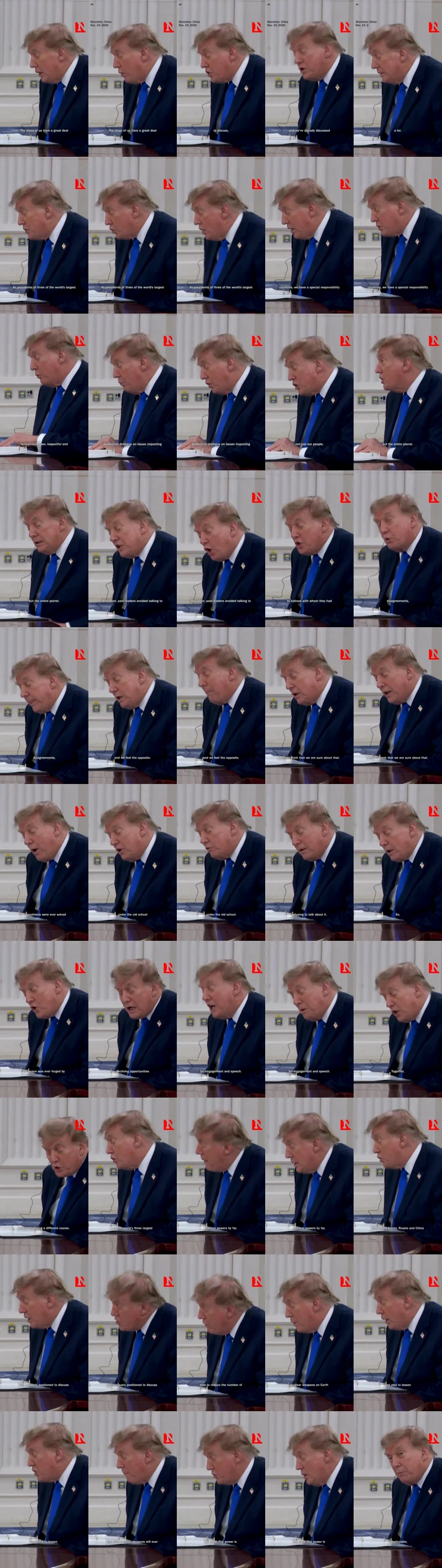
President Donald Trump, Chinese President Xi Jinping and Russian President Vladimir Putin touted how they were deciding the fate of the world ahead of their trilateral meeting this week on the sidelines of the APEC summit in Shenzhen, China.

As such, the joint statement from the U.S., China and Russia after their leaders' 90-minute meeting will be pored over about which issues were prioritized, what was omitted and who emerged on top. The talks addressed global issues like reducing nuclear threats, UN reform and increasing the world's supply of petroleum products amid an energy crisis.

Putin benefited from criticism of the International Criminal Court (ICC), which has issued an arrest warrant for him linked to the Ukraine War, a topic absent from a readout after the meeting.

Read More on World

Xi used the meeting to demonstrate Beijing's unique and growing convening power on the world stage, William Yang, Northeast Asia senior analyst at the International Crisis Group told Newsweek on Thursday.

"China probably emerges from the trilateral summit feeling confident," Yang said.

From left: Russian President Vladimir Putin, U.S. President Donald Trump and Chinese President Xi Jinping at the trilateral meeting at Kylin Villa on the sidelines of the Asia-Pacific Economic Cooperation Summit in Shenzhen, China, on November 19, 2026.
From left: Russian President Vladimir Putin, U.S. President Donald Trump and Chinese President Xi Jinping at the trilateral meeting at Kylin Villa on ...

What Did the Joint Statement Say?

The closed-door meeting at the Kylin Villa in Shenzhen lasted for 90 minutes, a half-hour longer than the scheduled time.

The U.S. released the statement after Russia and China as they outlined their roles as permanent members of the UN Security Council as key to reforming the body. The statement also committed to the importance of energy flows and petroleum products in a pledge that comes amid a spike in global energy prices exacerbated by the U.S. war with Iran.

The trio reaffirmed that a nuclear war cannot be won, must not be fought and would engage in dialogue "on reducing nuclear risks and preventing nuclear proliferation."

But the trio also said that the ICC "and other similar bodies must not abuse their jurisdiction."

Who Are the Winners?

China

The joint readout, which highlighted Trump and Putin thanking Xi for hosting the summit, suggested that the U.S. and Russian leaders need to curry favor from Xi, Yang said.

"On the other hand, China avoided committing itself to a trilateral nuclear negotiation that it views as unfair to its interests and position," Yang said.

Since the meeting yielded no meaningful conclusion on settling the Russia-Ukraine war, China also avoided souring its relationship with European countries by hosting the summit.

"Overall, Beijing will feel relatively confident about its relative position vis-a-vis Washington and Moscow following this meeting," Yang added.

Chinese President Xi Jinping speaks during a trilateral meeting with U.S. President Donald Trump and Russian President Vladimir Putin at Kylin Villa on the sidelines of the Asia-Pacific Economic Cooperation Summit in Shenzhen, China, on November 19, 2026.
Chinese President Xi Jinping speaks during a trilateral meeting with U.S. President Donald Trump and Russian President Vladimir Putin at Kylin Villa o...

Putin

After years of isolation and sanctions caused by his invasion of Ukraine on February 24, 2022, Putin's presence at the top table of global diplomacy was welcomed by Russian media.

Trump's comments about the ICC and the statement against it will serve Russian leader well, as will rhetoric during the summit that reinforces his vision of a global order that pivots away from Western dominance.

“Nobody expected everything to go so well," Putin said as part of his goodbye to Xi.

Who Are the Losers?

Ukraine & Europe

Trump said he had raised the wars in Iran and Ukraine with the leaders earlier in the day, but the conflicts were not mentioned in the statement released by Russia and China.

T