SCMP (South China Morning Post) - China-US-Russia trilateral set for Thusday on APEC sidelines - Orange Wang - Published: 9:12am, 16 Nov 2026Updated: 3:47pm, 16 Nov 2026
The state leaders of China, the United States and Russia will meet in the southern Chinese city of Shenzhen on Thursday on the sidelines of the Apec summit, Beijing said on Monday.
The high-stakes meeting between Chinese President Xi Jinping and his counterparts Donald Trump and Vladimir Putin will mark the first time the leaders of the world’s three foremost nuclear and geopolitical powers sit down together in a three-way format.
The announcement follows confirmations from the White House on Friday and the Kremlin on Saturday that the unprecedented talks will go ahead alongside the Asia-Pacific Economic Cooperation summit in Shenzhen, which opens on Wednesday.
The talks will take place on the sidelines of the Apec Economic Leaders’ Meeting – the first international gathering of the world’s most powerful economies to be hosted by China since the 2016 G20 summit in Hangzhou.
The White House on Friday confirmed an unprecedented meeting between leaders of the US, China and Russia on the sidelines of the Asia-Pacific Economic Cooperation (Apec) summit in Shenzhen next week.
“President [Donald] Trump will conclude his visit to China with a trilateral meeting between the president of the United States, the president of the People’s Republic of China and the president of the Russian Federation,” said Olivia Wales, the White House assistant press secretary.
Wales added that “among other topics”, Trump planned to discuss the “reduction of nuclear weapons”.
Wenran Jiang, the founding director of the China Institute and Mactaggart Research Chair Emeritus at the University of Alberta, is an adviser at the Institute for Peace and Diplomacy.
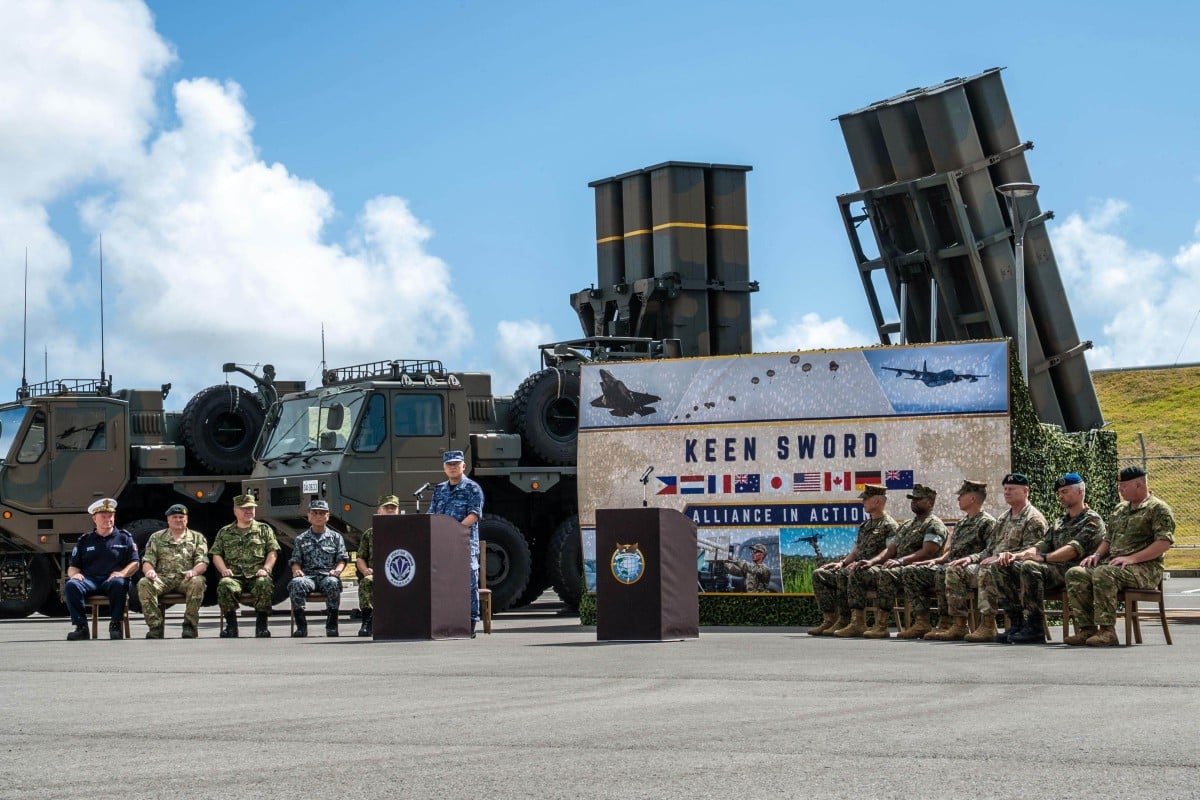
Just weeks after US President Donald Trump and Chinese President Xi Jinping invoked their countries’ World War II alliance at the White House, Keen Sword 27 turned symbolism into hardware. The 11-day exercise, which wrapped up on October 29, deployed US Marine NMESIS anti-ship launchers and MADIS air-defence systems to Yonaguni – Japan’s westernmost island, just 110km (70 miles) from Taiwan.
Japan mobilised its new Type 25 missile, with a reported 1,000km range, from Kumamoto for the system’s first large-scale drill. The containment arc is no longer a concept; it has been exercised, coordinated and institutionalised under Tokyo’s new Joint Operations Command.
That architecture did not begin with missiles on Yonaguni. In early August, Japanese Defence Minister Shinjiro Koizumi swung through Canberra and New Delhi, signing a hypersonic missile-testing agreement with Australia and a dedicated maritime security memorandum with India. They are building blocks of an autonomous Indo-Pacific network Tokyo is constructing as Washington’s attention fractures between its war with Iran, alliance disputes and domestic politics.
The vacuum Japan is filling has three dimensions. First, the Iran war has drained US assets: the USS Tripoli redeployed from Sasebo naval base to the Middle East with 2,200 Marines, while Japan’s order of 400 Tomahawk missiles has been delayed. Second, Trump’s transactional message to allies – “we can’t go around and protect all of these countries” – shattered the presumption of automatic US protection. Third, the Quadrilateral Security Dialogue (Quad) is in flux after Trump skipped the Delhi summit, fuelling fears of a US-China agreement that sidelines allies.
Tokyo has stopped waiting. It has set up bilateral emergency consultation mechanisms with Australia, Germany, France and the Philippines, covering ammunition sharing, intelligence coordination and joint maintenance.
Domestically, Tokyo has inaugurated the National Intelligence Bureau and lifted defence spending to more than 9 trillion yen (US$57 billion), hitting its 2 per cent gross domestic product target early. Externally, Japan is weaving a six-node security chain including the Philippines, Australia, India, Taiwan and Southeast Asia, with Japan as the hub.
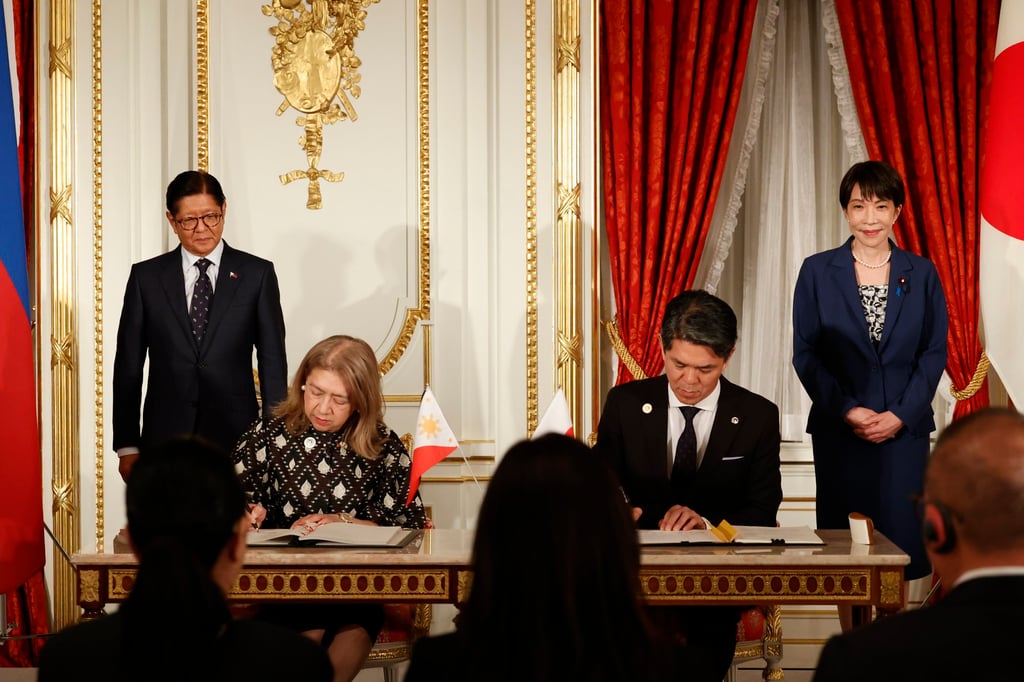
(Left to right) Philippine President Ferdinand Marcos Jnr, Mylene J Garcia-Albano, ambassador of the Philippines to Japan, Kazuya Endo, ambassador of Japan to the Philippines, and Japanese Prime Minister Sanae Takaichi sign documents during a cooperation agreement ceremony at the Akasaka Palace state guest house in Tokyo, Japan, on May 28. Photo: Rodrigo Reyes Marin
The Philippines is the cornerstone. The Japan-Philippines Reciprocal Access Agreement entered into force in September 2025, and an Acquisition and Cross-Servicing Agreement in August this year. Japan has delivered five coastal radar systems to the Philippines and is negotiating to export up to five Abukuma-class frigates.
Australia serves as a production and testing centre. On August 18, Koizumi and Australian Deputy Prime Minister Richard Marles agreed that Japanese forces would test long-range missiles at Australian ranges. Australia also has plans to build upgraded Mogami-class frigates locally.
India is the industrial partner. The August 20 maritime security memorandum covers joint shipbuilding and the Unicorn communications array, among other matters. In September, Japan deployed three F-2 fighters to India for the Veer Guardian 26 joint training exercise.
Taiwan forms the implicit southern anchor. Japanese Prime Minister Sanae Takaichi’s warning that use of force against Taiwan could constitute a threat to Japan’s survival has led to a military build-up near the Taiwan Strait, as well as a protracted and furious response from Beijing. Keen Sword 27 rehearsed coordinated anti-ship strikes, with Japanese Aegis destroyers acting as opposing forces and US Space Force protecting communications.
Southeast Asia is involved through Tokyo’s Official Security Assistance programme, with its budget more than doubling to 18.1 billion yen for financial year 2026. It is creating an arc of security assistance spanning 12 countries, with the Philippines, Vietnam, Indonesia and East Timor expected to be among them. Even the diminished Quadrilateral Security Dialogue has operational life: in May, the four partners launched a maritime surveillance initiative.
Why have Takaichi’s Taiwan comments sent China-Japan ties into a tailspin?
China sees this as a serious challenge. Foreign Minister Wang Yi’s warning against Japanese right-wing forces attempting to reverse the course of history is not merely about historical memory – it is an expression of alarm at Japan’s transformation into an independent security provider across the Indo-Pacific.
However, the containment arc has a blind side. While Washington and Tokyo drilled in southwestern waters, a trade delegation from the Chinese province of Heilongjiang visited the Russia-controlled island of Etorofu – a Japanese-claimed island off Hokkaido which Russia calls Iturup – last month. Beijing’s move offered a reminder of its position that victory in the world anti-fascist war should be “respected and safeguarded”.
The more Washington demands obedience and depletes its own stockpiles in the Iran war, the more Tokyo builds autonomous capacity and exports counterstrike capabilities while also exposing its own limits.
India guards its strategic autonomy closely. The Philippines’ constitution limits permanent foreign military bases. Australian dependence on Chinese trade breeds friction. South Korea resists a Japan-led containment architecture, mindful of both Beijing’s reaction and the spectre of Japanese colonial rule.
For Beijing, the nightmare is no longer a rearmed Japan – it is a Japan that can project power from the Indian Ocean to the Taiwan Strait through a network China cannot easily dismantle. Plan A-plus might prove more durable than Washington’s Plan A as it is institutionalised across multiple partners rather than dependent on a single ally, but durability is not stability. Whether Japan’s arc persists will define East Asia’s trajectory long after November’s Asia-Pacific Economic Cooperation summit in Shenzhen.
Wenran Jiang, the founding director of the China Institute and Mactaggart Research Chair Emeritus at the University of Alberta, is an adviser at the Institute for Peace and Diplomacy.



No comments:
Post a Comment