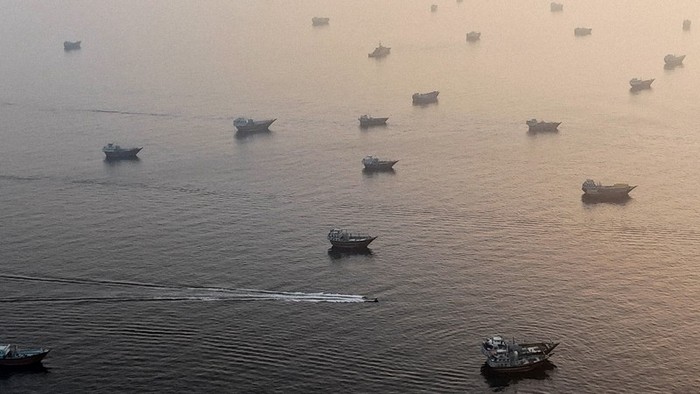
View in browser Declaring that “the deal is all signed” with Iran, as President Trump did today, is like shopping for a wedding dress after a good first date: It’s just too soon. A deal has an element of finality and permanence. A nuclear deal with Iran, for example, would require specific obligations, concessions, and verification measures, such as inspections, agreed to by all parties. What Iran and the United States are moving toward, with a signing ceremony scheduled for Friday in Geneva, is an agreement that could set the conditions for a potential deal. In the meantime, the war’s shaky cease-fire would be extended for 60 days and commercial shipping would once again transit the Strait of Hormuz unimpeded. (Neither side has released the agreed-upon text, although U.S. officials said today that Trump, Vice President Vance, and the speaker of Iran’s Parliament have already digitally signed on the dotted line.) If all goes to plan, both sides would then use the breathing room to address more complicated issues, such as how to manage Iran’s nuclear program, just as they were doing before February 28, when Trump went to war. Although the war has weakened Iran’s military, killed members of its leadership, and put pressure on Tehran, the memorandum of understanding is also an acknowledgment that the U.S. cannot solve the problem of Iran with either a war or economic pressure. Despite the thousands of strikes, and the damage done to Iran’s oil-export-driven economy, the U.S. has little choice but to try diplomacy again. Another mark of how much the U.S. has deviated from its aims at the conflict’s outset is the fate of the Strait of Hormuz. Its centrality to the new memorandum might suggest that Iran’s blockage of the narrow channel was a reason for the U.S. and Israel to go to war in the first place. Not so. The strait was open on the day the war started. Iran closed it, snarling global energy-supply chains, to gain exactly the leverage now being employed at the negotiating table. By contrast, none of Trump’s initial goals for the conflict has been achieved. The negotiations are designed to address the nuclear program, but it is not clear whether reducing Iran’s missile batteries and its proxy militias will be on the agenda for the 60-day talks, or the additional negotiating increments that will almost certainly follow. “I worry about results, and I worry about getting to a place that is good for the American people,” Vance told us in a brief interview. “Right now, we’re on a pathway to get to a very good place for our country. I want to keep on working towards that end.” Maybe at the end of that cycle, the U.S. and Iran will have an agreement worth calling a deal. The results of the war have been muddy enough that hawks on each side want to see a convincing victory and believe that such an outcome might still be within reach. “The Islamic Republic is not a problem that can be negotiated away,” Mark Dubowitz, the chief executive of the Foundation for Defense of Democracies, wrote on X yesterday. He suggested that the United States should support Iranians in overthrowing the regime, something that Trump signaled he favored at the start of the war but has since abandoned. “The only solution is maximum support for the Iranian people,” Dubowitz continued. “Given the opportunity and assistance they need, they can cripple—and ultimately end—this terrorist regime.” Senator Lindsey Graham of South Carolina, a Trump ally who strongly supported military action, suggested on X that the U.S. is giving up too much too quickly just to secure the strait’s reopening, even though its closure has sent energy prices soaring. Graham, who rarely criticizes the president directly, said that he was “pleased” that the Strait of Hormuz would reopen but was “somewhat concerned that Iran’s view of the agreement seems different than what the American negotiating team is claiming.” He didn’t provide specifics, and accounts vary regarding exactly how and when the Strait of Hormuz will reopen. Graham also reminded Trump that any nuclear deal would need Congress’s formal sign-off, and he heaped pressure on Vance, a presumed candidate for president in 2028, to make the case on Capitol Hill. Other GOP Iran hawks were notably quiet in the hours after Trump’s triumphant announcement yesterday. Rather than cheering the news, party leaders, including House Speaker Mike Johnson, celebrated the president’s 80th birthday and the Ultimate Fighting Championship event at the White House. Neither Johnson nor Senate Majority Leader John Thune has said anything official or substantial about the Iran development since. About a dozen other Republican backers of the Iran war either declined or did not respond to requests for interviews or comment—hardly a ringing endorsement of their president’s negotiating prowess. Critics of Trump’s Iran policy on the right and the left found some unity in demanding to see the full text of the memorandum, viewing its secrecy as a sign that American negotiators had whiffed. “Trump must release the details publicly, brief Congress immediately, and end this war for good,” Senate Minority Leader Chuck Schumer said in a statement. U.S. officials, briefing reporters earlier today, said the text would be released but didn’t say when. Meanwhile, Iranian hard-liners (some of whom came to power when other leaders were killed in the war), as well as members of Iran’s Parliament and the Islamic Revolutionary Guard Corps, argue that Iran was too quick to surrender the leverage that Tehran gained by closing the strait. They want guarantees of long-term economic relief, not temporary understandings or the extension of an already fragile cease-fire, which Trump once described as “shooting in a more moderate manner.” Both the regime and hawks in Iran “want to turn this strategic moment into a new reality in the region, while gaining economic benefits,” Vali Nasr, a professor of international affairs and Middle East studies at Johns Hopkins University School of Advanced International Studies, told us. The difference between the hawks and the decision makers is that the decision makers “don’t want to go back to a hot war” and want to prioritize the regime’s survival. U.S. officials told reporters that no frozen Iranian assets have yet been released and that any initial relief would consist of limited, reciprocal “small gestures” intended to build trust. But Tehran has reasons to be hopeful. “What you’ll see is that, you know, we are prepared to release frozen funds, and we are prepared to release sanctions,” one of the U.S. officials said. That may serve to only further infuriate the hawks in Washington. Around the time that Trump said a deal had been reached, Israel launched strikes inside Beirut, retaliating against Hezbollah, Iran’s proxy. Tehran had linked any agreement to a cessation of strikes inside Lebanon. But U.S. officials have said that an agreement was not conditional on Israel’s withdrawal from Lebanon and stressed that any cease-fire would not be one-sided, and would preserve Israel’s right to respond to Hezbollah attacks. Israel’s latest strikes likely reinforced Tehran’s belief that Washington cannot constrain Israeli Prime Minister Benjamin Netanyahu, who is not ready for even a temporary arrangement. “We know the near entirety of the Israeli political spectrum is unhappy about what is transpiring,” H. A. Hellyer, a senior associate fellow at the Royal United Services Institute International, told us. “I think between now and Friday, publicly or privately, we are going to be seeing a lot of tension between Washington and Tel Aviv about what this deal means for Lebanon in particular.” Hellyer suggested that Netanyahu was unlikely to respond to rhetoric about the need for Israel to stand down, which would require Washington to look for greater sources of leverage, such as withholding arms sales and aid. If the Trump administration isn’t willing to go that far, Tehran may question Trump’s commitment to the prevention of Iran’s nuclear development. Central to the negotiation is enforcement, U.S. officials told reporters, in which sanctions relief would be tied not to any single action but to Iranian behavior. The message is “everything is on the table” if Iran complies—and nothing is if it does not. U.S. officials acknowledged that cease-fires and transitions from conflict to peace are inherently messy, and they warned that implementation challenges are likely and could possibly include violations by hard-line factions inside Iran. But officials held out hope that successful negotiations, with the support of others in the region such as Qatar and the United Arab Emirates, could encourage Tehran to become a more constructive regional actor. The ultimate test, of course, is whether signing a memorandum can translate to a durable peace before domestic politics or regional instability scupper its chances. Trump may be unlikely to restart the war—as he has threatened to do if the talks don’t go well—especially given the proximity of the midterm elections. But don’t expect U.S. troops to return home anytime soon. The U.S. will maintain its current military posture in the region for now, the U.S. officials said. Any reduction in U.S. forces will depend on Iran following through on its commitments under an agreement that has not yet been reached—and that may not be for some time. Related: |









No comments:
Post a Comment