|
|
31.03.2026 - 22:16 | Son Güncellenme:
DHA
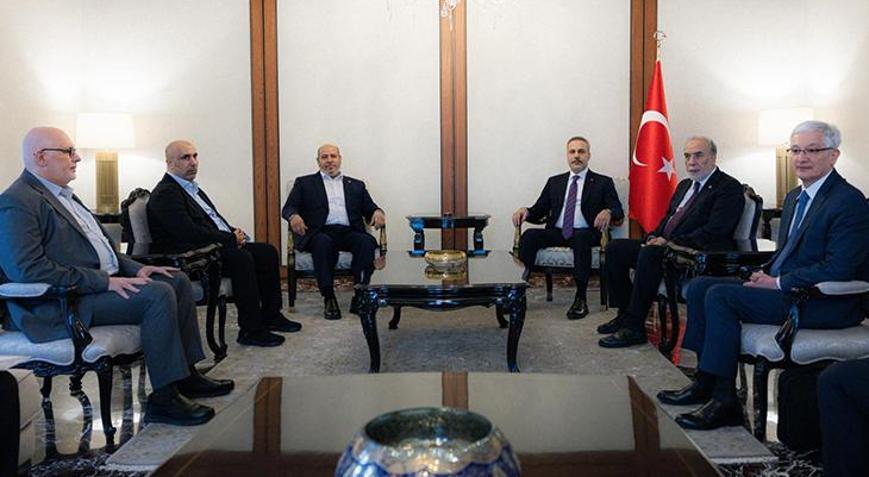
Dışişleri Bakanlığı'ndan yapılan açıklamaya göre; Bakan Fidan, Hamas Siyasi Büro Üyesi Halil Hayye Başkanlığı'ndaki Hamas Heyeti ile Ankara’da görüştü.
A month after the United States and Israel began military strikes on Iran, any hopes of a quick and decisive victory have been tempered by weeks of counterstrikes. The immediate prospects for a diplomatic off-ramp look inauspicious as Washington and Tehran believe that their respective campaigns are putting the other side under sufficient duress to make maximalist demands.
A particular kind of confidence precedes wars of choice. It belongs to leaders who believe they can calibrate violence: The strikes will be sharp, the aims limited, and the escalation controlled. The adversary will be chastened rather than provoked, and the war will remain obedient to those who began it.
Over the course of the war, the United States and Israel have been able to deliver significant blows to Iran: targeting senior political and military leaders, degrading Iran’s stocks and production of missiles, and sinking scores of its naval assets. Yet Tehran has been able to launch regular salvos of drones and missiles in response at Israel, U.S. bases in the region, and Gulf Arab states. A string of attacks against vessels off its southern coast, especially in and around the Strait of Hormuz, has helped sharply curtail traffic through the vital waterway.
Talk of potential off-ramps and negotiations has swirled over the past week. But given the wider irreconcilability of Washington’s and Tehran’s positions, an escalatory turn seems likelier. For the United States, that could take the form of deploying U.S. forces to Iranian territory or stymying Iran’s own, ongoing use of the strait; for Iran, the entry into the fray of its Houthi allies in Yemen could inject added volatility by threatening traffic in the Red Sea.
Historically, strong states take their greatest risks when they are coming off a run of apparent victories. Successes such as the Venezuela raid in January helped cement for Trump the impression that force could be used cleanly, predictably, and without long-term cost. Perceived success produces an illusion of control, expanding leaders’ tolerance for risk and driving escalation.
This is the dynamic now shaping the United States and Israel’s war with Iran. What was presented as a campaign of precision increasingly looks like a familiar story of strategic overconfidence. Washington has mistaken its early military gains for political traction and confused its tactical success with a path to durable order. Iran may have lost its supreme leader, commanders, nuclear facilities, and military assets. But the larger question was never whether it could be hurt but whether this pain would lead to the government’s capitulation.
There is the illusion of air power at work. Regimes under attack often harden rather than crack. Societies under bombardment do not always turn against their rulers; often, they first turn against the foreign power dropping the bombs.
Iran is no exception. Before this war, the Islamic Republic faced profound domestic discontent, much of it justified. But outside attack has a way of rearranging political emotion. Nationalism is starting to fill spaces that dissent once occupied. A state that looked brittle in peacetime is appearing sturdier once the nation itself is under siege.
Much of the commentary in Washington still treats Iran as if it were merely absorbing blows and lashing out in anger. But Tehran is fighting according to a logic that has shaped its planning for years: If it cannot match the United States and Israel in conventional power, it can outlast them by making that power harder and costlier to use.
The emerging pattern of Iranian strikes suggests an effort less at theatrical retaliation than at strategic disruption. The target set points to four priorities: blinding radars, degrading command networks, straining missile interceptor stockpiles, and raising economic pressure by bringing shipping and energy transit through the Strait of Hormuz to a near halt.
From Tehran’s perspective, this reflects an attempt to shift the war from a contest of firepower to a contest of endurance. Iranian planners have long assumed that the opening phase of a conflict would require firing at a high tempo in order to deplete interceptor stocks and expose seams in missile defense coverage. Only then would the war settle into a more sustainable phase of attrition, where fewer missiles and drones might stand a better chance of penetrating weakened defenses. Reports suggesting shorter warning times in Israel and thinner coverage in parts of the Gulf indicate that this logic may already be working.
Amid global oil and gas disruptions, China stands prepared for the electrostate era.
Why the Gulf’s grand strategies will not change. 
The same is true of Iran’s regional targeting. If U.S. bases across the Middle East come under repeated pressure, then the cost of sustaining U.S. operations rises sharply. Iran does not need to defeat the U.S. military outright. It needs to make the exercise of that military advantage more expensive and more politically fraught.
This is where the Iranian perspective is often missed. Tehran’s objective is not simply to retaliate. It is to force a new strategic equation. That equation runs through geography as much as through missiles. The Strait of Hormuz has always been central to Iran’s deterrence doctrine, but this war suggests Tehran may be trying to turn abstract leverage into practical bargaining power. If passage through the strait increasingly depends on Iranian tolerance—or if states begin seeking side arrangements to secure safe transit—that would amount to a quiet acknowledgment of something Washington has long tried to deny: that Iran retains meaningful coercive influence over one of the world’s central economic arteries.
Nor is Hormuz the only pressure point. With the Houthis entering the war, the pressure could extend to the Bab el-Mandeb, shutting off navigation through the Red Sea as well. At that point, the conflict becomes a contest over the maritime chokepoints that bind Asia, Europe, and the Middle East.
That is why U.S. President Donald Trump is now considering sending ground troops to take over Iranian islands to force Tehran to reopen Hormuz. But this is not simply another step up the ladder; rather, it is a step into the escalation trap. Air power can disrupt and degrade, but it cannot secure territory or impose lasting political outcomes. And when it fails to achieve those goals, pressure builds for ground forces. Once that threshold is crossed, the structure of the conflict changes.
At the same time, the killing of the Islamic Republic’s old guard—men with experience who acted with more calculated cautiousness—renders Tehran more amenable to risky gambits. Even without this, introducing ground forces onto Iranian territory would sharply increase the incentives for escalation, including mining the strait, targeting U.S. ground troops, torching the regional infrastructure, and potentially activating the Houthis to close the Bab el-Mandeb.
Iran remains under severe strain, militarily and economically. Its people are paying a terrible price. But weakness does not preclude strategy. The stronger side assumes it can dominate escalation because it can inflict greater pain at every rung of the ladder.
But escalation dominance does not translate into escalation control. The United States and Israel can win every exchange of force and still lose control of the conflict’s trajectory and aims. That is the core danger of wars driven by the illusion of control: Each step appears justified by the last, even as the overall path becomes more dangerous and a U-turn more difficult.
The reality is that if there is not a serious push for a cease-fire—one that addresses deterrence, sanctions, sovereignty, and the nuclear issue in terms more serious than slogan and fantasy—the war will escalate in a way that is not controlled by the United States or Israel alone. As that happens, and the war extends from weeks into months, the costs will become harder to reverse. Regional actors will face increasing incentives to widen the conflict, and the risk of terrorism beyond the immediate theater will rise.
The most dangerous moment when countries succumb to the illusion of controlled war is not the opening strike. Rather, it is the moment after apparent success—when leaders believe the next escalation will work for the same reasons that the last one did. That is how countries become trapped by their own strength and how wars escape their authors.
This post is part of FP’s ongoing coverage. Read more here.
Robert A. Pape is a professor of political science and the director of the Chicago Project on Security and Threats. He is the author of Bombing to Win: Air Power and Coercion in War and writes The Escalation Trap on Substack.
Ali Vaez is the International Crisis Group’s Iran project director and a co-author of How Sanctions Work: Iran and the Impact of Economic Warfare. X: @AliVaez
Is the United States succeeding in Iran? It depends on who you ask. In a Pew Research survey published last week, 61 percent of Americans disapproved of U.S. President Donald Trump’s handling of the conflict, while 37 percent expressed approval. The numbers mirror support for Trump in general, suggesting a divide in opinion based largely on partisan predispositions. Tellingly, seven out of every 10 Republicans but only one out of every 10 Democrats approve of how the White House is executing the war so far.
Another way of examining the success of the joint U.S. and Israeli assault on Iran could be the scale of damage. On this metric and after one month of conflict, the United States and Israel have imposed far more costs on Iran than the other way round. Several top Iranian political and military leaders have been killed, including the supreme leader, Ayatollah Ali Khamenei; Iran’s air force and navy have mostly been destroyed; its nuclear program has been further set back; its ability to launch ballistic missiles has been degraded; and one of Iran’s key allies, the Lebanon-based militant group Hezbollah, has faced intense bombardment. On the other side of the ledger, the main headline is that Iran has succeeded in shutting down key routes of travel and commerce without inflicting much lasting damage so far.
Why, then, does it feel like the United States is winning the battle but losing the war? The answer here may have to do with expectations. And on this front, the mere survival of Iran’s regime and its ability to hurt the global economy and enrich U.S. adversaries suggest the Islamic Republic is emerging with a better hand. Survival and disruption were always Tehran’s strategic goals in the event of a war. Trump’s visible frustration makes it clear that he’s being denied the quick operation he wished for.
The first reason why the United States could be seen as losing would be its maximalist aims at the start of the war. In a video posted on Truth Social on Feb. 28, Trump seemed to suggest that he was hoping for regime change, as well as to end Iran’s ability to build missiles, ensure its proxy groups can no longer destabilize the region, and prevent Iran from obtaining a nuclear weapon. None of those objectives have been met so far.
As several analysts in Foreign Policy suggested at the start of the war, the Islamic Republic had carefully selected replacements for key political and military roles to guarantee the regime’s survival. The country’s ability to launch missiles has indeed been degraded, yet it continues to fire them at Israel and at U.S. allies in the region. Tehran has previously displayed an ability to rebuild its missile program in the space of a few months, as it did after U.S. and Israeli attacks last June, and it will likely rush to do so again as soon as this war is over. Hezbollah is decimated but survives. And, as evidence that Iran has a layered plan for prolonging the conflict, the Houthi rebels in Yemen have only just entered the war, firing missiles at Israel over the weekend. Finally, some 440 kilograms of highly enriched uranium still exist somewhere in Iran, ready for a new crop of leaders—and a more vengeful one at that—to return to.
A second reason for seeing the war as a U.S. failure would be the immense economic costs that Iran has imposed on the world so far. The price of jet fuel has risen by 120 percent this year. Brent crude, the key benchmark for global oil prices, has risen by more than 87 percent in the same period. Much of this is because Iran has largely shut off the Strait of Hormuz, through which a fifth of global crude usually passes every day. So, too, does 20 percent of all liquefied natural gas (LNG). The supply disruption in LNG, coupled with damage to a major Qatari gas field from an Iranian missile strike, has led natural gas prices to surge by more than 70 percent in Europe this month. The Strait of Hormuz also serves as a conduit for a third of global helium supplies—a key component not only in children’s balloons but also in the manufacturing of semiconductors—and a third of global fertilizer sales. The longer the blockade goes on, the more likely the world will face a chip and food crisis in addition to an energy one. These ripple effects are essentially the Islamic Republic’s way of reminding the world that it won’t go quietly into the night. And according to GeoPoll, which conducted a survey in Egypt, Kenya, Nigeria, Pakistan, Saudi Arabia, and South Africa, only 18 percent of respondents blame Iran for the conflict and its global costs. Instead, 29 percent blame the United States and 38 percent blame Israel. Some of this could be because the attacks took place amid diplomatic talks that neutral observers saw as promising.
A third reason why the United States is emerging as a loser from the current war is the fact that unlike its misadventure in Iraq under President George W. Bush, it sought neither domestic nor international approval. This time, there were no shibboleths about democracy promotion or a rules-based order. The only real ally the United States has in this war is Israel, which itself has become more isolated and unpopular globally than it has been in a generation. Trump faced an acute embarrassment by first calling for help from NATO allies and then, after realizing that no assistance would be forthcoming, denying that he needed a hand. The trans-Atlantic relationship emerges weaker from this war. So, too, does Washington’s ability to portray itself as the leader of a system whose rules it is actively trashing.
Fourth, the war is having the unexpected outcome of enriching U.S. adversaries. In a bid to check rising oil prices, the U.S. Treasury rescinded existing oil sanctions on both Iran and Russia. As a result, Tehran is now raking in more daily crude revenue than it did before the war began. Moscow, meanwhile, is gaining an additional $150 million in oil revenue every day the conflict goes on—money that it will no doubt use in its war in Ukraine. The picture is more mixed for China, which gets more than half of its oil from the Gulf. While Beijing faces some supply constraints, its foreign policy is relatively unencumbered by the entanglements that Washington routinely finds itself in. In all likelihood, Chinese military leaders are closely following how rapidly the United States is using up missile interceptors, leaving it less able to deter attacks in other arenas.
Finally, the war is shaking support for Trump among Republican lawmakers. The U.S. Defense Department has suggested that it will request $200 billion in additional funding to support its ongoing engagements in Iran but has yet to put in a formal proposal, likely because there are growing doubts there will be enough support on Capitol Hill. “Let me repeat: I will not support troops on the ground in Iran,” said Rep. Nancy Mace, a Republican lawmaker from South Carolina, on X after attending a classified House Armed Services Committee meeting on Iran last week. “Even more so after this briefing.”
A full accounting of the war can only be conducted after its conclusion. The United States may yet inflict further damage to Iranian military infrastructure that could change this assessment. Already, we can imagine how each side might spin the results: Iran will tout standing up to the world’s greatest military superpower and a regional hegemon; Israel will say it decimated the capabilities of its enemies, even if temporarily; and the United States could simply point to its demonstration of overwhelming brute strength.
But even if the war were to end in the next few days, the reality is that whatever is left of the Iranian regime will be vindicated simply by its survival. Its leaders will be infused with a sense of revenge that they could take out either domestically or internationally. Future leaders of Iran will study the conflict and realize that their greatest deterrent is an ability to impose immense costs on the global economy. That could mean postwar leadership will move quickly to rebuild an arsenal of attack drones and missiles. It may also abandon its old nuclear fatwa and decide a bomb would be its best form of security, as it is for North Korea. What would the conflict have been for? It may be Israel’s strategy to repeatedly mow down adversaries in the region; it should hardly be Washington’s. Trump has long railed against expensive, protracted wars in the Middle East. It’s likely that he misjudged the nature of Iran’s regime, as well as how its size and geography make it significantly different than Venezuela, a country whose leader the United States captured in a single overnight mission.
Escalation is already shattering Washington’s illusion of control.
An American myth reemerges for the Iran war.
There’s still time for a sensible compromise between Washington and Tehran.
Spare a thought for the long-suffering residents of the region. In Iran and Lebanon, thousands of people have been killed and more than a million displaced. In Israel, one sees a population that has spent the better part of two years rushing to bunkers at the first pitch of sirens. And in the Gulf states, expats and migrant workers have had to contend with an instability they never imagined when they moved to Dubai or Doha. If all of this is only to return to a future war, then what was it all for?
This post is part of FP’s ongoing coverage. Read more here.


