Summary
US President Donald Trump says Iran talks could resume "over the next two days", after the first round in Pakistan last weekend ended without a deal
Meanwhile, Israel and Lebanon have agreed to launch direct negotiations after talks today in Washington DC, the US says
The US says no ships passed through its blockade in the first 24 hours, and six merchant vessels turned around after "direction from US forces" - BBC Verify analyses the latest shipping data
The first 24 hours of the US naval blockade of Iran's ports have been notable for their inconsistency, writes our security correspondent - possibly because American forces were not yet ready for it
China's foreign ministry calls the blockade "dangerous and irresponsible", while Iran calls it a violation of its sovereignty
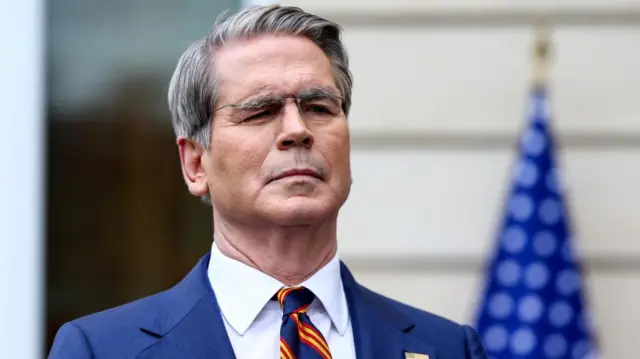
'Bit of pain' worth long-term security from Iran, Bessent tells BBC
US Treasury Secretary Scott Bessent tells the BBC a "small bit of economic pain" is worthwhile for long-term international security.
As the International Monetary Fund (IMF) warns the US-Israel war with Iran could plunge the global economy into recession, Bessent says the conflict was intended to eliminate the threat of Iranian nuclear strikes on Western capitals.
"I wonder what the hit to global GDP would be if a nuclear weapon hit London... I am saying that I am less concerned about short-term forecasts, for long-term security," he says.
Iran does not have nuclear weapons, and he UK government has said there is "no assessment" that Iran was trying to target Europe with missiles. As the BBC has previously reported, the threat of Iranian ballistic missiles being targeted at London is remote.

IMF: Oil prices and war could derail global growth
Meeting with US and Israel 'productive', says Lebanese ambassador
Lebanon's ambassador the the United States, Nada Hamadeh Moawad, has called the preliminary talks with the US and Israel "productive".
In a statement she says she called for the "urgent need for the full implementation" of the November 2024 cessation of hostilities agreement.
This was an agreement reached following 13 months of fighting between Israel and Hezbollah, which gave the Iran-backed group 60 days to end its armed presence in southern Lebanon.
Moawad adds that she also called for a ceasefire and for the return of displaced persons to their homes.
She says she emphasised Lebanon's "full sovereignty over all Lebanese lands" and called for measures to alleviate the "acute humanitarian crisis" caused by the conflict.
The date and venue for further talks will announced at a later date, she concludes.
Getty ImagesSeveral ships cross strait and leave Iranian ports since start of US blockade
The efficacy of the US naval blockade of Iranian ports has remained largely unclear during its first full day, with our security correspondent Frank Gardner suggesting a lack of preparation and transponder interference as possible explanations.
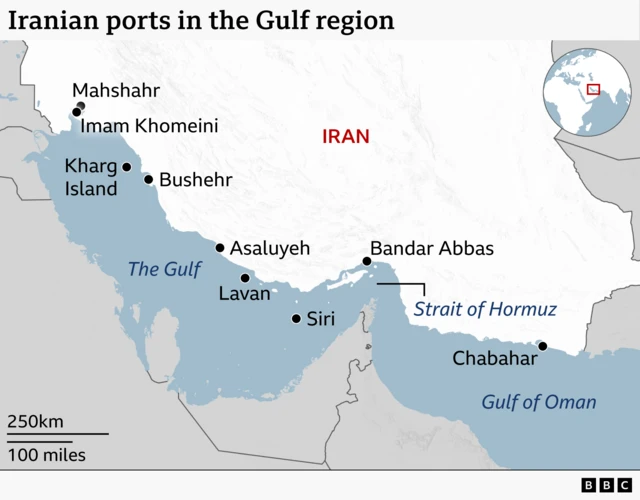
Shipping data analysed by BBC Verify shows that at least four Iran-linked ships, including two that visited Iranian ports, crossed the Strait of Hormuz on Tuesday.
A further three ships that were not linked to Iran were seen to have crossed the strait after the blockade started at 10:00 ET (14:00 GMT) on Monday.
Despite this, US Central Command said no ships have made it past the blockade in its first 24 hours, adding that more than 10,000 military personnel, along with dozens of warships and aircraft, have been involved in the tactic.
It said that six merchant vessels turned around and re-entered an Iranian port after complying with "direction from US forces" - while ship tracking data analysed by BBC Verify showed two Iran-linked ships changing direction after travelling through the strait off the back of the blockade being imposed.
US oil sanctions reinstated to maintain 'maximum pressure' on Iran - Treasury
More now on the US Treasury's decision not to renew its lifting of sanctions on select Iranian oil.
The move was done to maintain "maximum pressure" on Iran, the department says on social media.
It adds in a post on X that the department is prepared to deploy secondary sanctions against foreign financial institutions that "continue to support Iran's activities".
Treasury Secretary Scott Bessent said last month the permit was applicable to the sale of crude oil and petroleum products of Iranian origin currently loaded on vessels, with the authorisation lasting until 19 April.
He said the move would quickly bring about 140m barrels of oil to global markets.
About a fifth of the 100m barrels of oil that the world consumes every day usually travels via the Strait of Hormuz.
ReutersBessent announced the temporary easing of select Iranian oil last month
Israel and Lebanon will launch direct negotiations following meeting, says US
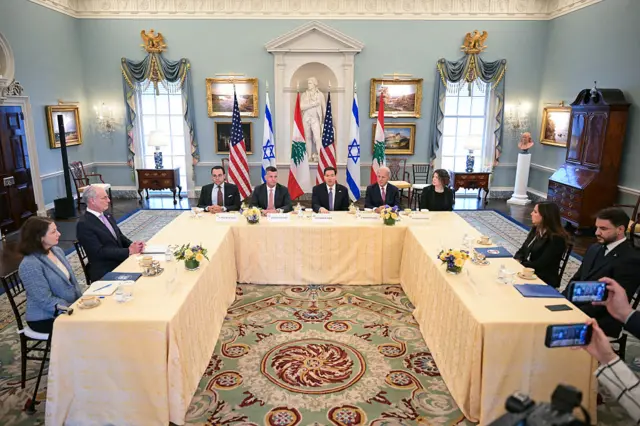
Israel and Lebanon have agreed to launch direct negotiations after talks today in Washington DC, according to the United States, whose representatives also attended the meeting.
US state department deputy spokesman Tommy Pigott says in a statement the meeting between the countries' ambassadors and US Secretary of State Marco Rubio was "historic", adding the US hopes the new engagement will lead to a long term peace deal brokered by the US.
Both Israel and Lebanon agreed to work towards reducing the influence of Iran-backed Hezbollah, Pigott says, and the Lebanese government "plans to restore the monopoly of force and to end Iran's overbearing influence".
The Lebanese side also called for a "ceasefire and concrete measures to address and alleviate the severe humanitarian crisis" in the country.
Israel reportedly agreed to work with Lebanon to dismantle "all non-state terror groups" and "achieve a durable peace", but did not appear to directly agree to stop strikes on the country.
"The United States expressed its support for Israel's right to defend itself from Hezballah's continued attacks," the statement says.
The meeting marked the first direct talks between the two countries' governments since 1993.
US Treasury will not renew easing of Iran oil sanctions
BreakingThe US Treasury will not be renewing its temporary easing of Iran oil sanctions, which was set to expire later this week.
The government department says in a post on X that the short-term authorisation permitting the sale of Iranian oil currently stranded at sea "will not be renewed" after it expires on 19 April.
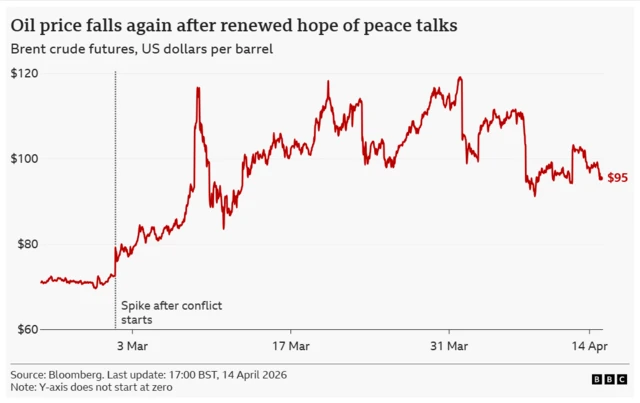
'Glimmers of hope' for peace driving further oil price falls
Jemma Crew
Business reporterFurther falls to oil prices on Tuesday are "based on glimmers of hope that both sides remain keen to make a lasting peace deal", according to an analyst.
The price of global benchmark Brent crude dropped 4.5% to a low of $94.87 a barrel on Tuesday, before recovering slightly.
"News of a potential second round of talks has been helpful in soothing markets, alongside the suggestion that Iran will not test the US blockade, instead opting to pause shipments to avoid a military confrontation," says Lindsay James, investment strategist at Quilter.
She says traders may also have been encouraged by signs that several sanctioned tankers "appeared to make it through the Strait of Hormuz earlier today but have since turned back".
It could be that incorrect locations had been shown in tracking data, or indicate that US military pressure is being wielded beyond the Strait, she says.
The difficulty in uncoupling Hezbollah from Iran in peace talks
Nada Tawfik
Reporting from US State DepartmentTalks at the state department lasted a little more than two hours. A US official here wanted to stress that for the Americans, there is no link between the negotiations between the United States and Iran in Islamabad and the Israel-Lebanon talks.
"Iran will not be allowed to dictate the future of Lebanon any more. These talks are part of that effort," the official says.
However, Iran insists that Hezbollah in Lebanon must be included in any agreement. And many experts, including Professor Shibley Telhami from the University of Maryland and the Brookings Institute, believe it's hard to uncouple one from the other in this environment.
"I think it’s impossible for Iran to have a ceasefire without Hezbollah, for its internal credibility, its legitimacy and its strategic goals," he tells the BBC.
'New era of peace' - Israeli ambassador
Leiter goes on to describe more about his conversation with Lebanese ambassador to the US Nada Hamadeh at the US state department.
"We talked about a number of things, most importantly the long-term vision, where there'll be a clearly delineated border between our countries, and the only reason we'll need to cross into each other's territory will be in business suits to conduct business or in bathing suits to go on vacation."
"We made it clear that the security of our civilians is not up for negotiation," Leiter adds.
"This was a victory for sanity for responsibility and for peace," he says.
Hezbollah is "as weakened as it's ever been," Leiter says, promising to continue to "rid" the region of the group's "malignant" threat.
Israel's fighting in Lebanon has weakened Hezbollah to the point in which it's possible for the Lebanese government to "move into a new era of peace", Leiter says.
The three parties spoke for two-and-a-half hours, he says, with a joint statement expected to be released soon.
We have not yet heard from the United States or Lebanon on the meeting.
All three countries 'on the same side of the equation' - Israeli ambassador
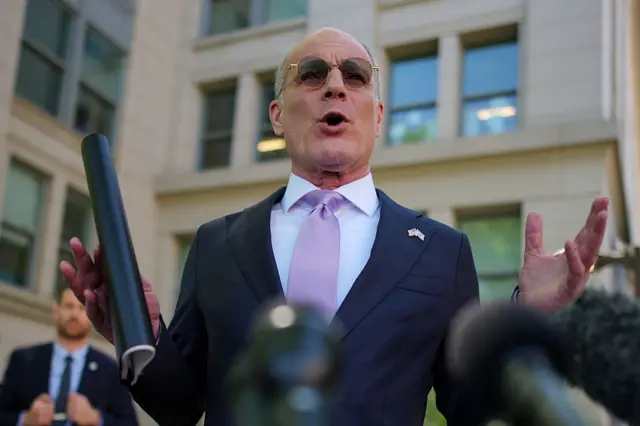
Getty ImagesAfter talks between Israel, Lebanon and the United States in Washington on Tuesday, Israeli Ambassador to the US Yechiel Leiter tells gathered reporters that representatives from all three countries "discovered today that we are on the same side of the equation and that's the most positive thing we could have come away with."
He adds: "We are both united in liberating Lebanon from the occupation power dominated by Iran called Hezbollah."
Israel confirms talks with Lebanon have ended
The Israeli Embassy in Washington have also confirmed that the talks with Lebanon and the United States have concluded.

Two Iranian ships leave port in defiance of blockade
By Alex Murray
Ship tracking data analysed by BBC Verify has found further evidence of ships leaving Iranian ports in apparent defiance of a US naval blockade.
The cargo ship Ashkan3 appears to have left the vicinity of Iran's Chabahar port - which is hundreds of kilometres east of the strait of Hormuz - on 13 April unladen with cargo. It is currently sailing eastwards near to Pakistan.
Another vessel, a container ship called Shabdis, left the vicinity of Chabahar port on 13 April, again unladen with cargo. After the US blockade came into effect, it began sailing eastwards and is now near India. It is transmitting its destination as Zhuhai in China.
Neither of these ships crossed the strait after the blockade started. Both are sailing under the Iranian flag.
Israel-Lebanon-US talks in Washington have ended - Lebanese media
Talks between Israel, Lebanon and the United States being held in Washington DC have ended, according to Lebanon's state-run National News Agency.
It says they lasted about two hours.
We've not had any word from the US or Israeli delegations yet.
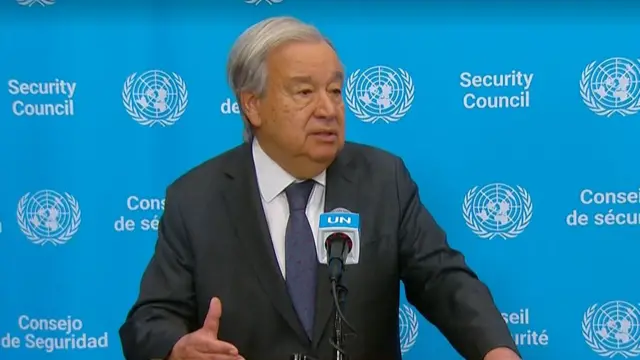
'It is time for diplomacy over escalation', says UN head
Pool VIA ReutersUN Security-General António Guterres is speaking to press in New York about the war in the Middle East.
Asked about a report that Iran and US may resume talks in the next two days, he says: "The indication we have is that it is highly probably that these talks will restart."
On negotiations between Israel and Lebanon, he says that "nobody expects" these talks today to "solve all the problems" - but they are "very important" to "create conditions" to change the situation.
He also warns that respect for international law - around the world, and "starkly in the Middle East" - is being "trampled".
The secretary-general says "too many are choosing to turn a blind eye to justice", with rules governing use of force ignored and civilians "exposed to intolerable harm".
He says international law "applies to all states without exception", adding that it "applies urgently to the conflict in the Middle East".
Guterres says "serious negotiations" must resume and the ceasefire "must be preserved and extended as necessary", and that "international navigational rights and freedoms – including in the Strait of Hormuz – must be respected by all parties."
"It is time for restraint and responsibility. It is time for diplomacy over escalation. It is time for a renewed commitment to international law," he says.
Watch: The Israeli town on the frontline with Hezbollah

Watch: The Israeli town on the frontline with Hezbollah
On the border between Lebanon and Israel lies Metula - Israel's northernmost town.
Surrounded on three sides by Lebanon, Metula is one of the first in the firing line when rockets are fired by Hezbollah, the Iranian-backed political and military group.
Israeli authorities say 12 soldiers and two civilians have been killed by Hezbollah rockets over the past six weeks as the conflict continues.
In Lebanon, more than 2,000 people have been killed in Israeli strikes, local authorities say, since fighting renewed on 2 March after a Hezbollah attack on Israel.
Israel seeks 'peace and normalisation' with Lebanon, but Hezbollah issue still looms
Joel Gunter
Reporting from JerusalemReutersIsrael's Foreign Minister Gideon Sa'ar said Israel’s issue was not with Lebanon but with Hezbollah
Israeli Foreign Minister Gideon Sa’ar said today that Israel was seeking "peace and normalisation" with Lebanon.
Sa’ar said Israel’s issue was not with Lebanon itself, but with Hezbollah - the Iran-backed political and militant group Israel is fighting.
Normalisation would be historic, as the two countries currently have no diplomatic relations and are technically still at war.
But that wouldn’t necessarily solve the issue of Hezbollah. Leader Naim Qassem said yesterday the group is not prepared to recognise or take part in any process that doesn’t begin with a ceasefire agreement with Israel.
Israeli officials have been clear - they are not prepared to commit to a ceasefire with Hezbollah or to remove their troops from southern Lebanon.
Israel’s stated goal is the complete disarmament of Hezbollah, something the group is not willing to agree to at this stage. So there is an impasse.
Today’s talks have been described as preparatory, and it is still very early in the process, but it is hard to see a clear way forward to a peaceful outcome.
Hezbollah says it has attacked 13 Israeli settlements
Talks between Israel and Lebanon continue.
Meanwhile, Hezbollah says it has targeted 13 Israeli settlements in the north of the country with missiles.
It says the attacks will continue until US-Israeli strikes stop.
Earlier, an IDF spokesperson said Israeli forces expect an increase in attacks from Hezbollah, as talks between Lebanon and Israel begin in the US.
- The Lebanese government, despite being involved in the talks, is not a party to the conflict and has almost no influence over Hezbollah, our Middle East correspondent writes
Tracking data shows two Iran-linked ships change direction
By Joshua Cheetham
Ship tracking data analysed by BBC Verify suggests two Iran-linked vessels that travelled through the Strait of Hormuz after a US blockade was imposed have now changed direction and appear to be heading back.
The US-sanctioned tanker Rich Starry, which reports it is carrying cargo, sailed east from Sharjah in the UAE through the strait overnight, but has now changed direction, data shows.
Tracking data also shows a bulk carrier, Christianna, which crossed the strait on Monday after the blockade having called at Iran’s Bandar Iman Khomeini, has now changed direction.
The US's Central Command has claimed that six merchant vessels have been asked to turn around and have complied.
Another tanker, the US-sanctioned Elpis, passed the strait heading east on Tuesday and may have come from the Iranian port of Bushehr, tracking shows.
The data is still showing it stationary east of the strait. It is possible these ships have been broadcasting false position reports - known as “spoofing” - to disguise their locations.
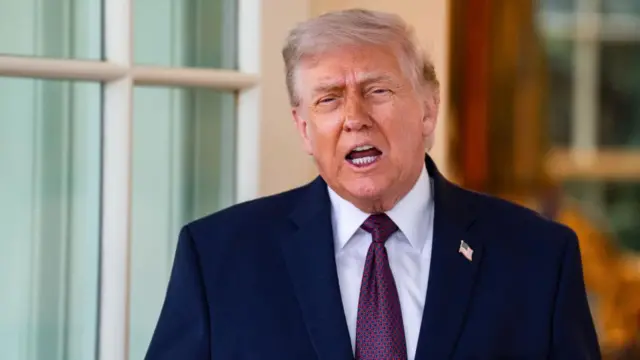
Trump says US and Iran may hold talks in 'next two days' - report
BreakingEPATalks between the US and Iran could restart "in the next two days", Donald Trump has told the New York Post.
"Something could be happening over the next two days, and we're more inclined to go there [Pakistan]," he tells the newspaper.
This comes after a weekend meeting in Islamabad, Pakistan, involving US Vice-President JD Vance and Iran's Parliament Speaker Mohammad Bagher Ghalibaf, among others. The talks ended without a deal.
Earlier today, Iran's state-run media said messages have been exchanged between Tehran and Pakistan, but there is "no information" about any agreement to hold further talks with the US.

Lebanon wants peace, but has very little to offer
Hugo Bachega
Middle East correspondent reporting from BeirutFor the first time in decades, the ambassadors to the US of Israel and Lebanon, countries that do not have diplomatic relations, are meeting in Washington, in what many hope will pave the way for a ceasefire in the war here, where Israel has been fighting the Iranian-backed group Hezbollah.
There is very little the Lebanese authorities can offer, however.
The state is not a party to the conflict, and has almost no influence over Hezbollah, which is accused by opponents of defending the interests of Iran and dragging Lebanon into unwanted wars. This one has killed more than 2,000 people, according to the health ministry, which does not distinguish combatants from civilians, and displaced a fifth of the population.
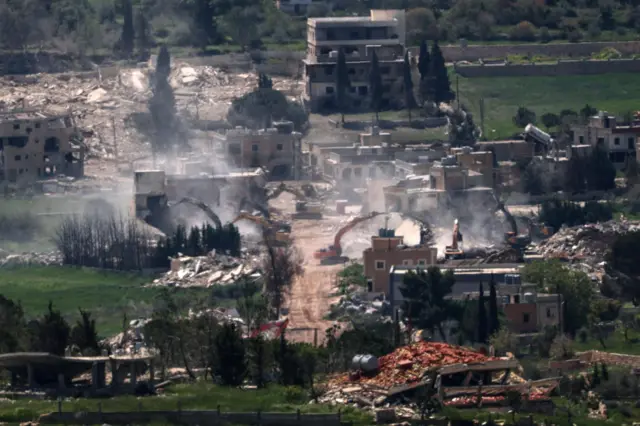
Communities are in ruins, and many residents may never be able to go back. Invading Israeli troops continue their ground operations, to create what officials describe as a security buffer zone along the border, which has raised fears that parts of the country will remain under occupation even after the war.
One of the roots of this conflict is Hezbollah’s arsenal. Disarmament is a demand from the US, Israel and many Lebanese, but the government in Beirut cannot deliver it without Hezbollah’s consent, amid concerns the use of force could result in violence.
Supporters say Hezbollah is the only protection they have from Israel, and the group is already saying it will not abide by any decision.
EPAIsraeli army excavators demolish buildings in the southern Lebanese village of Mais al-Jabal - just over 1km (0.62 miles) from Israel, after Israel warned all houses near the border would be demolished as part of its buffer zone plans





No comments:
Post a Comment