Escalating India-Pakistan Tensions and Trump’s Trade War in Asia |
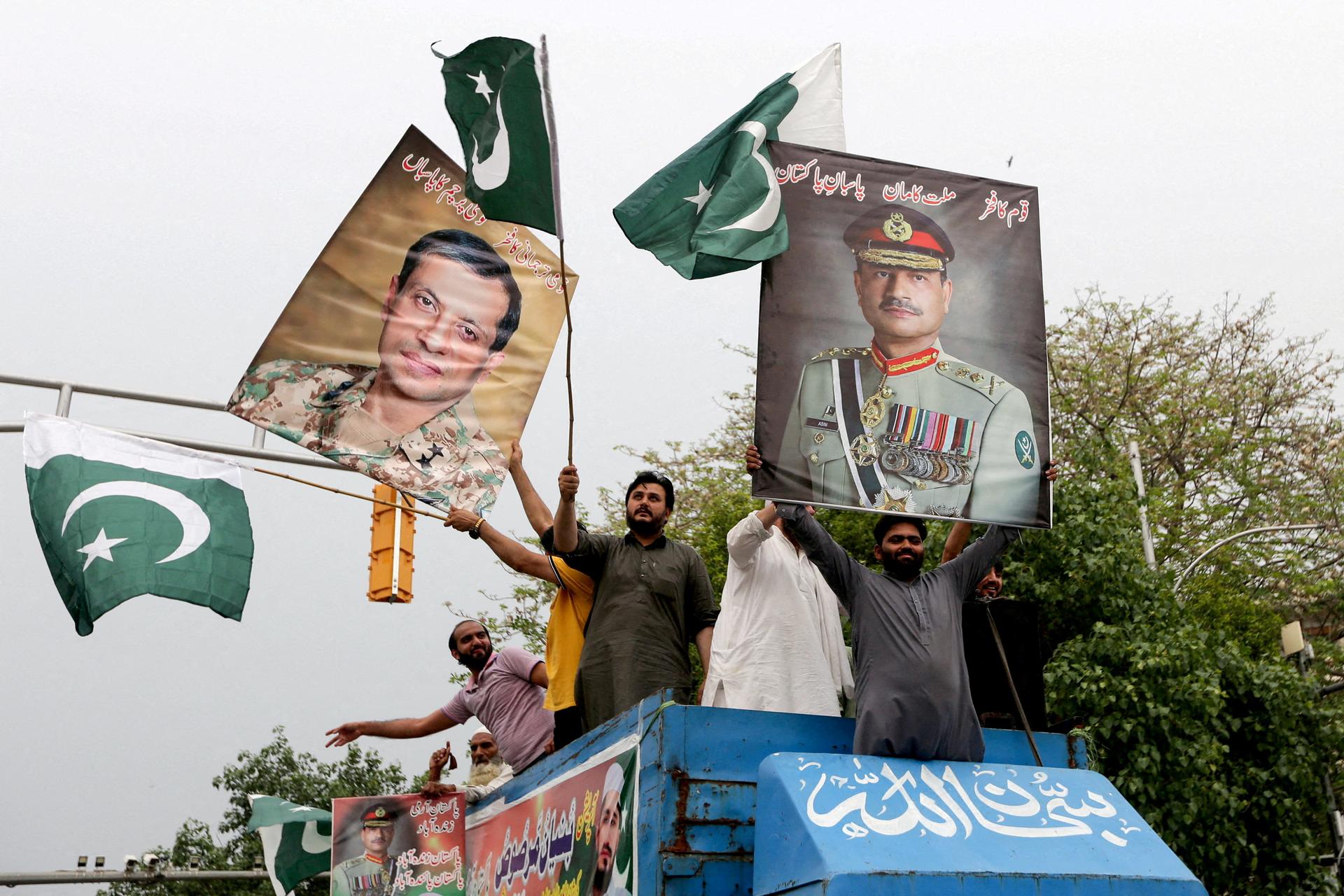
People carry posters showing Pakistani Chief of Army Staff Asim Munir and Ahmed Sharif Chaudhry, director general of the Pakistan Armed Forces’ interservice public relations wing, as they rally in support of the Pakistan Army a day after the ceasefire announcement between India and Pakistan, in Lahore, Pakistan, on May 11, 2025. (Mohsin Raza/Reuters) |
In this month’s newsletter, Council on Foreign Relations (CFR) experts examine escalating tensions between India and Pakistan, the fallout of Donald Trump's tariffs and trade war on Asia, and authoritarianism and power struggles in Southeast Asia, among other topics. |
|
|
Following a terrorist attack in Kashmir, India and Pakistan are heading toward conflict. As security asymmetries in India-administered Kashmir and Pakistan-administered Kashmir heighten the likelihood of violence and broader geopolitical trends undermine potential guardrails that have previously prevented war, it remains to be seen whether the Donald Trump administration can pull Indian Prime Minister Narendra Modi back from the brink of escalation, write Research Associate Steven Honig and Program Coordinator Natalie Caloca in Asia Unbound. Get their take
|
India’s recent aerial attacks on Pakistan have escalated tensions between the two nuclear-armed nations following an attack in Indian-administered Kashmir that killed twenty-six tourists. The Trump administration needs to consider incentives to offer both countries if the conflict escalates further. A war in South Asia would be highly detrimental to U.S. interests, argues Senior Fellow for India, Pakistan, and South Asia Manjari Chatterjee Miller on CFR.org. Get her take |
In this CFR Meeting, panelists including Distinguished Fellow Kenneth I. Juster; Senior Fellow, China and South Asia Programs at the Henry L. Stimson Center Daniel Markey; and Adjunct Senior Fellow for India, Pakistan, and South Asia Alyssa Ayres discuss recent developments in the India-Pakistan conflict, analyzing the drivers of escalation, the domestic political dynamics shaping bilateral relations, and the consequences for regional security, great-power competition, and U.S. foreign policy in South Asia. Watch the discussion |
|
|
U.S.-China trade talks in Geneva caused a temporary slash of tariff rates, but the ripple effect will not disappear anytime soon. China has learned that the Trump administration is unwilling to ignore the domestic pressure applied by U.S. businesses and will factor that realization into negotiation framework and economic statecraft calculations, explains Maurice R. Greenberg Senior Fellow for China Studies Zongyuan Zoe Liu on CFR.org. Learn more
|
China, Japan, South Korea, and the ten states that make up the regional organization called the Association of Southeast Asian Nations (ASEAN), issued a statement indirectly indicting Trump’s tariffs and trade wars and suggesting a shared desire to collaborate more closely on economic issues. Senior Fellow Rebecca Patterson, Whitney Shepardson Senior Fellow Brad W. Setser, and Senior Fellow for Southeast Asia and South Asia Joshua Kurlantzick comment on the statement’s significance and whether it indicates a shift in global trade relationships for CFR’s RealEcon Initiative. Get their take |
Trump’s proposed “reciprocal” tariff plan places some of the highest tariff levels on East Asian countries—many of which depend on U.S. markets to grow their economies and have huge trade surpluses with the United States. Kurlantzick explains why many Asian economies are particularly exposed to higher tariff rates and why Trump is targeting them in this article for CFR.org. Read the article
|
Vietnam’s massive trade surplus with the United States and the recent practice of assembling items made of Chinese components to avoid tariffs has made it one of the countries most vulnerable to the Trump administration’s tariff policies. Vietnam has met many of Trump’s demands but is unlikely to join a coalition of countries isolating China, putting it in an impossible bind, argues Kurlantzick in Asia Unbound. Read his take |
In her article for Foreign Affairs, Liu explains how powerful players in Trump’s orbit misjudged the resilience of China’s economy in the face of a U.S.-China trade war. To make a lasting deal with China, Liu argues, the United States should first accept the structural reality that it will always run a trade deficit with China, and should focus on structuring that deficit in a durable way to level the playing field in advanced industries that will shape the future. Get her take |
On this episode of The President’s Inbox, Liu sits down with Mary and David Boies Distinguished Senior Fellow in U.S. Foreign Policy James M. Lindsay to discuss China’s response to Trump’s tariff hikes and what it means for the future of U.S.-China relations. Listen to the episode |
|
|
Power Struggles and Authoritarianism in Southeast Asia |
The Philippines held recent elections for several seats in its upper house of parliament, its entire lower house, and some regional and local elections. The election centered on a battle between the big current dynasties: the Dutertes and the Marcoses. Former president and dynasty head Rodrigo Duterte won an important mayoralty while awaiting a trial at the International Criminal Court for crimes during his bloody “drug war.” However, the Duterte news overshadowed the fact that President Ferdinand Marcos Jr.’s supporters performed well, potentially diminishing the Duterte clan’s long-term power, explains Kurlantzick in Asia Unbound. Learn more |
Paul Chambers, a U.S. academic and leading expert on Thailand, was arrested in Bangkok on April 8 after an alleged violation of Thailand’s lèse majesté laws, or insulting the monarchy. The unusual arrest shows the hidden power of the military and special forces, which brought the complaint. Ultimately, such harassment could reduce foreign academic study of Thailand but is unlikely to succeed in quieting domestic supporters of lèse majesté reform, who have performed well in parliamentary elections, argues Kurlantzick in World Politics Review. Get his take |
|
|
The “Trump Effect” on Foreign Elections |
The Labor Party in Australia and the People’s Action Party (PAP) in Singapore scored victories in national elections this month. In this article for CFR.org, Kurlantzick notes that a major factor that allowed the unpopular Labor Party to still win in Australia, as in Canada, was that the incumbent Labor could more easily position itself as a foe to the Trump administration than Australia’s conservatives. Meanwhile, in Singapore, the long-ruling PAP won nearly two-thirds of the vote, as people opted for a trusted brand in unsteady times. Read the article
|
|
|
China presents itself as a peacemaker, but it has benefited from Russia’s war in Ukraine. For the Chinese government’s calculus to change, it would need to conclude that active engagement in postwar reconstruction would bring even greater benefits than the status quo, write Distinguished Fellow Thomas E. Graham and Maurice R. Greenberg Senior Fellow for China Studies Zongyuan Zoe Liu in Project Syndicate. Read the article |
|
|
Technology Deterrence in the Indo-Pacific |
As policymakers in the United States, Australia, India, Japan, and South Korea continue efforts to harmonize technological deterrence efforts against China, uncertainty about U.S. commitments to its allies is likely to disrupt the regional integration process, resulting in an uneven mix of cooperation with partners across technologies, argues Ira A. Lipman Chair in Emerging Technologies and National Security and Director of the Digital and Cyberspace Policy Program Adam Segal in this article for Perry World House. Read his argument |
|
|
CFR President and Senior Fellow Receive Prestigious Japanese Honors |
The government of Japan has announced CFR President Michael Froman and John E. Merow Senior Fellow for Asia-Pacific Studies Sheila A. Smith as recipients of the 2025 Spring Conferment of Decorations on Foreign Nationals, among Japan’s most prestigious honors, for their distinguished achievements in advancing U.S.-Japanese economic relations and mutual understanding. Learn more about their work in advancing U.S.-Japan relations in this press release on CFR.org. Read the news release |
|
|
The Asia Unbound blog examines political, economic, and social developments in Asia and the region’s central importance in global affairs.
|
|
|
- China and U.S. Trade Breakthrough (Zongyuan Zoe Liu, Late Night Live)
- China Is Beating the U.S. in the Warship Race (William Henagan, World in 10)
- Chinese Banks’ Dollar Lending Decline (Zongyuan Zoe Liu, FEDS Notes)
- How Does the Pause in the U.S.-China Trade War Affect the Global South? (Zongyuan Zoe Liu, China Global South Project)
- How India’s and Pakistan’s Armed Forces Compare, as Nuclear Fears Grow (Manjari Chatterjee Miller, Newsweek)
- India Says It Targeted Pakistan’s Radar in Clash Amid Speculation System Was Made in China (Manjari Chatterjee Miller, South China Morning Post)
- None of Our Business: Is the U.S. Washing its Hands of the India-Pakistan Conflict? (Joshua Kurlantzick, Straits Times)
- Pakistan PM Says India Must ‘Suffer the Consequences’ for ‘Cowardly’ Attack (Manjari Chatterjee Miller, The Guardian)
- Poll Shows Support for Higher Defense Spending in Taiwan (David Sacks, Taiwan Plus)
- Singapore’s Ruling Party Extends Monopoly With Decisive Election Win (Joshua Kurlantzick, Reuters)
- Superpowers Eye Own Interests in India-Pakistan Conflict (Manjari Chatterjee Miller, RTÉ)
- Trump’s Liberation Day Lasted ‘Barely Forty Days’ Before the U.S. Had to Bow Out (Zongyuan Zoe Liu, Times Radio)
- Trump’s Truce With China on Tariffs Comes at a Cost to U.S. Credibility (Zongyuan Zoe Liu, PBS News)
- U.S. and China to Discuss Tariffs in Switzerland Amid Trade Tensions (Zongyuan Zoe Liu, Scripps News)
- The U.S. Alone Can’t Compete With China. Here’s What Absolutely Can. (Rush Doshi, 3 Take Aways)
- Washington Between a Growing Partnership With India and a Historic Relationship With Pakistan (in Arabic) (Manjari Chatterjee Miller, Al Jazeera)
- What India Lost in Its Brief Battle With Pakistan (Manjari Chatterjee Miller, The Intelligencer)
- What’s Behind India and Pakistan’s Conflict Over Kashmir, and Why It’s So Serious (Manjari Chatterjee Miller, ABC News)
- Who Has the Upper Hand in the Trade War Between China and the U.S.? (in Swedish) (Zongyuan Zoe Liu, Kinamedia)
- Why the U.S.-China Tariff Pause Is a “Bigger Win for China” (Zongyuan Zoe Liu, Yahoo Finance)
- With Pakistan-India, Trump Turns Back To Cautious U.S. Diplomacy (Manjari Chatterjee Miller, Barron’s)
|
|
|
The Asia program at the Council on Foreign Relations informs policymakers, business leaders, and the public about the complex challenges facing the world’s largest continent. To stay up to date on the latest Asia-related commentary and analysis, follow CFR’s Asia program on X and visit our blog Asia Unbound. |
|
|
Rush Doshi
@RushDoshi C.V. Starr Senior Fellow for Asia Studies and Director of the China Strategy Initiative |
| Adam Segal
@ADSChina
Ira A. Lipman Chair in Emerging Technologies and National Security and Director of the Digital and Cyberspace Policy Program |
|
|
|


No comments:
Post a Comment