CNN -
Federal agencies begin to
reopen after longest-ever
shutdown ends
What we're covering
• Trump signs funding bill: The federal government is beginning to reopen its agencies after President Donald Trump signed the House-passed funding package last night to end the 43-day shutdown.
• Ramifications persist: Air travel is still feeling the effects, with nearly 1,000 flights canceled today. Workers who haven’t received a paycheck in weeks will still have to wait for back pay, and those on assistance like food stamps are eagerly awaiting the government to finally get funds out the door.
• Epstein files: Meanwhile, the House is gearing up to vote next week on a contentious bill compelling the release of all of the Justice Department’s Jeffrey Epstein case files. The House Oversight Committee released a massive trove of documents yesterday from Epstein’s estate, including emails that repeatedly mentioned Trump. The president accused Democrats of bringing up Epstein to “deflect” from their handling of the shutdown.
Without ACA subsidies, this Maryland couple's premiums will rise nearly fivefold — a cost they cannot afford
Chris and Donna Vetters health care premiums will increase nearly five times what they currently pay if Congress is unable to reach a deal to extend Affordable Care Act subsidies — a cost they say they cannot bear.
Donna Vetters, who has a small medical billing business, said that they don’t earn enough to afford the new cost.
Chris, who receives a federal pension and social security, said the new premiums would be half of his income.
The couple also expressed their concerns of not being able to afford preventative care.
“Well, the fear is that we wouldn’t be able to afford regular screenings at our age, that would be important,” said Chris, who has atrial fibrillation. “So it’s literally rolling the dice on whether we live or die at this point … and that’s scary.”
Asked about their message to Congress, Chris said he would like to ask House Speaker Mike Johnson, “Why would he want us to die?”
On the shutdown deal, the couple have split opinions. Donna said she feels like Democrats “caved in” and should have pushed harder for a better deal. Meanwhile, Chris said he wanted the deal to go through so that Congress would go back into session and negotiate.
The current health care subsidies are set to expire on December 31 if Congress does not pass an extension.
Hassett says October jobs report will be released, but incomplete
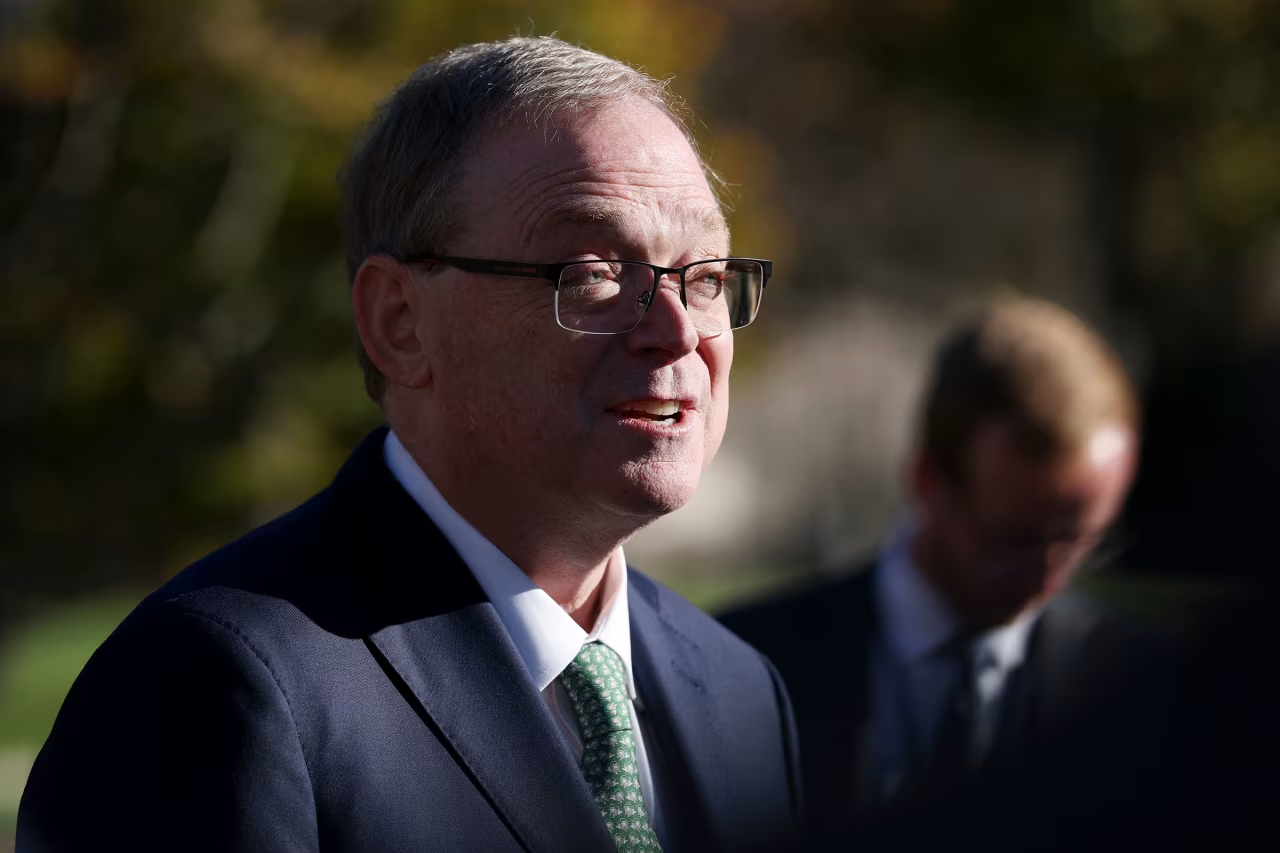
National Economic Council Director Kevin Hassett said today that due to the government shutdown, the monthly employment report for October will be incomplete.
Hassett told Fox News in an interview that the lapse is due to the fact that one of the two surveys that comprise the jobs report – the household survey – was not conducted for the month of October.
The Bureau of Labor Statistics’ monthly snapshot of the labor market is composed of two surveys: One of households (which provides demographic data and feeds into the all-important unemployment rate) and the other of businesses (designed to measure employment, hours and earnings).
The business survey, which is drawn partly from electronic and administrative sources, is expected to be easier to retroactively tabulate for October, economists told CNN. However, the survey of households is conducted via phone and in person and was scheduled to take place during the week of October 19.
Hassett said it would be only for one month.
The October jobs report was originally set to be released on November 7, but became a casualty of the government shutdown as workers at the Bureau of Labor Statistics were furloughed.
CNN’s Alicia Wallace contributed to this report.
Senate staff to start getting paychecks tomorrow, email shows

Senate staffers will begin receiving paychecks again tomorrow after Congress ended the 43-day government shutdown, according to an email shared with CNN.
An email sent to all Senate staff says the paychecks will begin tomorrow “as a result of the end in the lapse in appropriations.”
Senate staffers are set to receive three paychecks in the span of one week. The first check going out tomorrow will cover the paycheck staffers missed on October 20. Staffers will receive another payment on Monday, covering the November 5 paycheck. The regular pay period will then resume next Thursday, November 20.
The legislation reopening the government guaranteed retroactive pay for federal workers who were furloughed or worked without pay during the shutdown.
HHS email to employees: “The Democrat-led shutdown is over”
On the first day of the government reopening, the Department of Health and Human Services sent an email to its employees saying that “the Democrat-led shutdown is over,” according to the email reviewed by CNN.
The email outlines that employees must report to work on Thursday and that the department is working to complete back pay “on or before Friday, November 21st.”
To conclude, the message uses a sign-off closely associated with President Donald Trump: “Thank you for your dedication on behalf of the American people and your attention to this matter.”
It’s the latest in a series of highly unusual steps from the Trump administration throughout the funding stalemate to use the federal government and its employees to promote political messaging related to the shutdown.
As CNN previously reported, in one instance, multiple furloughed workers from the Department of Education had out-of-office messages blaming Democrats for the shutdown automatically sent from their email accounts without their consent or knowledge. Federal workers at other agencies, meanwhile, said they were provided with suggested partisan language to include in their own out-of-office email notices.
Over the more than month-long closure, messages appeared on several agency webpages blaming Democratic senators for Congress’ failure to agree to extend funding at the start of the fiscal year.
These actions raised concerns about the Hatch Act, which states that federal government officials and employees are required to perform their duties in a nonpartisan manner.
The federal law is intended to “protect federal employees from political coercion in the workplace,” according to the Office of the Special Counsel.
Government employees are back in the office today. Here's when they'll receive back pay

The timing for when the roughly 1.4 million federal workers who were furloughed or working without pay will receive their back pay may vary by agency. Many have missed two full paychecks and a partial one during the shutdown.
In the past, it only took a few business days for workers to be paid, said Jacqueline Simon, policy director at the American Federation of Government Employees. But she was concerned that this year it could take longer because many human resources staffers at agencies were furloughed or have left amid the administration’s downsizing efforts.
Adding to the complexity is that federal workers are not all paid at the same time since the government uses multiple pay systems, said Stier of Partnership for Public Service.
“It’s a huge undertaking on top of a lot of other things that the federal employees are going to have to be doing,” he said, though it should take a matter of days, not weeks.
But “until we get paid, everyone’s going to still have those same financial stressors on them,” said Ben Emmel, who represents 2,400 Government Accountability Office employees as president of the International Federation of Professional & Technical Engineers Local 1921.
House staffers, who are paid monthly, will receive their retroactive compensation on Tuesday or Wednesday, according to a House administrative official.
Heading for the exit?: Caitlin Lewis, who runs CivicMatch, which connects federal employees with jobs in state or local governments, said the shutdown has pushed many federal workers to the exits.
“People want to stick it out as long as they can. But this is the latest in a deep cycle of instability that is pushing public servants out of the government since the inauguration,” Lewis said.
Could another government shutdown be looming in January?
The longest government shutdown in US history has come to an end, but the Affordable Care Act could create another fight come January 30 — the next deadline to fund the government. CNN’s Manu Raju explains why.

No comments:
Post a Comment