Why Pope Leo XIV Will Not Visit Hagia Sophia

Pope Leo XIV is breaking with decades of papal tradition during his current trip to Turkey by not paying a visit to Hagia Sophia. The official program, which details his visit to the nearby Blue Mosque, makes no mention of a stop at the historic site, a deviation that has drawn significant attention from religious observers and journalists.
The decision is particularly notable because every Pope since Paul VI has visited the site.
A broken tradition: The precedents
The tradition of a papal visit to Hagia Sophia began with Pope Paul VI in 1967, who, according to witnesses, was overcome with emotion, kneeling and weeping inside the structure.
Following him, three more popes continued this practice while Hagia Sophia operated as a museum:
- Pope John Paul II visited in 1979.
- Pope Benedict XVI visited in 2006.
- The most recent papal visitor was Pope Francis in 2014.
Pope Leo XIV is the first Pope in over half a century to omit a visit to the historic site from his official itinerary.
Pope Leo XIV avoids the diplomatic minefield by skipping the Hagia Sophia visit
The primary reason for the omission is the delicate shift in Hagia Sophia’s status from a secular museum back to an active mosque in 2020.
The Vatican’s initial reaction to the 2020 re-conversion of Hagia Sophia from a museum back into an active mosque was one of profound disappointment and sorrow. On July 12, 2020, just days after the decree was signed, Pope Francis broke with the Vatican’s initial public silence to address the issue in improvised remarks after his Sunday Angelus. The Pontiff stated, “My thoughts go to Istanbul. I think of Hagia Sophia, and I am very saddened.”
By abstaining from a visit to the site in its current capacity as a mosque, Pope Leo XIV may be aiming to reinforce this previous stance of disapproval. In other words, he could be demonstrating that the Vatican has not normalized or accepted the 2020 change.
Speaking to Rome Reports, Filippo Forlani, Historian at the Pontifical University of the Holy Cross, suggests the difficulty lies in inter-religious dialogue: “So indeed, going to a place that has returned to being a mosque might, from the perspective of inter-religious dialogue, I don’t know, be somewhat complicated. And that’s why I imagine Pope Leo preferred not to go there.”
Juan Antonio Cabrera, from the Pontifical Patristic Institute Augustinianum, views the move as an act of prudence. He notes the controversial aspects of the matter, particularly the covering of its iconic mosaics since it resumed functioning as a mosque. Cabrera states, “The reason is probably diplomatic, not wanting to hurt certain sensitivities.”
The omission highlights the fragile balance the Vatican must strike between affirming Christian history and fostering positive inter-religious relations with Turkey.
The significance of Hagia Sophia for Christianity
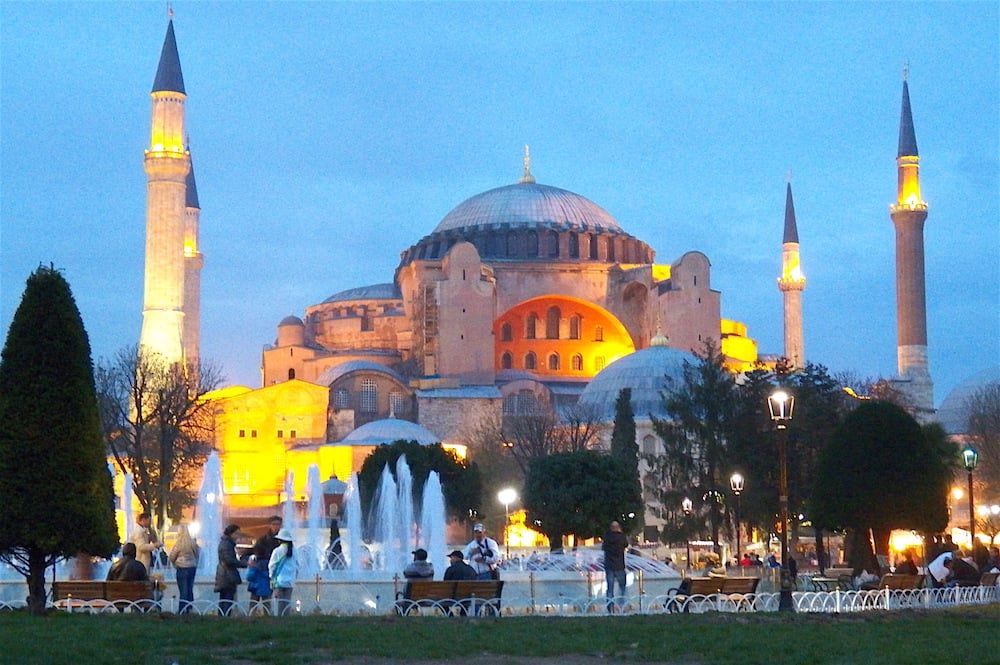
For the Christian world, particularly the Eastern Orthodox Church, Hagia Sophia (meaning “Holy Wisdom” in Greek) is far more than a building; it is a profound and deeply symbolic monument.
The Church of the “One and Undivided Church”: Built by the Byzantine Emperor Justinian I in the 6th century, the Hagia Sophia was the largest Christian church for nearly one thousand years and stands as a powerful, architectural symbol of the unity of the early Christian Church.
The church was the setting for one of the most defining moments in Christian history: the Great Schism between the Eastern and Western Churches. In 1054, Cardinal Humbert, on behalf of the Roman Church, laid the Bull of Excommunication on the altar of Hagia Sophia, formalizing the permanent split between Catholicism and Orthodoxy.
Pope Leo XIV’s decision not to visit, therefore, is not merely a scheduling choice but a weighty statement that acknowledges the complex, often painful, layers of history and religious identity now defining the site.
Related: Pope Leo Arrives in Turkey; Set to Join Patriarch Bartholomew in Nicaea Trip

No comments:
Post a Comment