Tuesday, December 3, 2019

CB Erdoğan'ın , 6ncı Din Şurası'ndaki konuşması

Zülal Kalkandelen

Erdoğan’dan laikliğe öldürücü darbe

03 Aralık 2019 Salı

Geçen hafta yapılan 6. Din Şûrası, CHP’deki kumpas skandalının gölgesinde kaldı. AKP’li Cumhurbaşkanı Erdoğan’ın kapanışta yaptığı konuşmayı dikkatle dinlediniz mi?
Birçok şey söylemiş, ama bazı sözlerinin üzerinde durmak gerekli. 
Önce İslam dininin hayatın tüm alanlarını kuşatan kurallar ve yasaklar manzumesi olduğunu vurgulamış; “ticaretten beşeri münasebetlere, eğitim öğretimden evliliğe, temizlikten kılık kıyafete, yaşantının her safhasını düzenleyen bir dine inanıyoruz” demiş.
Ve şu sonuca varmış: 
“İslam bize göre değil, biz İslama göre hareket edeceğiz. Nefsimize ağır gelse de hayatımızın merkezine dönemin koşullarını değil, dinimizin hükümlerini yerleştireceğiz.”
Bir kişi, hayatının merkezine dini koyup tüm alanları ona göre düzenleyerek yaşayabilir. Hayatını nasıl yaşayacağını yetişkin bir insana kimse dikte edemez, etmemelidir. 
Farz edelim ki Erdoğan, bir vatandaş olarak sadece kendi hayatını düzenlemeyi kastetti... Ama aynı konuşmada, devletin başı olarak, din görevlilerini “sıradan bir memur gibi değil, peygamberlerin vaizleri gibi hareket etmeleri” için görevlendiriyor. 
Din Şûrası’nda konuşan Erdoğan, herhangi bir vatandaş değil, bu ülkenin Cumhurbaşkanı. Onun “İslam’a göre hareket edeceğiz” demesi laikliğe öldürücü darbedir!

* * *  
Hayatın her alanının dine göre şekillendirilmesi, ancak ŞERİAT hukukunun benimsenmesi ile olur.
İnsanların medeni ilişkilerini, mülkiyet ilişkilerini, hak ve borçlarını düzenlemek için öncelikle Medeni Hukuk’u kaldırmanız gerekir. 
Yürürlükteki Ticaret Kanunu’nu kaldırıp faizi yasaklamanız gerekir. 
Resmi nikâhı kaldırıp sadece dini nikâhı geçerli saymanız gerekir.
Eğitim ve öğretimi İslama göre düzenlemek için laik eğitimi kaldırıp, karma eğitim kurumlarını yok etmeniz gerekir. 
Kadınları türban ve çarşafa sokmanız gerekir!

Eğitimdeki dinci çember 
AKP döneminde pıtrak gibi çoğalan imam hatipler, anaokullarına kadar inen dini eğitim sınıfları, kız ve erkek öğrencilerin ayrıldığı okullar ile eğitim giderek dinselleştirildi.
Din görevlileri müftü ve imamlara nikâh kıyma yetkisi verildi. 
Türban serbestisi ilkokula kadar indi. 
Bunların hepsi laikliğin içini boşaltmaktır! 
Türkiye’de “Devletin dini, İslam dinidir” maddesi, 10 Nisan 1928’deki değişiklikle  anayasadan çıkarıldı ve laiklik ilkesi 1937’de anayasaya girdi. İnsanlığın en önemli kazanımlarından biri olarak 82 yıldır anayasada yer alıyor. 5 Şubat 2020’de 83. yıl olacak.

Temel ilkelerinden biri laiklik olan CHP’nin ana muhalefet partisi olarak Erdoğan’ın Din Şûrası’ndaki  konuşmasına gereken yanıtı vermesi ve sesini yükseltmesi gerekmiyor mu? 
15 yıl önce Erdoğan...

Bir de Erdoğan’a şunu hatırlatmak lazım. Kendisi, 2004’te ABD Dışişleri Bakan Yardımcısı Marc Grossman, Büyük Ortadoğu Projesi görüşmeleri kapsamında "Ilımlı İslam devleti modelini” dile getirdiğinde böyle tepki göstermişti:
“Anayasa'da belirtiliyor. Türkiye, laik, sosyal hukuk devletidir. Devletimizin adı bu. İslam farklı bir şey. Müslüman’ın dinini yaşaması da laikliğin güvencesindedir. Bu güven arz ediyor. Devlet de bireyin inancı da burada güçleniyor. Bu sadece Müslüman için önemli değil, ülkemizde yaşayan diğer dinler için de, Hıristiyan, Musevi, diğerleri için de güvence, farklı mezhepler için de güvence. Bu nereden kaynaklanıyor, laiklikten kaynaklanıyor. Onun için bizim devletimizin adı İslam değil.”

Bu sözlerinden 15 yıl sonra, bir Cumhurbaşkanı olarak, “hayatın tüm alanlarında İslama göre hareket edeceğiz” dediğinde, bu ülkenin farklı din ve mezheplere inanan ya da inançsız vatandaşları ne olacak? 
Onların din, inanç ve inanmama özgürlüğünün güvencesi nereden gelecek?

Is Iran on the edge of a precipice?

Is Iran On The Edge Of A Precipice?

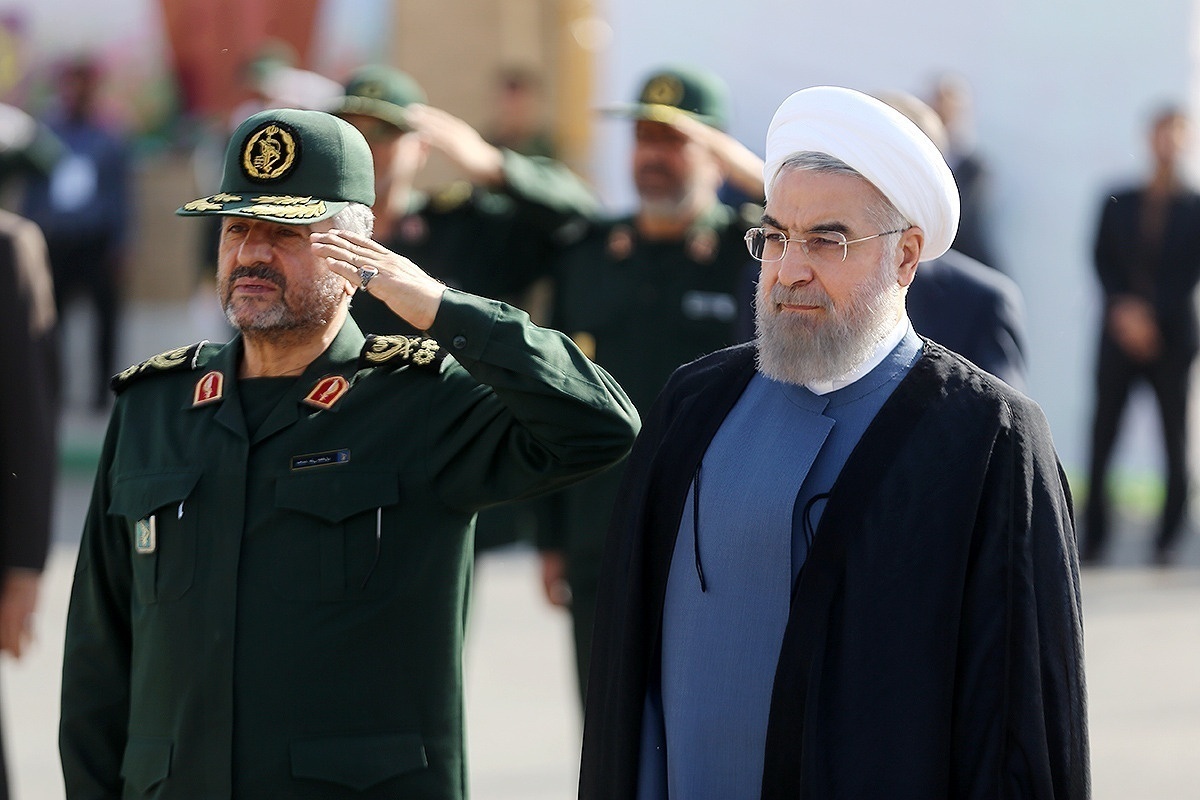
General Mohammad Ali Jafari of the Revolutionary Guards and Iranian President Hassan Rouhani
By Daniel Brumberg
The widespread protests caused by the Iranian government’s decision on November 15 to raise the price of gasoline by a whopping 50 percent have generated a flurry of speculation about their wider political implications for Iran’s rulers. What does seem clear, as several Iran experts have noted, is that these protests were in some sense unprecedented. In a matter of hours, they spread to some 100 cities, including southern Tehran. The protesters set fire to myriad institutions that many Iranians associate with the regime, including banks and Friday prayer halls, and many of them denounced Supreme Leader Ali Khamenei and called for the downfall of the regime. This spasm of popular resistance was far more extensive than the protests of 2018 and early 2019.
In fact, in both geographical and political terms, the demonstrations rivaled—and perhaps even surpassed—the 2009 June “Green Movement” that brought hundreds of thousands into Tehran’s streets. The Iranian government’s decision to shut down the internet in the entire country—a first for any developing nation—underscored the regime’s perception that the protesters posed a dire security and political threat, one that had to be met with decisive and massive force.
Most Iran experts would also agree that the government’s violent response achieved its desired goal: to restore order and, in so doing, signal that any renewal of the protests would not be tolerated. The killing of some 143 protesters, according to Amnesty International, was itself a sign of just how threatened the regime felt. In fact, it had tried to avoid killing large numbers of Iranians lest it be accused of perpetrating the kinds of massacres that helped set the stage for the fall of the shah in 1978. Wagering that it had no choice but to use a heavy-handed approach, for the time being the regime has prevailed. The partial restoring of the internet (and threat to close it down permanently) suggests that its strategy to contain growing anger among the very classes on which the regime has tried to sustain its revolutionary legitimacy is meeting with some success.
The bigger question is whether the protests will produce a wider political movement, one that has the support of an urban professional and business middle class that remains reluctant and/or incapable of challenging the regime. This reluctance is entirely understandable. Over the last few years the security apparatus has been upgraded by a government that believes—not without reason—that it is facing a US-led economic war whose ultimate aim is to destroy the Islamic Republic of Iran. This fear feeds the deeply held view that foreign forces are the real instigators of all protests, including those that have shaken Iran-backed governments in Lebanon and Iraq. But neither brute force nor cash transfers into the accounts of those Iranians most affected by price increases will provide what Iran needs most: a renegotiation of the social and political contract. The problem for the regime (and the opposition) is that its securitization of the political arena is closing the door to any form of peaceful political accommodation. This may be welcome news for those who imagine that Iran is ripe for a new revolution. But the more likely outcome is that the Islamic Republic will deteriorate into a security state that will be incapable of solving the basic problem of political representation.
A Fraying Ruling Bargain
Since the birth of the Islamic Republic of Iran in 1979, the country’s leaders have provided the promise of economic security, jobs, and a basic level of social justice in return for citizen support—or at least acquiescence. This ruling bargain is literally fueled by oil. But it is also justified by an official religious doctrine that has been articulated by Supreme Leader Ayatollah Ali Khamenei and his allies in the clerical and political institutions. It is enforced by a powerful security establishment led by the Islamic Revolutionary Guard Corps (IRGC) and allies in the police and intelligence forces. This patronage system was also buttressed by the incorporation of a state-controlled electoral system that allows elites representing diverse constituencies the opportunity to negotiate over a range of issues, including economic policy.
This semi-authoritarian system gave the regime a means of managing conflicts so long as two conditions obtained: oil income kept flowing and elected leaders (and their allies in the press, universities, and business community, among others) did not reject the legitimacy of the state itself. The repression of the 2009 Green Movement underscored this system’s limits to dissent, especially by a vast urban middle class. By dint of its education, professions, and exposure to global forces, this middle class seeks not merely economic goods but also the intellectual benefits that come from working in parliament, universities, the media, the legal profession, and other vocations that require a minimal degree of free speech and discussion.
Over the last years, this ruling bargain has frayed to the point that it may be impossible to restore. The key driver of this development has been a growing economic crisis whose most visible manifestations are escalating inflation rates, rising unemployment (10.5 percent nationally last September with 26 percent among youth), a plummeting national currency, the rial, and an increasing poverty rate. With 75 percent of Iran’s 83 million people living in urban areas, this downward spiral has made life difficult precisely in those areas whose educated residents have access to cell phones and the internet and, further, to city streets and squares that offer a potential avenue for mobilizing mass protests.
There is little doubt that the sanctions imposed by the Trump White House have made it much harder to sustain the massive spending required to fund the ruling bargain. Faced by a sharp decline in oil exports (down to an available 350,000 bpd in November after domestic consumption), the Iranian government has been pressed to reduce expenditures. The latter include a direct monthly cash handout of $10.80 (455,000 rials) each to some 78 million Iranians as well as a huge subsidy for fuel.
Three days after the gasoline price increase, the government announced a compensation plan designed to assist low income families. Why it failed to make this announcement in tandem with the price increases is a mystery, particularly since it appears that the government had prepared this plan in advance. Still, it is unlikely that any promise to compensate those most harmed by the price increases would have made much difference since, in fact, the protesters’ actions signaled fundamental political concerns. The burning of hundreds of banks and government buildings, according to a government minister underscores escalating anger with what is widely perceived as a corrupt and unaccountable political elite. Echoing the deeper political grievances of so many other protesters in the Middle East and beyond, many of Iran’s demonstrators assailed the very legitimacy of the Islamic Republic and its top leaders, from Khamenei on down. As one Washington-based Iran expert put it, the protesters struck at the “heart of the regime’s revolutionary legitimacy.”
From Legitimacy Crisis to What?
The road from a legitimacy crisis to regime change or transformation is long and uncertain. Along the way three possibilities may emerge. The first, which is most likely, is a further hardening of the regime and a closure of the existing political arena. The second, which could actually emerge as a consequence of the first, is a gradual (if de facto) process of political liberalization whose parameters and limits would be negotiated and fought over by rival political leaders. The last and least likely possibility is regime collapse followed by a democratic revolution.
A further closure of an already stifled political arena is not without risks. As the clampdown on the opposition that followed the 2009 protests demonstrated, efforts by hard-liners to shut down all dissent and exclude reformist leaders and parties from the political arena can have the unintended effect of denuding the system of the very institutions that provide a mechanism for managing and deflecting conflict. Deprived of the mechanism, the gap between regime and society expanded, thus setting the stage for the election of President Hassan Rouhani in 2013 and the subsequent effort to strengthen a fractured reformist camp. But Iran’s intervention in Syria and the widening war in Iraq against the so-called Islamic State—coupled with the backlash from hard-line forces that followed the signing of the 2015 nuclear agreement—had the effect of sidelining reformist forces. Their fate seemed practically sealed two years later, when the Trump Administration’s decision to abandon the nuclear agreement and reimpose sanctions not only pulled the rug out from under Rouhani, but it all but guaranteed that hard-liners would exploit his misfortunes to assert even greater control over the political and economic system.
The hard-liners’ efforts were abetted by a strengthening of the security apparatus that had in fact begun following the 2009 uprising. The regime expanded the police (the “Law Enforcement of the Islamic Republic of Iran,” or NAJA) by increasing their numbers, building new police stations, and creating in Tehran some 400 patrolling units in 375 neighborhoods. These actions were clearly designed to make it difficult for middle class protest in the political heartland of Iran. Fast forward to 2018, when in the wake of countrywide protests, especially in rural areas—the backbone of the regime—the parliament authorized a 400 percent weapons increase for NAJA. If, as it appears, it was NAJA forces rather than the IRGC or Basij forces that led the recent (and ongoing) repression of protests, this development would only underscore the prospects for a wider securitization of the political system.
As noted above, Iran’s recent history suggests that a further hardening of the regime could have the unintended effect of reopening the door to the now isolated reformists. The power and authority of Iran’s supreme leader and his office—already greatly debilitated—could be eroded if he finds himself dependent on one key faction and thus incapable of posing as the ultimate arbiter of the political field. But as his recent uncompromising statements make clear, Khamenei’s number one priority is reasserting control. This requires a close alliance with the IRGC, even if such an entente could further isolate the supreme leader and the office he embodies.
The second scenario is a reassertion of reformist influence through the existing electoral system. While Iran’s experience demonstrates that reformists can sometimes mobilize support in ways that surprise both them and their potential followers, reformist leaders are not well positioned to leverage the protests. They are not only divided; in the wake of protests that featured attacks on government institutions, reformist leaders appear reluctant to speak out in a manner that might identify them with the protesters. However justified they may be, the demonstrators’ actions have played well into the hands of hard-liners and the supreme leader, who has painted the protesters as witting or unwitting agents of foreign forces determined to spread chaos. Moreover, it would be a mistake to assume that the protesters command equal support across the ideological and social spectrum of Iran’s complex society. Fear of disorder should never be underestimated—a point that was suggested by at least one public opinion poll conducted by the University of Maryland, which reported that some 66 percent of the sample believes that the police handled the 2017-2018 protests “very well” or “somewhat well.”
It is not yet known whether the recent protests have provoked similar concerns about public order. What is clear is that the demonstrators’ actions—coupled with the hard-liners’ efforts to depict them as foreign agents—have left Rouhani with little room to maneuver. With hard-liners on the march and a leaderless protest movement whose ardent youth have rebelled against the system itself, he has chosen to emulate and amplify Khamenei’s verbal assaults. Thus, while insisting that the right to legal protest must be respected, Rouhani has not hesitated1 to back Khamenei.
For those Iranians and their supporters who believe and assert that the only path forward is “to move beyond the Islamic Republic toward a radical redistribution of wealth and power,” Rouhani’s statement is positive proof that the system cannot be changed from within. Indeed, the discrediting and isolation of the reformists will reduce the political conflict to a polarized contest that could only invite more violence, thus precluding an even limited reopening of the political system down the road. Iran’s hard-liners might welcome such an outcome even if it comes at the cost of making Iran increasingly ungovernable.
The Dangerous Irrelevance of US Policy toward Iran
Responding to the protests, US Secretary of State Mike Pompeo tweeted  that the “US is with You, the US Supports You,” addressing the protesters. He then followed up this declaration with another tweet, inviting Iranians to send video documentation of the crackdown to the US government. Whether these tweets help or harm Iran’s demonstrators is a matter of debate. But what is sure is that Iran’s hard-liners will make every effort to ensure the failure of what they call the “western conspiracy” to bring chaos. A country under the thumb of a paranoid security apparatus that, among other things, has effectively taken hostage no less than 13 Iranians with binational citizenship will not bend to the White House’s policy of “maximum pressure.”
On the contrary, both at home and abroad, the IRGC is pushing back with its own pressure campaign. The Trump Administration has embraced the protesters’ cause. For the United States and the White House, in particular, this approach brings little risk or costs. But for those Iranians who seek some path forward, a precarious US-Iranian stalemate is bad news. What Iranian protesters and their cohorts in the wider region need is the political space and will to forge an exit ramp off the highway of escalating conflict. Sadly, none of the regional powers favor such an outcome. As for the United States, it is largely out of the game.
Daniel Brumberg is a Non-resident Senior Fellow at Arab Center Washington DC, where this article was originally published. 
Print Friendly, PDF & Email

Monday, December 2, 2019

The Arab Spring Nine Years On by Ali Tuygan

The Arab Spring Nine Years On


December 2, 2019
The Arab Spring began on December 17, 2010 in Tunisia as street vendor Mohammed Bouazizi set himself on fire to protest the arbitrary seizing of his vegetable stand by police. Mass protests forced President Zine El Abidine Ben Ali to resign in January 2011, after 23 years in power and go into exile in Saudi Arabia.
In February 2011, mass protests forced Egyptian President Hosni Mubarak to resign after three decades in power.
Libya‘s uprising began in February 2011 after security forces in the eastern city of Benghazi opened fire on a protest. On 18 March 2011, the Security Council adopted Resolution 1973 which demanded immediate ceasefire and an end to all violence; authorized member states to take all necessary measures to protect civilians while excluding a foreign occupation force of any form on any part of Libyan territory. The next day, a conference in Paris, held under French, British and US leadership, decided to start air operations against Gaddafi’s forces “to protect the civilians”. Within hours air strikes began. It soon became clear that the purpose was regime change. Gaddafi had been in power for more than four decades.
Yemen‘s President Ali Abdullah Saleh was the fourth Arab leader to be forced from power. Demonstrations calling for the end of his 33-year rule began in January 2011 and forced him to hand over power to his deputy Hadi. On March 25, 2015, Saudi Arabia launched “Operation Decisive Storm”. The West supported the intervention.
In Syria, protests began in the southern city of Deraa in March 2011. By July 2011, thousands of people across the country were attending protests demanding President Assad’s resignation. Protests paved the way for external meddling and proxy wars.
Of these five countries, Tunisia remains Arabs’ and broad Middle East’s only hope for democratic evolution. In Egypt, the army overthrew President Morsi in July 2013.   A year later, former army chief Abdul Fattah al-Sisi won the presidential election. Today, Egypt is under authoritarian rule but it has avoided violent internal conflict.
The other three countries, namely Libya, Yemen and Syria were the subject of external military interventions.
Today, Libya is a failed state. The UN warned in September that escalating violence and a deepening humanitarian crisis in Libya is pushing the country closer toward a return to the full-scale civil war that overthrew of Muammar Gaddafi in 2011.
REPORT THIS AD

Yemen is home to world’s worst humanitarian disaster.
And, Syria’s proxy war has devastated the country and its people.
And, even before the Arab spring, Iraq had been the subject of an invasion and remains unstable to say the least.
Thus, after nine years, the question “what if external powers had not interfered?” becomes relevant. Would these three countries have been better or worse off without external interventions? Surely, left to their own devices, they would not have emerged as democracies, but they could have avoided some of the devastation, nonetheless. And, the West might have avoided the emergence of ISIS and a divisive immigration problem.
President Macron has been among the vocal critics of Turkey’s incursion in Syria. In his interview with The Economist where he mentioned NATO’s “brain death”; he complained that NATO was not consulted before the incursion. The misguided rational and consequent failures of Turkey’s Syria policy aside, one may remind him that NATO was involved in the Libya intervention under Operation UNIFIED PROTECTOR and the result has still been disaster. In reality, this was a Sarkozy-led intervention, had an internal politics dimension and its failure was openly admitted later by President Obama. In the same Economist interview Mr. Macron himself said, “…We’ve sometimes made mistakes by wanting to impose our values, by changing regimes, without popular support. It’s what happened in Iraq or in Libya…” He is right about having made mistakes but his reference to values lacks sincerity. The Libya intervention was not about values.
Yesterday, leader of the British opposition Jeremy Corbyn said:
 “I was also one of the few in parliament who warned against the NATO-led intervention in Libya in 2011.
“Britain should not have joined that conflict which has created a vast ungoverned space, contributed to misery in the region and made us less safe at home.” [i]
After almost a decade of Arab spring, Western countries involved in Libya’s, Yemen’s and Syria’s proxy wars need to look at their policies and do some soul searching.
They should admit that their interventions were never about democracy, human rights and freedoms but replacing unfriendly regimes with friendly ones or at least debilitating them. If this were the mission, it has been accomplished through the weakening of Iraq and destruction of Syria, the two countries which have historically constituted the Arab core.
West’s regional allies must also give some thought to what has transpired in the Middle East during the past decade, admit their failures, first and foremost among them their incompetence at working together in the face of a multitude of external and internal challenges.
As for Turkey, Ankara misread the Arab spring. Soon it found itself in a Syria labyrinth which later evolved into a Middle East one. As a result, we are struggling with loss of direction.
Early this year, widespread demonstrations in Algeria showed that majority of the people were disenchanted with the ruling elite. And, they forced President Bouteflika to resign in April. Some called it the “re-blossoming of the Arab spring”. In recent months, disenchanted Iraqis took to the streets. Iraq’s prime minister has finally resigned but hundreds have lost their lives in clashes with the security forces. The people of Lebanon are also staging protests. Hopefully, these calls for democracy, accountability and end to corruption will not again fall on the deaf ears of those who are only interested in perpetuating their power.
With the benefit of hindsight, the West should refrain from new overt/covert interventions but give unreserved political and economic support to Tunisia’s fledgling democracy because all the Middle East needs is one, just one success story.
……………………………………………………………………………………..


REPORT THIS ADREPORT THIS

About Ali Tuygan

Ali Tuygan is a graduate of the Faculty of Political Sciences of Ankara University. He joined the Ministry of Foreign Affairs in January 1967. Between various positions he held in Ankara, he served at the Turkish Embassy in Brussels, NATO International Staff, Turkish Embassies in Washington and Baghdad and the Turkish Delegation to NATO. From 1986 to 1989 he was Principal Private Secretary to the President of the Republic. He then served as ambassador to Ottawa, Riyadh and Athens. In 1997 he was honored with a decoration by the Italian President. Between these assignments abroad he served twice as Deputy Undersecretary for Political Affairs. In 2004 he was appointed Undersecretary where he remained until the end of 2006 before going to his last foreign assignment as Ambassador to UNESCO. He retired in 2009. In April 2013 he published a book entitled “Gönüllü Diplomat, Dışişlerinde Kırk Yıl” (“Diplomat by Choice, Forty Years in the Ministry of Foreign Affairs”) in which he elaborated on the diplomatic profession and the main issues on the global agenda. He has published articles in Turkish periodicals and newspapers.
This entry was posted in Uncategorized and tagged