Summary
Iran's foreign minister says the Strait of Hormuz is "completely open" to commercial ships for the remainder of the ceasefire, but tracking data shows very few vessels actually transited through it
"THANK YOU!" Donald Trump posts on Truth Social - moments later, he says the US naval blockade of Iranian ports will continue until a peace deal is agreed
Oil prices drop after Iran's announcement - why does the strait matter so much?
Earlier, a 10-day ceasefire between Israel and Lebanon began, with celebrations and fireworks in Beirut - here's what we know about the truce
More than 2,000 people in Lebanon have been killed in the six-week conflict, with one in five people displaced; Israel says two of its civilians and 13 soldiers have been killed
The ceasefire is very fragile - our security correspondent Frank Gardner ex
US placing new sanctions on seven ‘Iran-backed Iraqi militia commanders’
The US Department of Treasury will place further sanctions on Iraqi militia commanders as part of "Operation Economic Fury".
“We will not allow Iraq’s terrorist militias, backed by Iran, to threaten American lives or interests,” says Secretary of the Treasury Scott Bessent.
The US Department of the Treasury’s Office of Foreign Assets Control (OFAC) says it has designated seven Iraqi militia commanders responsible for “planning, directing, and executing attacks against US personnel, facilities, and interests in Iraq".
The militia organisations include Kata’ib Hizballah, Kata’ib Sayyid Al-Shuhada, Harakat Al-Nujaba, and Asa’ib Ahl Al-Haqq.
UK and France further outline their joint mission in the strait
AFP via Getty ImagesEarlier today, UK Prime Minister Keir Starmer and French President Emmanuel Macron announced that their countries will be leading a mission to protect freedom of navigation in the Strait of Hormuz.
They've just issued a statement confirming their mission and outlining its three main points.
- "First, we called for the unconditional, unrestricted, and immediate re-opening of the Strait of Hormuz. The right of transit passage without restrictions or tolls is the bedrock of international trade."
- "Second, we confirmed our support for the vital work of the International Maritime Organisation to ensure the safety of seafarers and vessels. We will continue to work with the shipping industry to ensure that they can resume operations as soon as conditions permit, including through engagement with shipping operators, insurers, and industry bodies."
- "Third, France and the United Kingdom confirmed that they are establishing an independent and strictly defensive multinational mission to protect merchant vessels, reassure commercial shipping operators, and conduct mine clearance operations as soon as conditions permit following a sustainable ceasefire agreement."

What is Iran's 'co-ordinated route' for vessels in the strait?
By Shayan Sardarizadeh
As we reported earlier, Iran’s Foreign Minister Abbas Araghchi announced in a post on X that the Strait of Hormuz is now “completely open for the remaining period of ceasefire” with the US, which is due to end on 22 April.
Araghchi also said the passage of commercial vessels is allowed via the "co-ordinated route” previously announced by Iran.
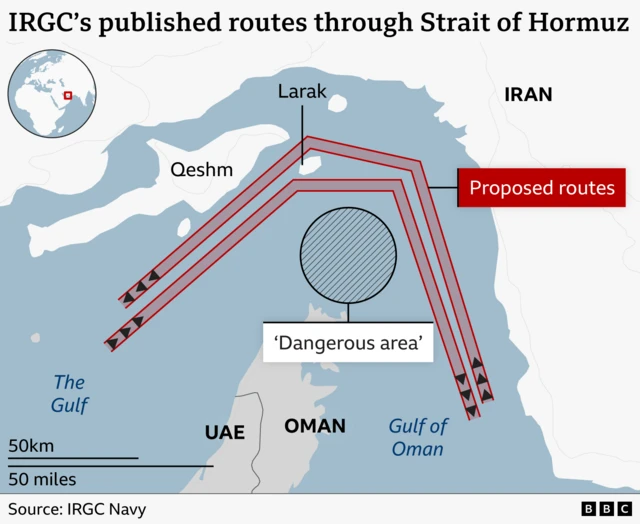
He is likely referring to a map and two routes designated by Iran’s Islamic Revolutionary Guard Corps (IRGC) and widely reported by Iranian media last week.
Vessels going towards the Gulf would have to take a route north of Iran’s Larak Island. Those moving towards the Gulf of Oman would go to the south of the island.
The map marked a region in the middle of the channel linking the Gulf and Gulf of Oman as a “dangerous area” to be avoided.
Iran said last week any vessels that did not follow the designated routes risked hitting naval mines or being attacked by the IRGC.
- While there was a flurry of shipping activity in the Gulf throughout Friday, maritime tracking services show very few vessels actually transited through the strait, with some appearing to turn back or stop
Oil prices have eased, but we're not out of the woods yet
Dharshini David
Deputy economics editorThe Brent crude oil price has closed at $90 per barrel - down nearly 10%.
That response underscores how vital the Strait of Hormuz is to all our economic fortunes.
As energy costs had plateaued, even drifting slightly lower in recent days, the pressure at the petrol pump - and in the borrowing costs that dictate mortgage rates - had started to ease.
If the latest drop in energy prices is sustained, then there's likely to be more relief.
But we're a long way from business as usual. Crude oil remains far above the $70 or so seen ahead of the war.
This is potentially a limited reopening which will help only vessels stranded in the Strait – and it’s unclear how many will move. Shipping operators have told us they are cautious.
And the damage to infrastructure in the region means energy production, such as that of liquid gas in Qatar, could take years to fully recover.
But even with a swift resolution to the war, analysts warn that - as the impact of what happens in the last seven weeks continues to filter through – there will be a hit to prices and growth that could outlast hostilities.
What Trump has been saying to the media today
Aside from his social media posts, US President Donald Trump has also given a series of interviews today. Here is a roundup of the main points he made to reporters:
- Trump told CBS News, the BBC's US partner, that Iran has "agreed to everything", including the removal of nuclear materials from the country
- He told the AFP news agency there were "no sticking points" left in the peace negotiations with Iran and that an agreement in writing is "very close"
- Separately, he told Bloomberg that Tehran has agreed to suspend its nuclear programme indefinitely without receiving any frozen funds from the US in exchange. In an interview with NewsNation, Trump is reported to have said Iran has agreed to stop enriching uranium
- To Reuters, he said that Iran has agreed to allow the US to enter its territory to collect enriched uranium. "We're going to go in with Iran, at a nice leisurely pace, and go down and start excavating with big machinery," he says. "We'll bring it back to the United States"
- The president told Axios that negotiators might meet again this weekend to finalise a deal to end the war. The news outlet also reported, citing unnamed US officials, Iran is requesting the release of $20 billion of frozen funds in exchange for enriched uranium
- When asked about the Iranian request, a White House spokesperson told the BBC: "Only announcements from President Trump or the White House — not anonymous sources — should be taken as fact. Productive conversations with Iran continue, but we will not negotiate via the press.”
- Iran has yet to confirm any of the details of what Trump has told reporters. A senior Iranian official has told Reuters significant difference remain in their negotiations and a spokesperson for the foreign ministry said the enriched uranium was going nowhere
Iran's uranium will not be transferred anywhere, says spokesman
Ghoncheh Habibiazad
Senior reporter, BBC PersianIran's enriched uranium will not be transferred anywhere, says a senior official in Tehran.
Speaking to TV state media in Iran, Foreign Ministry spokesperson Esmail Baghaei says that "the transfer of uranium to the US has not been presented as an option. Iran’s enriched uranium is as sacred to us as the soil of Iran and will under no circumstances be transferred anywhere".
It comes after Trump said earlier today that Iran has "agreed to everything", including the removal of enriched uranium from the country.
On negotiations, Baghaei says that "the lifting of sanctions is of great importance to us, compensation for the damages incurred is a particular priority for Iran".
Backlog of ships in Gulf will take time to clear
The shipping industry still needs to know if it's safe for ships to pass through the Strait of Hormuz, the Secretary General of the International Maritime Organisation tells BBC World Business Report.
"I need further clarification for the shipping industry that there will be no risks for the ships to navigate and it will be in accordance with international law," Arsenio Dominguez says.
The IMO has information that some ships have started to sail, but still needs to verify that as "some ships turn off their identification systems in order not to be targeted", he says.
Dominguez adds that there's a major backlog of around 1,600 trapped in the Persian Gulf, which will take time to clear.
Trump claims Iran has 'agreed to everything' - including giving up enriched uranium
ReutersUS President Donald Trump has claimed that Iran has "agreed to everything", including the removal of enriched uranium from the country.
Speaking by phone to CBS, the BBC's US partner, Trump says that the removal of the material would not involve American ground troops, while also saying that "we'll be getting it together [with the Iranians]".
"We'll go down and get it with them, and then we'll take it," he says. "We'll have an agreement and there's no need for fighting when there's an agreement."
The uranium would then be brought to the United States, he says.
When the US and Iran called a temporary ceasefire last week, enriched uranium emerged as a point of contention, with Iran's National Security Council (SNSC) saying that the truce outlined an "acceptance of [uranium] enrichment", despite US claims to the contrary.
- What is enriched uranium? It's uranium where a specific isotope has been concentrated - when it's enriched to 90%, it can be used to make nuclear-grade weapons. According to senior US officials, at the start of the war Iran possessed approximately 440kg of uranium enriched to 60%.
Maritime security firm still advising clients of ‘very high chance’ of attack for ships
Cormac McGarry, director for maritime security at the consultancy firm Control Risks, tells the BBC's 5 Live Drive that he is “no more optimistic than he was yesterday,” despite Iran saying the strait is “completely open”.
The firm is still advising their clients of a “very high chance they’ll be attacked” if they sail through the Strait of Hormuz.
McGarry says that the statement made by Iran’s foreign minister “basically changes nothing” as the implicit threat of mines remain.
“But right now the scenarios are looking pretty bleak for shipping over the next few weeks,” he says.
IDF 'will continue to remove threats in southern Lebanon'
The Israel Defence Forces says it "remains on high alert and will continue to remove threats in southern Lebanon throughout the area between the border with Israel and the designated line".
In a statement on Telegram earlier, the force said this is "in accordance with ceasefire understandings".
The post says on Thursday night, IDF soldiers began an operation last night, prior to the ceasefire agreement coming into effect. Soldiers landed in the "Christofani Ridge" in southern Lebanon and "established an operational presence in the area".
Earlier, Lebanese state-run National News Agency reported that Israeli forces hit the city of Tyre in southern Lebanon last night just before the ceasefire came into effect, killing 13 people and injuring 35. The outlet has now updated the number of wounded people to 70.
Lebanese state media says person killed in south after ceasefire began
Lebanese state media says that an Israeli airstrike has killed one person today, after the 10-day ceasefire between Lebanon and Israel came into effect last night.
The state-run National News Agency quotes the Health Emergency Operations Center of the Ministry of Public Health, reporting in Arabic that a motorcyclist was killed, and three people were wounded on a highway in the Bint Jbeil district, after being targeted by a drone.
The agency separately reported that the Israel Defence Forces had also fired two shells towards the town of Bayut al-Sayyad today.
We have approached the IDF for comment.
Senior US officials could meet for further talks in Pakistan within days - CBS News
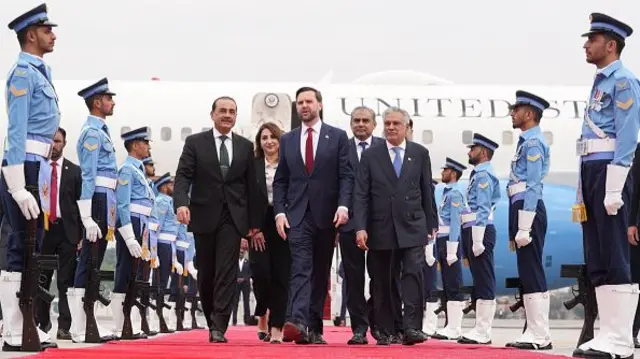
Pool/Getty ImagesUS Vice-President JD Vance arrives in Islamabad for talks with Iranian officials, 11 April 2026
The BBC's US partner, CBS News, is reporting that US officials may return to Pakistan for further talks with Iran within days.
Citing "several people familiar with the deliberations", CBS says that the Trump administration is looking at sending senior officials back to Pakistan to renew talks with Iran.
These negotiations could resume as soon as Monday, it says.
- A reminder: Pakistan's capital, Islamabad, hosted US and Iranian delegations for talks last weekend, but failed to reach a peace deal. There are also reports that Pakistan's army chief met Iranian officials in Tehran on Thursday as part of efforts to extend the current ceasefire agreement.
Shipping industry should be 'cautious' about Iran's claim Strait of Hormuz is open
AFP via Getty ImagesSecretary general of the International Maritime Organisation, Arsenio Dominguez
The secretary general of the International Maritime Organisation, Arsenio Dominguez, has told the BBC that the shipping industry needs to be "cautious" about Iranian claims that the Strait of Hormuz is open.
Speaking to Newshour, Dominguez says "any progress of course is welcome but I'm still in the process of verifying the information that is circulating".
He says "the main concern" remains the "20,000 seafarers that are trapped", along with nearly 2,000 vessels.
"For us it is imperative that the ships resuming transit in the Strait of Hormuz do it in a safe manner," he says.
Dominguez says that he doesn't have "specific guarantees" at the moment, so is calling "for the shipping industry to be cautious until there is more clarity".
Hormuz Strait: Status unchanged
Frank Gardner
Security correspondentThe headlines have perhaps been a little misleading. The Strait of Hormuz is no more open this evening than it was at this time yesterday.
Iran is still insisting that all vessels follow its "designated route" as determined by its Ports and Maritime Organisation, and that this is subject to permission by the Islamic Revolutionary Guards Corps (IRGC) Navy.
This route is not the same as the well-established and internationally-accepted Traffic Separation Scheme that was agreed in the 1960s between the two nations, Iran and Oman, that border the Strait.
Iran says only commercial ships are permissible, so not, for example, the naval warships of the US Navy’s 5th Fleet, that is headquartered beyond the strait and inside the Gulf, in Bahrain.
In other words, these are the same conditions that Iran laid down previously as it seeks to exercise what it calls its "sovereign right" to exert its control over this vital maritime chokepoint.
To the International Maritime Organisation (IMO) and to the global shipping trade this is unacceptable. The US, meanwhile, says it is keeping in place its blockade of all Iran’s Gulf ports until a final deal is thrashed out. Until then, the crisis over the Strait of Hormuz remains unresolved.

Mixed signals as Trump declares strait fully open, but Iran suggests there may be limitations
Anthony Zurcher
North America correspondentThe devil, as they say, is in the detail.
And that’s all the more true when the matter is one of war, peace and regional security.
Donald Trump has been exceedingly upbeat in his characterisations of the US-Iran negotiations over the course of today. But when it comes to specifics, there is still a significant grey area - and Iran has been offering mixed signals.
The US president has declared the Strait of Hormuz fully open, but Iranian officials have since suggested there may be limitations on shipping through the key waterway.
And Trump’s assertion that the US will continue its naval blockade of Iran could complicate matters further.
Trump has also declared that Iran will hand over its nuclear material to the US, but American media outlets indicate that negotiations over the future of Iran’s nuclear programme are far from completed.
Taken in its entirety, it appears the current negotiations - conducted from a distance, not in person - are still very much in flux.
The president’s optimism may end up well-founded. But if that turns out not to be the case, it wouldn’t be the first time his words have moved ahead of the reality on the ground.
German shipping giant welcomes 'good news' on Strait of Hormuz
Jonathan Josephs
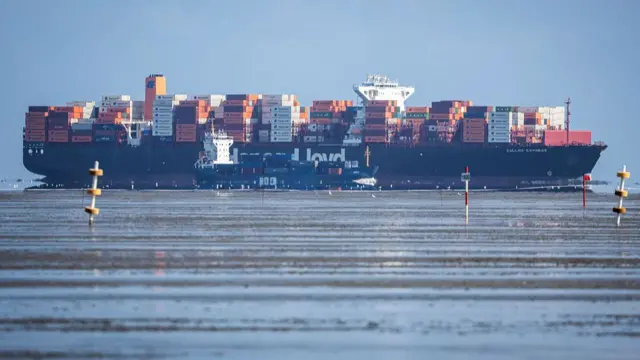
Business reporterGetty ImagesThe Callao Express - a Hapag-Lloyd ship - photographed in Germany last year
The German shipping giant Hapag-Lloyd says the reopening of the Strait of Hormuz is "good news".
It says the safety and security of its crews and vessels remains its priority, including the cargo of its customers.
The world's fifth biggest shipping firm has six vessels that have been stuck in the Gulf since the Iran war began and tells the BBC that it still has questions that need answering before it can return to the waterway "but they might be resolved within the next 24 hours".
The issues it needs to address include insurance coverage and making sure that it has sufficient clarity from the Iranian authorities about which sea corridor it should use and how.
Executives are working through those issues but the company "would prefer to pass the strait as soon as possible".
Not all shipping companies are taking the same approach, with one firm which didn't want to be named telling the BBC the Iranian statement didn't "change anything" for now.
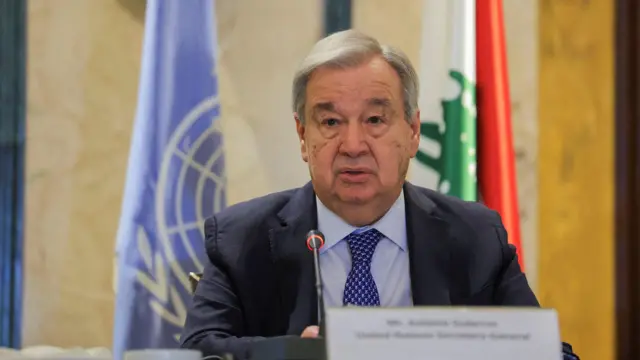
'A step in the right direction,' says UN secretary general
ReutersThe statement says Guterres is “fully supportive of the diplomatic efforts to find a peaceful path forward” out of the war
Iran's foreign minister declaring the Strait of Hormuz completely open for the remaining period of ceasefire is a "step in the right direction", United Nations Secretary General Antonio Guterres says.
In a statement he says: "We need the full restoration of international navigational rights and freedoms in the Strait of Hormuz to be respected by all parties.”
It adds that Guterres hopes that "together with the ceasefire, this measure will contribute to creating confidence between the parties and strengthen the ongoing dialogue facilitated by Pakistan".
Iran's foreign minister X post draws backlash from some Iranian news outlets
Ghoncheh Habibiazad
Senior reporter, BBC PersianThe post that Iranian Foreign Minister Abbas Araghchi posted in English on X has drawn backlash from Iranian news outlets.
Araghchi posted: "In line with the ceasefire in Lebanon, the passage for all commercial vessels through [the] Strait of Hormuz is declared completely open for the remaining period of ceasefire, on the coordinated route as already announced by Ports and Maritime Organisation of the Islamic Rep. of Iran."
Iranian state TV has focused more on “coordinated routes” and has largely ignored the part that passage for all commercial vessels through the strait is “completely open” for the remaining period of the ceasefire.
Tasnim News Agency, affiliated with the Islamic Revolutionary Guard Corps (IRGC), calls the post “bad and incomplete” saying such passage would be considered “void” should the US naval blockade continue.
“The Foreign Ministry itself should reconsider this kind of communication,” Tasnim said.
The Student News Network (SNN), linked to the IRGC's paramilitary Basij Student Organisation, called for “clarification” by Iranian authorities so that the “interpretation” of Donald Trump’s “victory” in relation to this matter will be “challenged and dismantled.”
The Fars news agency - also affiliated with the IRGC - has also called on the authorities to "clarify" the matter, saying that "short, pithy statements" on X are "not suitable" for persuading "domestic public opinion" of Iranians.
Iranians "call on the authorities not to allow the enemy's narrative and hostile media to fill the narrative vacuum," Fars claims.
In Iran, one street in one city symbolises the huge civilian cost of this war
Lyse Doucet
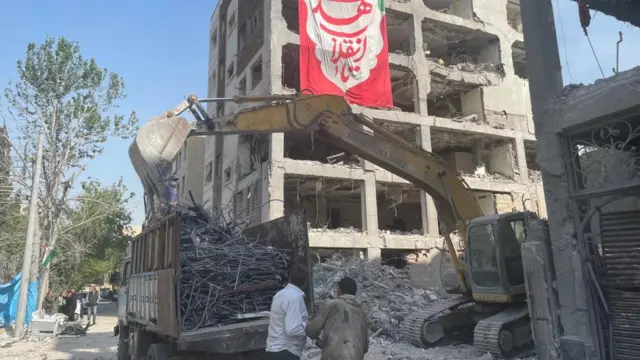
Chief international correspondent, in Iran"This is the help President Trump promised the people of Iran?” Mehran asks mockingly as we stand in the grey broken rubble of his home.
On the other side of Mahnaz Street, the main target of the attack on 8 April is now a gaping hole in this leafy Tehran neighbourhood.
As a fragile ceasefire holds, excavators shove chunks of concrete into piles and workmen carry twisted steel cables away.
People keep arriving to see the site for themselves.
“I’ve been here for 25 years - there was no military activity, just people living here,” Mehran insists.
His home, and a few others facing the gutted building, have been shredded by the force of the explosion.
It was impossible for us on a brief visit to establish why it was a target.
But people living close by keep coming up to us to offer their accounts.
“I never saw any security people," says Mohammad who was forced to flee his office building during the strikes.
"We only found household objects like refrigerators and beds in the ruins,” chimes in Mehdi, one of the workers.
One street in one city symbolises the huge civilian cost of this war and the risks if the ceasefire collapses.
On a wall facing the ruins of Mehran’s home someone has painted “Trump’s help has arrived. Death to America.”
Trump's rapid-fire updates on social media almost like a news wire with Hormuz updates
Anthony Zurcher
North America correspondentDonald Trump’s Truth Social account has seemed almost like a news wire service feed over the past hour.
The US president, who is currently at his hotel in Las Vegas, has provided a constant stream of updates on the state of US-Iran negotiations, painting an upbeat picture of the prospects of a peace deal in the days ahead.
Iran will hand over its "nuclear dust" to the Americans. It has agreed to "never" again attempt to close the Strait of Hormuz to shipping, Trump says.
"A great and brilliant day for the world," he enthuses.
The reality is more complicated than that, as my colleagues have been pointing out.
But the markets - which Trump closely monitors - have been nearly as enthusiastic as the president himself.
That certainly is welcome news to Trump, given that the economic impact of this conflict - particularly at petrol stations - has been a significant drag on the president’s popularity in the US.








No comments:
Post a Comment