|
 |
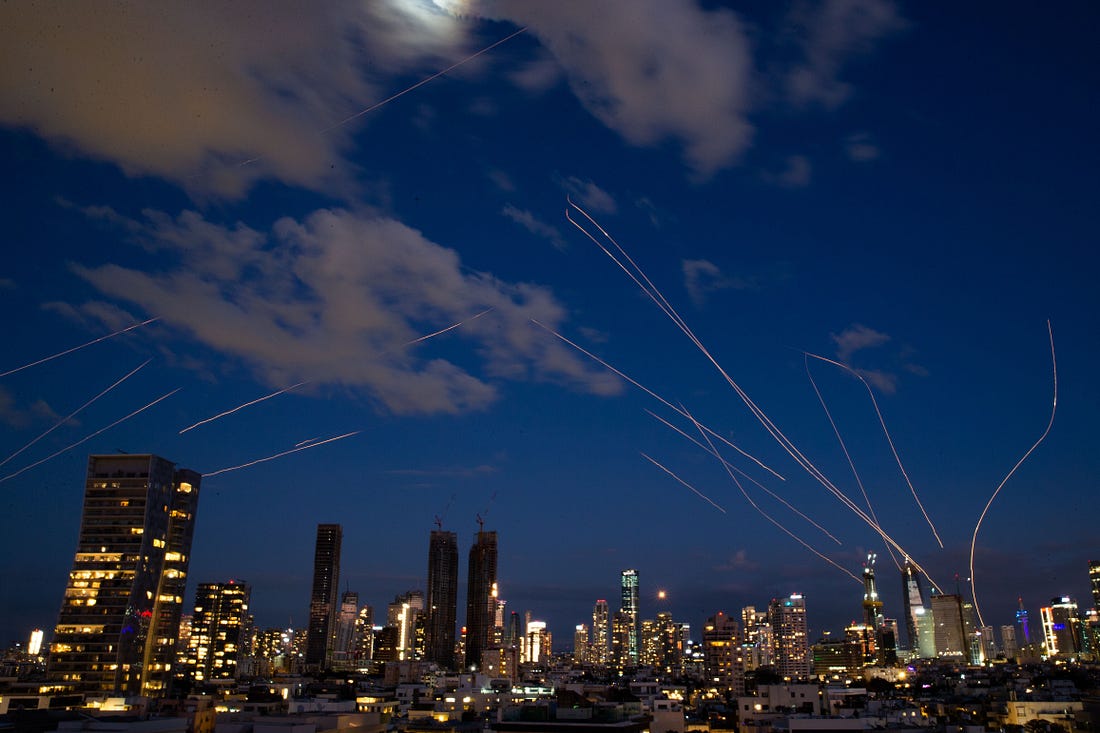
I’ve been warning for several weeks that war with Iran was likely. It wasn’t hard to read the signs: OSINT showed assets moving to the theater weeks ago. Trump’s MO is that when he puts military assets into play, he uses them. And the three major players—Trump, Israel, and Iran—all seemed to think that war was in their best interests.
And here we are.
Today’s newsletter is unlocked because it’s an important moment. Come join the Bulwark+ community if you want to see around corners.



 |
1. It’s a Mystery!
No one knows what the end state in Iran will be. Today we’re going to talk about the universe of “likely” outcomes, but let’s stipulate that none of them is >50 percent.¹
Keep your mind open to all the glorious possibilities. 🤯
A. The Happy Place
Maybe it all works out in the end I’m Ron Burgundy?
President Trump said that the Iranian people should rise up and overthrow the government. This is not going to happen; the Iranian people have no means to overthrow the government. The Iranian regime controls both the military and the police. Full stop.
Even if the Iranian people did overthrow the government, there is no process by which to establish a new government. There are no pre-existing governing structures to be co-opted. There is no endoskeleton of civil society to prop up the country while new governing structures emerge.
Trump told Iranians, “Take over your government. It will be yours to take.” He did this for one reason only: so that if/when this war goes pear-shaped, he can blame the Iranian people.
What a coward.
That said, there are a few of scenarios in which Iran becomes a less repressive place.
(1) A leader emerges who manages to hold the country together in the short term while positioning Iran to become more stable and less despotic in the long term. Maybe this looks similar to the nascent democracy in Iraq; maybe it looks more like the modern, “benign” autocracy of Saudi Arabia.²
(2) The United States and/or some coalition steps in to provide internal security while the Iranian people organize a new regime.
(3) The United States and Saudi Arabia remove economic sanctions on Iran and help the Iranian economy strengthen. This economic expansion creates enough prosperity to buy internal stability while the next regime emerges.
These are overlapping scenarios, all of which seem quite unlikely. But you never know.
B. Life in Iran Sucks, But There’s Greater Regional Stability
From the perspective of America, Israel, and the Gulf Arab states, liberalization in Iran is great, but unnecessary. Stability in the Middle East can be increased through the elimination of the Islamic Republic of Iran even if what replaces it isn’t very nice.
Iran is the primary regional antagonist. It undergirds the Houthis, Hamas, and Hezbollah; it antagonizes Saudi Arabia; it seeks to destabilize Iraq and destroy Israel. The removal of this cancer could bring down the temperature everywhere, even if life for Iranians remains more or less crappy.
I suspect this outcome is what Israel and Saudi Arabia are hoping for.
It’s important to understand that you could get to this point through a variety of outcomes inside Iran because it’s not a permanent end state. The idea is simply to shake the Etch-a-Sketch and see what happens. Because even if something dangerous emerges, it could take several years.³
In fact, from Israel and Saudi Arabia’s perspectives, having Iran become a chaotic, failed state might be the most desirable outcome.⁴ If Iran’s conventional military is “totally obliterated,” its stores of missiles and rockets are emptied, and its capacity to develop and manufacture complex munitions and delivery systems is destroyed, then having the region’s preeminent expansionist power reduced to a failed state might be an attractive outcome.
C. Instability Everywhere
Or maybe instability in Iran spills over to the rest of the region. You may have noticed that none of the governments in the Middle East has an abundance of popular legitimacy.
Saudi Arabia and Qatar are gangster states. Iraq’s democracy is fledgling. Afghanistan and Pakistan are taking pot shots at each other. Turkey’s dictator is only a decade removed from a serious attempted coup. Israel’s government has been the subject of mass internal protests. The Syrian regime is in its infancy.
What if a butterfly flaps its wings in Tehran and you get a coup in Pakistan, which is a nuclear power?
D. The Iranian Regime Survives
Maybe the Islamic Republic is still run by the mullahs. Maybe it’s run by the IRGC or some sort of military junta. Either way, there is continuity of government.
What then?
Maybe the new rulers of Iran seek out a partnership with the United States, like the new ruler of Venezuela did. Or maybe the new rulers are crafty enough to find a way to allow Trump to declare victory while preserving their own future optionality. Or maybe Iran’s new rulers are more aggressively anti-American than the clerics and this posture finds popular support among Iranians.
Maybe Iran’s military capabilities are not as seriously degraded as Israel and the United States hope and, after a time, Iran’s expansionist project resumes.
E. Iran Wins
“Winning” here means that Iran is able to inflict enough damage on the region to create serious economic or political instability for America and our allies. This instability makes it necessary for America and Israel to declare victory and end hostilities while the Iranian regime retains the capacity to perpetuate itself and be a regional military power.⁵
It’s weird to talk about this war as if the range of possible outcomes runs from good, to mixed, to bad. It’s even weirder to say that we can have outcomes that look good in some ways, but bad in other ways, and that this balance might shift over time.
But that’s life. The world is complex and we don’t do easy answers here. It’s not enough to say Orange Man Bad. We have to understand the shape of things to come.
If that’s the kind of independent media you want, then come help us build it. Join Bulwark+.
2. You Can Just Do Stuff
In the short term, America is likely to see at least limited upside from the Iran war. This has led some people—even Trump critics—to suggest that the new phase of Trump’s aggressive foreign policy shows that the old American establishments of both parties were foolish.
“You can just do stuff,” is the shorthand.
And that’s sort of true. You can just do stuff, if you ignore the law.
The Trump regime conducted a series of illegal attacks on ships off the coast of Venezuela and then abducted the Venezuelan head of state after (maybe?) negotiating with his deputy to install her as president, provided she paid a tribute of oil to the American president, the proceeds of which were deposited into accounts based in Qatar.⁶
The Trump regime then planned a war in conjunction with the Israeli government and commenced hostilities without seeking congressional approval—or even giving congressional consultation. This war has—just as a factual matter—no legal basis.⁷
I’m not sure what it means to say that a president who ignores the law demonstrates that presidents can act decisively if they choose. Because that’s not what the actions in Venezuela and Iran demonstrate. They demonstrate that presidents can act decisively only if they ignore the law and behave like autocrats.
But we already knew that, didn’t we?
Democracies are wildly inefficient. Liberalism is, in many ways, a tax on decisive action. Checks, and balances, and rules, and laws constrain governments and often prevent commonsense solutions such as, “What if we just kidnapped the bad Venezuelan president?”
And up until this year Americans had not merely tolerated these inefficiencies, but cherished them.
The animating idea of liberal democracy is that you put up with a lot of inefficiency because it makes the overall system more robust, more able to absorb shocks, and more free. Up until this year, Americans preferred liberty to executive efficiency.
We said, “No, Mr. President. You can’t just do things. You must obey the law. Even when it is burdensome.”
But we’re clearly past that as a society. The voters, the Congress, and the Supreme Court have all decided that the president should be a defined-term autocrat.⁸
At this point, all that’s left it to hope that they’ll voluntarily stick to the “defined term” part. I am not as optimistic as some others on this count.
There is one limitation to the “you can just do stuff” view: nuclear weapons.
We inhabit a world order in which nuclear states can do whatever they want to non-nuclear states. International law—as imperfect as it was—is basically gone now that America, long leader of the international order, has abandoned the rule of law in favor of the law of the jungle.
The only rational response for the rest of the world is to acquire nuclear weapons, as quickly as possible. I expect the next 20 years will see a great deal of nuclear proliferation as everyone from Canada, to Germany, to Poland, to Japan, to South Korea, to Australia goes nuclear. Whether you are a dictator or a democratically-elected leader, possession of nuclear weapons is now your only shield against aggression from Russia, China, and/or the United States.
Maybe this, too, will turn out for the best.
Or maybe not.
Enjoy your Iranian war, America. May whatever good that comes of it be worth the price.
3. Downbuild
Not sure what I think about eliminating redundancies.
Sharks are innocent. Or at least they’re not eating the internet. As a family of cartilaginous fish, sharks are collectively not guilty of most, if not all, charges of biting, chomping, chewing, or otherwise attacking the underwater network of fiber-optic cables. The people who build and maintain the nearly 600 subsea cables that carry almost all of our intercontinental traffic—supporting just about every swipe, tap, Zoom, and doomscroll anywhere on the planet—have a love-hate relationship with this myth, which has persisted for decades. They might even hate that I’m starting this piece with it.
If a cable is suspended over the seabed, a shark might gum it as it explores. Sometimes they’ll lunge for a cable that’s being pulled out of the water. But for a shark to actually bite a cable, you’d have to wrap it in fish, much as you’d hide a pill in a hunk of cheese for the dog. Rats can be a threat on land, because their incisors never stop growing, so they like to file them down on semisoft cables. But nobody ever asks about rats, maybe because, as a friend of mine pointed out, “sharks make you cool, but rats sound like you have a problem.”
Sometimes people ask about satellites or, especially in Sweden (where I live), about alleged sabotage in the Baltic Sea. But historically, shark bites have commanded the most attention. The myth began nearly 40 years ago, with the development of a subsea fiber-optic cable known as TAT-8. TAT-8 practically invented the concept of an internet cable, and now that it’s ready for retirement, I spent time with the offshore workers, crew members, and engineers who are in the process of pulling it off the seabed. That’s the real story of subsea cables—not sabotage or sharks, but the humans who take care of the physical stuff that keeps all of our digital communication flowing.
Fiber-optic transmission is a near-magical way of carrying information by pulses of light. Most people don’t even think about how quickly we’ve accepted instantaneous communication as normal, even those of us who can remember when an international phone call had to be booked in advance. The more people I meet in this industry, in this network of networks of people and things, the more insulting it sounds to hear that “we” only notice it when it breaks. (Who is this “we,” I always want to know?) Billions of people are able to walk around not noticing this infrastructure because of the daily work of a few thousand people, sometimes at sea, other times buried under piles of permits, surveys, and purchase orders for thousands of kilometers of cables that will join the millions of kilometers of cables on the seabed that ensure that our planet is continuously being hugged by light. . . .
TAT is short for Trans-Atlantic Telephone, and TAT-8—built by AT&T, British Telecom, and France Telecom—was the eighth transoceanic system across the Atlantic. It was the first to use optical fibers to transmit traffic between Europe and the United States. Fiber optics for communication had only been worked out in theory in the 1960s, and terrestrial cables were first used in the 1970s. But using this technology to span continents was practically tantamount to human galactic expansion.
When TAT-8 went into service on December 14, 1988, the science fiction writer Isaac Asimov spoke on video link from New York to audiences in Paris and London: “Welcome everyone to this historic transatlantic crossing,” he said, “this maiden voyage across the sea on a beam of light.”
Probably none of them is >30 percent. 🤷♂️
“Benign” is a euphemism here; it’s a sliding scale.
There’s an “I’ll be gone, you’ll be gone” aspect to this trade.
This is basically what Pete Hegseth pointed to this morning when he bragged that there would be no “nation building” in Iran. Just “nation destroying,” I guess?
This is a paleo-conservative view which was often expressed by such luminaries as John Derbyshire in the early post-9/11 days when they suggested, in not so many words, that “rubble don’t make no trouble” because they wanted America to bomb its various enemies back to the stone age and then vamoose.
One addendum to basically every possible outcome here: Ukraine loses. War in the Middle East raises the price of oil, which helps Russia finance its war against Ukraine. And it’s not like Putin cares too much what happens to Iran—he no longer relies on Iranian drones, having ramped up domestic manufacturing of improved designs, and Iran was (is?) a competitor for influence in the Caucasus anyway. Meanwhile, the United States is using up huge numbers of missile interceptors trying to prevent Iranian missiles from landing on its bases all over the Middle East, which will make the Pentagon that much less willing—or even unable—to sell more to Ukraine, even if the White House wanted to.
The Ukrainians keep defying everyone’s predictions of imminent doom, but they can’t catch a break. At least it’s spring.
It sounds crazy when you say the entire sequence out loud, doesn’t it?
I’m talking here about American domestic law. There’s a whole separate question of international law—but if we can’t even make the president obey the Constitution, what’s the point of pretending international law is going to bind him?
If he is a Republican. Obviously.

No comments:
Post a Comment