Foreign Minister Jeenbek Kulubayev of Kyrgyzstan, left, and the permanent representative to the UN, Aida Kasymalieva, center, celebrating their country’s win for a UN Security Council seat, outgunning the Philippines in a runoff, June 3, 2026. The other winners are Austria, Portugual, Trinidad and Tobago and Zimbabwe, all joining the Council on Jan. 1. JOHN PENNEY/PASSBLUEFive countries from the Africa, Asia-Pacific, Latin America-Caribbean and Western Europe regional blocs were elected by the United Nations General Assembly as nonpermanent members to the Security Council for a two-year term, starting Jan. 1, 2027. Although some of the countries ran uncontested, a three-way race for the two open European seats were bitterly fought.
Zimbabwe, Trinidad and Tobago, Austria, Portugal and Kyrgyzstan emerged the winners, garnering the required two-thirds majority votes (127 total) through secret ballot, held on June 3. Kyrgyzstan beat the Philippines in multiple rounds of balloting, with the final tally 141 to 49, securing a seat for the Central Asian country for the first time since its independence in 1991, after the collapse of the Soviet Union.
In a single round of balloting, Portugal and Austria won a total of 134 and 131 votes, respectively, edging out Germany with 104 votes, reflecting a tight race to secure the two coveted seats for Europe. The single open seats for Africa and the Latin America-Caribbean blocs each were uncontested, filled by Zimbabwe and Trinidad and Tobago with overwhelming majority votes of 182 and 181, respectively.
In a nearly full turnout in the Assembly Hall, 191 of the 193 UN member states voted in the election.
Germany did not hide its disappointment at losing the three-way race to Austria and Portugal. Johann Wadephul, the foreign minister, told reporters after the vote: “Obviously, the result is a real disappointment. It’s a bitter defeat.”
He added that Germany, which he said entered the race late — having announced its candidacy in 2019 — put the country “at a disadvantage from the start” and that “it was not possible” to make up for lost time, yet it “fought up to the very last minute, we gave everything we have.” (Austria, which has served three times in the Council, said it announced its recent candidacy 15 years ago; Germany has served six terms in the Council; Portugal, three.)
Wadephul also conceded that Germany’s “rocket-solid support for Ukraine” may have cost it a seat, suggesting that Russia campaigned against Germany because it “does not want such a voice at the table in the Security Council.” Germany’s “special responsibility” to stand up for Israel may have also factored in the defeat, given Germany’s initial stance on the war in Gaza and other Mideast conflicts.
A few African diplomats told PassBlue that Germany’s voting record on Palestine in the General Assembly may have come back to haunt the country in the June 3 vote. In 2024, for example, Germany abstained in an Assembly vote approving full UN membership to Palestine.
“Having obtained the required two-thirds majority and the largest number of votes, Austria, Portugal, Trinidad and Tobago and Zimbabwe are elected members of the Security Council for a two-year term beginning on 1 January 2027,” Annalena Baerbock, president of the General Assembly, declared before the runoffs between Kyrgyzstan and the Philippines began.
In the first round, Kyrgyzstan drew 105 votes, while the Philippines won 85, both falling short of the 127 two-thirds majority tally by members present and voting. Kyrgyzstan eventually emerged with 142 votes, after keenly contesting three rounds of restricted ballots to clinch the only seat for the vast region.
According to Security Council Procedure, an independent research entity, Kyrgyzstan’s seat in the Council will leave 59 other states that have yet to serve in the body.
Separately, on June 2, Bangladeshi Foreign Minister Khalilur Rahman narrowly defeated Andreas Kakouris of Cyprus, by 99 votes to 91, to be elected president of the General Assembly’s 81st session, starting on Sept. 8.
Zimbabwe won a seat for the Africa bloc uncontested. Taonga Mushayavanhu, center, is the permanent representative, and Amon Murwira is the foreign minister, right. The country succeeds Somalia in the Security Council. JOHN PENNEY/PASSBLUEComing and going
The five newly elected countries will succeed Denmark, Greece, Pakistan, Panama and Somalia, whose terms end on Dec. 31. The new members will join Bahrain, Colombia, the Democratic Republic of the Congo, Latvia and Liberia, whose mandates continue into 2027. The permanent members are Britain, China, France, Russia and the United States.
The new countries are joining the Council during a period of intense debates over Security Council reform, increasing protracted regional conflicts, downsizing peacekeeping operations and the evolving role of multilateral diplomacy.
Austria campaigned on the theme of “partnership, dialogue and trust.” During an interactive dialogue organized by the World Federation of United Nations Associations (WFUNA) on May 14, Gregor Koessler, Austria’s permanent representative to the UN, said Vienna’s foreign policy assessments and history of neutrality would allow it to serve as a bridge-builder in the polarized international environment.
Portugal framed its campaign around “prevent, partner and protect,” asserting the need for consistent adherence to international law and stronger diplomatic efforts to prevent conflicts before they escalate.
“At a moment when the Charter is under pressure, from Gaza to Ukraine, from Sudan to Haiti, the principles of the UN Charter must remain the foundation of international peace and security,” Portugal’s envoy, Rui Vinhas, said during the WFUNA dialogue.
A central theme of Zimbabwe’s campaign was stronger cooperation between the UN and regional organizations, particularly the African Union. Zimbabwe’s permanent representative, Taonga Mushayavanhu, said his country’s candidacy is a chance to bring more global South perspectives into Security Council deliberations. Yet, Zimbabwe has not paid its annual dues to the UN’s regular budget this year so far.
The country was last in the Council in 1983-1984 and 1991-1992.
In a separate WFUNA dialogue, on May 19, Trinidad and Tobago’s permanent representative, Dennis Francis Parsan, outlined combating the illicit trafficking of small arms and light weapons, advancing the women, peace and security agenda and addressing the security implications of artificial intelligence as priorities for his country.
The nation previously served as a nonpermanent member in 1985-1986 and as president of the 78th General Assembly session. It has also not paid its dues to the UN regular budget so far this year.
Kyrgyzstan campaigned on a commitment to the UN Charter, multilateralism and conflict prevention. The permanent representative, Aida Kasymalieva, described the race as a milestone in the country’s post-independence development.
“This is not only about a seat,” she said during a WFUNA session on May 20. “It’s about the completion of a long chapter of state-building, democratic transition, national consolidation, and international engagement.”
Before adjourning the June 3 meeting, Baerbock announced the election results of chairs for the Assembly’s six main committees’ 81st session, all ambassadors:
Lok Bahadur Chhetri of Nepal for the First Committee (Disarmament and International Security); Coly Seck of Senegal for the Fourth Committee (Special Political and Decolonization); Suela Janina of Albania for the Second Committee (Economic and Financial); James Larsen of Australia for the Third Committee (Social, Humanitarian and Cultural); Ibrahim Folorunsho Jimoh of Nigeria for the Fifth Committee (Administrative and Budgetary); and Trishala Persaud of Guyana for the Sixth Committee (Legal).




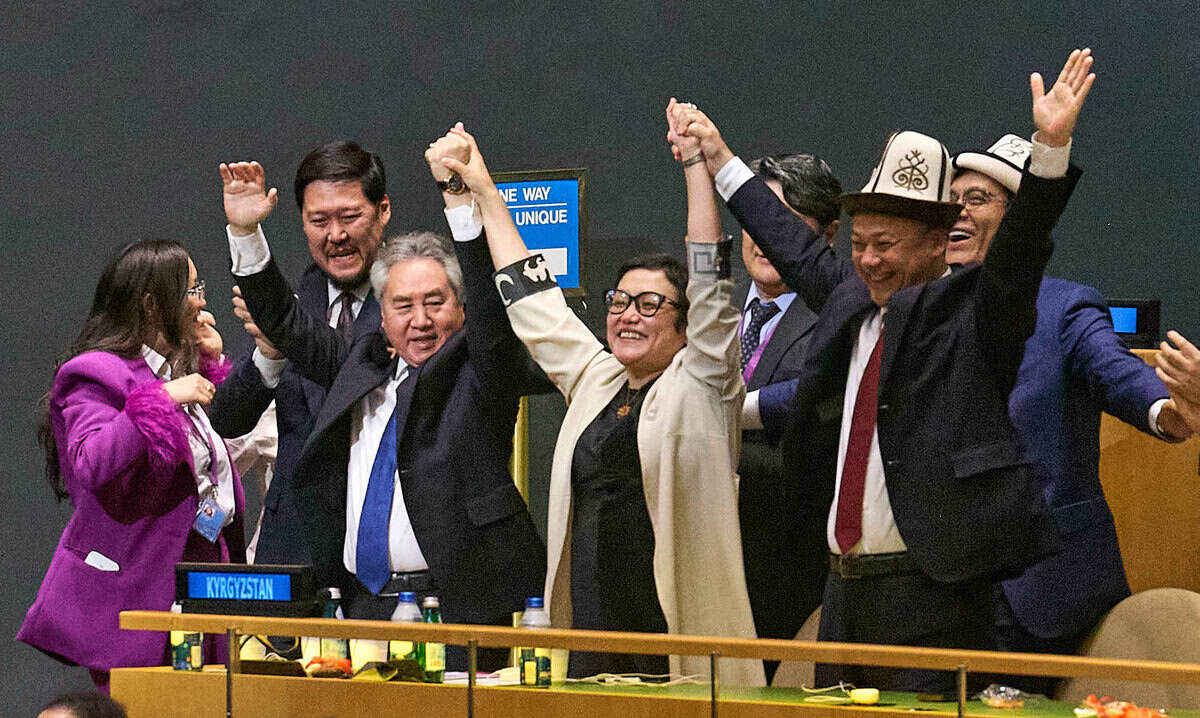 Foreign Minister Jeenbek Kulubayev of Kyrgyzstan, left, and the permanent representative to the UN, Aida Kasymalieva, center, celebrating their country’s win for a UN Security Council seat, outgunning the Philippines in a runoff, June 3, 2026. The other winners are Austria, Portugual, Trinidad and Tobago and Zimbabwe, all joining the Council on Jan. 1. JOHN PENNEY/PASSBLUE
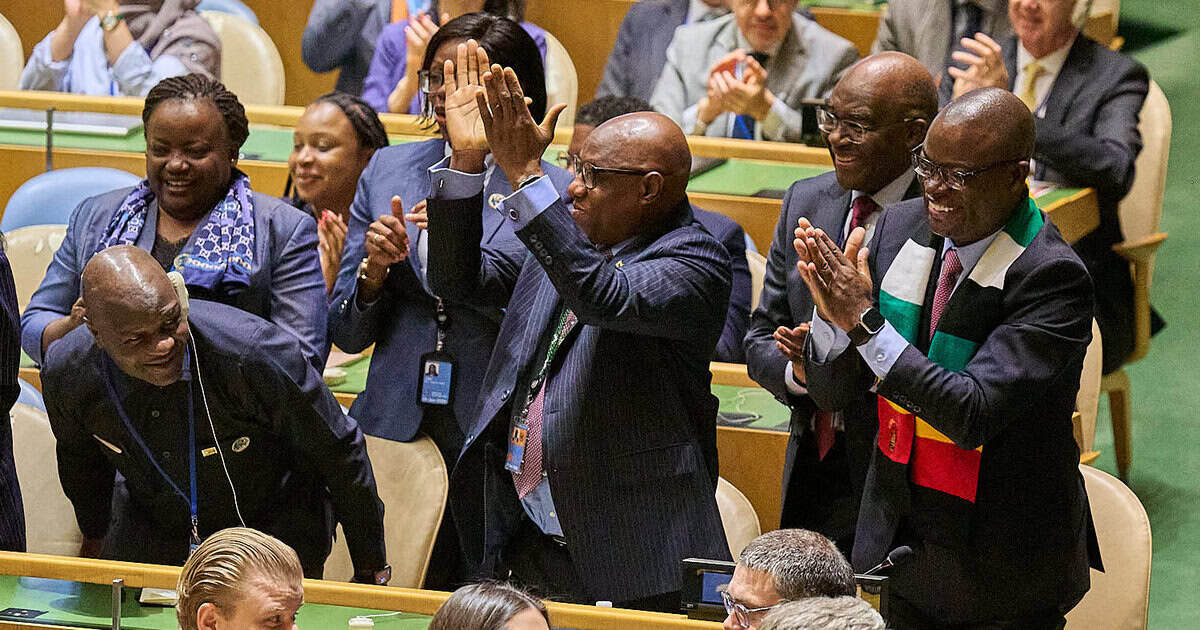 Zimbabwe won a seat for the Africa bloc uncontested. Taonga Mushayavanhu, center, is the permanent representative, and Amon Murwira is the foreign minister, right. The country succeeds Somalia in the Security Council. JOHN PENNEY/PASSBLUE
No comments:
Post a Comment