As leaders from the Group of Seven countries gather in Évian-les-Bains, France for their annual summit, many of the headlines have focused not on announcements regarding top issues on the agenda but rather on what the leaders have whispered over hot mics.
So to get a sense of what the leaders have actually achieved thus far, I rang up our econ experts Josh Lipsky (who has been to several of these summits as a former International Monetary Fund and White House official) and Alisha Chhangani. Here’s what my hot mic picked up:
JOSH: The situation looming over the G7 is a secret US-Iran memorandum of understanding that no one has seen other than the US and the Iranians but that impacts everyone around the table. So every question with the media, when they come in the room, is what’s in the MOU? France has its own agenda and wants to talk AI and trade imbalances. But the MOU is dominating the conversation.
ALISHA: But we’ve seen some ground made on some of the conversations we thought were going to be tough. [US President Donald] Trump has hinted that he could put pressure on Russia through sanctions, specifically by reimposing oil sanctions. They also agreed on things like how to tackle Ebola and on research and innovation around cancer, for example. There is the looming concern with Trump being there and the volatility with his presidency and what he’ll bring to the G7. But so far, things aren’t as bad as I thought they would be.
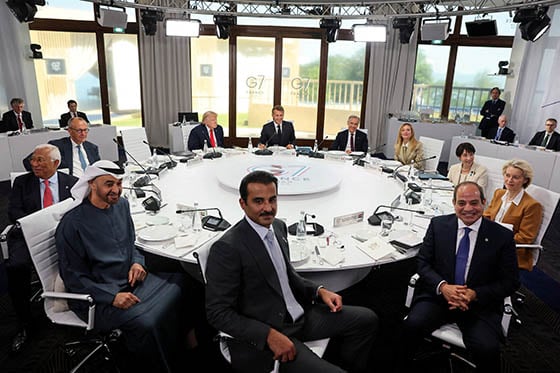
JOSH: You’ve got them sitting around the table, they’re chitchatting. In a hot mic moment, [Canadian Prime Minister Mark] Carney was explaining to Trump why Canada plans to import a capped number of Chinese electric vehicles, and then Trump responded positively. You also have [German Chancellor Friedrich] Merz giving Trump a soccer jersey. Given the fact that there were trade wars and there remain tensions in the relationship over issues like Greenland and Iran, it’s almost surprising the feeling of collegiality at the table. The fact that these people can spend two or three days with each other in person in a relatively secluded environment, it actually bears a lot of fruit later on when there’s a crisis. The next time there’s a problem—trade war, conflict—it is different when you can draw on the personal relationship you’ve had with this person.
And as both Josh and Alisha tell me, it’s also important to note who was at the chummy table—particularly the leaders who aren’t part of the G7. Your AC Intel starts there.








No comments:
Post a Comment