Live
Summary
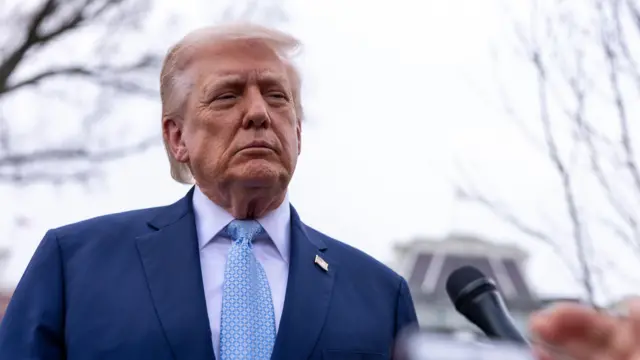
President Donald Trump says the US is considering "winding down" operations against Iran, but that other nations must guard the Strait of Hormuz - a vital shipping lane for oil
Trump adds that he does not want a ceasefire. The US is making detailed plans for the possibility of deploying ground troops to Iran, the BBC's US partner CBS News reports
The US says it will temporarily lift sanctions on Iranian oil stuck at sea, to contain the war's ongoing impact on energy prices
Overnight, a new wave of Israeli strikes were launched on Tehran and Beirut. Meanwhile, Saudi Arabia, Kuwait and Israel all say they have intercepted drones and missiles
Earlier, the UK approved the use of its bases for the US to launch strikes on Iranian sites that target Hormuz. Trump says the UK's decision is "very late" - how has the UK's stance shifted?
Iran's foreign minister accuses UK PM Keir Starmer of "putting British lives in danger", adding "Iran will exercise its right to self-defence"
The Gulf is "on the cusp" as the fourth week of war approaches, the BBC's security correspondent reports
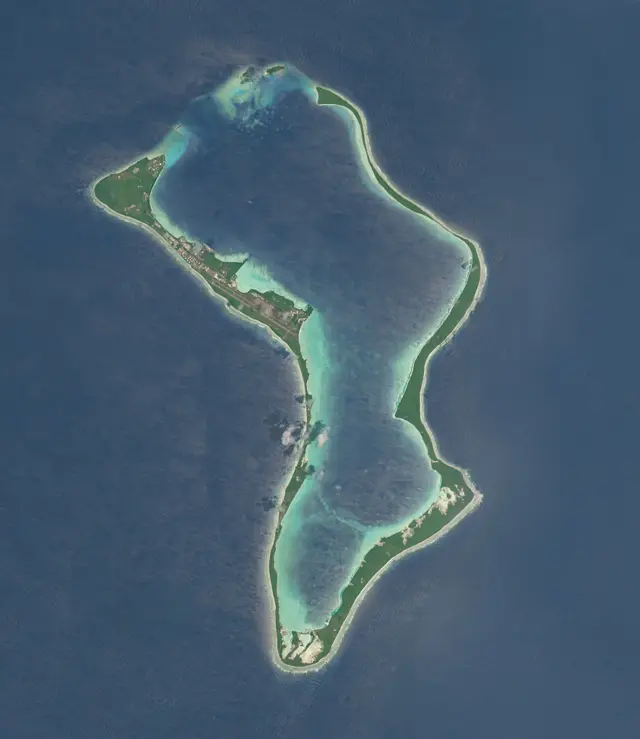
Reports say Iran fires two ballistic missiles at Diego Garcia base
Iran fired two intermediate-range ballistic missiles at Diego Garcia, a joint US-UK military base, according to reports in US media.
The Wall Street Journal, citing multiple sources, reports that neither missile hit the base, which is located in the Indian Ocean.
CNN, citing a US official, reports the missiles were launched on Friday morning local time.
The distance from Iran to Diego Garcia is about 3,800km (2,361m). Iran's former supreme leader had ordered the maximum range of Iranian missiles should not exceed 2,000km (1,243m).
The BBC has contacted the Pentagon and the UK's Ministry of Defence. The Pentagon says it has "nothing to provide at the moment".
Getty ImagesSatellite image of the Diego Garcia military base, taken in 2013
US to allow sale of Iranian crude as Trump hits out at NATO allies
Simi Jolaoso
North America correspondentEPAAllowing the sale of Iranian crude oil already at sea is the latest conflict-related concession from the Trump administration, which is struggling with Iran’s tight grip on the Strait of Hormuz.
Critics warn the revenue could fund Tehran’s war effort, but the White House insists Iran will struggle to access the money.
It came as Donald Trump said the US was close to meeting its objectives and may begin winding down its military campaign - claiming Iran’s military capabilities had been severely degraded. He had earlier said he did not want a ceasefire.
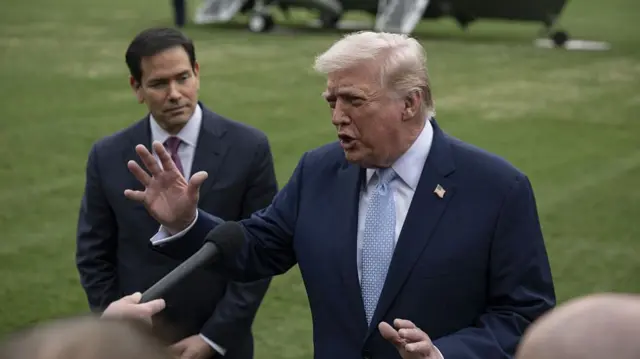
Trump went on to say the Strait of Hormuz would have to be guarded by other nations which use it - again criticising his allies for not joining the effort, calling Nato members “cowards,” and the UK, too slow.
Israel says it has struck Hezbollah targets in Beirut
Hugo Bachega
Middle East correspondent, in BeirutThe Israeli military says it has struck Hezbollah targets in the Lebanese capital, Beirut.
Lebanese media says Israeli military aircraft carried out two air raids. There are no reports of casualties.
The attacks happened after the IDF issued evacuation orders late at night for seven neighbourhoods in the southern suburbs of Beirut known as the Dahieh, where Hezbollah is based.
There were also Israeli attacks in the south of the country.
Reports say a house in the town of Ghandouriyeh was hit, and at least one person was killed.
Across Lebanon, more than a thousand people have been killed since the start of this conflict, and over a million have been displaced.
Meanwhile, Hezbollah says it fired rockets at Israel's Filon base, near the northern city of Rosh Pinna.
South Korea joins signatories of joint statement on Strait of Hormuz
South Korea says it will contribute to international efforts to ensure safe and free navigation of the Strait of Hormuz, the Reuters news agency reports.
It is the most recent signatory to a statement that was issued on Thursday and expresses a "readiness to contribute" to "appropriate" measures to secure the strait.
Originally signed by the leaders of the UK, France, Germany, Italy, the Netherlands and Japan, the statement has since been joined by Canada, Australia, New Zealand, Denmark, Latvia, Slovenia, Estonia, Norway, Sweden, Finland, Czechia, Romania, Bahrain and Lithuania.
It remains unclear what the efforts to secure the waterway would entail.
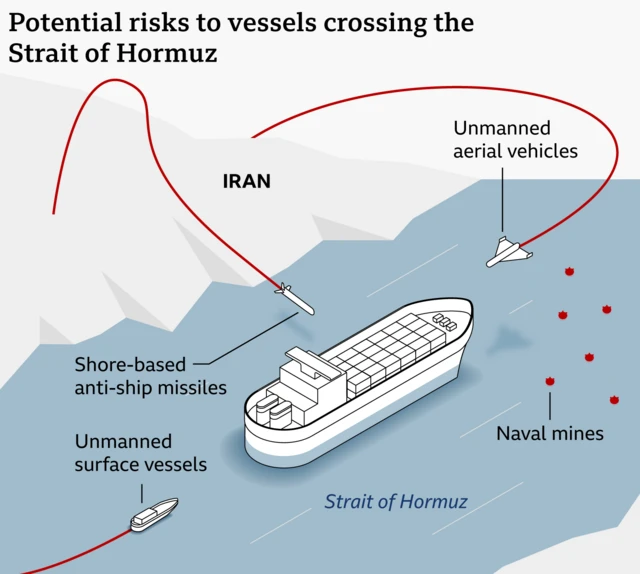
You can read more about why the Strait of Hormuz is so important here.
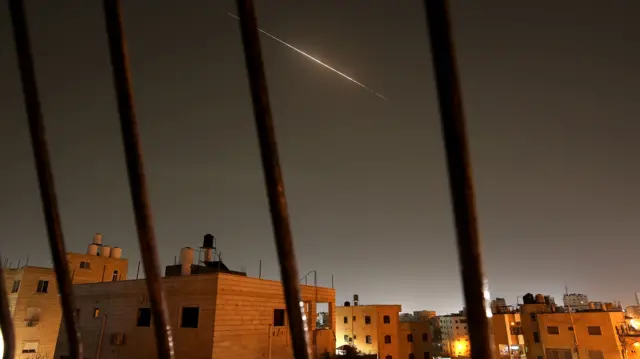
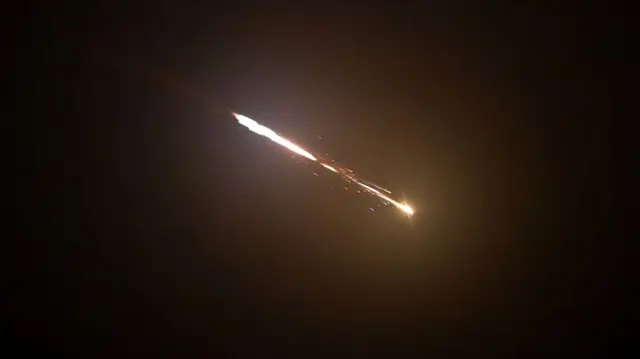
Missiles pictured over the occupied West Bank
Missiles launched from Iran towards Israel were photographed in the sky over Hebron in the occupied West Bank, early on Saturday morning.
Israel responded to several attacks overnight, which the IDF has said were launched from Iran.
Anadolu via Getty ImagesAnadolu via Getty ImagesIsrael and Gulf nations respond to attacks
Israel has responded to several attacks over the past few hours, which the Israeli military says are Iranian.
The IDF confirmed that alerts were sent to the public as a precautionary measure, as defensive systems operated to "intercept the threat".
Saudi Arabia says they have intercepted dozens of drones overnight, while neighbouring Kuwait confirmed that their air defence system had been activated in response to "hostile missile and drone threats".
As we reported earlier, Iran has also made threats to strike the UAE city of Ras Al Khaimah with "decisive force" as part of a dispute over two islands occupied by Iran but long claimed by the Emirates.

Trump's shift in tone suggests recognition Strait of Hormuz can't be resolved by US alone
Simi Jolaoso
North America correspondentPresident Trump is grappling with the strategic quagmire that is the Strait of Hormuz.
It may be the obstacle standing between him and a declaration of victory in this conflict.
Trump is now framing the chokehold as a problem for the rest of the world and not for the United States, despite previously insisting the US would secure it “one way of the other” and dismissing the need for support from NATO allies and key partners like Japan and South Korea.
Now, he is again calling on those countries to step in, labelling some “cowards” for their reluctance.
The reality is, a spike in Hormuz affects a fuel station in Washington just as much as one in Tokyo.
President Trump’s shift in tone suggests a frustrated recognition that this is a problem he must face and not one he may be able to resolve alone.
Watch: Huge fire erupts at US diplomatic facility in Baghdad
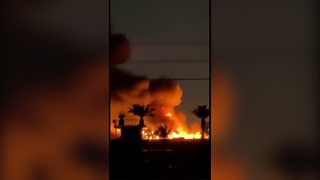
This is video of a blaze at a US diplomatic facility in Baghdad, which we reported on a couple of hours ago.
Sources in the Iraqi capital told AFP that there were at least three attacks on the diplomatic and logistics hub, which they report houses US military personnel, and a fire broke out following the third strike.
US looking at ways to seize Iran's nuclear materials, CBS reports
The Trump administration has been strategising ways to secure or extract Iran's nuclear materials, multiple sources have told CBS News, the BBC's US partner.
Two sources told the publication that planning has centred on the possible deployment of forces from the secretive Joint Special Operations Command, an elite military unit that is often tasked with highly sensitive operations.
Another source said that US President Donald Trump has not yet made a decision on any such operation.
A White House spokeswoman told CBS that it is the Pentagon's job to make preparations.
For context: The US and Israel have repeatedly targeted key sites linked to Iran's nuclear programme - which Iran insists is entirely peaceful - with air strikes since the beginning of the war on 28 February.
The two countries have led Western opposition to Iran's nuclear programme, claiming Iran is seeking to develop a nuclear bomb - something Iran has vehemently denied.
Statement attributed to IRGC overseas operations arm appears on Iranian media
Ghoncheh Habibiazad
Senior reporter, BBC PersianOne thing that I spotted today was that, for the first time since the war started on 28 February, a statement attributed to Esmail Qaani has emerged on Iranian outlets.
Qaani is the chief commander of the Islamic Revolutionary Guard Quds Force Corps (IRGC-QF), which is in charge of the IRGC’s overseas operations.
Iranian outlets have published the statement, addressed to commanders and leaders of the "Axis of Resistance" - Iran’s coalition of allies and proxies.
In the statement, Qaani argues that the absence of senior figures does not weaken the movement.
He states that although the "leader of the martyrs of resistance" is no longer present, the ideological path of the Islamic Republic under its founder Ruhollah Khomeini and the late Ali Khamenei will continue with "firmness and authority" under the new Supreme Leader, Mojtaba Khamenei.
The trend of Iranian outlets publishing written messages attributed to Iranian officials and commanders seems to be growing in Iran. Today, a written message attributed to Mojtaba Khamenei was read aloud by the state TV’s presenter.
This represented a stark difference compared to Nowruz messages given by his father Ali Khamenei, who would traditionally deliver the message in front of camera.
Mojtaba Khamenei, who was chosen as the successor to his father earlier this month, has yet to be seen in person - nor filmed or photographed - since being chosen. So far, several written messages by him have been published by Iranian media.
Iran ready to help Japanese ships pass Strait of Hormuz, Iranian FM tells Japanese media
Iranian Foreign Minister Abbas Araghchi has told Japan's Kyodo News that Iran is prepared to allow the passage of Japanese-linked vessels through the Strait of Hormuz.
Araghchi stated that discussions with the Japanese side had already begun, with a view to a temporary lifting of the blockade, the publication reported.
A Japanese government official told Kyodo that "direct negotiations with the Iranian side are the most effective way to lift the blockade", in response to Araghchi's remarks.
They added that the utmost care must be taken not to provoke the US, noting that even if Japanese vessels were allowed to pass through the waterway, it would not solve the ongoing energy crisis.
Another official from Japan's Ministry of Foreign Affairs told Kyodo that the "true intent" behind Araghachi's statement should be "carefully assessed".
Gulf is on the cusp as Eid begins, says BBC's Frank Gardner

The BBC's security correspondent Frank Gardner takes a look at the where things stand in the Middle East, as the war between the US, Israel and Iran approaches a fourth week.
Israel launches new strikes on Tehran, IDF says
The Israel Defence Forces (IDF) says they are striking "Iranian terror regime targets" in Tehran, Iran's capital.
It comes following Israeli strikes on Lebanon, which the IDF said were targeting Beirut. It had issued an evacuation warning for seven areas in the south of the city shortly before announcing the start of the attack.
Threat level for Middle East remains critical, says maritime body
The United Kingdom Maritime Trade Operations (UKMTO) says that the maritime threat level across the Arabian Gulf, Strait of Hormuz and Gulf of Oman remains critical.
Though there have been no reported maritime incidents in the past 24 hours, there have been 21 confirmed attacks on commercial vessels and offshore infrastructure since the 1 March.
The UKMTO noted the incidents have had no consistent pattern of Western ownership linkage, which it warned was indication the current strike pattern reflects a campaign of broad maritime disruption.
Islamic Resistance in Iraq says it attacked 'enemy' bases
The Islamic Resistance in Iraq says it has carried out 27 operations in the past 24 hours, employing dozens of drones and missiles "against enemy bases in Iraq and the region".
It comes as we receive reports of renewed drone strikes on a US diplomatic facility near Baghdad International Airport.
Sources told AFP that there were at least three attacks on the diplomatic and logistics hub, which they report houses US military personnel. A fire broke out near the facility following the third strike, one official confirmed to the news outlet.
For context: Iran supports militias under the umbrella of the Islamic Resistance in Iraq (IRI) which are part of the Popular Mobilisation Forces (PMF).
The PMF were formed over the last decade to fight the Islamic State group.
US making specific plans for ground troops in Iran - CBS
Getty ImagesUS military officials are making detailed preparations for the possibility of deploying ground troops into Iran, the BBC's US partner CBS reports, citing multiple unnamed sources briefed on the discussions.
Senior Pentagon officials are making specific requests to plan for such a move, CBS reports.
The planning includes conversations about how the US would handle the detention of Iranian soldiers if there were US troops in the country, CBS cites two of the officials as saying.
On Friday, President Donald Trump said that the US was considering "winding down" its operations against Iran. He earlier told reporters that does not want a ceasefire.
President Donald Trump earlier told reporters that he was not planning to send ground troops to "anywhere", adding "If I were, I certainly wouldn't tell you".
The Department of Defense has not responded to the BBC's request for comment about the reported troop movements on Friday.
US Central Command, which is in charge of Washington's military operations in the Middle East, declined to speculate on potential troop movements.
US temporarily lifts sanctions on Iranian oil stuck at sea
ReutersThe US Treasury is temporarily lifting sanctions on Iranian oil currently at sea, allowing it to be sold to most countries in order to keep oil prices down.
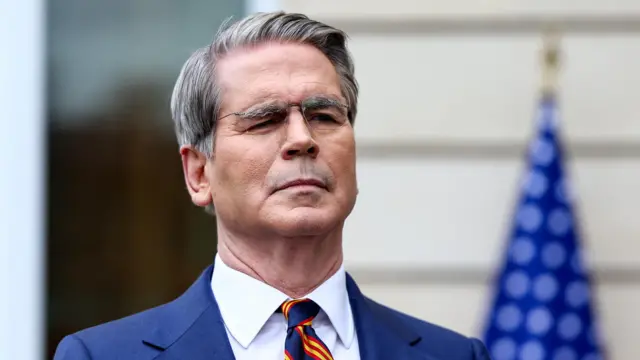
The "short-term authorization" will allow approximately 140 million barrels of oil to enter global markets, Treasury Secretary Scott Bessent said in a statement posted to X on Friday.
Bessent said Iran will have "difficulty accessing" any financial profit generated from the sale.
The authorisation is "strictly limited to oil that is already in transit and does not allow new purchases or production", Bessent said.
"In essence, we will be using the Iranian barrels against Tehran to keep the price down," he added.
Oil and gas prices have risen sharply since the war began, and after Iranian strikes hit energy infrastructure in the Middle East.
The price of Brent crude oil is holding around $112 a barrel, up 3% Friday and 53% for the past year.

‘Missile debris’ falls near al-Aqsa mosque and Western Wall in Jerusalem
TelegramBy Shaina Oppenheimer
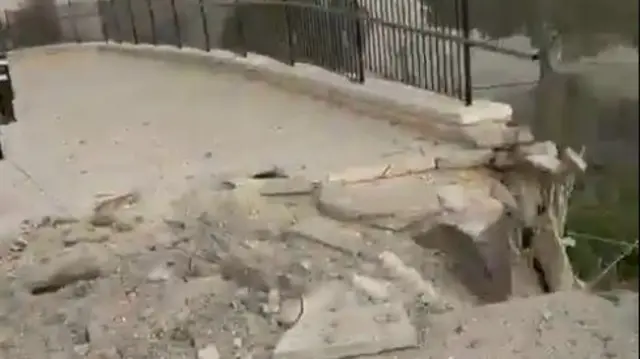
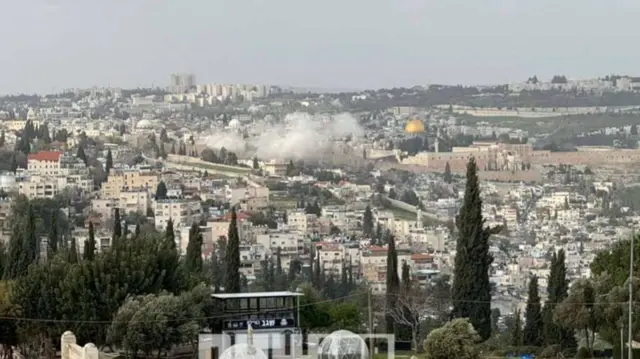
Fragments reported to be from an Iranian missile have fallen near the holy sites of the Western Wall and al-Aqsa mosque in the Old City in occupied East Jerusalem.
Verified footage shows damage to a railing and pavement in the Jewish Quarter. BBC Verify has checked the footage is authentic by matching what could be seen in the video with satellite maps.
A reverse-image search showed the footage had not appeared online before today. Earlier this week, missile fragments fell near the roof of the Church of the Holy Sepulchre.
Israeli authorities have closed holy sites in the Old City - including the church and al-Aqsa mosque - citing security concerns due to the war.
TelegramRetired colonel estimates timeline of US troops arriving in Middle East
Speaking to the BBC, retired Colonel Mark Cancian lays out a timeline of when recently announced US reinforcements will be arriving in the Middle East.
The first set of Marines will probably arrive in about five to seven days, after leaving Japan about a week ago, says Cancian, a senior advisor for defence and security at the Center for Strategic and International Studies.
Another group of reinforcements announced on Friday - about 2,500 Marines - will take at least 30 days to arrive once they depart the west coast of the US.
Another smaller group - about 400 Marines - are at sea now and will arrive in about 20 days.
"So there's going to be reinforcements, but its going to take a while for all of them to get there," he says.
Iran threatens it will hit UAE with 'decisive force' over islands dispute
Iran is threatening to strike the UAE city of Ras Al Khaimah with "decisive force" as part of a dispute over two islands long claimed by the Emirates.
In a message carried by the state broadcaster on Telegram, the spokesman for Iran's armed forces warns that any "further aggression" on the islands of Abu Masa and Greater Tunb will be met by strikes on the Emirati city.
It does not specify the aggression but comes against the background of both islands being occupied by Iran for decades but claimed by the UAE.




No comments:
Post a Comment