Trump tariffs steel and aluminum at 25%
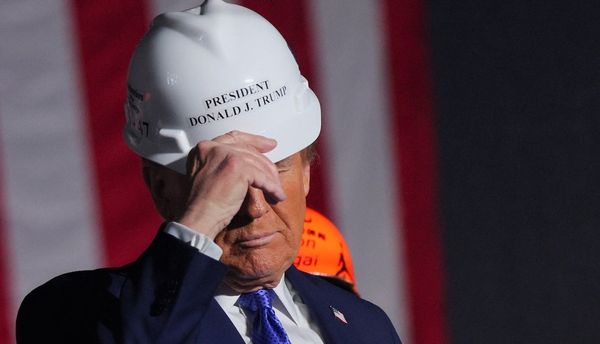
US President Donald Trump signed an executive order Monday imposing 25% tariffs on all steel and aluminum imports to the US. This raises the tariff rate on aluminum to 25% from the previous 10% that Trump imposed in 2018, and it reinstates a 25% tariff on “millions of tons” of steel and aluminum imports previously exempted or excluded.
“Today I’m simplifying our tariffs on steel and aluminum,” Trump stated. “It’s 25% without exceptions or exemptions.”
Cue the negotiations. On Monday, Trump reportedly took a call from Australian Prime Minister Anthony Albanese, who is seeking a carve-out for Australian steel exports. Albanese described their conversation as “constructive and warm” but did not want to “speak on [Trump’s] behalf.”
Prime Minister Justin Trudeau said Tuesday that the tariffs were “entirely unjustified” and “unacceptable,” noting that Canada – the US’ biggest source of aluminum and one of its top sources of steel – would respond if necessary but will try to work with the US administration to avoid their implementation. Mexican President Claudia Sheinbaum, who has also threatened countermeasures in recent weeks, said her country would keep a “cool head.”
The EU, meanwhile, said Tuesday that it would respond with “firm and proportionate countermeasures.”
The new US tariffs are set to take effect on March 4, and Trump added that he will also consider additional tariffs on cars, pharmaceuticals, and computer chips.
Why now? Trump’s announcement came two days after the visit of Japanese Prime Minister Shigeru Ishiba, who announced that Japan would increase its US investment to $1 trillion, including a commitment from Nippon Steel to “invest heavily” in US Steel, after a $15 billion buyout was nixed last year by the Biden administration. The deal is another reflection of Trump’s plan to strengthen domestic steel production and make imports less attractive – or even necessary.
Was there a connection? “It’s certainly possible,” says Eurasia Group’s Japan Director David Boling. “But we knew steel tariffs were coming — it was only a matter of time. While Trump is proud to be Tariff Man, he could also be called the Man of Steel. Steel is his favorite industry.” We’re waiting to see whether Ishiba picks up the phone like Albanese and leverages Nippon’s investment to lift the levies.
Jordan’s King Abdullah to meet Trump in wake of Gaza proposal
Jordan’s King Abdullah II will visit the White House on Tuesday, becoming the first Arab leader to meet with President Donald Trump since he returned to office. The meeting will occur in the shadow of Trump’s controversial plan to force out most of the 2.1 million Palestinians living in the Gaza Strip and resettle them in neighboring countries, including Jordan.
King Abdullah has flatly rejected Trump’s proposal, which includes the US taking control over the coastal enclave, much of which is rubble after nearly 16 months of the Israeli bombardment in response to Hamas’ Oct. 7 assault. In a post on X last week, the Jordanian royal court condemned what it called “any attempts to annex land and displace the Palestinians.” But Trump has doubled down – in a Fox News interview clip that was set to air Monday, he said Palestinians would not have the right to return to the enclave at all.
Trump has repeatedly insisted that Egypt and Jordan – US allies who enjoy billions in American aid and trade – “will” accept at least “some” Gazans.
And he has leverage: The US sends about $1.5 billion in annual aid to Jordan or about 40% of the kingdom’s total foreign assistance. The US is also Jordan’s largest export market. Late Monday, Trump threatened to withhold aid from both Jordan and Egypt unless they agree to accept Palestinians.
Historical perspective: Egypt controlled Gaza for much of the first two decades after Israel declared independence in 1948, and Jordan, which ruled the West Bank, took in millions of displaced Palestinians. Following Israel’s victory in the 1967 Six-Day War, Abdullah’s father’s regime battled Palestinian rebels for control of the country in a conflict known as “Black September.”
Meanwhile, on the ground: Hamas announced Monday that it was postponing the further release of hostages, citing what it said were Israeli violations of the fragile ceasefire deal that was agreed upon in January. Each side has repeatedly accused the other of violations, but thus far the freeing of hostages and prisoners has continued. The continuation of the deal, whose first phase is set to run until the end of February, is now in doubt.
Judge declares White House in defiance of court order on blocked funds
Federal Judge John J. McConnell Jr. ruled Monday that the Trump administration is defying his Jan. 29 order to release billions in federal grants, marking the first explicit judicial declaration of the White House disobeying a court order. Some legal scholars are raising the alarm that a constitutional crisis could be brewing.
The dispute centers on a White House memo that froze federal funds until they aligned with Trump’s priorities. The Justice Department argues that the administration’s actions are lawful because the money still being blocked was allocated for clean energy projects and transportation infrastructure under Joe Biden’s Inflation Reduction Act, which was stopped under a different executive order signed on Trump’s first day in office. This, they say, is separate from the memo freezing federal funds across the board.
McConnell ordered the government to “immediately restore frozen funding.” But the judge’s statement came a day after Vice President JD Vance posted that judges shouldn't control executive power, as the White House faces a series of blocked court cases – including ending birthright citizenship, restricting access to Treasury Department systems, and nearly 40 other lawsuits against the 53 executive orders he has signed so far.
If the White House does not back down or chooses to ignore the court’s orders, it could call into question whether the judicial branch has the power to constrain the executive, undermining the founding principle of checks and balances, and putting the country on the course toward a constitutional crisis.
Putin looks back to the future
What future does Vladimir Putin imagine for Russia? That’s been a crucial question for those in Europe and the United States who want to know what he might want in exchange for peace with Ukraine. A leaked Russian government report offers a few possible answers.
According to the Financial Times, Russian Prime Minister Mikhail Mishustin presented a report last April to several dozen senior government officials and the heads of some of Russia’s largest state-owned companies that suggests the Kremlin hopes to create a “macro region” with Moscow as its center. This bloc would become a financial, trade, and transport network and political sphere of influence that includes much of the territory of the former Soviet Union.
Russian leadership of this bloc would allow the Kremlin to promote a common worldview among members and to set rules, standards, and sanction policies of its own. The establishment of this new bloc, which would be financed largely through trade in raw materials with the global south, would allow Russia to act as a global power on par with the United States, China, and the EU.
The report acknowledges that Western sanctions have limited Russia’s ability to realize this vision and that Moscow must look beyond the war in Ukraine to play a “long game.” It does not consider the possibility that the unwillingness of Russia’s neighbors to return to their former roles as Russian satellites might prove a greater obstacle to Russia’s renewal than Western sanctions have. Nor does it make clear how Russia intends to establish itself as an international peer to countries with far larger and more dynamic economies.




No comments:
Post a Comment