NEWSWEEK - News Article
The Day Putin Peaked
PUBLISHED
AUG 15, 2026 AT 05:00 AM EDT

One year ago today, Russian President Vladimir Putin appeared to hold all the cards.
After 3 1/2 years of grueling quagmire in Ukraine and virtual isolation from the White House, the Russian leader had secured a historic meeting with a U.S. counterpart deeply skeptical—sometimes outright opposed—to the West's united front in support of Kyiv.
President Donald Trump's stunning political comeback in many ways reinforced Putin's long-term calculus about the fragility of transatlantic solidarity, and now he would make his case directly in the somewhat symbolic setting of Alaska, a former Russian imperial territory where no head of the Kremlin had ever before set foot.

John Bolton, the veteran U.S. diplomat who served as national security adviser during Trump's first term, declared in the immediate aftermath of the summit that "Putin clearly won," having "achieved most of what he wanted" from the meeting without any concrete commitments.
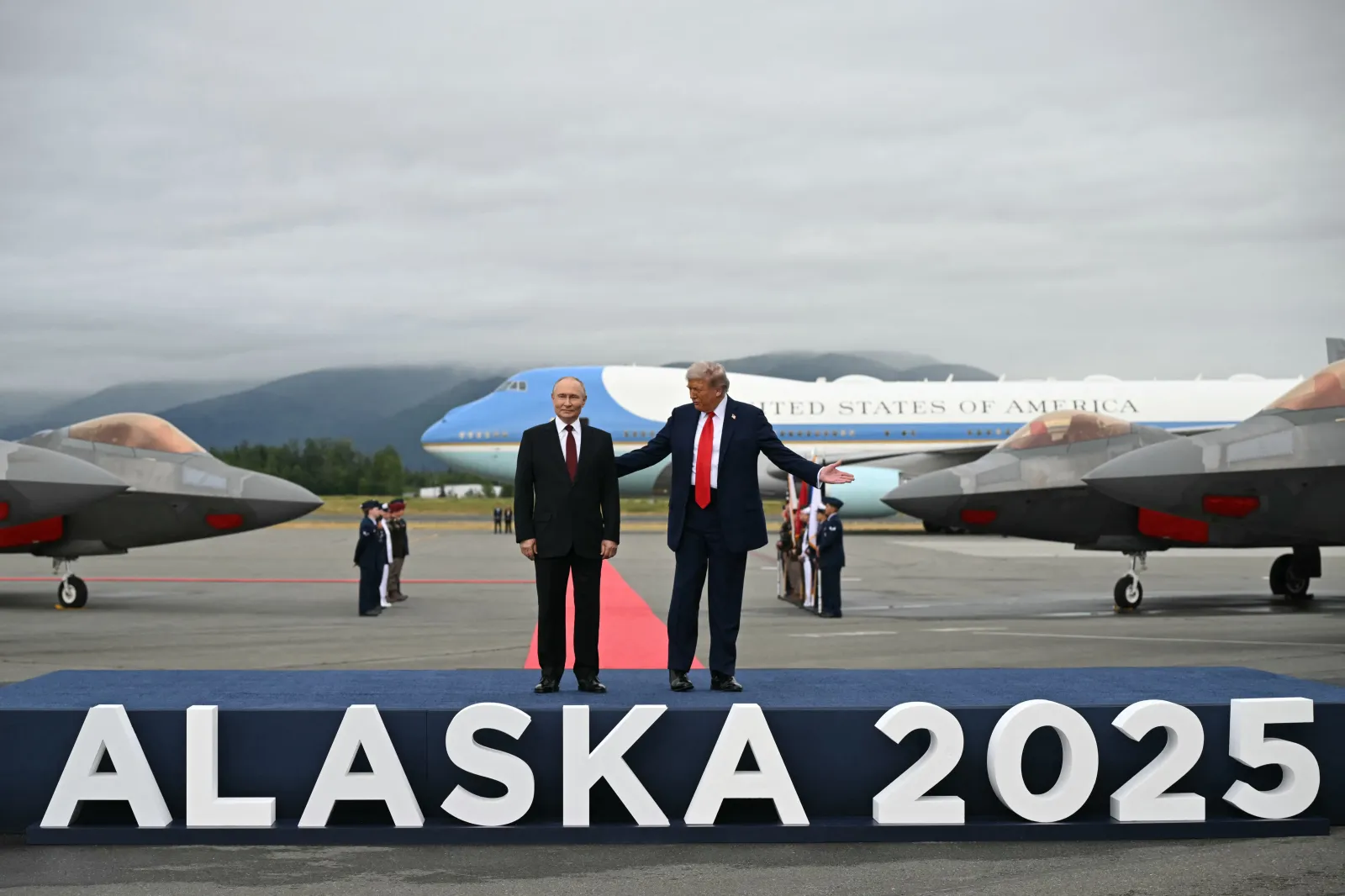
Hands were shaken, new U.S.-brokered talks began and some analysts predicted a total collapse in U.S. aid to Ukraine. But for all the symbolism and political capital the summit offered Moscow, what has followed can hardly be described as a decisive breakthrough.
"I think on net it was an important summit from Russia's point of view," Bolton told Newsweek on Thursday, looking back at the meeting for its anniversary. "I wouldn't say Putin emerged the victor. I think he lived to fight another day politically with Trump, which was important."
Moreover, the "biggest" shift Bolton saw over the past year was on the battlefield, where Ukrainian strikes on infrastructure deep into Russian territory have once again clouded visions of Russia's path to certain victory that he said had emerged as a dominant narrative in the minds of Trump and his special envoy, Steve Witkoff, in the first year of this administration.
"And while it's certainly not to say that Russia might not yet win," Bolton added, "I don't think anybody would argue that you can make a credible case that Russian victory is inevitable."


Independent Journalism Needs You!
Why Alaska Looked Like a Triumph
While little has emerged in terms of tangible gains for Putin from the Alaska summit, the encounter marked a major achievement in his efforts to reassert influence on the world stage and, perhaps most crucially, recalibrate his relationship with Trump.
Putin used the opportunity to capitalize on the relatively positive rapport established during Trump's first term and their dynamic seemingly held even greater potential the second time around.
An indignant Trump had begun directing some of his harshest rhetoric toward traditional U.S. allies in Europe that he accused of aligning with the same liberal agenda as his Democratic opponents at home. His accusations were not too far from Moscow's own depictions of a decaying globalist European order.
"The Alaska summit was an important indicator of the transformation of U.S.-Russia relations," Ivan Timofeev, director general of the Russian International Affairs Council think tank in Moscow, told Newsweek. "While President Biden’s administration rebuffed by default any meaningful dialogue after the outbreak of the militarized dispute between Russia and Ukraine, President Trump’s approach was of stark difference.
"However, such a change had a broader context. President Trump and his associates reconsidered the relations with Europe and Ukraine at least on the rhetorical level. The new paradigm was much more pragmatic including the calculation of costs and benefits in the relations with allies and partners. In the case of Russia, the very fact of joint search for the resolution of major problems, including Ukraine, was a step forward."
Even if there were "missed opportunities" to realize a more comprehensive detente in U.S.-Russia relations, Timofeev said that "the fact that negotiations and U.S.-Russia discussions continued for such a long period was an achievement itself."
To this day, apparent similarities in Trump and Putin's outlooks on great power geopolitics constitute a central reading of the summit from Russia's point of view.
"The key point that Russia has occasionally claimed it took away from the summit was an agreement with the United States about the way the world should work," Keir Giles, associate fellow of Chatham House's Russia and Eurasia Program, told Newsweek.
This concept is sometimes referred to in Russian media as the "Spirit of Anchorage," which Giles described as dictating "that the desirable position for the United States is a retreat from global presence and a focus on the Western Hemisphere."
"That is entirely in accordance with Russia's ideas that the world should be divided into spheres of influence, where the United States sticks to its own backyard and gives Russia a free hand in what it considers to be its own backyard, specifically Europe and its central and eastern parts," Giles said.
Trump’s relationship with Ukrainian President Volodymyr Zelensky, on the other hand, could hardly seem to get worse at the time. The bad blood between the two men dated to the infamous "quid pro quo" scandal during which the U.S. leader in his first term was accused of threatening to withhold weapons to Ukraine if it did not open a corruption investigation into the Biden family, leading to Trump's first House impeachment in 2019.
Seeking a reset for Trump’s second term, Zelensky instead received a public scolding in February of last year that shocked even a number of Republicans and appeared to spell doom for the Washington-to-Kyiv aid pipeline as Putin’s time to shine arrived in Anchorage in August.
The White House's 28-point plan inspired little confidence for Ukraine's supporters. It would see frontlines frozen, Ukraine effectively concede currently Russian-held lands—roughly one-fifth of Ukraine's pre-war territory—as well as Kyiv's commitment to cap its armed forces and forego long-sought entry into NATO.
The Alaska meeting also coincided with renewed momentum for Russia on the front. Following a prolonged period of little territorial change at great cost for both sides, Russian troops had gradually begun grinding forward, introducing new tactics adapted to the realities of drone warfare and capitalizing on Ukraine's manpower shortages to exploit gaps in defensive lines.
Olexiy Haran, professor at the National University of Kyiv Mohyla Academy, said that Ukrainians had a different term for the so-called "Spirit of Anchorage"—"the bad smell of Anchorage."
What Happened Next
Today, Ukraine's disadvantages remain dire. But Russia's failure to translate its upper hand into resolute success has weakened its hand as Ukraine and its European supporters campaigned ferociously to push back against a feared total U.S. U-turn.
Haran credited Ukraine's partners, including Europe, Canada and Japan, with having "managed to persuade Trump not to look weak" in pressing for the 28-point plan.
But he noted that the administration also played a role in Ukraine's ability to introduce added pressure on Russia.
"There's a lot of criticism regarding Trump, I'm also among these critics, but intelligence data continues to be supplied to Ukraine. That's really, really important," Haran told Newsweek. "And the Europeans are buying American weapons for Ukraine. So, it's not for free, but still, it continues."
Last month's NATO summit in Ankara appears particularly informative as Ukraine secured a new $81 billion package in military and financial assistance from European nations and Canada.
Ukraine's long-range drone campaign has drawn attention to Russia's homefront, costing the Kremlin billions of dollars, stoking fuel crises and costing the Kremlin billions of dollars in economic fallout. Polls indicating waning public support among Russians, with a Levada Center survey published last month showing the Russian leader's approval rating had dipped to its lowest point since the beginning of the conflict—February 24, 2022—at 74 percent.
Meanwhile, Trump appears to be losing patience with the situation altogether.
"I think [Zelensky] wants to make a deal, and I think Putin wants to make a deal, but there's a lot of dislike, as you probably noticed," Trump said during a July 31 Cabinet meeting in his latest comments on the conflict. "He seems very reluctant to make concessions, President Putin, I mean. Well, nobody wants to make concessions, but they're both going to have to make some concessions."
Andrey Kortunov, a member of the Russian International Affairs Council, argued that Trump's expectations regarding Ukraine and its European supporters did not appear to match reality once it came time to approach the negotiating table.
"It seems that in the beginning of his second term, Donald Trump underestimated the resilience of the Ukrainian army and the Ukrainian state, as well as the commitment of major European nations to continuously provide military and financial assistance to Kyiv," Kortunov said.
"A year ago, Trump might have thought that the Ukrainian side would have to accept any plan that he could negotiate in good faith with Vladimir Putin. However, over the last year neither the Ukrainian leaders nor their European partners demonstrated a lot of additional flexibility on the terms of a possible settlement."
And as the U.S. pivots to a strategy of first securing a workable framework with Kyiv, and then convincing Moscow, Kortunov predicted little movement on the Kremlin's part, either.
"It is very unlikely that President Putin will make any significant changes to the positions that he articulated in Anchorage a year ago," Kortunov said. "There is no feeling in Moscow that the dynamics on the battlefield has shifted in favor of the Ukrainian side—Russia continues its offensive, albeit slowly.
"This means that, unfortunately, today we are not too close to the end of the conflict."
Did Putin Really Peak?
Little optimism appears to exist on either side of conflict one year after Trump and Putin's landmark sit-down in Anchorage.
Giles, who had described the Alaska summit as "disastrous for Ukraine and Europe" in its immediate wake, warned that much of the narrative regarding Kyiv's success in turning the tables on Moscow, both politically and on the battlefield, had been fueled by "incomplete depictions" of the conflict in the media.
And "for all the enthusiasm which greeted the videos of things in Russia going up in flames, first the oil refineries, then the Wildberries warehouses," he said, "there are other developments which are going to be far more damaging for Kyiv, like, for example, the lack of air defense munitions, the arrival of North Korean ballistic missiles, the damage to the heating and power infrastructure, which means that next winter the combination of those factors is going to be an even bigger challenge for Kyiv."
Putin may also expand mobilization, with reports indicating the possibility of drafting up to a half-million additional soldiers after Russia's parliamentary elections next month.
As for the White House's position, Giles argued that "every time there is a statement from the Trump administration that appears vaguely beneficial to European security by being more even-handed with how it sees Russia and Ukraine, the excitement is an overreaction because time and again those hopes have been let down."
Analysts pointed out unanimously how the fleeting nature of the administration's messaging made it difficult to conclude any substantive evolution in Trump's views of the war.
The advent of a new war in the Middle East, launched on February 28 by the U.S. and Israel against Iran just days after the fourth anniversary of Russia's invasion of Ukraine, has only further scattered the White House's consistency on fulfilling its commitment to put an end to Europe's deadliest conflict since World War II.
Bolton, for his part, warned that such distraction could ultimately work in favor of Putin as the Russian leader continues to bet on victory in the long run.
"I think now the lack of attention may benefit Russia even more if Ukraine is really as hard up for interceptors as Zelensky is saying," Bolton said. "They're very worried that if somewhere or another we don't find more Patriot missiles, Ukraine's in real trouble.
"So, it's not Putin that's at this point disadvantaged by lack of attention. I think it's more Ukraine, for a variety of reasons, that is the loser."
Contact Newsweek editors on this story: Alfred Joyner and Dave Siminoff.
No comments:
Post a Comment