Erdogan’s Victory Has Implications for Germany’s Domestic Politics
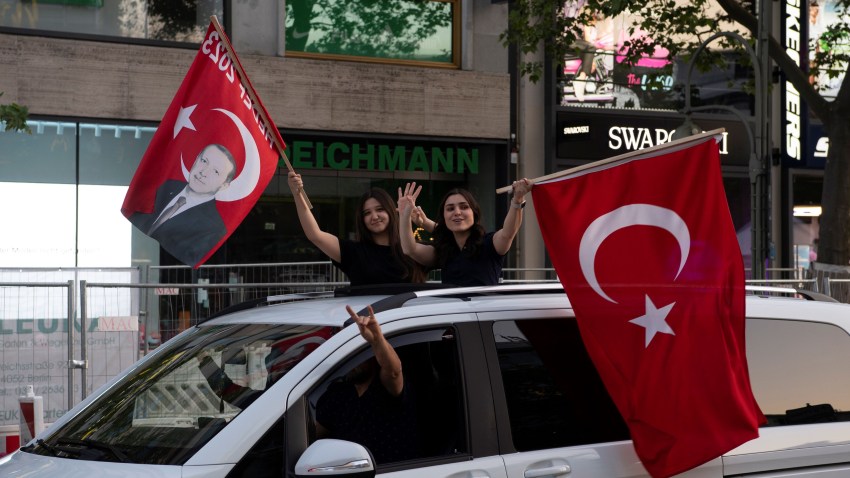
When Turkish President Recep Tayyip Erdogan won yet another election last month, motorcades of his Turkish-German supporters rolled through German cities to celebrate his victory. The spectacle has become routine in recent years—as have the expressions of outrage from German politicians and the media over these public demonstrations of joy at the triumphs of a conservative, Islamist and authoritarian leader. Backed by tabloid newspapers such as the Bild Zeitung, the conservative wings of the Christian Democratic Union and its Bavarian sister party, the Christian Social Union, responded by demanding that more pressure be put on migrants to integrate into German society. Meanwhile, the far-right Alternative for Germany, or AfD, party used it as an opportunity to promote anti-migrant nativism.
For the leaders of Germany’s center left among the Social Democratic Party, or SPD, and Greens, these images of Turkish-Germans celebrating the success of Erdogan and his ruling Justice and Development Party, or AKP, generate uncomfortable dilemmas. German center-left politicians express frustration with the willingness of many Turkish-Germans to vote for the AKP and its ultra-nationalist coalition partner, the Nationalist Movement Party, or MHP. But they try to avoid stoking a wider backlash against migrants in general, which the German economy desperately needs to tackle its current labor shortages.
More broadly, the phenomenon highlights the growing role of Turkish-Germans and Kurdish-Germans in German domestic politics. A handful of political leaders from these diasporas, such as Agriculture Minister Cem Ozdemir, have held prominent positions since the 1990s. But in the past decade, a much wider range of figures emerged to play a central role, such as Belit Onay, the Green mayor of Hanover, as well as Serap Guler and Hakan Demir, members of parliament from the CDU and SPD, respectively.
This presence has in turn begun to force media outlets and political parties to engage with the nuances and fault lines among Kurdish- and Turkish-German communities. Though the AKP and MHP elicit substantial support among many first- and second-generation migrants, some Turkish-Germans reject both parties’ authoritarianism. So while right-wing factions in the CDU/CSU and far-right AfD leaders focused on the 65 percent of Turkish diaspora votes cast for Erdogan, other observers pointed out that these numbers did not tell the whole story. While the Turkish diaspora in Germany as a whole encompasses over 2.9 million people, only half are eligible to vote in Turkish elections. With a voter participation rate of just under 50 percent, that means that only around 500,000 voted for Erdogan and his coalition, and 230,000 cast their ballots for opposition parties.
Though it is difficult to establish why half of the eligible voters did not cast their ballots, several factors are worth keeping in mind. As polling places for diaspora voters are usually located in Turkish embassies or consulates, many Kurdish-Germans who support Kurdish autonomy or independence may have feared hostility or even violence from other voters or Turkish officials with nationalist allegiances. Moreover, Turkish-Germans who have grown up with liberal or left-leaning views are able to find a political home in Germany’s SPD or Greens, which have proven welcoming to people with migrant backgrounds, thereby dampening their participation in diaspora politics.
It also bears noting that Turkey’s politics can be a matter of peripheral interest for many first- and second-generation Turkish- and Kurdish-Germans whose parents and grandparents settled in Germany over 60 years ago. Though some of these nonvoters may have weak or distant preferences with regard to Turkish politics, their overall indifference is a potential sign that their integration into German society is far more advanced than hysterical tabloid headlines would suggest.
A substantial part of the Turkish diaspora will remain permanently aligned with right-wing views, rather than becoming a potential bank of votes for the German center-left after their interest in homeland politics wanes.
Yet even with these caveats, the fact that Erdogan’s regime, despite its authoritarianism, misogyny and ultranationalist jingoism, could still gain 500,000 votes from Turkish-Germans indicates the scale of the integration challenge that Germany faces. And while media discourses in Germany have finally acknowledged how diverse these communities are, the extent of support for the AKP and MHP among so many Turkish-Germans raises difficult questions for all German parties.
These debates have been particularly fraught when it comes to how Erdogan’s political machine has been able to tighten its control over transnational Islamic institutions that play a fundamental role in the everyday lives of devout Turkish-Germans. Though supposedly autonomous, the DITIB association that controls hundreds of mosques across Germany is in effect an affiliate of Turkey’s state-controlled Directorate of Religious Affairs, or Diyanet. With most imams at DITIB mosques having undergone religious training through Diyanet structures under the control of AKP-led governments, this diaspora religious infrastructure has been easily co-opted for electoral mobilization by Erdogan supporters ever since extensive diaspora voting became possible in 2014.
This misuse of DITIB’s structures elicits fierce criticism from across the political spectrum in Germany. But the reasons why Erdogan was able to so easily coopt them since first taking power in 2002 often remain unmentioned. Both SPD and CDU/CSU governments in what was then West Germany initially welcomed DITIB’s expansion, which was organized by the military junta that governed Turkey in the early 1980s. The hope then was that strong religious organizations could limit the appeal among Turkish migrants of far-left networks that might sympathize with the Soviet bloc. By 2002, a decade after the end of the Cold War, the logic had changed, but it still fueled a benevolent view of the AKP’s takeover of Diyanet and DITIB, in the hopes that Islamic institutions under the control of a moderate Islamist government in Ankara could prevent disaffected young Turkish-Germans from drifting toward extremist alternatives, like al-Qaida.
Along with these historical miscalculations, the resilience of AKP and MHP structures among Turkish-Germans also reflect contemporary realities that are difficult to acknowledge and accept, particularly for the Greens and SPD. It is hard to escape the dawning realization that a substantial part of the Turkish diaspora will remain permanently aligned with right-wing views, rather than becoming a potential bank of votes for the German center-left after their interest in homeland politics wanes. The extent of Turkish-German backing for the MHP and AKP is an indication that the Greens and SPD have reached the limits of allegiance they can expect to find among these migrant communities.
Instead, the German parties most likely to profit from an integration pathway that draws conservative diaspora milieus away from Turkish party allegiances are the CDU/CSU and AfD. The economic liberalism of the Free Democratic Party, or FDP, might attract some Turkish-German small-business owners. But on issues such as LGBTQ rights, religious traditions and the role of the military in public life, diaspora voters attracted to the AKP or MHP will find themselves most at home in a German political context on the right side of the political spectrum. Rather than accusing the left of being too lax when it comes to handling migrant communities, the CDU/CSU should put more effort into providing a political home for conservative Turkish-Germans, to ensure that the next generation doesn’t shift its allegiances from Erdogan’s authoritarian bloc in Turkey to the far-right AfD in Germany.
Debates in the wake of political shocks can be revealing as much for what is unsaid as for what is said in response to them. That discourses in Germany about Turkish and Kurdish diasporas have begun to reflect on their complexity is a sign of how much progress has been made in changing attitudes toward migrant communities over the past decade. Yet the extent to which Germany’s political leaders struggle to acknowledge the reasons why Erdogan retains a loyal base among many Turkish-Germans indicates how much more ground must be covered before Germany has the honest debate about migration and integration that so many Germans claim to want.
Alexander Clarkson is a lecturer in European studies at King’s College London. His research explores the impact that transnational diaspora communities have had on the politics of Germany and Europe after 1945 as well as how the militarization of the European Union’s border system has affected its relationships with neighboring states. His weekly WPR column appears every Wednesday.

No comments:
Post a Comment